
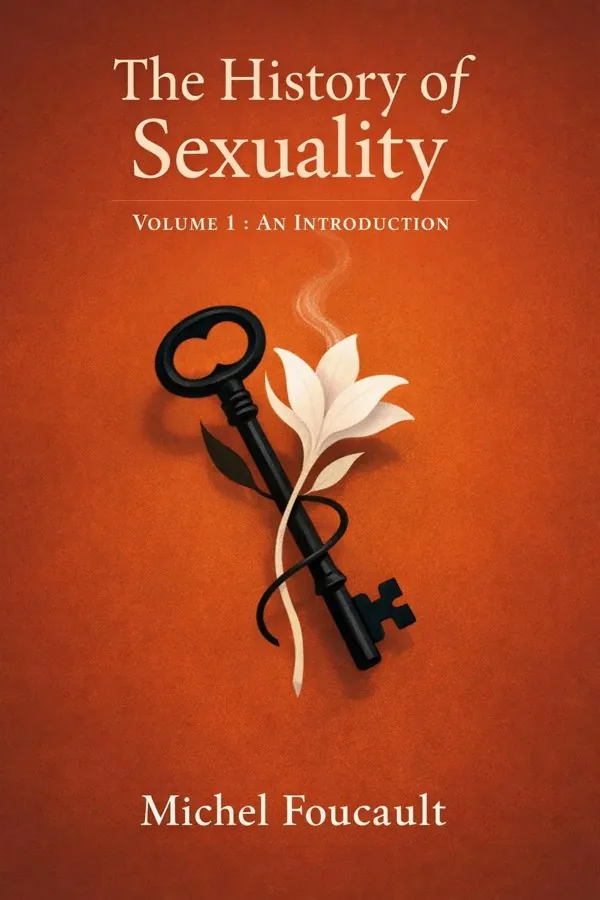
The History of Sexuality, Volume 1: An Introduction: Summary & Key Insights
 10 min9 chaptersAudio available
Key Takeaways from The History of Sexuality, Volume 1: An Introduction
The most surprising fact about modern sexuality is not silence but verbosity.
What a society calls deviant often tells us more about its methods of control than about the behavior itself.
Modern people are trained to believe that the truth of the self lies hidden inside and must be spoken aloud.
Not all cultures seek sexual truth in the same way.
Sexuality, for Foucault, is not simply a natural drive that society later represses.
What Is The History of Sexuality, Volume 1: An Introduction About?
The History of Sexuality, Volume 1: An Introduction by Michel Foucault is a western_phil book spanning 7 pages. Michel Foucault’s The History of Sexuality, Volume 1: An Introduction is one of the most influential works of modern philosophy because it overturns a deeply familiar story: that Western society simply repressed sex and that freedom means finally speaking openly about it. Foucault argues something far more unsettling and illuminating. Beginning in the seventeenth century, modern societies did not fall silent about sex; they generated an enormous number of conversations, classifications, investigations, and confessions about it. Sex became a privileged object of knowledge, administration, and control. Rather than treating power as a force that only says “no,” Foucault shows how power also produces identities, norms, expert vocabularies, and institutions. Priests, doctors, educators, psychiatrists, and state officials all helped turn sexuality into something to be examined, regulated, and internalized. The result is a radically new way of thinking about modern life, one that links intimate desire to politics, science, family structure, and social order. Foucault, a major French philosopher and historian of ideas, brings extraordinary authority to this argument through his groundbreaking analyses of power, knowledge, and institutions.
This FizzRead summary covers all 9 key chapters of The History of Sexuality, Volume 1: An Introduction in approximately 10 minutes, distilling the most important ideas, arguments, and takeaways from Michel Foucault's work. Also available as an audio summary and Key Quotes Podcast.
The History of Sexuality, Volume 1: An Introduction
Michel Foucault’s The History of Sexuality, Volume 1: An Introduction is one of the most influential works of modern philosophy because it overturns a deeply familiar story: that Western society simply repressed sex and that freedom means finally speaking openly about it. Foucault argues something far more unsettling and illuminating. Beginning in the seventeenth century, modern societies did not fall silent about sex; they generated an enormous number of conversations, classifications, investigations, and confessions about it. Sex became a privileged object of knowledge, administration, and control.
Rather than treating power as a force that only says “no,” Foucault shows how power also produces identities, norms, expert vocabularies, and institutions. Priests, doctors, educators, psychiatrists, and state officials all helped turn sexuality into something to be examined, regulated, and internalized. The result is a radically new way of thinking about modern life, one that links intimate desire to politics, science, family structure, and social order. Foucault, a major French philosopher and historian of ideas, brings extraordinary authority to this argument through his groundbreaking analyses of power, knowledge, and institutions.
Who Should Read The History of Sexuality, Volume 1: An Introduction?
This book is perfect for anyone interested in western_phil and looking to gain actionable insights in a short read. Whether you're a student, professional, or lifelong learner, the key ideas from The History of Sexuality, Volume 1: An Introduction by Michel Foucault will help you think differently.
- ✓Readers who enjoy western_phil and want practical takeaways
- ✓Professionals looking to apply new ideas to their work and life
- ✓Anyone who wants the core insights of The History of Sexuality, Volume 1: An Introduction in just 10 minutes
Want the full summary?
Get instant access to this book summary and 100K+ more with Fizz Moment.
Get Free SummaryAvailable on App Store • Free to download
Key Chapters
The most surprising fact about modern sexuality is not silence but verbosity. Foucault challenges the common belief that the modern West suppressed sex into secrecy. In his view, from the seventeenth century onward, European societies actually multiplied the occasions on which sex had to be discussed. It was spoken of in confessionals, medical consultations, legal proceedings, schools, family manuals, demographic studies, and psychiatric case files. Sex did not disappear from public life; it became a topic that authorities endlessly examined.
This matters because it changes how we understand power. If power were only repressive, it would simply forbid speech. But modern power often works by encouraging speech under controlled conditions. A child is asked to describe improper behavior to a parent or teacher. A patient is invited to disclose desire to a doctor. A citizen becomes part of statistical categories about birthrates, fertility, and morality. In each case, speaking about sex seems liberating or necessary, yet the speech also feeds systems of surveillance, classification, and expertise.
You can see this logic today in self-help culture, therapy language, online identity labels, and institutional forms that ask us to define our intimate selves. More conversation does not automatically equal more freedom. Sometimes it means more refined control.
Actionable takeaway: When you encounter public or private conversations about sexuality, ask not only who is finally being allowed to speak, but also who is prompting the speech, how it is being categorized, and what forms of authority it serves.
What a society calls deviant often tells us more about its methods of control than about the behavior itself. Foucault argues that modern power did not merely push “perverse” sexual acts to the margins. It actively produced categories of perversity by naming, describing, and studying them. In the nineteenth century, there was a major shift: instead of treating certain acts as isolated sins or crimes, institutions began treating them as expressions of distinct types of persons.
This is why Foucault famously points to the invention of identities such as “the homosexual” as a species of person. Earlier societies condemned specific acts, but modern medicine, psychiatry, and law increasingly attached these acts to personalities, histories, bodies, and destinies. The result was not just moral judgment. It was a new social reality in which individuals could be inspected, classified, corrected, or normalized.
The mechanism remains familiar. A school may identify a student as troubled rather than address one troubling behavior. Media discourse may turn tendencies into identities and identities into permanent psychological truths. Institutions gain power when they can define who people are, not just what they have done.
Foucault’s point is not that identities are unreal or meaningless. It is that they emerge inside historical systems of knowledge and power. Categories can help people recognize themselves and build community, but they can also trap people inside expert definitions.
Actionable takeaway: Be cautious whenever a behavior, preference, or tendency is quickly transformed into a total identity. Ask who benefits from the classification and whether it expands agency or narrows it.
Modern people are trained to believe that the truth of the self lies hidden inside and must be spoken aloud. Foucault traces this idea to the Christian practice of confession, where individuals were encouraged to scrutinize thoughts, desires, temptations, and sins and then reveal them to an authority. Over time, this confessional model spread far beyond religion. Doctors, psychiatrists, teachers, judges, and therapists inherited the expectation that the subject must speak the truth of desire.
Confession appears humane because it invites openness. Yet for Foucault it is also a powerful social technique. The person who confesses does not simply express a preexisting truth; the confession itself helps produce that truth. The authority listening interprets, labels, and validates what has been said. The result is a bond between self-disclosure and regulation.
Examples are everywhere. In therapy, one may feel compelled to narrate one’s deepest drives in order to become legible. In school discipline, children are often asked not just what they did but what they wanted or felt. On social media, people may publicly narrate identity and desire in ways that feel authentic while also becoming data for platforms and audiences.
Foucault does not reject confession in every context. Rather, he reveals its political structure. Whenever we assume that speaking about sex automatically reveals the deepest truth of the self, we participate in a historical system that links subjectivity to authority.
Actionable takeaway: Before disclosing intimate truths, ask whether the setting truly serves your freedom or whether it mainly requires self-exposure in exchange for recognition, care, or legitimacy.
Not all cultures seek sexual truth in the same way. Foucault contrasts two broad traditions: ars erotica and scientia sexualis. In an ars erotica, sexual knowledge is cultivated through experience, technique, pleasure, initiation, and mastery. The emphasis is on intensifying sensation and transmitting practical wisdom. In the Western scientia sexualis, by contrast, truth about sex is sought through inquiry, confession, examination, and classification. The authority belongs not to skilled enjoyment but to expert interpretation.
This distinction helps explain why the modern West is so obsessed with discovering what sex means rather than learning what pleasures do. Instead of asking how desire can be artfully lived, modern institutions ask what desire reveals about health, morality, danger, personality, or normality. Sex becomes a puzzle to decode rather than a practice to cultivate.
You can see this contrast today in the difference between experiential learning and diagnostic language. One approach asks, “What creates trust, pleasure, reciprocity, and embodied awareness?” The other asks, “What category explains me? What profile do I fit?” Both may matter, but Foucault warns that the modern West privileges explanation over experience.
His point is not romantic nostalgia for non-Western traditions. It is a critique of a regime that elevates experts and truth-claims over lived experimentation. Sexuality becomes scientifically legible at the cost of becoming heavily administered.
Actionable takeaway: In thinking about intimacy, balance the desire to explain yourself with the practice of attending to embodied experience, mutuality, and pleasure that cannot always be reduced to labels or diagnoses.
Sexuality, for Foucault, is not simply a natural drive that society later represses. It is a historical apparatus, a “deployment,” made up of discourses, institutions, norms, and practices that organize bodies and pleasures. This deployment took shape in modern Europe as sex became central to family life, medicine, education, public health, and state administration. Sexuality is therefore not just what people desire. It is a social framework that tells them what desire means.
Foucault identifies four strategic figures in this deployment: the hysterical woman, whose body is medicalized; the masturbating child, whose development is monitored; the Malthusian couple, whose reproduction is managed; and the perverse adult, whose deviations are analyzed. These figures show how sexuality entered everyday life through family and institutional concerns.
Consider how these patterns persist. Women’s bodies remain sites of intense medical and moral attention. Children’s innocence and risk are endlessly discussed by educators and media. Couples are addressed through fertility policy, tax policy, and family planning discourse. Adults are still classified through psychological and sexual norms. Sexuality is thus woven into social governance.
Foucault’s insight is that sexuality is not one more thing power acts on; it is one of the principal ways power organizes modern subjects. We come to understand ourselves through categories already shaped by institutions.
Actionable takeaway: Notice how often ideas about sex are linked to family stability, health expertise, education, and policy. This helps reveal sexuality not as a private essence, but as a public framework that shapes self-understanding.
One of Foucault’s most important claims is that power is productive. We often imagine power as a force located in the state, the law, or a censor who forbids behavior. Foucault argues that this picture is too narrow. Power is also diffuse, relational, and embedded in everyday practices. It circulates through institutions, expert knowledge, routines, and norms. Most importantly, it produces realities: categories, desires, bodies of knowledge, and forms of selfhood.
This changes the analysis of sexuality. If power only repressed sex, then liberation would simply mean removing prohibitions. But if power also creates the very terms through which we understand sex, then resistance becomes more complex. We must examine how our identities, truths, and freedoms are themselves shaped by power.
A practical example is workplace wellness or educational guidance. These may appear supportive, yet they often define what counts as healthy, mature, responsible, or normal. People then monitor themselves accordingly. In the sexual domain, advice literature, psychological tests, legal standards, and public campaigns can all generate norms that people internalize without direct coercion.
Foucault does not say power is always malicious. Productive power can enable as well as constrain. It creates possibilities for recognition, collective identity, and self-articulation. But it always operates through structuring the field of action.
Actionable takeaway: When evaluating rules or norms, do not ask only, “What is being forbidden?” Also ask, “What kind of person is this system encouraging me to become, and what truths about myself am I being taught to accept?”
Modern politics increasingly focuses not just on territory or obedience, but on life itself. Foucault uses the concept of biopower to describe the rise of forms of power that manage populations through birthrates, mortality, health, hygiene, longevity, and reproduction. Sexuality becomes crucial here because it sits at the intersection of individual bodies and collective population processes.
In older sovereign power, a ruler’s defining right was often to take life or let live. In biopower, the emphasis shifts toward fostering life, optimizing it, regulating it, and measuring it. Governments, medical authorities, and public institutions become interested in fertility, venereal disease, marriage, maternal health, child development, and demographic trends. Sex matters because it affects the vitality and future of the population.
This insight helps explain why sexual norms can be presented as public concerns rather than private choices. Debates about contraception, abortion, sex education, marriage, and family policy are never only about morality. They are also about how societies imagine the health, productivity, and continuity of the social body.
We still live within biopolitical systems. Public health campaigns, reproductive technologies, census data, and demographic anxieties all show how intimate life remains politically administered. Even apparently neutral statistics can shape what kinds of families and futures are valued.
Actionable takeaway: In social debates about sex and reproduction, look beyond moral slogans to the underlying population logic. Ask how bodies, families, and futures are being measured, optimized, or ranked in the name of collective well-being.
Foucault’s method is as important as his conclusions. He does not offer a linear story in which one institution deliberately invented modern sexuality and imposed it from above. Instead, he traces dispersed strategies, overlapping discourses, and shifting relations of force. His approach is genealogical: rather than searching for an eternal essence of sex, he studies how historical conditions made certain truths, categories, and practices possible.
This means he resists simple explanations. Sexuality is not caused by biology alone, nor by ideology alone, nor by a single ruling class conspiracy. It emerges from interactions among religion, medicine, law, education, family life, and state administration. A genealogical method pays attention to accidents, tactical shifts, and institutional borrowings.
This approach is useful far beyond philosophy. In workplaces, schools, or public debates, people often seek one villain or one origin for a complex problem. Foucault encourages us to map networks instead. Why is a practice taken for granted? Which institutions repeat it? What forms of expertise sustain it? How do people internalize it?
His method also avoids naïve liberation narratives. If our categories are historically produced, then critique cannot mean returning to some pure natural state. It means understanding how current arrangements were made and therefore how they might be changed.
Actionable takeaway: When confronting a social norm, resist overly simple explanations. Trace the institutions, expert languages, and routines that make it feel natural. Mapping the network of power is the first step toward thinking differently.
The dream that freedom arrives once we finally “speak our truth” is one of Foucault’s main targets. He does not deny that challenging silence can matter. But he warns that modern societies often turn acts of disclosure into new mechanisms of normalization. A politics centered only on releasing suppressed desire may leave untouched the very systems that define, sort, and administer desire.
For Foucault, resistance must be more inventive. It cannot rely solely on the belief that there exists a pure sexual self waiting to be liberated from repression. Since modern sexuality has been historically constructed, resistance may involve questioning the categories we inherit, refusing compulsory self-definition, experimenting with forms of life, and disrupting the institutions that demand confession and normalization.
This idea remains highly relevant. Contemporary culture often celebrates visibility, authenticity, and self-disclosure. These can be empowering, especially for marginalized people. Yet visibility can also expose people to surveillance, market capture, and renewed policing. Being recognized within a system is not always the same as transforming it.
Foucault invites a more strategic politics. Instead of only asking how to express oneself more fully, ask how social arrangements might be altered so fewer people are forced into narrow truths about themselves. Resistance may be collective, local, and experimental rather than centered on a final emancipation.
Actionable takeaway: Treat self-expression as one tool, not the whole of freedom. Pair personal authenticity with critical attention to the institutions, norms, and platforms that shape what kinds of identities become legible and governable.
All Chapters in The History of Sexuality, Volume 1: An Introduction
About the Author
Michel Foucault (1926–1984) was a French philosopher, historian of ideas, and social theorist whose work reshaped twentieth-century thought. Educated at the École Normale Supérieure, he became known for studying how institutions and expert discourses shape human experience. His major works examine madness, medicine, punishment, knowledge, and sexuality, including Madness and Civilization, The Birth of the Clinic, Discipline and Punish, and the multivolume History of Sexuality. Foucault rejected simple views of power as merely top-down repression, showing instead how power operates through everyday practices, norms, and systems of knowledge. His influence extends across philosophy, sociology, political theory, literary criticism, gender studies, and cultural history. He remains one of the most cited and debated thinkers in the humanities and social sciences.
Get This Summary in Your Preferred Format
Read or listen to the The History of Sexuality, Volume 1: An Introduction summary by Michel Foucault anytime, anywhere. FizzRead offers multiple formats so you can learn on your terms — all free.
Available formats: App · Audio · PDF · EPUB — All included free with FizzRead
Download The History of Sexuality, Volume 1: An Introduction PDF and EPUB Summary
Key Quotes from The History of Sexuality, Volume 1: An Introduction
“The most surprising fact about modern sexuality is not silence but verbosity.”
“What a society calls deviant often tells us more about its methods of control than about the behavior itself.”
“Modern people are trained to believe that the truth of the self lies hidden inside and must be spoken aloud.”
“Not all cultures seek sexual truth in the same way.”
“Sexuality, for Foucault, is not simply a natural drive that society later represses.”
Frequently Asked Questions about The History of Sexuality, Volume 1: An Introduction
The History of Sexuality, Volume 1: An Introduction by Michel Foucault is a western_phil book that explores key ideas across 9 chapters. Michel Foucault’s The History of Sexuality, Volume 1: An Introduction is one of the most influential works of modern philosophy because it overturns a deeply familiar story: that Western society simply repressed sex and that freedom means finally speaking openly about it. Foucault argues something far more unsettling and illuminating. Beginning in the seventeenth century, modern societies did not fall silent about sex; they generated an enormous number of conversations, classifications, investigations, and confessions about it. Sex became a privileged object of knowledge, administration, and control. Rather than treating power as a force that only says “no,” Foucault shows how power also produces identities, norms, expert vocabularies, and institutions. Priests, doctors, educators, psychiatrists, and state officials all helped turn sexuality into something to be examined, regulated, and internalized. The result is a radically new way of thinking about modern life, one that links intimate desire to politics, science, family structure, and social order. Foucault, a major French philosopher and historian of ideas, brings extraordinary authority to this argument through his groundbreaking analyses of power, knowledge, and institutions.
More by Michel Foucault

The Archaeology of Knowledge
Michel Foucault
10 min
Madness and Civilization: A History of Insanity in the Age of Reason
Michel Foucault
10 min
The Birth Of The Clinic: An Archaeology Of Medical Perception
Michel Foucault
10 min
Discipline and Punish: The Birth of the Prison
Michel Foucault
10 minYou Might Also Like

A Little History of Philosophy
Nigel Warburton
10 min
Areopagitica
John Milton
10 min
How To Think Like A Philosopher: Essential Principles For Clear Thinking
Peter Cave
10 min
Language, Truth and Logic
A. J. Ayer
10 min
The Age of Reason
Thomas Paine
10 min
The Essays
Michel De Montaigne
10 minBrowse by Category
Ready to read The History of Sexuality, Volume 1: An Introduction?
Get the full summary and 100K+ more books with Fizz Moment.