
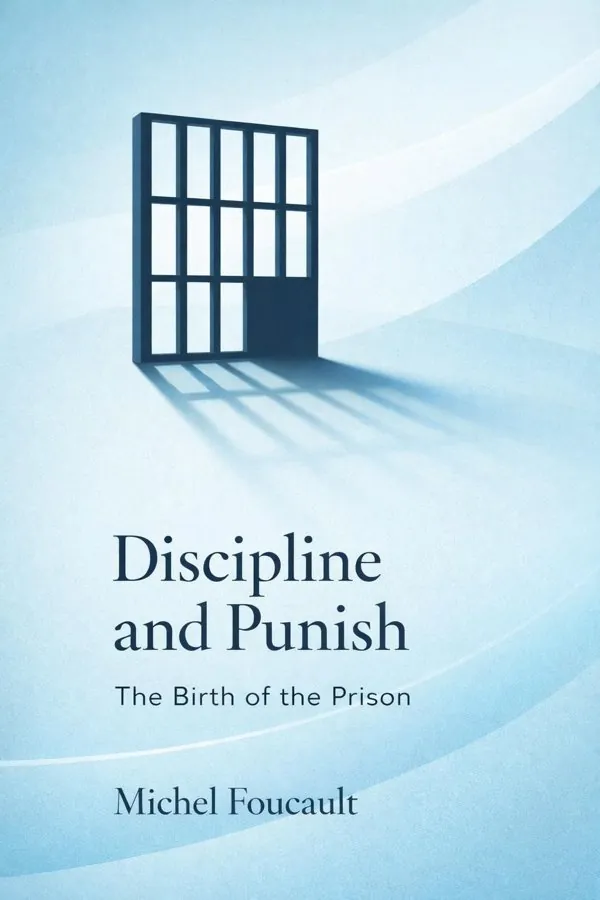
Discipline and Punish: The Birth of the Prison: Summary & Key Insights
 10 min9 chaptersAudio available
Key Takeaways from Discipline and Punish: The Birth of the Prison
Punishment once aimed less at reforming the criminal than at dramatizing the ruler’s power.
What if a penal system could punish more effectively by seeming less brutal?
The most powerful forms of control do not need chains when they can shape the body itself.
His answer is that the prison belongs to a much wider carceral network.
The most effective observer is the one you carry inside yourself.
What Is Discipline and Punish: The Birth of the Prison About?
Discipline and Punish: The Birth of the Prison by Michel Foucault is a western_phil book spanning 4 pages. Originally published in 1975, Discipline and Punish is Michel Foucault’s groundbreaking history of how modern societies learned to control people not mainly through spectacular violence, but through quiet, continuous discipline. Beginning with the brutal public execution of a condemned man and ending with the rise of the prison, Foucault shows that punishment did not simply become more humane. Instead, power changed form. It moved inward, targeting conduct, habits, time, movement, and even the inner life of the individual. What emerged was a new social order built on surveillance, normalization, and examination. This book matters because its argument reaches far beyond prisons. Foucault reveals how schools, hospitals, factories, military barracks, and administrative systems all rely on similar methods: observation, classification, correction, and constant comparison. His insight that modern power works by making people visible, measurable, and self-regulating remains central to debates about institutions, bureaucracy, data collection, and digital surveillance today. As one of the twentieth century’s most influential philosophers and historians of ideas, Foucault brings extraordinary depth to a subject that reshapes how we understand justice, freedom, and modern life itself.
This FizzRead summary covers all 9 key chapters of Discipline and Punish: The Birth of the Prison in approximately 10 minutes, distilling the most important ideas, arguments, and takeaways from Michel Foucault's work. Also available as an audio summary and Key Quotes Podcast.
Discipline and Punish: The Birth of the Prison
Originally published in 1975, Discipline and Punish is Michel Foucault’s groundbreaking history of how modern societies learned to control people not mainly through spectacular violence, but through quiet, continuous discipline. Beginning with the brutal public execution of a condemned man and ending with the rise of the prison, Foucault shows that punishment did not simply become more humane. Instead, power changed form. It moved inward, targeting conduct, habits, time, movement, and even the inner life of the individual. What emerged was a new social order built on surveillance, normalization, and examination.
This book matters because its argument reaches far beyond prisons. Foucault reveals how schools, hospitals, factories, military barracks, and administrative systems all rely on similar methods: observation, classification, correction, and constant comparison. His insight that modern power works by making people visible, measurable, and self-regulating remains central to debates about institutions, bureaucracy, data collection, and digital surveillance today. As one of the twentieth century’s most influential philosophers and historians of ideas, Foucault brings extraordinary depth to a subject that reshapes how we understand justice, freedom, and modern life itself.
Who Should Read Discipline and Punish: The Birth of the Prison?
This book is perfect for anyone interested in western_phil and looking to gain actionable insights in a short read. Whether you're a student, professional, or lifelong learner, the key ideas from Discipline and Punish: The Birth of the Prison by Michel Foucault will help you think differently.
- ✓Readers who enjoy western_phil and want practical takeaways
- ✓Professionals looking to apply new ideas to their work and life
- ✓Anyone who wants the core insights of Discipline and Punish: The Birth of the Prison in just 10 minutes
Want the full summary?
Get instant access to this book summary and 100K+ more with Fizz Moment.
Get Free SummaryAvailable on App Store • Free to download
Key Chapters
Punishment once aimed less at reforming the criminal than at dramatizing the ruler’s power. Foucault opens with the 1757 execution of Robert-Francois Damiens, who attempted to assassinate the French king. The horrifying details are not included for shock alone. They reveal a political logic: the criminal’s body became the site where sovereign authority avenged an offense against itself. Crime was understood as an attack on the ruler’s law, and punishment had to visibly restore damaged power.
Public torture was therefore theatrical. It involved ritual, spectacle, and an audience. The crowd did not merely watch suffering; it witnessed the state’s force. Yet this method was unstable. Spectacles could fail. The condemned might appear heroic, the executioner incompetent, or the crowd sympathetic to the prisoner rather than obedient to authority. What looked like overwhelming power could produce unrest, pity, or even rebellion.
Foucault uses this history to challenge the comforting story that modern punishment simply became kinder over time. He argues that the old system was not abandoned merely because it was cruel, but because it was politically inefficient. Sovereign vengeance gave way to more calculated forms of control.
We can still see echoes of this logic today whenever institutions perform punishment publicly to send a message: a viral firing, a televised trial, a school discipline case turned into an example. The target is not just the individual offender but the audience, whose behavior is also being shaped.
Actionable takeaway: When you encounter public punishment, ask what display of authority is being staged, who the audience is, and what kind of obedience the spectacle is meant to produce.
What if a penal system could punish more effectively by seeming less brutal? In the late eighteenth century, reformers such as Cesare Beccaria and Jeremy Bentham criticized arbitrary cruelty and demanded a justice system based on reason, regularity, and proportionality. Punishment, they argued, should deter crime through certainty rather than terror. The goal shifted from avenging the sovereign to defending society.
Foucault takes this reform movement seriously, but he also reads it critically. On the surface, penal reform appears humane: fewer mutilations, fewer public executions, more codified sentences. Yet beneath this humanitarian language, he sees a deeper transformation in how power operates. Reformers wanted punishment to be predictable, measurable, and efficient. The criminal act would be analyzed, classified, and matched with a calibrated response. Punishment became an instrument for managing populations rather than staging royal vengeance.
This was a major shift. The law no longer focused only on the body in pain but on behavior, motives, risk, and future conduct. Justice became less spectacular and more administrative. The condemned person was no longer simply destroyed; he was placed within a system designed to correct, deter, and classify.
Modern institutions still operate in this rationalized way. Performance reviews, school grading systems, workplace sanctions, and algorithmic risk scores all promise fairness through standardization. But they also expand the reach of judgment into everyday life, often under the language of improvement and efficiency.
Actionable takeaway: Be skeptical of systems that present themselves as purely rational or humane. Ask what kinds of measurement, categorization, and control they make possible in the name of fairness.
The most powerful forms of control do not need chains when they can shape the body itself. In the central section of the book, Foucault introduces discipline as a modern technology of power. Unlike sovereign power, which punishes dramatically and from above, disciplinary power works through small, repeated techniques that train individuals to become both docile and useful. It organizes bodies in space, divides time into routines, breaks actions into steps, and demands precise performance.
Foucault traces these methods in military drills, classroom seating plans, factory schedules, hospital wards, and workshop supervision. Each setting uses similar mechanisms: enclosure, partitioning, timetables, exercises, ranking, and constant correction. The body is taught where to be, how to move, when to act, and how to improve. Power becomes productive. It does not just prohibit; it manufactures capacities, habits, and compliant subjects.
This insight helps explain why modern domination often feels normal rather than oppressive. People adapt to rules that increase efficiency and competence, even as those same rules narrow spontaneity and autonomy. A student learns to sit still, raise a hand, track time, and internalize evaluation. An employee learns to meet metrics, manage attention, and convert effort into measurable output. Discipline works because it blends training with control.
Today, fitness trackers, productivity apps, behavioral dashboards, and workplace monitoring extend this logic into self-management. We often participate willingly, turning ourselves into projects of optimization.
Actionable takeaway: Examine the routines that structure your day. Which ones genuinely support your goals, and which ones mainly train you to conform to external expectations? Keep the useful discipline, but question the rest.
Prison seems like the obvious punishment for crime today, but Foucault asks a startling question: why did imprisonment become so natural, even though it often fails on its own stated terms? His answer is that the prison belongs to a much wider carceral network. It is not an isolated institution but part of a social continuum linking courts, police, schools, reformatories, hospitals, factories, and welfare systems. These institutions share techniques of observation, classification, correction, and normalization.
The prison became dominant not because it solved crime, but because it fit perfectly with a society already organized by discipline. It took the methods used elsewhere and intensified them: enclosure, timetable, surveillance, labor, examination, and reform. It also generated knowledge about individuals, producing files, histories, psychological profiles, and categories such as delinquent, habitual offender, and abnormal subject.
For Foucault, this is the crucial point: prison does not merely punish illegal acts; it helps create a certain kind of person, the delinquent, who can then be monitored and managed. The carceral system extends beyond prison walls because many institutions operate with the same logic of correction.
We can recognize this network today in the overlap between school discipline, juvenile justice, workplace monitoring, predictive policing, mental health assessments, and social-service interventions. Labels follow people. Administrative records shape opportunity. A person may leave one institution only to enter another organized by similar forms of scrutiny.
Actionable takeaway: Look for systems of control as networks rather than isolated problems. If you want to understand punishment, trace how schools, workplaces, health systems, and legal institutions reinforce one another.
The most effective observer is the one you carry inside yourself. Foucault’s most famous image in the book is Bentham’s Panopticon, a prison design in which inmates can be seen from a central tower without ever knowing whether they are being watched at a given moment. Because visibility is constant and verification impossible, prisoners begin to regulate themselves. The brilliance of the Panopticon lies not in physical force but in uncertainty: the possibility of observation becomes enough.
Foucault treats the Panopticon as more than a building. It is a model of modern power. Schools, offices, hospitals, and barracks need not copy its architecture literally to adopt its principle. What matters is asymmetrical visibility. One side observes, records, compares, and judges; the other side becomes permanently legible. Under these conditions, individuals internalize discipline and behave as if watched, even when no one is looking.
This concept has become even more relevant in the digital age. Cameras, activity logs, location tracking, browser analytics, keystroke monitoring, and social media metrics create environments where visibility is continuous. Often we cooperate voluntarily, sharing data because it is convenient, rewarding, or socially expected. We become both the watched and the self-watching subject.
Foucault’s insight is not that surveillance always crushes people openly. It often works by encouraging self-censorship, self-correction, and self-presentation. The power of surveillance lies in making control feel automatic.
Actionable takeaway: Audit the spaces where you feel compelled to perform because you might be watched. Reducing unnecessary visibility, setting privacy boundaries, and resisting constant self-display are practical ways to reclaim autonomy.
Modern institutions do not simply observe people; they turn them into cases. Foucault argues that one of discipline’s most important tools is the examination, which combines surveillance with judgment. Through tests, medical assessments, inspections, interviews, report cards, personnel files, and case notes, institutions compare individuals against norms and record the results. The examination therefore does two things at once: it makes people visible and it produces knowledge about them.
This process is central to the relationship between power and knowledge in Foucault’s thought. Institutions gain authority not only by commanding but by claiming to know who people are: talented or deficient, healthy or sick, disciplined or deviant, promising or dangerous. The individual becomes a documented object. A student is not just taught but ranked. A patient is not just treated but classified. A worker is not just employed but evaluated and profiled.
The examination is powerful because its judgments often appear neutral and scientific. Yet the categories used are never innocent. They define what counts as normal, successful, or problematic. Once recorded, they can follow a person across institutions, affecting access, reputation, and opportunity.
In daily life, the logic of examination now extends through standardized testing, credit ratings, behavioral scoring, hiring assessments, customer reviews, and algorithmic profiling. People learn to anticipate evaluation and shape themselves accordingly.
Actionable takeaway: Treat evaluations as historically shaped tools, not objective truths about your worth. Learn the criteria being used, challenge unfair standards when necessary, and avoid confusing an institutional score with your full identity.
Modern power punishes less by asking, 'What law was broken?' and more by asking, 'How far from the norm is this person?' Foucault shows that discipline introduces a new kind of judgment based on normalization. Individuals are measured against standards of behavior, productivity, health, intelligence, punctuality, conduct, and improvement. The goal is not merely to condemn prohibited acts but to correct deviations.
This is a profound shift. In a purely legal model, judgment focuses on offense and penalty. In a disciplinary model, judgment spreads into everyday life. A child is corrected for attentiveness, posture, and performance. An employee is rated for attitude, teamwork, and responsiveness. A patient is assessed for compliance. A citizen may be tracked by risk indicators or behavioral expectations. Norms become invisible laws governing far more than crime.
Foucault’s point is not that norms are always harmful. Shared standards can coordinate social life. The problem arises when normalization quietly expands, making everyone subject to continuous comparison and subtle coercion. People are encouraged to monitor themselves, hide deviations, and pursue acceptability rather than freedom.
This idea helps explain modern anxieties around metrics and social comparison. Whether through school rankings, beauty standards, productivity culture, or online reputation systems, people often experience power as pressure to become normal, optimized, and legible.
Actionable takeaway: Notice where you are being measured against a norm rather than judged by a clear rule. Ask who created the standard, whose interests it serves, and whether conformity is actually necessary.
One of Foucault’s sharpest questions is also one of the most unsettling: if prisons so often fail to reduce crime, why do they remain central? He argues that their persistence cannot be explained simply by effectiveness. From early on, prisons were criticized for producing recidivism, reinforcing criminal subcultures, and failing to reform inmates. Yet these critiques did not lead to abolition. Instead, they generated more reforms, more expertise, and more prison expansion.
Foucault suggests that prison endures because it serves broader social functions. It helps distinguish legal from illegal populations in ways that are politically useful. It isolates and manages a visible category of offenders. It produces the figure of the delinquent, someone whose life can be studied, supervised, and repeatedly intervened upon by police, judges, psychiatrists, and social workers. In this sense, prison is not a failed institution accidentally preserved; it is woven into a larger system of control.
This argument encourages readers to rethink reform. Better conditions, new treatment programs, or improved classifications may reduce suffering, but they can also strengthen the legitimacy of the carceral system without questioning its basic logic. Foucault does not offer a simple policy blueprint, but he insists on asking what institutions actually do, not just what they claim to do.
The same lesson applies beyond prison. Systems can survive repeated failure if they perform hidden functions for those in power.
Actionable takeaway: When evaluating any institution, do not ask only whether it meets its stated goals. Also ask what unintended or unspoken functions it may be serving by continuing to exist.
It is tempting to imagine power as something possessed only by rulers, governments, or elites. Foucault complicates that picture. In Discipline and Punish, power is not just centralized authority issuing commands from above. It is diffuse, relational, and embedded in ordinary practices. It moves through routines, spatial arrangements, administrative forms, expert language, and institutional expectations. People are not only oppressed by power; they also transmit it, enforce it, and internalize it.
This helps explain why modern control can be so resilient. A school principal, doctor, supervisor, parent, data analyst, or social worker may all participate in networks of discipline without acting with cruelty or malice. Power operates through procedures that appear practical, scientific, and beneficial. It is present in attendance systems, seating charts, progress reports, case management, behavior plans, and security protocols.
Foucault’s analysis is powerful because it changes where we look. Instead of focusing only on laws or dramatic acts of domination, he directs attention to the micro-mechanics of everyday life. How are spaces arranged? Who can see whom? What gets recorded? How are people compared? Which behaviors are rewarded, corrected, or pathologized?
This perspective is useful in contemporary debates about institutions, technology, and organizational culture. Control often grows through mundane processes rather than explicit repression.
Actionable takeaway: To understand power in any environment, map the small practices that shape behavior: observation, documentation, ranking, scheduling, and correction. Real insight often begins with these details.
All Chapters in Discipline and Punish: The Birth of the Prison
About the Author
Michel Foucault (1926–1984) was a French philosopher, historian of ideas, and one of the most influential thinkers of the twentieth century. His work explored how institutions, expert knowledge, and social practices shape what societies consider normal, true, and acceptable. Rather than treating power as something held only by governments or rulers, Foucault examined how it operates through prisons, hospitals, schools, clinics, and systems of classification. His major books include Madness and Civilization, The Birth of the Clinic, The Order of Things, Discipline and Punish, and The History of Sexuality. Across these works, he developed original methods for studying the history of ideas and the formation of modern subjects. Foucault’s thought continues to influence philosophy, sociology, legal theory, cultural studies, political theory, and critical approaches to surveillance and institutional life.
Get This Summary in Your Preferred Format
Read or listen to the Discipline and Punish: The Birth of the Prison summary by Michel Foucault anytime, anywhere. FizzRead offers multiple formats so you can learn on your terms — all free.
Available formats: App · Audio · PDF · EPUB — All included free with FizzRead
Download Discipline and Punish: The Birth of the Prison PDF and EPUB Summary
Key Quotes from Discipline and Punish: The Birth of the Prison
“Punishment once aimed less at reforming the criminal than at dramatizing the ruler’s power.”
“What if a penal system could punish more effectively by seeming less brutal?”
“The most powerful forms of control do not need chains when they can shape the body itself.”
“Prison seems like the obvious punishment for crime today, but Foucault asks a startling question: why did imprisonment become so natural, even though it often fails on its own stated terms?”
“The most effective observer is the one you carry inside yourself.”
Frequently Asked Questions about Discipline and Punish: The Birth of the Prison
Discipline and Punish: The Birth of the Prison by Michel Foucault is a western_phil book that explores key ideas across 9 chapters. Originally published in 1975, Discipline and Punish is Michel Foucault’s groundbreaking history of how modern societies learned to control people not mainly through spectacular violence, but through quiet, continuous discipline. Beginning with the brutal public execution of a condemned man and ending with the rise of the prison, Foucault shows that punishment did not simply become more humane. Instead, power changed form. It moved inward, targeting conduct, habits, time, movement, and even the inner life of the individual. What emerged was a new social order built on surveillance, normalization, and examination. This book matters because its argument reaches far beyond prisons. Foucault reveals how schools, hospitals, factories, military barracks, and administrative systems all rely on similar methods: observation, classification, correction, and constant comparison. His insight that modern power works by making people visible, measurable, and self-regulating remains central to debates about institutions, bureaucracy, data collection, and digital surveillance today. As one of the twentieth century’s most influential philosophers and historians of ideas, Foucault brings extraordinary depth to a subject that reshapes how we understand justice, freedom, and modern life itself.
More by Michel Foucault

The History of Sexuality, Volume 1: An Introduction
Michel Foucault
10 min
The Archaeology of Knowledge
Michel Foucault
10 min
Madness and Civilization: A History of Insanity in the Age of Reason
Michel Foucault
10 min
The Birth Of The Clinic: An Archaeology Of Medical Perception
Michel Foucault
10 minYou Might Also Like
A Little History of Philosophy
Nigel Warburton
10 min
Areopagitica
John Milton
10 min
How To Think Like A Philosopher: Essential Principles For Clear Thinking
Peter Cave
10 min
Language, Truth and Logic
A. J. Ayer
10 min
The Age of Reason
Thomas Paine
10 min
The Essays
Michel De Montaigne
10 minBrowse by Category
Ready to read Discipline and Punish: The Birth of the Prison?
Get the full summary and 100K+ more books with Fizz Moment.