
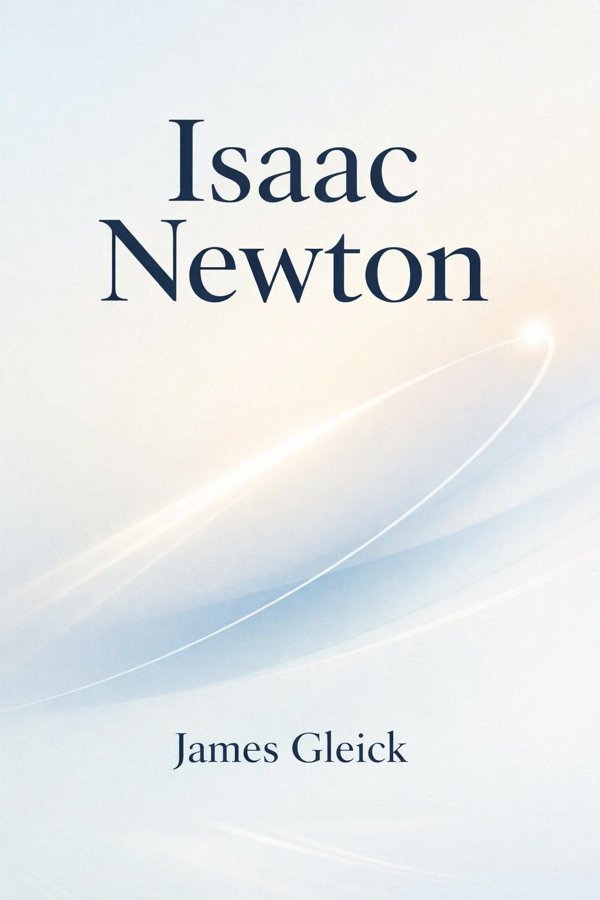
Isaac Newton: Summary & Key Insights
by James Gleick
 10 min8 chaptersAudio available
Key Takeaways from Isaac Newton
Some of history’s greatest breakthroughs begin not in collaboration, but in silence.
The world often looks messy until someone discovers the law beneath it.
Brilliance alone rarely shapes history; it usually needs ambition to force it into the world.
A discovery changes the world only when it can be expressed clearly enough to be shared, tested, and built upon.
The modern world likes specialization, but Newton’s life reminds us that transformative minds often roam widely.
What Is Isaac Newton About?
Isaac Newton by James Gleick is a biographies book. James Gleick’s Isaac Newton is far more than a compact biography of a famous scientist. It is a vivid portrait of a difficult, brilliant, obsessive mind whose ideas transformed humanity’s understanding of the universe. Gleick traces Newton’s path from a fatherless childhood in rural England to his emergence as the architect of modern physics, the creator of calculus, and the author of the Principia, one of the most influential books ever written. But this is not a simple celebration of genius. It is also a study of solitude, ambition, rivalry, secrecy, religion, and the cost of intellectual greatness. Gleick, acclaimed for his books on science, history, and ideas, brings exceptional authority to the subject. He has a rare gift for making complex concepts readable without draining them of depth, and for showing how scientific breakthroughs arise from personality, context, and relentless thought. This book matters because Newton’s legacy still shapes how we think about nature, knowledge, and certainty. To understand Newton is to better understand the foundations of the modern world.
This FizzRead summary covers all 8 key chapters of Isaac Newton in approximately 10 minutes, distilling the most important ideas, arguments, and takeaways from James Gleick's work. Also available as an audio summary and Key Quotes Podcast.
Isaac Newton
James Gleick’s Isaac Newton is far more than a compact biography of a famous scientist. It is a vivid portrait of a difficult, brilliant, obsessive mind whose ideas transformed humanity’s understanding of the universe. Gleick traces Newton’s path from a fatherless childhood in rural England to his emergence as the architect of modern physics, the creator of calculus, and the author of the Principia, one of the most influential books ever written. But this is not a simple celebration of genius. It is also a study of solitude, ambition, rivalry, secrecy, religion, and the cost of intellectual greatness. Gleick, acclaimed for his books on science, history, and ideas, brings exceptional authority to the subject. He has a rare gift for making complex concepts readable without draining them of depth, and for showing how scientific breakthroughs arise from personality, context, and relentless thought. This book matters because Newton’s legacy still shapes how we think about nature, knowledge, and certainty. To understand Newton is to better understand the foundations of the modern world.
Who Should Read Isaac Newton?
This book is perfect for anyone interested in biographies and looking to gain actionable insights in a short read. Whether you're a student, professional, or lifelong learner, the key ideas from Isaac Newton by James Gleick will help you think differently.
- ✓Readers who enjoy biographies and want practical takeaways
- ✓Professionals looking to apply new ideas to their work and life
- ✓Anyone who wants the core insights of Isaac Newton in just 10 minutes
Want the full summary?
Get instant access to this book summary and 100K+ more with Fizz Moment.
Get Free SummaryAvailable on App Store • Free to download
Key Chapters
Some of history’s greatest breakthroughs begin not in collaboration, but in silence. One of James Gleick’s central insights is that Newton’s extraordinary intellectual power was inseparable from his solitude. Newton was not naturally sociable, and he did not thrive in the lively, conversational culture that often surrounds scholarship. Instead, he worked in seclusion, turning inward with such intensity that he could spend years thinking through problems other people barely knew existed. Gleick shows how this isolation was not merely a biographical detail but a condition of Newton’s creativity. Removed from ordinary distractions, Newton developed habits of concentration so deep that they seem almost superhuman.
This isolation shaped both his strengths and his limitations. It gave him the patience to rethink the basic structure of motion, force, and the heavens. It also made him suspicious, secretive, and deeply sensitive to criticism. During the plague years, when Cambridge shut down and Newton returned to Woolsthorpe, he entered one of the most productive periods in scientific history. In relative seclusion, he developed ideas about calculus, light, and gravitation. The image is powerful: while public life stalled, private thought accelerated.
In practical terms, Newton’s life reminds us that serious thinking often requires protected time. Creative work, research, strategic planning, and even personal reflection benefit from intervals of withdrawal. Modern professionals can apply this by scheduling uninterrupted blocks for deep work, limiting notifications, and treating concentration as a resource rather than an accident.
The actionable takeaway: create regular periods of intentional isolation to do your most demanding thinking, because breakthrough ideas rarely emerge from constant distraction.
The world often looks messy until someone discovers the law beneath it. Gleick presents Newton as the person who made one of the boldest intellectual moves in history: he connected earthly and celestial phenomena under the same set of principles. Before Newton, it was easier to imagine that the heavens obeyed one kind of order while ordinary objects on Earth obeyed another. Newton shattered that divide. The falling apple and the orbiting moon, in his framework, became part of the same universe.
This was revolutionary not simply because it added a new scientific fact, but because it changed the kind of questions people could ask. Newton searched for mathematical regularity behind visible complexity. Motion, once described in fragments, could now be explained through laws. Gleick helps readers appreciate how radical this was. Newton was not just solving isolated puzzles; he was training humanity to expect hidden order in nature.
This habit of mind applies beyond science. In business, apparent chaos in customer behavior may hide repeatable patterns. In health, fluctuating energy may reflect sleep, diet, or stress patterns. In relationships, recurring conflict often follows identifiable triggers. The Newtonian mindset asks: what appears random, but is actually governed by structure? Instead of reacting to each event as unique, we look for underlying dynamics.
Gleick also shows that pattern recognition demands discipline. Newton did not settle for vague impressions. He translated observations into measurable relationships. That is a lesson for anyone making decisions today: intuition becomes far more useful when paired with evidence.
The actionable takeaway: when a situation seems confusing, step back and search for the deeper pattern, because clear laws often hide inside apparent disorder.
Brilliance alone rarely shapes history; it usually needs ambition to force it into the world. Gleick’s Newton was not a serene sage detached from reputation. He cared intensely about priority, recognition, and intellectual ownership. He could delay publication for years, yet once challenged, he fought fiercely to defend his place. This combination of reserve and competitive intensity gives the biography much of its human drama.
Newton’s disputes with Robert Hooke and later Gottfried Wilhelm Leibniz reveal a mind that could be both magnificently productive and painfully combative. He was capable of monumental abstraction, yet could descend into grievance when he felt threatened. Gleick does not reduce Newton to either hero or villain. Instead, he shows how ambition drove Newton to sharpen, organize, and publish work that might otherwise have remained private. The same force that made him vigilant about credit also made him relentless about precision.
This creates an uncomfortable but useful lesson. Ambition is not purely noble, but neither is it purely corrupting. In professional life, ambition can motivate excellence, persistence, and strategic focus. It can also breed insecurity, territorial behavior, and unnecessary conflict. Leaders, academics, creators, and entrepreneurs all face this tension. The challenge is not to eliminate ambition but to discipline it.
A practical example: if you are building a project, wanting recognition can push you to maintain standards and finish the work. But if every piece of feedback feels like a threat, your ambition has started to own you. Gleick’s portrait of Newton warns us that achievement without emotional balance can isolate even the most gifted people.
The actionable takeaway: use ambition as energy for high standards and decisive action, but do not let the need for credit poison collaboration or peace of mind.
A discovery changes the world only when it can be expressed clearly enough to be shared, tested, and built upon. Gleick highlights a crucial truth about Newton: his genius was not only conceptual but linguistic and mathematical. Newton did not simply have ideas about motion and gravity; he forged forms of expression that allowed those ideas to become durable knowledge. Equations, definitions, propositions, and demonstrations became the architecture through which nature could be described with unprecedented precision.
The Principia is often treated as an intimidating monument, but Gleick reveals its deeper significance. It was a system of thought turned into a communicable structure. Newton transformed observations into principles and principles into a coherent framework. In doing so, he helped establish what modern science would look like: not isolated claims, but interconnected reasoning that others could examine.
This matters today because many people have strong ideas but weak communication. A researcher with poor presentation skills may be ignored. A manager with a good strategy but vague language may fail to align a team. A founder who cannot explain a product’s value may lose momentum. Newton’s example shows that clarity is not separate from intellect; it is part of intellect.
There is also a caution here. Newton’s tendency to obscure parts of his work delayed understanding and fueled controversy. Knowledge gains power when it becomes legible. Whether writing a report, designing a lesson, or explaining a policy, the ability to give structure to complexity determines whether your insight can travel.
The actionable takeaway: invest as much effort in expressing your ideas clearly as in forming them, because influence depends on communication as much as on originality.
The modern world likes specialization, but Newton’s life reminds us that transformative minds often roam widely. Gleick shows that Newton was not only a mathematician and physicist. He immersed himself in optics, alchemy, theology, chronology, and biblical interpretation. To modern readers, this can seem surprising or even contradictory. How could the founder of mathematical physics spend so much time on subjects now considered mystical or obscure? Gleick’s answer is subtle: Newton’s curiosity did not recognize the boundaries we inherited later.
For Newton, all these pursuits belonged to a larger attempt to decode creation. He did not separate nature, scripture, matter, and history into sealed compartments. Though not all of his inquiries produced enduring science, they reveal a mind unwilling to stop at the edge of approved knowledge. This breadth mattered. It cultivated habits of close reading, symbolic interpretation, experimentation, and skepticism toward received authority.
There is a modern lesson here. People often assume that productivity requires narrowing one’s interests as early and completely as possible. But innovation frequently comes from crossing domains. A software designer can learn from psychology. A teacher can improve through storytelling and design. A scientist can benefit from philosophy. Interdisciplinary curiosity creates unexpected connections.
Of course, Gleick does not romanticize all detours. Some avenues absorb time without yielding proportionate value. The point is not to pursue everything indiscriminately, but to remain open to adjacent fields that stretch your thinking. Newton’s range shows that intellectual ecosystems matter: one line of inquiry can fertilize another.
The actionable takeaway: cultivate disciplined curiosity beyond your main specialty, because some of your best insights will come from unexpected intersections.
History often turns people into statues, and statues conceal more than they reveal. One of the strengths of Gleick’s biography is that it restores Newton’s humanity without diminishing his greatness. The Newton many people know is a simplified icon: the man with the apple, the discoverer of gravity, the genius in a powdered wig. Gleick peels back that image to reveal someone stranger and more compelling—private, severe, anxious, relentless, sometimes generous, often difficult.
This matters because myth can distort understanding. When we imagine geniuses as naturally complete, we lose sight of the actual conditions of achievement: frustration, error, rivalry, revision, obsession, and emotional complexity. Newton struggled with relationships, guarded his ideas, and could react sharply to disagreement. He did not glide through life effortlessly. His accomplishments emerged from extreme discipline and unusual psychological intensity.
That insight has practical relevance for anyone intimidated by excellence. In schools and workplaces, people often compare their messy process with someone else’s polished reputation. But Gleick’s Newton reminds us that even the greatest figures were uneven, conflicted human beings. Admiration is useful; idol worship is not. The more realistic our models of achievement become, the more achievable meaningful excellence appears.
In leadership, this perspective also encourages humility. Public image can become detached from private truth. A celebrated executive may be fragile; a quiet colleague may be capable of remarkable originality. Good judgment requires looking past surface narratives.
The actionable takeaway: resist simplistic hero stories and study the real, imperfect process behind achievement, because honest models teach more than polished myths.
We often imagine scientific progress as the work of lone geniuses, yet Gleick shows that even Newton’s achievements emerged within a web of institutions, correspondents, rivals, and readers. Newton was singular, but he was never entirely separate from the intellectual world around him. Cambridge, the Royal Society, printers, critics, and competing thinkers all shaped how his ideas developed and spread. Even conflict played a role. Challenges, objections, and rival claims forced Newton to clarify arguments he might otherwise have left incomplete.
This is one of the biography’s most useful lessons: knowledge is both personal and social. Newton’s solitary thought generated extraordinary ideas, but community gave them circulation, resistance, and consequence. Without Edmond Halley’s encouragement and practical support, the Principia may never have appeared as it did. Without critics, Newton might not have sharpened key points. Without institutions, his work might have remained private brilliance rather than public science.
The lesson generalizes well. In organizations, a strong idea becomes valuable only when it enters a system that can test and implement it. Writers need editors. Founders need skeptical investors or customers. Researchers need peer review. Teams often resist conflict because it feels uncomfortable, yet productive disagreement can strengthen outcomes when guided by shared standards.
At the same time, Gleick makes clear that conflict becomes destructive when ego overwhelms purpose. Newton’s feuds consumed energy and damaged relationships. The ideal is not endless debate, but rigorous exchange without personal corrosion.
The actionable takeaway: protect your independent thinking, but expose your ideas to strong people and structured critique, because real progress depends on both solitude and community.
Few thinkers did more than Newton to make the universe seem orderly, measurable, and lawful. Yet Gleick’s portrait also reveals a deeper tension: the more Newton discovered, the more he confronted mystery. He could describe planetary motion with unmatched power, but ultimate causes still remained elusive. He could quantify attraction, but the nature of action at a distance troubled many readers, including Newton himself. His scientific achievements expanded certainty while also exposing the boundaries of explanation.
This tension is central to the book’s enduring relevance. Modern readers often assume that science simply replaces uncertainty with facts. Gleick presents a subtler picture. Newton gave humanity a framework of astonishing explanatory strength, but not total closure. The laws worked, the predictions held, and yet philosophical and theological questions persisted. Newton’s own religious studies suggest he never saw human knowledge as complete.
This is a valuable mindset for contemporary life. In medicine, finance, technology, and policy, data can improve decisions without eliminating ambiguity. Strong models guide action, but they do not abolish risk. People get into trouble when they confuse useful explanation with final certainty. Newton’s example encourages intellectual confidence paired with epistemic humility.
A practical application: when making a major decision, gather evidence, identify the governing principles, and act based on the best available model. But leave room for revision. Certainty is not the same as competence. Good judgment often means knowing what can be known and what must still be navigated probabilistically.
The actionable takeaway: seek the clearest possible understanding, but hold even your best models with humility, because progress depends on disciplined confidence, not absolute certainty.
All Chapters in Isaac Newton
About the Author
James Gleick is a bestselling American author and journalist celebrated for writing about science, technology, and intellectual history with unusual clarity and narrative force. He first became widely known for Chaos, a landmark book that brought complex scientific ideas to a broad audience. Since then, he has written acclaimed works on Richard Feynman, information theory, time travel, and the cultural impact of faster communication. Gleick’s writing combines deep research with a storyteller’s instinct, allowing him to explain difficult concepts in ways that feel vivid and human. He has contributed to major publications and is widely regarded as one of the most influential interpreters of modern science for general readers. In Isaac Newton, he brings those strengths to one of history’s most formidable minds.
Get This Summary in Your Preferred Format
Read or listen to the Isaac Newton summary by James Gleick anytime, anywhere. FizzRead offers multiple formats so you can learn on your terms — all free.
Available formats: App · Audio · PDF · EPUB — All included free with FizzRead
Download Isaac Newton PDF and EPUB Summary
Key Quotes from Isaac Newton
“Some of history’s greatest breakthroughs begin not in collaboration, but in silence.”
“The world often looks messy until someone discovers the law beneath it.”
“Brilliance alone rarely shapes history; it usually needs ambition to force it into the world.”
“A discovery changes the world only when it can be expressed clearly enough to be shared, tested, and built upon.”
“The modern world likes specialization, but Newton’s life reminds us that transformative minds often roam widely.”
Frequently Asked Questions about Isaac Newton
Isaac Newton by James Gleick is a biographies book that explores key ideas across 8 chapters. James Gleick’s Isaac Newton is far more than a compact biography of a famous scientist. It is a vivid portrait of a difficult, brilliant, obsessive mind whose ideas transformed humanity’s understanding of the universe. Gleick traces Newton’s path from a fatherless childhood in rural England to his emergence as the architect of modern physics, the creator of calculus, and the author of the Principia, one of the most influential books ever written. But this is not a simple celebration of genius. It is also a study of solitude, ambition, rivalry, secrecy, religion, and the cost of intellectual greatness. Gleick, acclaimed for his books on science, history, and ideas, brings exceptional authority to the subject. He has a rare gift for making complex concepts readable without draining them of depth, and for showing how scientific breakthroughs arise from personality, context, and relentless thought. This book matters because Newton’s legacy still shapes how we think about nature, knowledge, and certainty. To understand Newton is to better understand the foundations of the modern world.
More by James Gleick
You Might Also Like

An American Marriage
Tayari Jones
10 min
Benjamin Franklin: An American Life
Walter Isaacson
10 min
I Know Why The Caged Bird Sings
Maya Angelou
10 min
Long Walk to Freedom
Nelson Mandela
10 min
Persepolis
Marjane Satrapi
10 min
Surely You're Joking, Mr. Feynman!
Richard P. Feynman
10 minBrowse by Category
Ready to read Isaac Newton?
Get the full summary and 100K+ more books with Fizz Moment.