
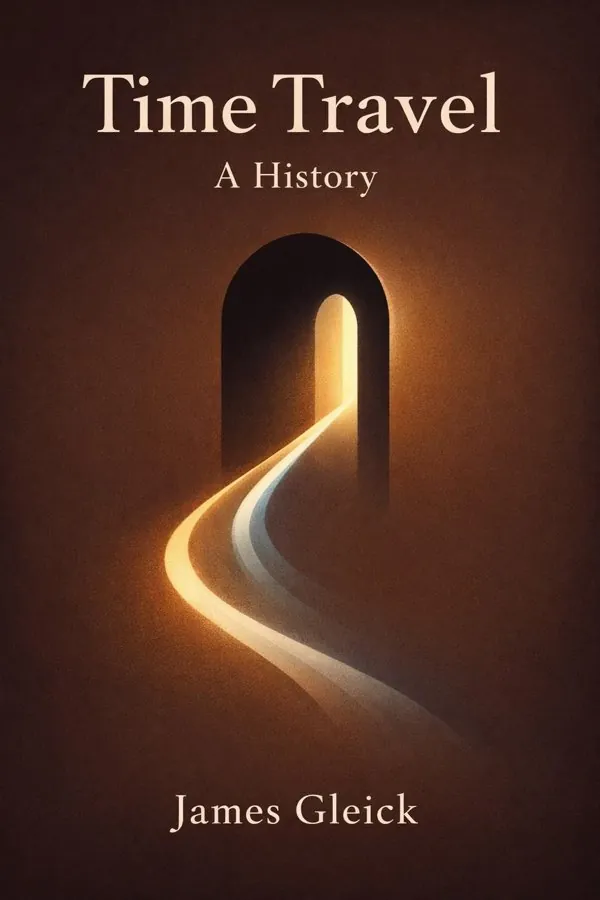
Time Travel: A History: Summary & Key Insights
by James Gleick
 10 min11 chaptersAudio available
What Is Time Travel: A History About?
Time Travel: A History by James Gleick is a popular_sci book spanning 11 pages. Time Travel: A History es un ensayo de no ficción que explora la evolución del concepto de viaje en el tiempo en la literatura, la ciencia y la cultura popular. James Gleick examina cómo la idea, nacida en la ficción victoriana, se convirtió en un tema central de la física moderna y la filosofía, abordando autores como H. G. Wells, Borges y Einstein, y reflexionando sobre cómo el tiempo moldea la conciencia humana.
This FizzRead summary covers all 11 key chapters of Time Travel: A History in approximately 10 minutes, distilling the most important ideas, arguments, and takeaways from James Gleick's work. Also available as an audio summary and Key Quotes Podcast.
Time Travel: A History
Time Travel: A History es un ensayo de no ficción que explora la evolución del concepto de viaje en el tiempo en la literatura, la ciencia y la cultura popular. James Gleick examina cómo la idea, nacida en la ficción victoriana, se convirtió en un tema central de la física moderna y la filosofía, abordando autores como H. G. Wells, Borges y Einstein, y reflexionando sobre cómo el tiempo moldea la conciencia humana.
Who Should Read Time Travel: A History?
This book is perfect for anyone interested in popular_sci and looking to gain actionable insights in a short read. Whether you're a student, professional, or lifelong learner, the key ideas from Time Travel: A History by James Gleick will help you think differently.
- ✓Readers who enjoy popular_sci and want practical takeaways
- ✓Professionals looking to apply new ideas to their work and life
- ✓Anyone who wants the core insights of Time Travel: A History in just 10 minutes
Want the full summary?
Get instant access to this book summary and 100K+ more with Fizz Moment.
Get Free SummaryAvailable on App Store • Free to download
Key Chapters
To understand how time travel first became conceivable, we must return to the late nineteenth century—a period of unmatched confidence in progress. Steam engines shrieked, railways expanded, and people began moving through space faster than ever before. It was an age addicted to acceleration. Naturally, this fascination with speed raised questions not only about moving through space but also about moving through time.
The Victorians were discovering geological deep time, Darwinian evolution, and the dizzying immensity of cosmic history. Humanity had just learned that the Earth was not a few thousand years old but unimaginably ancient. This new temporal consciousness—that history stretched billions of years behind them—created a cultural anxiety, a restlessness to bridge the gulf between past and future.
In this ferment, the imaginative leap to time travel became possible. Writers like Edward Bellamy and Mark Twain speculated about utopias and regressions, while scientists debated the measurement of time itself, increasingly treating it as a dimension to be quantified rather than a mystery to be endured. H. G. Wells was the one who fused these influences, giving the abstract idea tangible form. His Time Traveller’s machine was, literally, a Victorian device: brass, levers, and dials—the same aesthetic of innovation that powered the industrial imagination.
Time travel was born at the intersection of romantic longing and mechanical possibility. In the age of gears and boilers, the notion that time, too, might be engineered seemed almost inevitable.
With *The Time Machine*, Wells did more than invent a story; he gave humanity a new mental instrument. Few works of fiction ever create a concept, and this one did. His Time Traveller proclaimed that time is just another dimension, akin to height, width, and depth. Beneath that literary gesture lay a conceptual revolution: time became space-like.
In the book, Wells’s traveler rides into the future—not a mere prophecy but an embodied journey. That act changed forever how we imagine time. Suddenly, temporal movement wasn’t metaphysical; it was mechanical. The future was not abstraction—it was a destination.
This idea rippled outward. Science fiction blossomed as an imaginative laboratory for temporal thought. Authors began to perceive the future as real and continuous with the present. Historians, too, adopted a new outlook, thinking of progress as a trajectory rather than a divine timeline. Wells transformed our imagination of history and possibility, offering a glimpse of cosmic loneliness and entropy, the slow dying of stars, and the fragility of humankind in the vast arc of time.
In *The Time Machine*’s dark vision—the sun dimming, people devolving into subhuman forms—Wells revealed how the future could serve as a mirror to the present. To travel in time, he implied, was to travel in consciousness, to confront what we are and might become. That act of imaginative expansion remains foundational to every subsequent vision of time travel.
+ 9 more chapters — available in the FizzRead app
All Chapters in Time Travel: A History
About the Author
James Gleick es un escritor y periodista estadounidense conocido por sus obras sobre ciencia y tecnología, entre ellas Chaos: Making a New Science y The Information. Sus libros han sido finalistas del Premio Pulitzer y del National Book Award, y se destacan por su capacidad para hacer accesibles conceptos científicos complejos al público general.
Get This Summary in Your Preferred Format
Read or listen to the Time Travel: A History summary by James Gleick anytime, anywhere. FizzRead offers multiple formats so you can learn on your terms — all free.
Available formats: App · Audio · PDF · EPUB — All included free with FizzRead
Download Time Travel: A History PDF and EPUB Summary
Key Quotes from Time Travel: A History
“To understand how time travel first became conceivable, we must return to the late nineteenth century—a period of unmatched confidence in progress.”
“With *The Time Machine*, Wells did more than invent a story; he gave humanity a new mental instrument.”
Frequently Asked Questions about Time Travel: A History
Time Travel: A History by James Gleick is a popular_sci book that explores key ideas across 11 chapters. Time Travel: A History es un ensayo de no ficción que explora la evolución del concepto de viaje en el tiempo en la literatura, la ciencia y la cultura popular. James Gleick examina cómo la idea, nacida en la ficción victoriana, se convirtió en un tema central de la física moderna y la filosofía, abordando autores como H. G. Wells, Borges y Einstein, y reflexionando sobre cómo el tiempo moldea la conciencia humana.
More by James Gleick
You Might Also Like

Structures: Or Why Things Don"t Fall Down
J.E. Gordon
10 min
The Road to Wigan Pier
George Orwell
10 min
Bonk: The Curious Coupling of Science and Sex
Mary Roach
10 min
First Bite: How We Learn to Eat
Bee Wilson
10 min
In Pursuit Of The Unknown: 17 Equations That Changed The World
Ian Stewart
10 min
Napoleon's Buttons: 17 Molecules That Changed History
Penny Le Couteur and Jay Burreson
10 minBrowse by Category
Ready to read Time Travel: A History?
Get the full summary and 100K+ more books with Fizz Moment.