
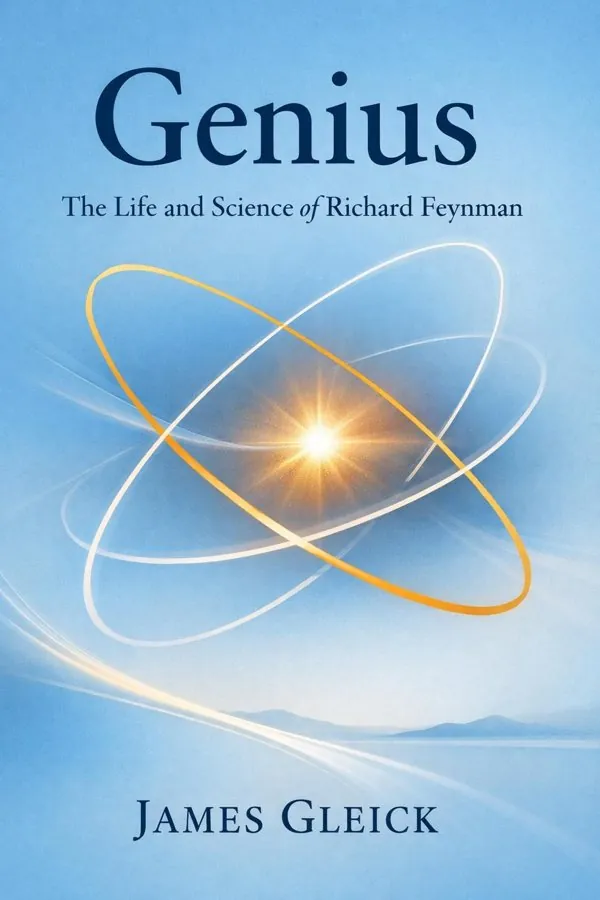
Genius: The Life and Science of Richard Feynman: Summary & Key Insights
by James Gleick
 10 min9 chaptersAudio available
Key Takeaways from Genius: The Life and Science of Richard Feynman
Genius often begins not with grand ambition, but with an unusual way of paying attention.
Real originality often begins when someone stops performing intelligence and starts pursuing truth.
Great thinkers do not just collect knowledge; they enter communities that sharpen and challenge their minds.
History sometimes turns scientists into participants in events far larger than science itself.
A true scientific breakthrough often comes from making the impossible seem understandable.
What Is Genius: The Life and Science of Richard Feynman About?
Genius: The Life and Science of Richard Feynman by James Gleick is a biographies book spanning 6 pages. James Gleick’s Genius: The Life and Science of Richard Feynman is far more than a standard scientific biography. It is a vivid portrait of a man who reshaped modern physics while also becoming one of the twentieth century’s most recognizable public intellectuals. The book follows Richard Feynman from his childhood in Far Rockaway to MIT and Princeton, through the Manhattan Project, into his Nobel Prize–winning work on quantum electrodynamics, and finally to his celebrated years at Caltech and his role in the Challenger disaster investigation. Along the way, Gleick explores both the science and the myth: the disciplined thinker behind the prankster image, the patient teacher behind the dazzling intuition, and the deeply human figure behind the legend. What makes this biography matter is that it shows genius not as magic, but as a distinct way of seeing, questioning, and simplifying reality. Gleick is especially suited to this task. As a leading writer on science and intellectual history, he brings clarity, narrative force, and deep respect for ideas, making Feynman’s life understandable and compelling for scientists, students, and general readers alike.
This FizzRead summary covers all 9 key chapters of Genius: The Life and Science of Richard Feynman in approximately 10 minutes, distilling the most important ideas, arguments, and takeaways from James Gleick's work. Also available as an audio summary and Key Quotes Podcast.
Genius: The Life and Science of Richard Feynman
James Gleick’s Genius: The Life and Science of Richard Feynman is far more than a standard scientific biography. It is a vivid portrait of a man who reshaped modern physics while also becoming one of the twentieth century’s most recognizable public intellectuals. The book follows Richard Feynman from his childhood in Far Rockaway to MIT and Princeton, through the Manhattan Project, into his Nobel Prize–winning work on quantum electrodynamics, and finally to his celebrated years at Caltech and his role in the Challenger disaster investigation. Along the way, Gleick explores both the science and the myth: the disciplined thinker behind the prankster image, the patient teacher behind the dazzling intuition, and the deeply human figure behind the legend. What makes this biography matter is that it shows genius not as magic, but as a distinct way of seeing, questioning, and simplifying reality. Gleick is especially suited to this task. As a leading writer on science and intellectual history, he brings clarity, narrative force, and deep respect for ideas, making Feynman’s life understandable and compelling for scientists, students, and general readers alike.
Who Should Read Genius: The Life and Science of Richard Feynman?
This book is perfect for anyone interested in biographies and looking to gain actionable insights in a short read. Whether you're a student, professional, or lifelong learner, the key ideas from Genius: The Life and Science of Richard Feynman by James Gleick will help you think differently.
- ✓Readers who enjoy biographies and want practical takeaways
- ✓Professionals looking to apply new ideas to their work and life
- ✓Anyone who wants the core insights of Genius: The Life and Science of Richard Feynman in just 10 minutes
Want the full summary?
Get instant access to this book summary and 100K+ more with Fizz Moment.
Get Free SummaryAvailable on App Store • Free to download
Key Chapters
Genius often begins not with grand ambition, but with an unusual way of paying attention. Richard Feynman’s childhood in Far Rockaway was shaped by a father who encouraged him to look beneath labels and ask what things really meant. Instead of memorizing facts, young Feynman learned to investigate. He repaired radios, experimented with circuits, and treated mechanical problems as puzzles waiting to be cracked. This early habit mattered because it trained him to trust direct engagement with the world more than inherited authority.
Gleick shows that Feynman’s early brilliance was not simply a matter of raw intelligence. It was rooted in method. He liked to test ideas, strip away confusion, and build understanding from first principles. A broken radio was not just an object to fix; it was a system whose hidden logic could be uncovered. That same attitude later defined his physics. He did not approach nature as a collection of accepted formulas. He approached it as something that should make sense if examined honestly enough.
This lesson applies far beyond science. In business, education, and personal growth, the people who learn fastest are often those who ask basic but penetrating questions. Why does this process work this way? What assumption am I taking for granted? What can I test for myself? Feynman’s childhood suggests that mastery grows when curiosity becomes active, not passive.
The practical takeaway is simple: practice explaining everyday systems in your own words. Whether it is a financial habit, a software tool, or a machine, do not stop at naming it. Ask how it works, why it fails, and what hidden pattern governs it. That habit is the seed of deeper understanding.
Real originality often begins when someone stops performing intelligence and starts pursuing truth. At MIT, Feynman moved from talented student to independent thinker. He absorbed mathematics and physics quickly, but what distinguished him was his refusal to be impressed by formality for its own sake. He wanted solutions that felt real, not merely elegant on paper. If a method was cumbersome, he looked for a cleaner one. If an explanation was conventional but vague, he kept digging until it became intuitive.
Gleick presents these years as formative because Feynman began developing a style that would remain constant throughout his life: irreverent, practical, and deeply conceptual. He was not content to imitate professors or excel within established rules. He experimented with approaches, trusted his own reasoning, and developed confidence in attacking problems from unconventional angles. This was not rebellion for show. It was a disciplined demand that knowledge should be genuinely understood.
There is a useful modern parallel here. Many people confuse expertise with fluency in jargon, credentials, or standard procedures. Feynman’s example suggests something more demanding: if you cannot reconstruct the logic yourself, you may not understand it as well as you think. In any field, from programming to policy to medicine, breakthrough thinking often comes from individuals who can move beyond received methods without abandoning rigor.
A practical application is to adopt a personal “understanding test.” After learning a concept, try solving a problem using a different method, or explain the idea without technical terms. If you cannot do that, keep working. The actionable takeaway: do not aim merely to know what experts say. Aim to understand well enough to think independently.
Great thinkers do not just collect knowledge; they enter communities that sharpen and challenge their minds. At Princeton, where Feynman studied under John Archibald Wheeler and interacted with some of the leading physicists of the age, his gifts encountered a higher level of pressure. Here he was no longer merely exceptional among students. He was tested against the frontiers of theoretical physics itself. Gleick shows that this environment helped transform Feynman’s instinctive brilliance into a more durable intellectual power.
At Princeton, Feynman learned an important balance. On one hand, he retained his impatience with pretension and his preference for concrete reasoning. On the other, he was forced to engage deeply with abstract theory, difficult mathematics, and the unresolved problems of quantum mechanics. This tension became productive. He did not abandon intuition; he trained it. He learned that originality requires both freedom and discipline.
This stage of his life offers a lesson about growth in demanding environments. Talent can thrive when surrounded by people who raise the standard, but only if the individual remains confident enough to preserve an independent voice. Too much conformity kills innovation; too much ego blocks learning. Feynman succeeded because he did both: he absorbed the best of elite scientific culture while resisting its dead habits.
In practical terms, this idea applies to professional development. Seek out settings where your assumptions will be challenged by strong peers, mentors, or competitors. But do not disappear into imitation. Take notes on what others do well, then adapt it to your own strengths. The actionable takeaway: place yourself in difficult rooms, learn aggressively, and keep your intellectual independence intact.
History sometimes turns scientists into participants in events far larger than science itself. During World War II, Feynman joined the Manhattan Project at Los Alamos, where some of the era’s greatest physicists worked to build the atomic bomb. Gleick treats this period not only as a technical milestone in Feynman’s life, but as a moment when intellect, urgency, bureaucracy, and morality collided. Feynman thrived in the intense problem-solving atmosphere, helping tackle the practical and theoretical issues involved in the bomb’s development. Yet the project also exposed the uneasy relationship between scientific creativity and political power.
Los Alamos amplified many of Feynman’s traits. He was playful, fearless, and brilliant under pressure. He cracked safes, mocked needless administrative rituals, and found ways to keep thinking lively inside a secret military machine. But beneath the stories lies a serious question: what happens when pure inquiry serves destructive ends? Gleick does not reduce this period to simple judgment. Instead, he shows how war compressed ethical reflection, making technical success feel urgent and necessary while postponing fuller reckoning.
This tension remains relevant today in fields like artificial intelligence, biotechnology, and surveillance. Skilled people are often asked to focus narrowly on what can be built, not on what should be built. Feynman’s wartime experience reminds us that technical brilliance does not exempt anyone from moral responsibility.
A practical application is to ask ethical questions early, not after the system is already running. If your work affects safety, privacy, or public trust, create a habit of discussing consequences alongside performance. The actionable takeaway: cultivate moral imagination at the same time you cultivate expertise, especially when your skills can reshape the world.
A true scientific breakthrough often comes from making the impossible seem understandable. Feynman’s most important contribution to physics was his role in the development of quantum electrodynamics, the theory describing how light and matter interact. Before this achievement, quantum theory had extraordinary predictive power but could seem mathematically tangled and conceptually opaque. Feynman helped transform the field by introducing new ways of calculating interactions, especially through the visual and intuitive tools now known as Feynman diagrams.
Gleick emphasizes that Feynman’s genius was not only in solving equations but in changing how physicists thought. His diagrams turned intimidating processes into manageable representations. They provided a practical language for particle interactions and made advanced calculations more accessible to the broader physics community. This was not simplification in the shallow sense. It was simplification that revealed structure.
That is why this chapter of Feynman’s life matters even to non-scientists. In every complex field, progress depends on finding representations that reduce confusion without distorting truth. A good map, model, dashboard, or framework can unlock action where raw complexity produces paralysis. Feynman’s achievement shows that insight often means redesigning the way a problem is seen.
For example, a manager facing a complicated workflow might create a visual process map instead of drowning in email threads. A student studying a difficult concept might sketch relationships rather than reread definitions. The practical lesson is to search for forms that clarify structure. The actionable takeaway: when a problem feels overwhelmingly complex, ask not only how to solve it, but how to represent it more clearly.
Recognition can clarify achievement, but it can also distort the person behind it. Feynman’s Nobel Prize, shared in 1965 for work in quantum electrodynamics, confirmed his status as one of the great physicists of his generation. Yet Gleick is careful to show that public recognition also helped create the larger-than-life image of Feynman as the spontaneous, unconventional genius who simply saw what others missed. That image contained truth, but not the whole truth.
Feynman did possess extraordinary intuition, speed, and originality. Still, Gleick’s biography reveals the labor beneath the legend: years of immersion, collaboration, frustration, and revision. The cult of genius often hides the long apprenticeship required for major work. It encourages people to think breakthroughs arrive by magic, rather than through persistent engagement with hard problems. Feynman himself could contribute to the myth, especially in stories that emphasized his ease and eccentricity. But the biography restores complexity by showing discipline beneath charm.
This matters because modern culture still romanticizes exceptional talent. People may admire outcomes while avoiding the process that produces them. In workplaces, schools, and creative fields, this can lead to passivity: if greatness is innate and mysterious, then effort seems secondary. Feynman’s life suggests the opposite. Distinctive gifts matter, but they become powerful only through relentless practice and unusual honesty about what one does not yet understand.
A practical response is to admire excellence without mystifying it. When you encounter impressive work, study the method, not just the result. Ask what habits, repetitions, collaborations, and failures made it possible. The actionable takeaway: replace the fantasy of effortless brilliance with respect for sustained, disciplined curiosity.
Some thinkers advance knowledge; a rarer few change how people feel about knowledge. In his years at Caltech, Feynman became not just a leading physicist but an extraordinary teacher and cultural figure. His lectures, later collected in famous volumes, were celebrated for their clarity, energy, and intellectual honesty. He did not merely present finished answers. He invited students into the act of thinking, showing them where confusion lived and how one might move through it.
Gleick shows that Feynman’s charisma as a teacher came from a combination of performance and principle. He enjoyed an audience, loved the drama of ideas, and understood timing, surprise, and vivid analogy. But beneath the showmanship was a real educational philosophy: if a concept could not be explained with clarity, then understanding was incomplete. He wanted students to feel the logic of physics, not just memorize its formulas.
This has broad implications for anyone who communicates expertise. Whether you are leading a team, writing, teaching, or pitching an idea, people rarely remember information delivered as lifeless abstraction. They remember structure, vivid examples, and intellectual sincerity. Feynman’s example suggests that communication is not separate from understanding. It is one of its strongest tests.
A practical application is to build explanation into your workflow. After solving a problem, ask yourself how you would teach it to a beginner in three minutes. Use examples, images, and plain language. If the explanation feels muddy, the thinking may still be muddy too. The actionable takeaway: treat teaching, even informally, as a tool for refining your own understanding and extending your influence.
Play is often mistaken for distraction, when in fact it can be a mode of serious intelligence. Feynman’s personality was famously eclectic: he played the bongo drums, explored art, delighted in puzzles, and approached many parts of life with mischievous irreverence. Gleick does not present these traits as mere decoration around the science. They were connected to how Feynman thought. He resisted dead seriousness, distrusted empty status, and used playfulness to keep perception fresh.
This did not mean he lacked rigor. Rather, play helped him avoid mental rigidity. By treating problems as puzzles rather than burdens, he preserved a sense of movement and possibility. His curiosity spilled across disciplines and activities, creating a kind of intellectual cross-training. The same mind that enjoyed cracking safes or sketching could return to physics with renewed sharpness. Irreverence also served a purpose: it protected him from being intimidated by institutions, reputations, or academic fashion.
Today many people work in environments that reward caution, repetition, and polished seriousness. Yet innovation often depends on the ability to experiment without fear of looking foolish. Play can open unexpected angles, reduce anxiety, and generate combinations that formal processes miss. This does not require becoming a flamboyant eccentric. It requires making room for exploratory thinking.
Try introducing low-stakes experimentation into your routine. Brainstorm ten bad ideas before searching for the good one. Approach a stubborn problem with a sketch, analogy, or game-like constraint. Ask the naive question others avoid. The actionable takeaway: protect a space for curiosity and play, because flexibility of mind is often the hidden partner of deep work.
All Chapters in Genius: The Life and Science of Richard Feynman
About the Author
James Gleick is an American author, journalist, and historian of science celebrated for bringing complex scientific ideas to a broad audience. He first gained major recognition with Chaos: Making a New Science, a landmark work that helped popularize chaos theory. His other notable books include Isaac Newton and The Information: A History, a Theory, a Flood, both praised for their intellectual range and narrative clarity. Gleick’s writing often explores the relationship between science, technology, culture, and the people whose ideas transform the modern world. In Genius, he applies those strengths to Richard Feynman, combining biography, scientific explanation, and cultural history. His work is known for being both accessible and rigorous, making him one of the most respected interpreters of scientific thought for general readers.
Get This Summary in Your Preferred Format
Read or listen to the Genius: The Life and Science of Richard Feynman summary by James Gleick anytime, anywhere. FizzRead offers multiple formats so you can learn on your terms — all free.
Available formats: App · Audio · PDF · EPUB — All included free with FizzRead
Download Genius: The Life and Science of Richard Feynman PDF and EPUB Summary
Key Quotes from Genius: The Life and Science of Richard Feynman
“Genius often begins not with grand ambition, but with an unusual way of paying attention.”
“Real originality often begins when someone stops performing intelligence and starts pursuing truth.”
“Great thinkers do not just collect knowledge; they enter communities that sharpen and challenge their minds.”
“History sometimes turns scientists into participants in events far larger than science itself.”
“A true scientific breakthrough often comes from making the impossible seem understandable.”
Frequently Asked Questions about Genius: The Life and Science of Richard Feynman
Genius: The Life and Science of Richard Feynman by James Gleick is a biographies book that explores key ideas across 9 chapters. James Gleick’s Genius: The Life and Science of Richard Feynman is far more than a standard scientific biography. It is a vivid portrait of a man who reshaped modern physics while also becoming one of the twentieth century’s most recognizable public intellectuals. The book follows Richard Feynman from his childhood in Far Rockaway to MIT and Princeton, through the Manhattan Project, into his Nobel Prize–winning work on quantum electrodynamics, and finally to his celebrated years at Caltech and his role in the Challenger disaster investigation. Along the way, Gleick explores both the science and the myth: the disciplined thinker behind the prankster image, the patient teacher behind the dazzling intuition, and the deeply human figure behind the legend. What makes this biography matter is that it shows genius not as magic, but as a distinct way of seeing, questioning, and simplifying reality. Gleick is especially suited to this task. As a leading writer on science and intellectual history, he brings clarity, narrative force, and deep respect for ideas, making Feynman’s life understandable and compelling for scientists, students, and general readers alike.
More by James Gleick

You Might Also Like

An American Marriage
Tayari Jones
10 min
Benjamin Franklin: An American Life
Walter Isaacson
10 min
I Know Why The Caged Bird Sings
Maya Angelou
10 min
Long Walk to Freedom
Nelson Mandela
10 min
Persepolis
Marjane Satrapi
10 min
Surely You're Joking, Mr. Feynman!
Richard P. Feynman
10 minBrowse by Category
Ready to read Genius: The Life and Science of Richard Feynman?
Get the full summary and 100K+ more books with Fizz Moment.