
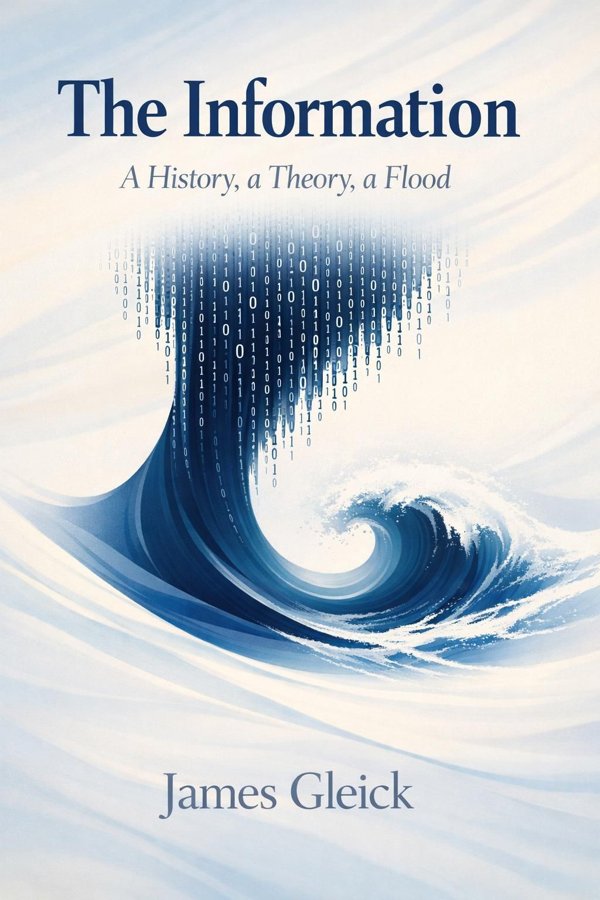
The Information: A History, a Theory, a Flood: Summary & Key Insights
by James Gleick
 10 min9 chaptersAudio available
Key Takeaways from The Information: A History, a Theory, a Flood
Before information could be written, printed, encoded, or digitized, it lived in human minds.
A civilization changes when speech becomes visible.
When messages begin to outrun messengers, society reorganizes itself.
One of the book’s most important insights is also one of its most surprising: information can be measured without asking what a message means.
A profound threshold was crossed when humans stopped using symbols only to represent things and started using machines to manipulate symbols automatically.
What Is The Information: A History, a Theory, a Flood About?
The Information: A History, a Theory, a Flood by James Gleick is a popular_sci book spanning 11 pages. What if information is not just something we send, store, and consume, but one of the deepest forces shaping civilization itself? In The Information: A History, a Theory, a Flood, James Gleick tells the sweeping story of how humanity learned to capture thought in symbols, transmit signals across distance, measure uncertainty, and ultimately build a world saturated with data. Moving from oral storytelling and alphabets to telegraphs, computers, DNA, and the internet, Gleick shows that information is more than a technical concept. It is a framework for understanding memory, communication, logic, biology, and modern life. The book matters because we live in an age defined by abundance: messages, images, databases, algorithms, and constant connectivity. To understand our world, we need to understand what information is, how it travels, and what it does to human attention and society. Gleick is uniquely suited to guide that journey. A celebrated science writer known for making complex ideas vivid and accessible, he combines intellectual history, scientific explanation, and storytelling to reveal why information became one of the master ideas of the modern age.
This FizzRead summary covers all 9 key chapters of The Information: A History, a Theory, a Flood in approximately 10 minutes, distilling the most important ideas, arguments, and takeaways from James Gleick's work. Also available as an audio summary and Key Quotes Podcast.
The Information: A History, a Theory, a Flood
What if information is not just something we send, store, and consume, but one of the deepest forces shaping civilization itself? In The Information: A History, a Theory, a Flood, James Gleick tells the sweeping story of how humanity learned to capture thought in symbols, transmit signals across distance, measure uncertainty, and ultimately build a world saturated with data. Moving from oral storytelling and alphabets to telegraphs, computers, DNA, and the internet, Gleick shows that information is more than a technical concept. It is a framework for understanding memory, communication, logic, biology, and modern life.
The book matters because we live in an age defined by abundance: messages, images, databases, algorithms, and constant connectivity. To understand our world, we need to understand what information is, how it travels, and what it does to human attention and society. Gleick is uniquely suited to guide that journey. A celebrated science writer known for making complex ideas vivid and accessible, he combines intellectual history, scientific explanation, and storytelling to reveal why information became one of the master ideas of the modern age.
Who Should Read The Information: A History, a Theory, a Flood?
This book is perfect for anyone interested in popular_sci and looking to gain actionable insights in a short read. Whether you're a student, professional, or lifelong learner, the key ideas from The Information: A History, a Theory, a Flood by James Gleick will help you think differently.
- ✓Readers who enjoy popular_sci and want practical takeaways
- ✓Professionals looking to apply new ideas to their work and life
- ✓Anyone who wants the core insights of The Information: A History, a Theory, a Flood in just 10 minutes
Want the full summary?
Get instant access to this book summary and 100K+ more with Fizz Moment.
Get Free SummaryAvailable on App Store • Free to download
Key Chapters
Before information could be written, printed, encoded, or digitized, it lived in human minds. That simple fact changes how we think about the history of knowledge. In oral cultures, information was not stored on shelves or servers; it was carried by memory, ritual, repetition, and performance. Stories, genealogies, laws, and myths survived because communities developed techniques to preserve them through rhythm, meter, and shared recitation. Information was alive, social, and vulnerable.
Gleick uses this early world to remind us that information is never just a neutral substance. It always depends on a medium. In oral societies, the medium was the human voice and the collective memory of the group. That made information flexible but fragile. A story could adapt to a new audience, but it could also be lost when a generation disappeared. Knowledge required caretakers. Memory was infrastructure.
This perspective also helps explain why writing was such a revolution. It did not simply record speech; it externalized memory. It allowed knowledge to outlast individuals and travel beyond the immediate community. Yet oral habits never vanished. Even today, podcasts, speeches, religious rituals, and classroom teaching all preserve older patterns of knowledge transmission.
A practical example is how modern professionals remember complex material. We still use ancient mnemonic tools: repetition, narrative structure, and rhythmic phrasing. Great speakers and teachers know that information becomes memorable when it is shaped like a story rather than delivered as disconnected facts.
Actionable takeaway: when you want information to last, do not rely on raw data alone. Organize it into patterns, stories, and repeated forms that the human mind can actually retain.
A civilization changes when speech becomes visible. Writing systems transformed information from an event into an object. Once thoughts could be marked in clay, ink, or paper, knowledge no longer had to vanish the moment words were spoken. It could be inspected, copied, compared, archived, and challenged. This was one of humanity’s decisive leaps.
Gleick highlights the importance of symbolic systems, especially alphabets, because they compressed language into manageable units. Instead of requiring thousands of symbols, alphabetic writing broke speech into a small set of reusable signs. That simplification democratized literacy over time and created a bridge between sound and abstraction. Writing made administration, law, literature, mathematics, and science more scalable.
The deeper point is that a writing system is a technology of thought. It does not merely preserve ideas; it shapes them. Lists, ledgers, equations, indexes, and diagrams become possible only when information can be arranged outside the mind. Bureaucracies depend on records. Philosophy depends on close textual argument. Science depends on reproducible notation.
You can see this today in the difference between speaking an idea aloud and writing it down. The act of writing exposes gaps in logic. Notes, outlines, spreadsheets, and diagrams all extend cognition. Digital tools are new forms of this same ancient breakthrough: they let us manipulate thought as if it were an external object.
Actionable takeaway: use writing as a tool for thinking, not just recording. If a problem feels vague, turn it into words, lists, or symbols. Clarity often emerges when information is made visible.
When messages begin to outrun messengers, society reorganizes itself. The telegraph marked that turning point. For most of history, communication moved only as fast as a person, horse, or ship could travel. The telegraph severed information from physical transport. Suddenly, words could cross vast distances almost instantly. That shift was not merely technical; it changed commerce, war, journalism, governance, and the public sense of time.
Gleick shows that communication networks do more than connect places. They create new expectations. Once rapid transmission becomes possible, delay begins to feel intolerable. Markets start to synchronize. News becomes continuous rather than local. Language itself adapts: telegraphy encouraged brevity, coding, and standardization. Information became something that could be counted, priced, routed, and optimized.
This history helps us understand later networks, from telephone lines to the internet. Each new medium changes not just how fast messages travel, but how people think about distance, urgency, and relevance. The flood of modern notifications is an extension of the same logic. When communication becomes instant, everything competes for immediate attention.
A practical example is workplace communication. Email, messaging apps, and collaboration platforms promise efficiency, but they also multiply interruptions. Without boundaries, speed produces noise rather than clarity. The lesson of networks is that connection is powerful, but bandwidth and attention are finite.
Actionable takeaway: do not confuse faster communication with better communication. Design personal and team habits that match the right message to the right channel, and protect time for slower, deeper thinking.
One of the book’s most important insights is also one of its most surprising: information can be measured without asking what a message means. Claude Shannon’s information theory did exactly that. Working at Bell Labs, Shannon developed a mathematical framework for communication that focused on uncertainty, probability, signal transmission, and noise. His breakthrough was to define information in terms of choice and unpredictability. The more uncertain the message, the more information it carries.
This was revolutionary because it separated engineering from interpretation. A telephone line or radio channel does not need to understand a message to transmit it. What matters is whether symbols can be encoded, sent, and recovered reliably. Shannon’s bit became the basic unit of this world: a yes-or-no choice, the smallest measurable packet of information.
The applications are enormous. Compression algorithms reduce redundancy to store files efficiently. Error-correcting codes help data survive noisy channels. Digital communication, computing, streaming, and mobile networks all rest on Shannon’s principles. Even if most people never study the equations, they benefit from them every time a text message arrives intact or a video plays smoothly.
The concept also improves everyday thinking. If a report or presentation is too predictable, it carries little new information. If it is too chaotic, it becomes useless. Effective communication balances novelty and structure. You can also think of attention as a scarce channel: noise consumes capacity.
Actionable takeaway: when communicating, reduce noise and increase signal. Ask what is truly new, necessary, and clear, then strip away the rest.
A profound threshold was crossed when humans stopped using symbols only to represent things and started using machines to manipulate symbols automatically. Gleick traces this development through figures like Charles Babbage, Ada Lovelace, and Alan Turing. Their work revealed that calculation is not just arithmetic; it is rule-based symbol processing. Once that idea became clear, the computer was imaginable.
Babbage conceived machines that could automate computation. Lovelace saw further, recognizing that if numbers could represent other things, a machine might process music, text, or logic as well. Turing then formalized computation itself, showing how a simple abstract machine could carry out any procedure expressible as a sequence of rules. Together, these ideas reframed intelligence, logic, and machinery.
The significance is hard to overstate. Modern software, search engines, artificial intelligence, and digital platforms all depend on the insight that information can be encoded symbolically and transformed by algorithm. Computers do not think like humans, but they can execute formal operations at extraordinary speed and scale.
In daily life, this means many tasks once seen as uniquely human have become automatable: sorting records, checking grammar, recommending products, routing traffic, even generating text. That creates enormous convenience, but it also raises questions about judgment, creativity, and dependence on systems we barely understand.
Actionable takeaway: learn to see algorithms behind the tools you use. Ask what rules they follow, what inputs they depend on, and where human judgment still matters. Digital literacy begins with understanding that software is structured information acting on information.
One of Gleick’s boldest moves is to place genetics within the larger history of information. The discovery of DNA revealed that biology, too, depends on encoding, storage, copying, and transmission. Genes are not literally a language in the ordinary sense, but they function as instructions carried through molecules. Life preserves information across generations, mutates it, and subjects it to selection.
This does not reduce living beings to machines, but it does show why informational thinking became so powerful in modern science. The genetic code gave researchers a way to understand heredity with unprecedented precision. Sequences could be read, compared, copied, and eventually edited. Biology became, in part, a science of messages and mechanisms.
The practical consequences are everywhere: genetic testing, ancestry analysis, disease screening, biotechnology, and personalized medicine all rely on treating biological material as information that can be decoded. At the same time, Gleick’s framing invites humility. Information is not the whole story of life. Context matters. A gene’s effect depends on complex interactions within cells, bodies, and environments.
There is also an ethical dimension. Once genetic information becomes legible and manipulable, questions of privacy, ownership, and responsibility intensify. Who controls biological data? How should predictive knowledge be used? Informational power always brings moral choices.
Actionable takeaway: think of biology as informative, not deterministic. Use genetic and health information as one input among many, and stay alert to the ethical implications of data that reaches into the deepest layers of identity.
The modern world suffers from a paradox: we have never had more access to information, yet clarity often feels harder to achieve. Gleick describes the information explosion as both triumph and burden. Printing multiplied texts, libraries accumulated records, databases expanded memory, and digital systems unleashed a flood that now surrounds us continuously. Abundance solved the old problem of scarcity, but created a new problem of overload.
This matters because information is not the same as understanding. Raw accumulation can overwhelm the mind. Search engines return millions of results. News streams update by the minute. Social media compresses important and trivial content into the same format, asking the brain to evaluate everything at once. Without filters, priorities, and interpretation, information becomes noise.
The key shift in the digital age is that curation becomes as important as access. The bottleneck is no longer storage or transmission, but attention. The person who can select, organize, and interpret well has an advantage over the person who simply consumes more. This applies to students, leaders, researchers, and anyone making decisions under pressure.
A practical example is learning online. It is easy to collect articles, videos, and notes endlessly. It is harder to synthesize them into a coherent model. Knowledge grows when information is connected, tested, and applied, not merely gathered.
Actionable takeaway: build an information diet. Decide what sources deserve trust, what inputs deserve limits, and what routines turn consumption into reflection. In an age of flood, discernment is a superpower.
A message can be transmitted perfectly and still fail to matter. That is the tension at the center of Gleick’s account. Information theory brilliantly explains how signals are encoded and sent, but human life depends on semantics, context, and interpretation. Meaning is not contained in bits alone. It emerges through minds, cultures, situations, and goals.
This distinction is crucial because modern systems often blur it. A platform may optimize engagement, a model may detect patterns, and a database may store immense quantities of text, yet none of that guarantees wisdom or understanding. We can count messages without grasping significance. We can analyze words statistically without appreciating what they mean to particular people.
Gleick’s exploration of language, dictionaries, classification, and digital text points to a deeper truth: information becomes valuable when it enters a structure of understanding. Context tells us whether a fact is important. Interpretation tells us how pieces fit together. Judgment tells us what to do next.
This has immediate applications in education, management, and media. A teacher does more than deliver content; they create understanding. A leader does more than share updates; they establish meaning and direction. A reader does more than scan words; they connect them to experience and purpose.
Actionable takeaway: whenever you encounter information, ask three questions: What does it mean here? Why does it matter now? What action should follow? Those questions turn data into insight.
The most ambitious claim running through the book is that information is no longer just a topic within science. It has become a candidate for explaining reality at the deepest levels. In physics, computation, thermodynamics, and quantum theory, scientists increasingly treat information as fundamental. Questions about entropy, order, measurement, and the state of systems can be framed in informational terms.
Gleick does not present this as a settled doctrine so much as an extraordinary intellectual shift. Once information began as a tool for telegraphs and communication engineering, it spread into computing, genetics, linguistics, neuroscience, and physics. The concept proved so fertile because it links pattern, uncertainty, storage, and transformation across many domains.
For ordinary readers, the significance lies in perspective. Information is not just what appears on screens. It is a way of describing structure in the world. That helps explain why the concept appears everywhere from black hole debates to brain science to machine learning. The same basic questions recur: What is encoded? What is lost? What can be recovered? What are the limits of transmission and memory?
At a practical level, this broad view encourages interdisciplinary thinking. Breakthroughs often happen when ideas migrate across fields. Someone who understands information as a common language can better connect technology, biology, business, and science.
Actionable takeaway: cultivate an informational mindset. Look for patterns, signals, constraints, and feedback loops in any system you study. The habit of seeing structure beneath complexity can sharpen thinking in every area of life.
All Chapters in The Information: A History, a Theory, a Flood
About the Author
James Gleick is an American author and journalist celebrated for making complex scientific and technological ideas accessible to general readers. He began his career in journalism and became widely known for books that combine deep research, narrative energy, and intellectual clarity. His major works include Chaos, a landmark account of chaos theory, Genius, about Richard Feynman, and The Information, which explores the history and significance of information as a defining concept of modern life. Gleick’s writing often focuses on how scientific ideas reshape culture, language, and human understanding. He is especially admired for connecting technical subjects to broader historical and philosophical questions. Across his career, he has established himself as one of the leading interpreters of science for a broad audience.
Get This Summary in Your Preferred Format
Read or listen to the The Information: A History, a Theory, a Flood summary by James Gleick anytime, anywhere. FizzRead offers multiple formats so you can learn on your terms — all free.
Available formats: App · Audio · PDF · EPUB — All included free with FizzRead
Download The Information: A History, a Theory, a Flood PDF and EPUB Summary
Key Quotes from The Information: A History, a Theory, a Flood
“Before information could be written, printed, encoded, or digitized, it lived in human minds.”
“A civilization changes when speech becomes visible.”
“When messages begin to outrun messengers, society reorganizes itself.”
“One of the book’s most important insights is also one of its most surprising: information can be measured without asking what a message means.”
“A profound threshold was crossed when humans stopped using symbols only to represent things and started using machines to manipulate symbols automatically.”
Frequently Asked Questions about The Information: A History, a Theory, a Flood
The Information: A History, a Theory, a Flood by James Gleick is a popular_sci book that explores key ideas across 9 chapters. What if information is not just something we send, store, and consume, but one of the deepest forces shaping civilization itself? In The Information: A History, a Theory, a Flood, James Gleick tells the sweeping story of how humanity learned to capture thought in symbols, transmit signals across distance, measure uncertainty, and ultimately build a world saturated with data. Moving from oral storytelling and alphabets to telegraphs, computers, DNA, and the internet, Gleick shows that information is more than a technical concept. It is a framework for understanding memory, communication, logic, biology, and modern life. The book matters because we live in an age defined by abundance: messages, images, databases, algorithms, and constant connectivity. To understand our world, we need to understand what information is, how it travels, and what it does to human attention and society. Gleick is uniquely suited to guide that journey. A celebrated science writer known for making complex ideas vivid and accessible, he combines intellectual history, scientific explanation, and storytelling to reveal why information became one of the master ideas of the modern age.
More by James Gleick
You Might Also Like
Structures: Or Why Things Don"t Fall Down
J.E. Gordon
10 min
The Road to Wigan Pier
George Orwell
10 min
Bonk: The Curious Coupling of Science and Sex
Mary Roach
10 min
First Bite: How We Learn to Eat
Bee Wilson
10 min
In Pursuit Of The Unknown: 17 Equations That Changed The World
Ian Stewart
10 min
Napoleon's Buttons: 17 Molecules That Changed History
Penny Le Couteur and Jay Burreson
10 minBrowse by Category
Ready to read The Information: A History, a Theory, a Flood?
Get the full summary and 100K+ more books with Fizz Moment.