
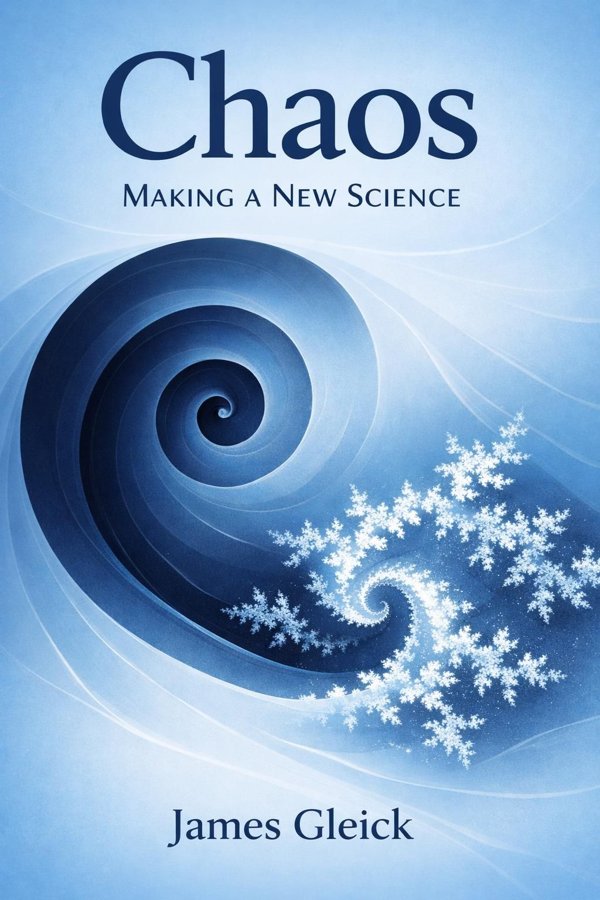
Chaos: Making a New Science: Summary & Key Insights
by James Gleick
 10 min6 chaptersAudio available
What Is Chaos: Making a New Science About?
Chaos: Making a New Science by James Gleick is a popular_sci book spanning 6 pages. Chaos: Making a New Science es un libro de divulgación científica que explora el desarrollo de la teoría del caos, una rama de las matemáticas y la física que estudia los sistemas dinámicos no lineales y su comportamiento impredecible. Gleick presenta las ideas de científicos como Edward Lorenz, Benoît Mandelbrot y Mitchell Feigenbaum, mostrando cómo el caos ha transformado la comprensión de fenómenos naturales y sociales.
This FizzRead summary covers all 6 key chapters of Chaos: Making a New Science in approximately 10 minutes, distilling the most important ideas, arguments, and takeaways from James Gleick's work. Also available as an audio summary and Key Quotes Podcast.
Chaos: Making a New Science
Chaos: Making a New Science es un libro de divulgación científica que explora el desarrollo de la teoría del caos, una rama de las matemáticas y la física que estudia los sistemas dinámicos no lineales y su comportamiento impredecible. Gleick presenta las ideas de científicos como Edward Lorenz, Benoît Mandelbrot y Mitchell Feigenbaum, mostrando cómo el caos ha transformado la comprensión de fenómenos naturales y sociales.
Who Should Read Chaos: Making a New Science?
This book is perfect for anyone interested in popular_sci and looking to gain actionable insights in a short read. Whether you're a student, professional, or lifelong learner, the key ideas from Chaos: Making a New Science by James Gleick will help you think differently.
- ✓Readers who enjoy popular_sci and want practical takeaways
- ✓Professionals looking to apply new ideas to their work and life
- ✓Anyone who wants the core insights of Chaos: Making a New Science in just 10 minutes
Want the full summary?
Get instant access to this book summary and 100K+ more with Fizz Moment.
Get Free SummaryAvailable on App Store • Free to download
Key Chapters
To begin the story of chaos, we must start in the early 1960s with Edward Lorenz, a quiet meteorologist working at MIT. Lorenz was building a simple computer model to simulate weather. He fed it a set of equations—a few variables to describe convection, temperature, and pressure—and watched his computer print out numerical patterns representing the evolution of a tiny artificial weather system. One day, in order to redo a calculation, he rounded one of the initial numbers slightly, changing it from 0.506127 to 0.506. To his astonishment, the new sequence diverged completely from the original. The two simulated weather systems, identical at first glance, soon bore no resemblance.
That was the moment when Lorenz glimpsed something extraordinary: deterministic systems—those governed by precise laws—could behave unpredictably. Small changes in initial conditions produced vastly different outcomes. This was the seed of what later became known as the “butterfly effect,” the notion that the flap of a butterfly’s wings in Brazil could set off a tornado in Texas. Though poetic, the phrase captured a profound truth about nonlinear systems—they were sensitive, not random. That sensitivity, Lorenz realized, undermined the dream of perfect prediction in meteorology and beyond.
The scientific world wasn’t ready for Lorenz’s insight. The dominant tradition in physics revered linearity and equilibrium: the straight line, the harmonic oscillator, the system that could be reduced to solvable, elegant equations. Weather was dismissed as too messy, too complex. Lorenz’s discovery was quietly published in a meteorological journal in 1963, barely noticed. But beneath the surface, his equations—the Lorenz attractor—would later become icons of chaos theory, their shape resembling a butterfly’s wings. They gave form to the abstract notion of deterministic unpredictability, and that form would inspire mathematicians, physicists, and artists alike to look again at the tangled web of nature and see beauty where they once saw only disorder.
The Lorenz attractor was more than an invention of equations; it was a window into a new geometry. In traditional physics, systems tend toward attractors—stable states or repeating cycles. A pendulum settles at its lowest point; planets orbit in predictable ellipses. But Lorenz’s plots revealed something bizarre: in the space of possible outcomes, trajectories spiraled endlessly without repeating, yet they never wandered off into randomness. They traced a structure—a strange attractor—at once ordered and unpredictable.
The visualization of these attractors became a revelation. For the first time, scientists could literally see chaos—thanks to the computer, which became the silent collaborator of this new science. The intricate, self-similar shapes emerging from Lorenz’s equations hinted at a geometrical universe far removed from the Euclidean simplicity of lines and spheres. Within the apparent disorder lay an underlying coherence—patterns of infinite complexity arising from simple rules.
As researchers plotted more systems—chemical reactions, population dynamics, electronic circuits—they saw a common thread. Chaotic behavior wasn’t an anomaly; it was a fundamental feature of nonlinear systems. Strange attractors appeared again and again, each unique yet sharing a family resemblance. They embodied the essence of chaos: order without periodicity, structure without stability.
For me, this discovery was more than technical. It carried a philosophical charge. Nature, it seemed, was not operating on isolated equations but on dynamic patterns, endlessly folding and unfolding. The strange attractor became a metaphor for life itself—unpredictable in detail, yet bounded by hidden rules, as if the universe were sketching patterns that never exactly repeat but always follow a rhythm.
+ 4 more chapters — available in the FizzRead app
All Chapters in Chaos: Making a New Science
About the Author
James Gleick es un escritor y periodista estadounidense especializado en ciencia y tecnología. Es conocido por sus obras de divulgación que abordan temas complejos de manera accesible, como la teoría del caos, el tiempo y la información. Ha sido finalista del Premio Pulitzer y del National Book Award.
Get This Summary in Your Preferred Format
Read or listen to the Chaos: Making a New Science summary by James Gleick anytime, anywhere. FizzRead offers multiple formats so you can learn on your terms — all free.
Available formats: App · Audio · PDF · EPUB — All included free with FizzRead
Download Chaos: Making a New Science PDF and EPUB Summary
Key Quotes from Chaos: Making a New Science
“To begin the story of chaos, we must start in the early 1960s with Edward Lorenz, a quiet meteorologist working at MIT.”
“The Lorenz attractor was more than an invention of equations; it was a window into a new geometry.”
Frequently Asked Questions about Chaos: Making a New Science
Chaos: Making a New Science by James Gleick is a popular_sci book that explores key ideas across 6 chapters. Chaos: Making a New Science es un libro de divulgación científica que explora el desarrollo de la teoría del caos, una rama de las matemáticas y la física que estudia los sistemas dinámicos no lineales y su comportamiento impredecible. Gleick presenta las ideas de científicos como Edward Lorenz, Benoît Mandelbrot y Mitchell Feigenbaum, mostrando cómo el caos ha transformado la comprensión de fenómenos naturales y sociales.
More by James Gleick


You Might Also Like

Structures: Or Why Things Don"t Fall Down
J.E. Gordon
10 min
The Road to Wigan Pier
George Orwell
10 min
Bonk: The Curious Coupling of Science and Sex
Mary Roach
10 min
First Bite: How We Learn to Eat
Bee Wilson
10 min
In Pursuit Of The Unknown: 17 Equations That Changed The World
Ian Stewart
10 min
Napoleon's Buttons: 17 Molecules That Changed History
Penny Le Couteur and Jay Burreson
10 minBrowse by Category
Ready to read Chaos: Making a New Science?
Get the full summary and 100K+ more books with Fizz Moment.