
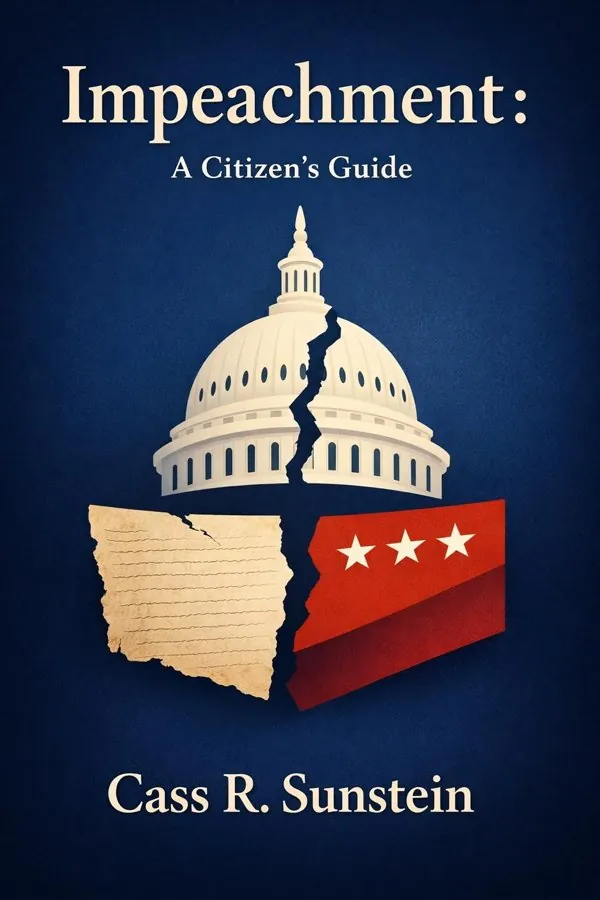
Impeachment: A Citizen's Guide: Summary & Key Insights
 10 min10 chaptersAudio available
Key Takeaways from Impeachment: A Citizen's Guide
A constitutional tool makes more sense when you know the problem it was built to solve.
Sometimes the shortest constitutional phrases carry the greatest weight.
The framers were not only designing a government; they were designing defenses against human weakness.
Few constitutional phrases generate more confusion than “high Crimes and Misdemeanors.
In times of crisis, people often speak as if impeachment were a dramatic single event.
What Is Impeachment: A Citizen's Guide About?
Impeachment: A Citizen's Guide by Cass R. Sunstein is a law_crime book spanning 10 pages. In Impeachment: A Citizen's Guide, Cass R. Sunstein takes one of the most emotionally charged words in American politics and explains it with clarity, restraint, and constitutional seriousness. Rather than treating impeachment as a slogan, a partisan weapon, or a media spectacle, Sunstein shows that it is a carefully designed emergency mechanism within the U.S. constitutional system. The book traces impeachment from its English roots to the debates of the Constitutional Convention, then examines how the phrase “high Crimes and Misdemeanors” should be understood in practice. Along the way, Sunstein separates ordinary political conflict from conduct that threatens the constitutional order itself. What makes this short book so valuable is its balance: it is accessible enough for general readers, yet rigorous enough to satisfy those looking for legal and historical grounding. Sunstein writes with authority as one of America’s leading constitutional scholars, drawing on legal history, institutional design, and democratic theory. The result is a compact but powerful guide for citizens who want to understand when impeachment is justified, why it exists, and how it protects the republic from dangerous abuses of public power.
This FizzRead summary covers all 10 key chapters of Impeachment: A Citizen's Guide in approximately 10 minutes, distilling the most important ideas, arguments, and takeaways from Cass R. Sunstein's work. Also available as an audio summary and Key Quotes Podcast.
Impeachment: A Citizen's Guide
In Impeachment: A Citizen's Guide, Cass R. Sunstein takes one of the most emotionally charged words in American politics and explains it with clarity, restraint, and constitutional seriousness. Rather than treating impeachment as a slogan, a partisan weapon, or a media spectacle, Sunstein shows that it is a carefully designed emergency mechanism within the U.S. constitutional system. The book traces impeachment from its English roots to the debates of the Constitutional Convention, then examines how the phrase “high Crimes and Misdemeanors” should be understood in practice. Along the way, Sunstein separates ordinary political conflict from conduct that threatens the constitutional order itself. What makes this short book so valuable is its balance: it is accessible enough for general readers, yet rigorous enough to satisfy those looking for legal and historical grounding. Sunstein writes with authority as one of America’s leading constitutional scholars, drawing on legal history, institutional design, and democratic theory. The result is a compact but powerful guide for citizens who want to understand when impeachment is justified, why it exists, and how it protects the republic from dangerous abuses of public power.
Who Should Read Impeachment: A Citizen's Guide?
This book is perfect for anyone interested in law_crime and looking to gain actionable insights in a short read. Whether you're a student, professional, or lifelong learner, the key ideas from Impeachment: A Citizen's Guide by Cass R. Sunstein will help you think differently.
- ✓Readers who enjoy law_crime and want practical takeaways
- ✓Professionals looking to apply new ideas to their work and life
- ✓Anyone who wants the core insights of Impeachment: A Citizen's Guide in just 10 minutes
Want the full summary?
Get instant access to this book summary and 100K+ more with Fizz Moment.
Get Free SummaryAvailable on App Store • Free to download
Key Chapters
A constitutional tool makes more sense when you know the problem it was built to solve. Sunstein begins by reminding readers that impeachment did not originate in the United States. It emerged in England, where Parliament needed a way to hold powerful officials accountable when ordinary legal remedies were inadequate. Kings often stood beyond direct challenge, but ministers, advisers, and other officers could still endanger the realm through corruption, betrayal, or abuse of authority. Impeachment became a political-legal mechanism for confronting that danger.
This history matters because it shows that impeachment was never primarily about punishing private wrongdoing. Its central purpose was public protection. The question was not simply whether an official had committed a crime in the narrow statutory sense, but whether that official had violated the trust attached to office. In that older tradition, abuses of power, reckless disregard for the public good, and disloyal conduct could justify removal even if they did not resemble ordinary crimes.
The American framers inherited this idea but adapted it to a republic. They did not want impeachment to become a routine parliamentary vote of no confidence, but they did want a remedy for officials who used public office in ways fundamentally inconsistent with constitutional government. For modern readers, this history clarifies a persistent confusion: impeachment is not just about lawbreaking; it is about dangerous misuse of public power.
A practical way to apply this insight is to ask, whenever impeachment is discussed: Is the issue merely scandal, or is it an abuse of office that threatens the system itself? That question keeps the debate anchored in constitutional purpose rather than political emotion.
Sometimes the shortest constitutional phrases carry the greatest weight. Article II, Section 4 provides that the President, Vice President, and all civil officers may be removed for “Treason, Bribery, or other high Crimes and Misdemeanors.” Sunstein emphasizes that this wording is both precise and open-ended. Treason and bribery are named specifically, but the broader phrase that follows signals that impeachable conduct extends beyond a narrow criminal code.
That design was intentional. The framers knew they could not anticipate every future danger posed by executive or judicial officers. If they had limited impeachment only to indictable crimes, a president could engage in serious constitutional wrongdoing without triggering removal. At the same time, they avoided language so vague that Congress could remove officials simply for unpopular decisions. The text therefore aims for a middle position: broad enough to reach grave abuses, narrow enough to resist ordinary political retaliation.
In practice, this means impeachment requires constitutional judgment, not just checklist legalism. A president who takes a controversial policy position, fires an official for lawful reasons, or pursues an aggressive agenda is not automatically impeachable. But a president who corruptly uses official powers for personal gain, undermines lawful elections, obstructs constitutional processes, or betrays the nation’s trust may fall within the clause even if prosecutors never file charges.
The takeaway is practical and important: when evaluating impeachment, do not ask only, “Was a crime technically committed?” Also ask, “Did the official violate the public trust in a way the Constitution cannot safely tolerate?”
The framers were not only designing a government; they were designing defenses against human weakness. Sunstein explains that the people who wrote the Constitution were deeply concerned about corruption, foreign influence, and the possibility that a president might place personal interest above national duty. Their debates reveal a recurring fear: what if an executive used the office not to serve the public, but to entrench power, reward allies, conceal misconduct, or invite outside influence?
This concern shaped the inclusion of impeachment in the constitutional structure. The framers rejected the idea that elections alone would be enough. Elections happen on a schedule, but threats to the republic can arise at any time. A president might corrupt the electoral process itself, misuse military or diplomatic authority, or obstruct efforts to uncover wrongdoing. Waiting for the next election could be too dangerous. Impeachment was therefore meant as an emergency constitutional response.
Sunstein also underscores that the framers did not equate impeachment with simple policy disagreement. They expected presidents and Congress to clash. Strong disagreement over taxation, war, appointments, regulation, or executive interpretation was part of politics. The impeachment power existed for something more serious: abuses that threatened constitutional democracy.
Modern examples help make this concrete. If a president adopts an unpopular immigration policy, that is generally a matter for elections, legislation, and judicial review. But if a president pressures officials to falsify results, trades official acts for private benefits, or sabotages lawful checks on executive power, the issue becomes constitutional survival, not mere politics.
Actionable lesson: when judging presidential conduct, distinguish between bad governance and disqualifying corruption. The framers built impeachment for the second category, not the first.
Few constitutional phrases generate more confusion than “high Crimes and Misdemeanors.” Sunstein’s key contribution is to strip away the misunderstanding that this phrase refers only to ordinary criminal offenses. Historically, “high” signaled the public and official nature of the misconduct. The focus was on wrongs committed by someone in high office against the constitutional order, the public trust, or the proper functioning of government.
This helps explain why some criminal acts may be irrelevant to impeachment while some noncriminal acts may be central. A private tax error from years before taking office, while serious, may not amount to an impeachable offense unless it reveals a broader pattern tied to public corruption. By contrast, using presidential authority to pressure agencies, intimidate witnesses, obstruct lawful investigations, or exchange public acts for personal benefit may be impeachable even if criminal liability remains uncertain.
Sunstein insists that the phrase should not be read so narrowly that dangerous executives escape accountability, nor so broadly that impeachment becomes available whenever Congress is outraged. The right standard asks whether the official has seriously abused the powers of office, subverted constitutional processes, or acted in a way incompatible with continued public trust.
This framework is useful beyond presidential crises. Citizens, journalists, and legislators can use it to assess allegations with discipline. Instead of asking only whether conduct is shocking, embarrassing, or illegal, they should ask whether it constitutes a grave constitutional wrong connected to office.
Takeaway: treat “high Crimes and Misdemeanors” as a standard of constitutional betrayal or abuse, not as a synonym for any crime or any controversy.
In times of crisis, people often speak as if impeachment were a dramatic single event. Sunstein reminds us that it is actually a carefully staged process designed to slow down passion and force institutional judgment. The House of Representatives has the power to impeach, which is similar to issuing formal charges. The Senate then tries the case, hears evidence, and decides whether removal is warranted. For presidential impeachments, the Chief Justice presides over the Senate trial.
This division of responsibility reflects constitutional design. The House, being closer to public sentiment, can respond when serious allegations arise. The Senate, with longer terms and a more deliberative structure, serves as a stabilizing tribunal. Requiring a two-thirds vote for conviction makes removal intentionally difficult. That high threshold protects against impulsive or purely partisan ousters while preserving a mechanism for response when misconduct is grave and broadly recognized.
The process also shows why impeachment is neither identical to criminal prosecution nor a mere legislative vote. Rules of evidence, argument, and constitutional interpretation matter, but so do prudence and institutional responsibility. Congress is not deciding whether an official should go to prison; it is deciding whether that official can safely remain in office.
For citizens, understanding the process reduces confusion during headline-driven controversies. A House vote does not by itself remove a president. Acquittal in the Senate does not necessarily mean the conduct was acceptable. Each stage serves a distinct purpose.
Actionable takeaway: when following impeachment debates, track the process step by step—investigation, articles, trial, and conviction standard—so you can judge outcomes with constitutional literacy rather than media shorthand.
Constitutional meaning becomes sharper when tested by history. Sunstein examines major American impeachment episodes not merely as political dramas but as case studies in constitutional interpretation. The impeachment of Andrew Johnson raised questions about whether fierce conflict with Congress and resistance to Reconstruction crossed the line into impeachable abuse. Richard Nixon’s case, though he resigned before trial, became a powerful example of how obstruction, misuse of agencies, and attacks on lawful accountability can fit squarely within impeachment’s purpose. Bill Clinton’s impeachment, by contrast, intensified debate over the difference between private misconduct, criminal wrongdoing, and threats to constitutional governance.
These episodes reveal that impeachment judgments are unavoidably contextual. Not every unlawful act by a president is equally relevant to office. Not every alarming pattern of conduct is neatly codified in criminal statutes. Historical practice suggests that the strongest impeachment cases involve an intersection of power, corruption, and public danger: efforts to subvert lawful institutions, conceal abuses through official authority, or place personal survival above constitutional duty.
Sunstein’s historical method helps readers avoid simplistic formulas. If one looks only for criminal conviction, Nixon becomes harder to explain. If one treats every lie or scandal as impeachable, Clinton becomes harder to distinguish. The real lesson lies in the connection between conduct and office.
This historical perspective also disciplines present-day debate. Before declaring any controversy impeachable or dismissing all impeachment talk as partisan noise, compare current conduct to earlier constitutional benchmarks.
Takeaway: use past impeachments as a constitutional map. Ask how closely new allegations resemble prior cases involving corruption, obstruction, betrayal of duty, or attacks on the lawful functioning of government.
A republic cannot survive if impeachment becomes a substitute for losing elections. One of Sunstein’s most important warnings is that impeachment must be clearly separated from ordinary political disagreement. Presidents make controversial choices all the time: they veto legislation, issue executive orders, interpret statutes aggressively, replace personnel, and pursue divisive priorities. Many citizens may consider these decisions reckless, harmful, or even immoral. But in a constitutional system, bad policy is usually addressed through elections, courts, legislation, protest, and public persuasion—not impeachment.
This distinction protects both democracy and stability. If Congress could remove a president whenever it believed the president was incompetent, ideologically extreme, or politically offensive, the executive would effectively serve at legislative pleasure. That would transform the constitutional structure. Impeachment would become a weapon of convenience rather than a safeguard of last resort.
Sunstein therefore argues for discipline in public debate. Citizens should resist the temptation to label every norm violation or policy outrage as impeachable. The essential question is whether the conduct reflects a grave abuse of official power or a direct threat to constitutional order. There is a difference between a president pursuing a lawful agenda you dislike and a president corruptly using office to sabotage accountability or democratic processes.
A practical example: adopting an unpopular environmental policy is not impeachable merely because opponents see it as destructive. But using official agencies to retaliate against political enemies or to manipulate enforcement for personal advantage may be.
Actionable lesson: before supporting impeachment, test your judgment with a simple question—would this conduct still seem disqualifying if committed by a president whose policies I generally support?
The deepest point of Sunstein’s book is that impeachment is defensive, not vengeful. Its purpose is to preserve constitutional democracy when a public official becomes a threat to it. That is why impeachment sits alongside other structural protections like separation of powers, checks and balances, and regular elections. It is not designed to express anger alone; it is designed to prevent continuing harm.
Seen this way, impeachment is a safeguard for exceptional situations: a president who corrupts law enforcement, invites foreign manipulation, systematically obstructs lawful oversight, or attempts to place himself above constitutional limits. In such circumstances, the issue is not whether the official deserves moral condemnation in the abstract. The issue is whether the republic can safely allow that person to continue exercising power.
This perspective also explains why impeachment remains relevant even when it is politically costly. Constitutional mechanisms are often hardest to use precisely when they are most needed. If the public and Congress refuse to act because the process is divisive, then a determined official may learn that sufficient power can defeat accountability. The safeguard becomes symbolic rather than real.
At the same time, Sunstein does not romanticize impeachment. It is disruptive by design. It should never be normalized. A republic that constantly reaches for impeachment is unstable; a republic that never uses it when necessary is defenseless.
Actionable takeaway: think of impeachment as constitutional emergency equipment. You do not use it for ordinary turbulence, but you must ensure it is available—and taken seriously—when the safety of the system is truly at risk.
Constitutions are tested less by calm periods than by leaders willing to push boundaries. Sunstein’s discussion has strong contemporary relevance because modern presidents command vast administrative, military, diplomatic, and communicative power. The office is more visible and more influential than the framers could have fully imagined. That makes the impeachment question more urgent, not less. A serious abuse of presidential authority can now affect elections, public trust, international relations, and domestic institutions at extraordinary speed.
Today’s political polarization creates a double danger. On one side, impeachment can be trivialized and invoked whenever opposition parties are furious. On the other, genuine abuses can be excused as normal hardball politics if partisan loyalty becomes absolute. Sunstein’s framework offers a way through that trap by returning to first principles: public trust, abuse of office, corruption, and danger to constitutional governance.
This relevance extends beyond any single president. The book equips readers to evaluate future crises involving executive overreach, judicial misconduct, or cabinet-level corruption. It also helps readers understand why institutions need norms as well as laws. Some conduct may sit in gray areas of legality while still violating the constitutional expectations attached to office.
For everyday civic life, the lesson is enduring. Democracies do not collapse only through coups; they can erode through tolerated abuses, selective accountability, and public exhaustion. Impeachment exists to interrupt that erosion when necessary.
Takeaway: use Sunstein’s framework as a standing civic tool. In any future controversy, ask whether the conduct reflects ordinary politics, serious illegality, or a deeper assault on constitutional trust—and respond accordingly.
All Chapters in Impeachment: A Citizen's Guide
About the Author
Cass R. Sunstein is an American legal scholar, author, and professor at Harvard Law School, widely regarded as one of the most influential public intellectuals in constitutional and administrative law. Over the course of his career, he has written extensively on topics including free speech, regulation, democracy, behavioral economics, and institutional design. He served as Administrator of the White House Office of Information and Regulatory Affairs under President Barack Obama, giving him direct experience with the workings of the federal government. Sunstein is also well known for helping popularize behavioral public policy through his coauthored work on “nudging.” In Impeachment: A Citizen's Guide, he brings together historical knowledge, legal precision, and civic concern to explain one of the Constitution’s most serious and misunderstood powers.
Get This Summary in Your Preferred Format
Read or listen to the Impeachment: A Citizen's Guide summary by Cass R. Sunstein anytime, anywhere. FizzRead offers multiple formats so you can learn on your terms — all free.
Available formats: App · Audio · PDF · EPUB — All included free with FizzRead
Download Impeachment: A Citizen's Guide PDF and EPUB Summary
Key Quotes from Impeachment: A Citizen's Guide
“A constitutional tool makes more sense when you know the problem it was built to solve.”
“Sometimes the shortest constitutional phrases carry the greatest weight.”
“The framers were not only designing a government; they were designing defenses against human weakness.”
“Few constitutional phrases generate more confusion than “high Crimes and Misdemeanors.”
“In times of crisis, people often speak as if impeachment were a dramatic single event.”
Frequently Asked Questions about Impeachment: A Citizen's Guide
Impeachment: A Citizen's Guide by Cass R. Sunstein is a law_crime book that explores key ideas across 10 chapters. In Impeachment: A Citizen's Guide, Cass R. Sunstein takes one of the most emotionally charged words in American politics and explains it with clarity, restraint, and constitutional seriousness. Rather than treating impeachment as a slogan, a partisan weapon, or a media spectacle, Sunstein shows that it is a carefully designed emergency mechanism within the U.S. constitutional system. The book traces impeachment from its English roots to the debates of the Constitutional Convention, then examines how the phrase “high Crimes and Misdemeanors” should be understood in practice. Along the way, Sunstein separates ordinary political conflict from conduct that threatens the constitutional order itself. What makes this short book so valuable is its balance: it is accessible enough for general readers, yet rigorous enough to satisfy those looking for legal and historical grounding. Sunstein writes with authority as one of America’s leading constitutional scholars, drawing on legal history, institutional design, and democratic theory. The result is a compact but powerful guide for citizens who want to understand when impeachment is justified, why it exists, and how it protects the republic from dangerous abuses of public power.
More by Cass R. Sunstein
You Might Also Like
Abortion and the Law in America: Roe v. Wade to the Present
Mary Ziegler
10 min
Black Edge: Inside Information, Dirty Money, and the Quest to Bring Down the Most Wanted Man on Wall Street
Sheelah Kolhatkar
10 min
Blood Feud: The Man Who Blew the Whistle on One of the Deadliest Prescription Drugs Ever
Kathleen Sharp
10 min
Catch and Kill: Lies, Spies, and a Conspiracy to Protect Predators
Ronan Farrow
10 min
Chaos: Charles Manson, the CIA, and the Secret History of the Sixties
Tom O'Neill with Dan Piepenbring
10 min
Code and Other Laws of Cyberspace
Lawrence Lessig
10 minBrowse by Category
Ready to read Impeachment: A Citizen's Guide?
Get the full summary and 100K+ more books with Fizz Moment.