
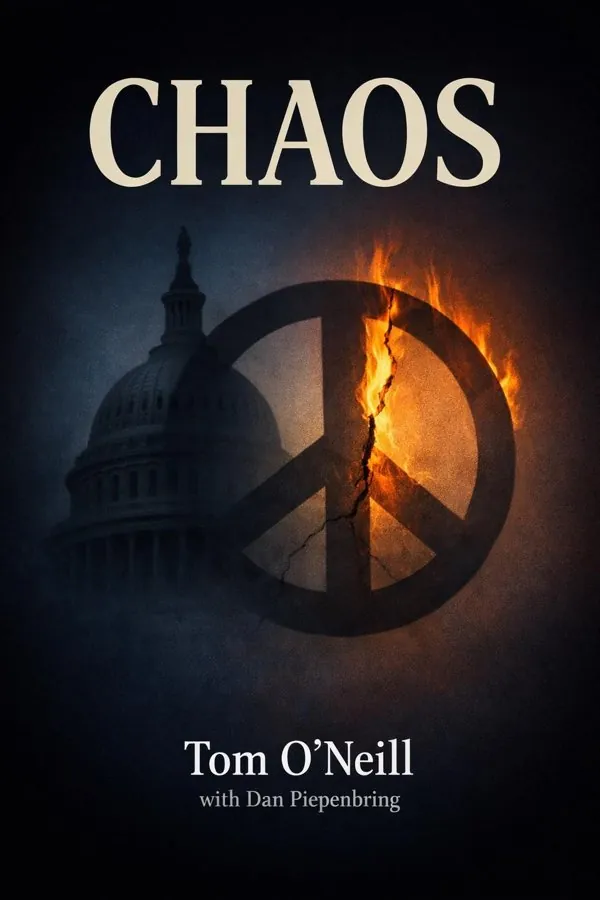
Chaos: Charles Manson, the CIA, and the Secret History of the Sixties: Summary & Key Insights
by Tom O'Neill with Dan Piepenbring
 10 min9 chaptersAudio available
What Is Chaos: Charles Manson, the CIA, and the Secret History of the Sixties About?
Chaos: Charles Manson, the CIA, and the Secret History of the Sixties by Tom O'Neill with Dan Piepenbring is a law_crime book spanning 9 pages. An investigative nonfiction work that reexamines the Manson murders and their connections to covert government operations, media manipulation, and the cultural upheaval of the 1960s. Drawing on two decades of research, O’Neill challenges the official narrative and explores the intersection of crime, politics, and counterculture in America.
This FizzRead summary covers all 9 key chapters of Chaos: Charles Manson, the CIA, and the Secret History of the Sixties in approximately 10 minutes, distilling the most important ideas, arguments, and takeaways from Tom O'Neill with Dan Piepenbring's work. Also available as an audio summary and Key Quotes Podcast.
Chaos: Charles Manson, the CIA, and the Secret History of the Sixties
An investigative nonfiction work that reexamines the Manson murders and their connections to covert government operations, media manipulation, and the cultural upheaval of the 1960s. Drawing on two decades of research, O’Neill challenges the official narrative and explores the intersection of crime, politics, and counterculture in America.
Who Should Read Chaos: Charles Manson, the CIA, and the Secret History of the Sixties?
This book is perfect for anyone interested in law_crime and looking to gain actionable insights in a short read. Whether you're a student, professional, or lifelong learner, the key ideas from Chaos: Charles Manson, the CIA, and the Secret History of the Sixties by Tom O'Neill with Dan Piepenbring will help you think differently.
- ✓Readers who enjoy law_crime and want practical takeaways
- ✓Professionals looking to apply new ideas to their work and life
- ✓Anyone who wants the core insights of Chaos: Charles Manson, the CIA, and the Secret History of the Sixties in just 10 minutes
Want the full summary?
Get instant access to this book summary and 100K+ more with Fizz Moment.
Get Free SummaryAvailable on App Store • Free to download
Key Chapters
When I first revisited the official version of the Tate–LaBianca murders, I assumed I’d simply validate what we all believed: that Charles Manson masterminded a cult of violence based on his own twisted vision of race war and apocalypse, famously branded as 'Helter Skelter' by prosecutor Vincent Bugliosi. But as I combed through police reports and courtroom records, the seams of that narrative began to unravel.
Bugliosi’s story painted Manson as an omnipotent manipulator, weaving rock music, drugs, and paranoia into a philosophy that drove his followers to kill. Yet each time I interviewed people close to the case—detectives, family members, surviving insiders—I found contradictions. Witnesses said things that didn’t match their testimony. Officers recalled evidence that was never logged. Even the timeline of arrests seemed suspect, as if certain leads had been quietly ignored.
My task evolved into unraveling not Manson himself, but the myth machinery that produced him. I discovered how heavily Bugliosi leaned on storytelling to fill gaps—the kind of storytelling used to make prosecution airtight by aligning chaos with order. In the pages of *Helter Skelter*, every mystery becomes motivation, every cult member’s confusion becomes proof of Manson’s control. But reality was messier: there were drugs, rivalries, experiments, and pressures from law enforcement to simplify everything. As I interviewed Bugliosi years later, the omissions and selective memories struck me. He was building a legend, and legends are built to endure, not to question.
The deeper I dug into Manson’s early history, the more peculiar his trajectory appeared. This was not a man society kept locked away despite repeated crimes; rather, it was a man inexplicably granted leniency time after time. From petty theft to pimping and carjacking, his record should have ensured long-term confinement. Yet probation officers called him 'harmless.' Parole boards released him early and often. Even in the months before the murders, while he was known to carry weapons and engage in violence, his parole violations were ignored.
Why was he protected? I found notes in court files that hinted at external observations by federal agencies. Conversations with former prison psychologists revealed Manson’s participation in studies involving behavior modification—a precursor to methods later seen in CIA-linked programs. Each story pointed to Manson as an object of fascination within government circles that studied deviance and control. Whether through negligence or deliberate oversight, Manson wasn’t just escaping justice; he seemed to be moving through a system that treated him as a specimen more than as a convict.
Every investigation I pursued raised more questions. Was he part of a behavioral research chain—the same one testing LSD and hypnosis in correctional facilities? Were his parole agents simply incompetent, or were they observing a sociological experiment in motion? The official narrative insists Manson was just another manipulative criminal, yet his peculiar immunity suggests someone—or something—had a vested interest in keeping him free long enough to become infamous.
+ 7 more chapters — available in the FizzRead app
All Chapters in Chaos: Charles Manson, the CIA, and the Secret History of the Sixties
About the Author
Tom O’Neill is an American journalist known for his long-form investigative reporting. Dan Piepenbring is a writer and editor who has collaborated on several major nonfiction works. Together, they produced 'Chaos' after years of research into the Manson case and its broader implications.
Get This Summary in Your Preferred Format
Read or listen to the Chaos: Charles Manson, the CIA, and the Secret History of the Sixties summary by Tom O'Neill with Dan Piepenbring anytime, anywhere. FizzRead offers multiple formats so you can learn on your terms — all free.
Available formats: App · Audio · PDF · EPUB — All included free with FizzRead
Download Chaos: Charles Manson, the CIA, and the Secret History of the Sixties PDF and EPUB Summary
Key Quotes from Chaos: Charles Manson, the CIA, and the Secret History of the Sixties
“But as I combed through police reports and courtroom records, the seams of that narrative began to unravel.”
“The deeper I dug into Manson’s early history, the more peculiar his trajectory appeared.”
Frequently Asked Questions about Chaos: Charles Manson, the CIA, and the Secret History of the Sixties
Chaos: Charles Manson, the CIA, and the Secret History of the Sixties by Tom O'Neill with Dan Piepenbring is a law_crime book that explores key ideas across 9 chapters. An investigative nonfiction work that reexamines the Manson murders and their connections to covert government operations, media manipulation, and the cultural upheaval of the 1960s. Drawing on two decades of research, O’Neill challenges the official narrative and explores the intersection of crime, politics, and counterculture in America.
You Might Also Like
Abortion and the Law in America: Roe v. Wade to the Present
Mary Ziegler
10 min
Black Edge: Inside Information, Dirty Money, and the Quest to Bring Down the Most Wanted Man on Wall Street
Sheelah Kolhatkar
10 min
Blood Feud: The Man Who Blew the Whistle on One of the Deadliest Prescription Drugs Ever
Kathleen Sharp
10 min
Catch and Kill: Lies, Spies, and a Conspiracy to Protect Predators
Ronan Farrow
10 min
Code and Other Laws of Cyberspace
Lawrence Lessig
10 min
Delay, Deny, Defend: Why Insurance Companies Don't Pay Claims and What You Can Do About It
Jay M. Feinman
10 minBrowse by Category
Ready to read Chaos: Charles Manson, the CIA, and the Secret History of the Sixties?
Get the full summary and 100K+ more books with Fizz Moment.