
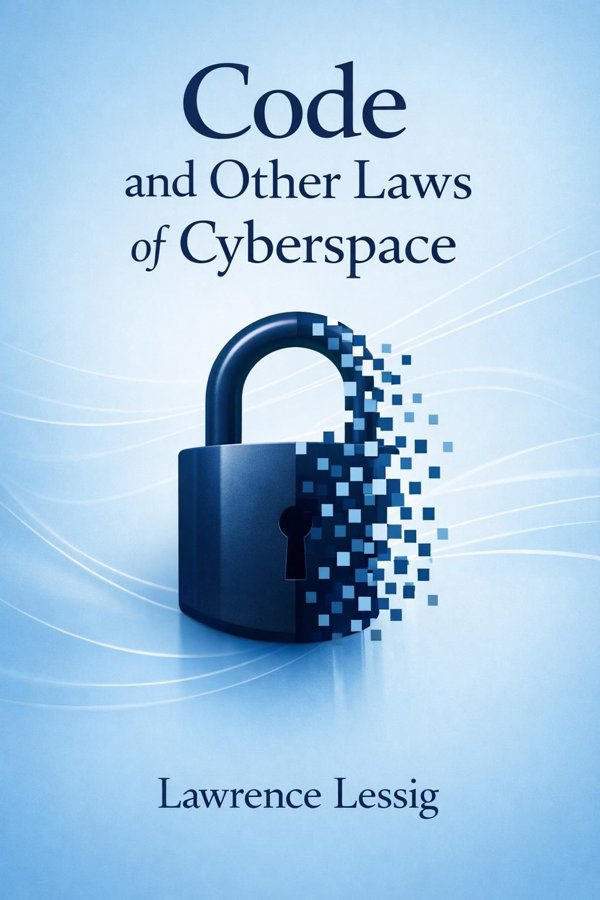
Code and Other Laws of Cyberspace: Summary & Key Insights
 10 min10 chaptersAudio available
Key Takeaways from Code and Other Laws of Cyberspace
Freedom is never as unbounded as it feels.
What people call freedom is often just a temporary feature of design.
Power becomes strongest when it stops looking like power.
In physical space, a wall can regulate more efficiently than a warning sign.
The internet is not ruled by a single sovereign; it is shaped by overlapping powers.
What Is Code and Other Laws of Cyberspace About?
Code and Other Laws of Cyberspace by Lawrence Lessig is a law_crime book spanning 10 pages. Lawrence Lessig’s Code and Other Laws of Cyberspace is one of the foundational books for understanding how the internet is governed—not only by courts and legislatures, but by the technical systems that make digital life possible. Lessig’s central claim is strikingly simple and enormously important: code regulates. The architecture of software, platforms, networks, and protocols determines what people can do online, what they cannot do, what can be monitored, and what can be controlled. In that sense, code functions like law. What makes the book enduring is that Lessig saw, early on, that cyberspace would not remain a naturally free frontier. Its design could be changed to favor anonymity or identification, openness or restriction, privacy or surveillance, innovation or monopoly. Those choices would shape society as much as formal legal rules. Drawing on legal theory, constitutional thinking, and real technological examples, Lessig shows that the internet’s values are built into its architecture. For anyone trying to understand digital privacy, platform power, intellectual property, online speech, or state regulation of technology, this book remains a powerful guide. Lessig writes not just as a scholar, but as one of the most influential legal thinkers on internet governance and digital rights.
This FizzRead summary covers all 10 key chapters of Code and Other Laws of Cyberspace in approximately 10 minutes, distilling the most important ideas, arguments, and takeaways from Lawrence Lessig's work. Also available as an audio summary and Key Quotes Podcast.
Code and Other Laws of Cyberspace
Lawrence Lessig’s Code and Other Laws of Cyberspace is one of the foundational books for understanding how the internet is governed—not only by courts and legislatures, but by the technical systems that make digital life possible. Lessig’s central claim is strikingly simple and enormously important: code regulates. The architecture of software, platforms, networks, and protocols determines what people can do online, what they cannot do, what can be monitored, and what can be controlled. In that sense, code functions like law.
What makes the book enduring is that Lessig saw, early on, that cyberspace would not remain a naturally free frontier. Its design could be changed to favor anonymity or identification, openness or restriction, privacy or surveillance, innovation or monopoly. Those choices would shape society as much as formal legal rules. Drawing on legal theory, constitutional thinking, and real technological examples, Lessig shows that the internet’s values are built into its architecture. For anyone trying to understand digital privacy, platform power, intellectual property, online speech, or state regulation of technology, this book remains a powerful guide. Lessig writes not just as a scholar, but as one of the most influential legal thinkers on internet governance and digital rights.
Who Should Read Code and Other Laws of Cyberspace?
This book is perfect for anyone interested in law_crime and looking to gain actionable insights in a short read. Whether you're a student, professional, or lifelong learner, the key ideas from Code and Other Laws of Cyberspace by Lawrence Lessig will help you think differently.
- ✓Readers who enjoy law_crime and want practical takeaways
- ✓Professionals looking to apply new ideas to their work and life
- ✓Anyone who wants the core insights of Code and Other Laws of Cyberspace in just 10 minutes
Want the full summary?
Get instant access to this book summary and 100K+ more with Fizz Moment.
Get Free SummaryAvailable on App Store • Free to download
Key Chapters
Freedom is never as unbounded as it feels. Lessig argues that every action we take, online or offline, is shaped by four modalities of regulation: law, social norms, the market, and architecture. Law regulates through rules and punishments. Social norms regulate through approval and shame. The market regulates through prices and economic incentives. Architecture regulates through the physical or technical environment itself—what is possible, difficult, or impossible.
This framework is the backbone of the book because it reveals that regulation does not come only from governments. A website can limit speech through its design. A payment system can discourage certain conduct by making transactions expensive. Social expectations inside an online community can pressure users to conform. And law can reinforce or reshape all of these forces. Lessig’s breakthrough is to put architecture—especially digital architecture—on equal footing with legal rules.
Think about a public park and a social media platform. In the park, a fence, police patrol, public expectations, and entry fees all influence behavior. Online, registration requirements, moderation tools, subscription pricing, and community culture play the same role. A platform that allows anonymous posting creates one kind of public sphere; one that requires verified identification creates another.
The practical lesson is that whenever you ask whether a digital space is free, fair, or safe, do not look only at formal policy. Ask what the code permits, what the business model rewards, what the community expects, and what the law threatens. Actionable takeaway: evaluate any online system through all four modalities before judging whether it truly protects or restricts user freedom.
What people call freedom is often just a temporary feature of design. Lessig challenges the early internet myth that cyberspace was inherently beyond regulation. In its formative years, the internet appeared open, decentralized, borderless, and difficult to control. Users could move across networks with limited identification, publish with relatively low barriers, and interact outside traditional gatekeepers. Many observers took these features as proof that law had lost its grip.
Lessig argues instead that this freedom was contingent. It emerged from a specific architecture: open protocols, decentralized routing, low authentication, and a culture that favored interoperability over control. Those were design choices, not natural laws. Because they were designed, they could be redesigned. The same internet that once enabled anonymity could later require identity. The same web that encouraged open access could be enclosed behind passwords, platforms, and permissions.
This distinction matters because it changes how we think about digital rights. If online liberty depends on architecture, then liberty is fragile. It can be altered quietly through software updates, standards changes, or infrastructure decisions long before a legislature passes a visible law. For example, an online forum that once allowed pseudonymous participation can add phone verification and algorithmic ranking, changing speech dynamics without changing the constitution.
The deeper insight is political: people often defend freedom too late because they notice legal restrictions but ignore architectural ones. Actionable takeaway: treat open digital systems as civic achievements that must be deliberately maintained, not as permanent features of the internet.
Power becomes strongest when it stops looking like power. One of Lessig’s most important claims is that cyberspace was moving from a relatively uncontrolled environment toward one that could be highly regulable. This shift would not happen only through censorship statutes or criminal penalties. It would happen through design changes that made identification easier, tracking cheaper, and control more seamless.
As networks evolved, institutions gained incentives to make online behavior more legible. Governments wanted law enforcement and compliance. Businesses wanted authentication, payment certainty, targeted advertising, and user profiling. Rights holders wanted stronger control over copying and distribution. Together, these incentives pushed the internet toward architectures that could monitor, sort, and constrain users more effectively than the early web could.
Lessig’s point is not that regulation is always bad. Some control can reduce fraud, protect children, secure transactions, or support accountability. The danger is that societies may slide into highly controlled digital environments without openly debating the trade-offs. A system designed to prevent harassment may also chill dissent. A platform designed to authenticate buyers may later authenticate all speakers. A tool created to manage copyright may also restrict fair use and creativity.
You can see this pattern today in mandatory logins, real-name policies, geo-blocking, app-store gatekeeping, content filters, and device-level permissions. Each may appear technical or practical, yet together they transform what kind of internet exists.
Actionable takeaway: when a digital service introduces new identity, tracking, or access restrictions, ask not only what problem it solves, but what future forms of control it enables.
In physical space, a wall can regulate more efficiently than a warning sign. Lessig extends this logic to cyberspace: code is law because it structures behavior directly. Legal rules tell people what they may or may not do, but code often determines what they can or cannot do. If software makes copying impossible, users do not merely risk punishment for copying—they lose the option altogether. If a platform disables anonymity, users cannot choose it, regardless of legal rights in principle.
This makes code uniquely powerful. It can be automatic, invisible, scalable, and indifferent to context. A court must interpret, enforce, and justify. Code simply executes. That is why Lessig insists that digital architecture is not politically neutral. Every design embeds values and allocates power. A search engine’s ranking system influences visibility. A recommendation algorithm shapes exposure. Privacy settings determine who is seen and by whom. Moderation tools affect what speech survives.
Consider digital rights management. Instead of suing users after infringement, rights holders can use technology to block copying from the start. Or consider a workplace platform that logs employee activity by default. No statute may require constant observation, yet the architecture makes surveillance routine.
Lessig is urging readers to become constitutionally minded about technology. If code regulates like law, then code deserves the same scrutiny we would apply to public rules: Who wrote it? Whose interests does it serve? Can it be challenged? Is it transparent?
Actionable takeaway: treat software design decisions as governance decisions and demand accountability, explanation, and user protections whenever code limits meaningful choice.
The internet is not ruled by a single sovereign; it is shaped by overlapping powers. Lessig shows that both public institutions and private actors regulate cyberspace, often in partnership and sometimes by proxy. Governments pass laws, pressure intermediaries, and influence standards. Companies build platforms, infrastructure, payment systems, and devices that determine what users actually experience. In practice, the line between public and private governance is often blurred.
This matters because private regulation can be as restrictive as state regulation, while escaping the safeguards normally attached to government power. A constitutional system may limit what a state can censor, but a private platform can remove speech through terms of service. A government may need warrants or procedures, but a company can gather extensive user data through routine interface design and then share it under legal compulsion or commercial arrangements. Sometimes the state gets what it wants not by legislating directly, but by leaning on private systems to enforce its goals.
Examples are everywhere: payment processors blocking disfavored transactions, internet service providers managing traffic, app stores deciding which software may exist, social media platforms enforcing speech rules, and cloud providers becoming points of infrastructural control. None of these actors is a legislature, yet each can profoundly affect freedom, access, competition, and due process.
Lessig’s insight remains critical in an era of platform dominance. Citizens cannot defend liberty if they watch only Congress and courts while ignoring code, contracts, and corporate governance.
Actionable takeaway: whenever a digital right is at stake, identify both the formal legal authority and the private intermediary with technical control, because real power often lies in their interaction.
Privacy is weakest when it relies on goodwill alone. Lessig argues that privacy in cyberspace cannot be protected merely by declarations, policies, or after-the-fact legal remedies. It depends fundamentally on architecture: whether systems are built to collect data sparingly or comprehensively, whether identity is required or optional, whether transactions can occur anonymously or only through persistent profiles.
Early internet design made some forms of privacy easier because identification was not deeply embedded. But as digital commerce and platform ecosystems expanded, the incentives shifted toward traceability. Businesses wanted more information to personalize services, target ads, manage risk, and lock in users. Governments often welcomed this traceability because it simplified investigation and control. The result was an environment where surveillance became structurally convenient.
Lessig’s key point is that once an architecture of surveillance is normalized, legal protections become harder to enforce in practice. If every click, purchase, message, and location is automatically logged, the burden shifts to users to resist collection rather than to institutions to justify it. This reverses the presumption of privacy. A privacy policy may describe the collection, but it does not undo the fact that the system is built to watch.
Examples include default tracking cookies, mandatory account creation, location-sharing settings buried in menus, and smart devices that continuously generate behavioral data. In each case, the architecture shapes what privacy means day to day.
Actionable takeaway: judge privacy claims by system design, not marketing language—favor services that minimize data collection, allow meaningful consent, and avoid making surveillance the default condition.
Protection becomes dangerous when it turns into control over culture itself. Lessig is deeply concerned with how intellectual property rules, combined with technical enforcement, can narrow access to knowledge and creativity in cyberspace. Copyright exists for a legitimate reason: to encourage creation by granting limited rights. But digital technologies allow rights holders to extend practical control far beyond what traditional law alone could easily achieve.
In the analog world, enforcement had friction. Copying, distribution, and monitoring were imperfect. In the digital world, works can be locked, tracked, licensed, and remotely controlled through code. This means that the balance embedded in copyright law—between rewarding creators and preserving public access, fair use, innovation, and education—can be distorted. Technology can enforce restrictions more rigidly than law intended.
Lessig worries that when every use is transformed into a licensed event, the commons shrinks. Students, researchers, artists, and ordinary users may face barriers to quotation, remix, preservation, and sharing. Innovation also suffers when new creators must seek permission at every step. The issue is not opposition to property, but opposition to a system in which property claims overwhelm democratic values and cultural development.
You can see this in subscription media ecosystems, anti-circumvention rules, locked e-books, streaming libraries that disappear, and platforms that remove content automatically without nuanced context. These systems may reduce infringement, but they can also suppress lawful use.
Actionable takeaway: support intellectual property frameworks and technologies that reward creators while preserving fair use, interoperability, educational access, and a robust public domain.
The most consequential regulators are often the least visible. Lessig highlights a central democratic problem: when code governs behavior, who is accountable? Traditional lawmaking has procedures, public debate, institutional checks, and at least some pathways for challenge. But software can impose rules through design teams, corporate priorities, technical standards bodies, or backend updates that ordinary users neither see nor understand.
This creates a legitimacy gap. If an online platform changes its algorithm and suddenly downgrades certain speech, users experience a new rule without legislative debate. If encryption standards are weakened, if interoperability is blocked, or if default settings shift toward greater surveillance, social outcomes change without obvious political process. Yet these changes may affect expression, competition, equality, and privacy at enormous scale.
Lessig does not suggest that every software decision should be put to a public vote. His point is more precise: because code regulates, the institutions that create and deploy code must be subject to forms of accountability proportionate to their power. That may include transparency, auditability, public-interest regulation, competition policy, user appeal mechanisms, and democratic scrutiny over technical standards that have broad social effects.
Modern examples include content moderation systems, automated credit scoring, app store approval practices, and recommendation engines shaping public discourse. The question is not only whether they work, but whether those affected can understand, challenge, and influence them.
Actionable takeaway: whenever a digital system exercises rule-like power over users, demand visible governance mechanisms—clear standards, explanations, appeals, and independent oversight—rather than accepting technical opacity as inevitable.
The struggle over liberty increasingly takes place before any law is enforced. Lessig’s closing concern is forward-looking: the future of regulation in cyberspace will depend on whether societies consciously shape digital architectures around public values or allow control to emerge by default from commercial and governmental incentives. The question is not whether the internet will be regulated. It already is. The real question is by whom, through what mechanisms, and in service of which ideals.
If citizens remain passive, cyberspace may evolve toward perfect traceability, tightly managed access, strong proprietary control, and concentrated private governance. Such an environment may be efficient and secure in certain respects, but it may also diminish anonymity, experimentation, dissent, and decentralized creativity. Alternatively, societies can build and defend architectures that preserve spaces for privacy, interoperability, openness, and distributed innovation.
Lessig’s argument is not nostalgic. He does not simply want to freeze the early internet. He recognizes that digital environments must address fraud, abuse, security, and economic coordination. But these goals should be pursued transparently and democratically, with explicit attention to constitutional values. Regulation by code is unavoidable; unexamined regulation by code is the danger.
For readers today, this means paying attention to digital identity systems, AI governance, platform concentration, encryption debates, and the legal incentives shaping technical design. The basic lesson of the book remains remarkably current: architecture is destiny only if citizens surrender the right to shape it.
Actionable takeaway: participate in technology policy as a civic issue—support institutions, products, and laws that embed privacy, openness, contestability, and user autonomy into the design of digital systems.
All Chapters in Code and Other Laws of Cyberspace
About the Author
Lawrence Lessig is an American legal scholar, writer, and professor whose work has profoundly shaped debates about internet governance, copyright, and digital freedom. He has taught at major institutions including the University of Chicago, Stanford Law School, and Harvard Law School, where he became one of the leading voices on how law interacts with technology. Lessig is widely known for arguing that software architecture can regulate behavior as powerfully as legal systems, a concept that influenced an entire generation of legal and policy thinking. He is also a founder of Creative Commons, the global licensing framework that helps creators share their work more openly. Beyond technology law, Lessig has written and advocated extensively on democratic reform, institutional corruption, and political accountability.
Get This Summary in Your Preferred Format
Read or listen to the Code and Other Laws of Cyberspace summary by Lawrence Lessig anytime, anywhere. FizzRead offers multiple formats so you can learn on your terms — all free.
Available formats: App · Audio · PDF · EPUB — All included free with FizzRead
Download Code and Other Laws of Cyberspace PDF and EPUB Summary
Key Quotes from Code and Other Laws of Cyberspace
“Freedom is never as unbounded as it feels.”
“What people call freedom is often just a temporary feature of design.”
“Power becomes strongest when it stops looking like power.”
“In physical space, a wall can regulate more efficiently than a warning sign.”
“The internet is not ruled by a single sovereign; it is shaped by overlapping powers.”
Frequently Asked Questions about Code and Other Laws of Cyberspace
Code and Other Laws of Cyberspace by Lawrence Lessig is a law_crime book that explores key ideas across 10 chapters. Lawrence Lessig’s Code and Other Laws of Cyberspace is one of the foundational books for understanding how the internet is governed—not only by courts and legislatures, but by the technical systems that make digital life possible. Lessig’s central claim is strikingly simple and enormously important: code regulates. The architecture of software, platforms, networks, and protocols determines what people can do online, what they cannot do, what can be monitored, and what can be controlled. In that sense, code functions like law. What makes the book enduring is that Lessig saw, early on, that cyberspace would not remain a naturally free frontier. Its design could be changed to favor anonymity or identification, openness or restriction, privacy or surveillance, innovation or monopoly. Those choices would shape society as much as formal legal rules. Drawing on legal theory, constitutional thinking, and real technological examples, Lessig shows that the internet’s values are built into its architecture. For anyone trying to understand digital privacy, platform power, intellectual property, online speech, or state regulation of technology, this book remains a powerful guide. Lessig writes not just as a scholar, but as one of the most influential legal thinkers on internet governance and digital rights.
More by Lawrence Lessig
You Might Also Like
Abortion and the Law in America: Roe v. Wade to the Present
Mary Ziegler
10 min
Black Edge: Inside Information, Dirty Money, and the Quest to Bring Down the Most Wanted Man on Wall Street
Sheelah Kolhatkar
10 min
Blood Feud: The Man Who Blew the Whistle on One of the Deadliest Prescription Drugs Ever
Kathleen Sharp
10 min
Catch and Kill: Lies, Spies, and a Conspiracy to Protect Predators
Ronan Farrow
10 min
Chaos: Charles Manson, the CIA, and the Secret History of the Sixties
Tom O'Neill with Dan Piepenbring
10 min
Delay, Deny, Defend: Why Insurance Companies Don't Pay Claims and What You Can Do About It
Jay M. Feinman
10 minBrowse by Category
Ready to read Code and Other Laws of Cyberspace?
Get the full summary and 100K+ more books with Fizz Moment.