
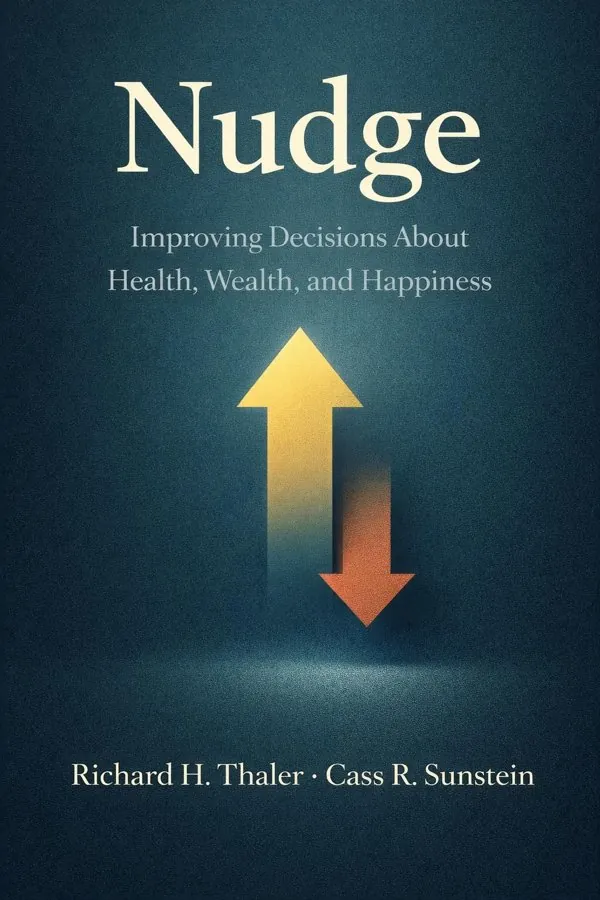
Nudge: Summary & Key Insights
by Richard H. Thaler, Cass R. Sunstein
 10 min9 chaptersAudio available
Key Takeaways from Nudge
The most important starting point in Nudge is a humbling one: people do not consistently choose what is best for themselves, even when they sincerely want to.
Every choice takes place somewhere, and that “somewhere” is never neutral.
At first glance, the phrase “libertarian paternalism” sounds contradictory.
Many bad decisions are not caused by laziness or low intelligence but by mental shortcuts that work well in some situations and fail badly in others.
A nudge works best when it reduces friction rather than relying on willpower.
What Is Nudge About?
Nudge by Richard H. Thaler, Cass R. Sunstein is a economics book published in 2008 spanning 12 pages. Why do smart people make choices they later regret? Why do employees fail to enroll in retirement plans that clearly benefit them, patients skip life-saving medications, and consumers get overwhelmed by too many options? In Nudge, Richard H. Thaler and Cass R. Sunstein argue that these mistakes are not random flaws but predictable patterns in human behavior. Drawing on behavioral economics, psychology, and public policy, they show that the way choices are presented strongly shapes the decisions people make. This insight leads to their central concept: choice architecture, or the design of the environments in which decisions happen. What makes the book powerful is its practical ambition. Thaler and Sunstein do not call for heavy-handed control or the elimination of personal freedom. Instead, they propose “libertarian paternalism”: guiding people toward better outcomes while preserving the right to choose otherwise. Their ideas have influenced retirement savings programs, health policy, school design, and government regulation around the world. Thaler, a pioneering behavioral economist and Nobel Prize winner, and Sunstein, a leading legal scholar and policy thinker, bring unusual authority to a book that is both intellectually influential and immediately useful.
This FizzRead summary covers all 9 key chapters of Nudge in approximately 10 minutes, distilling the most important ideas, arguments, and takeaways from Richard H. Thaler, Cass R. Sunstein's work. Also available as an audio summary and Key Quotes Podcast.
Nudge
Why do smart people make choices they later regret? Why do employees fail to enroll in retirement plans that clearly benefit them, patients skip life-saving medications, and consumers get overwhelmed by too many options? In Nudge, Richard H. Thaler and Cass R. Sunstein argue that these mistakes are not random flaws but predictable patterns in human behavior. Drawing on behavioral economics, psychology, and public policy, they show that the way choices are presented strongly shapes the decisions people make. This insight leads to their central concept: choice architecture, or the design of the environments in which decisions happen.
What makes the book powerful is its practical ambition. Thaler and Sunstein do not call for heavy-handed control or the elimination of personal freedom. Instead, they propose “libertarian paternalism”: guiding people toward better outcomes while preserving the right to choose otherwise. Their ideas have influenced retirement savings programs, health policy, school design, and government regulation around the world. Thaler, a pioneering behavioral economist and Nobel Prize winner, and Sunstein, a leading legal scholar and policy thinker, bring unusual authority to a book that is both intellectually influential and immediately useful.
Who Should Read Nudge?
This book is perfect for anyone interested in economics and looking to gain actionable insights in a short read. Whether you're a student, professional, or lifelong learner, the key ideas from Nudge by Richard H. Thaler, Cass R. Sunstein will help you think differently.
- ✓Readers who enjoy economics and want practical takeaways
- ✓Professionals looking to apply new ideas to their work and life
- ✓Anyone who wants the core insights of Nudge in just 10 minutes
Want the full summary?
Get instant access to this book summary and 100K+ more with Fizz Moment.
Get Free SummaryAvailable on App Store • Free to download
Key Chapters
The most important starting point in Nudge is a humbling one: people do not consistently choose what is best for themselves, even when they sincerely want to. Traditional economics often assumes rational actors who weigh costs and benefits carefully, process information efficiently, and pursue their long-term interests. Thaler and Sunstein show that real people do something messier. We procrastinate, overreact to short-term temptations, avoid difficult decisions, and get confused by complexity. These are not rare exceptions. They are regular features of human behavior.
The authors sometimes contrast idealized “Econs” with actual “Humans.” Econs save enough for retirement, compare every option logically, and resist impulse purchases. Humans, by contrast, are influenced by framing, defaults, habits, limited attention, and social pressure. A worker may mean to sign up for a retirement plan “next month” and delay for years. A patient may skip medicine not because it is unimportant but because the refill process is annoying. A diner may choose the dessert placed at eye level over the healthier option listed first.
This matters because many personal and social problems do not come from bad intentions. They come from environments that fail to account for how people really think. If decision-making is bounded by bias, then institutions should be designed with that reality in mind. Better outcomes often require fewer lectures about discipline and more thoughtful systems.
A practical lesson follows: before blaming yourself or others for bad choices, examine the decision environment. Ask what friction, temptation, confusion, or distraction is shaping behavior, and redesign the setting to support the choice you want to make.
Every choice takes place somewhere, and that “somewhere” is never neutral. One of Nudge’s most influential ideas is that every environment in which decisions are made has a choice architecture. Someone decides what appears first on a form, which buttons are large or small on a website, what foods are displayed at the front of a cafeteria, and whether a default option is preselected. Even when no one intends to influence behavior, the structure of the choice still guides people in one direction rather than another.
This means there is no such thing as a context-free decision. A benefits portal can make enrollment easy or confusing. A ballot can clarify options or create accidental errors. A hospital can display treatment information in a way that helps patients understand tradeoffs or overwhelms them into passivity. The authors argue that since choice architecture is unavoidable, the real question is not whether choices should be designed, but whether they should be designed well.
A classic example is cafeteria layout. If fruit is placed at eye level and desserts are less prominent, more people will choose fruit. Nothing is banned. No one loses freedom. But the arrangement matters. The same logic applies to digital products, personal finance dashboards, medication reminders, and energy bills that compare your usage to neighbors’ consumption.
The deeper insight is that small design decisions can create large behavioral effects. Good choice architecture respects human limitations and makes beneficial actions simpler, clearer, and more salient.
Actionable takeaway: identify one recurring decision in your life or organization and redesign the environment around it. Put the desired option first, reduce clutter, simplify steps, and make the better choice easier to notice and execute.
At first glance, the phrase “libertarian paternalism” sounds contradictory. Libertarianism emphasizes freedom of choice, while paternalism suggests guiding people for their own good. Thaler and Sunstein combine the two by arguing that institutions can steer people toward better decisions without coercion. The key is that people remain free to opt out. A nudge influences behavior, but it does not force compliance or make alternatives prohibitively costly.
This framework responds to a practical reality: people often need help, but many people reasonably resist government or institutional control. Libertarian paternalism offers a middle path. Instead of banning unhealthy food, a school can rearrange the cafeteria. Instead of forcing retirement savings, employers can automatically enroll workers while allowing them to withdraw. Instead of mandating one energy plan, utilities can present information in ways that make long-term costs clearer.
The authors defend this approach on ethical as well as practical grounds. Since some choice architecture is inevitable, designers should not pretend to be neutral when their systems already influence outcomes. If forms, menus, and procedures will affect behavior regardless, then those tools should be arranged to improve welfare as judged by the chooser, not the planner. A successful nudge helps people do what they themselves would want under conditions of more attention, more information, and less bias.
Critics worry that nudges can become manipulative. The authors answer that transparency, easy opt-out options, and evidence-based design are essential safeguards.
Actionable takeaway: when you design choices for others, ask two questions. Does this preserve freedom to choose differently? And does it make it easier for people to achieve outcomes they would likely endorse for themselves?
Many bad decisions are not caused by laziness or low intelligence but by mental shortcuts that work well in some situations and fail badly in others. Nudge explains that people rely on heuristics, simple rules of thumb, because the world is complex and attention is limited. These shortcuts save time, but they also create predictable errors. Understanding them is essential if we want to improve decision-making.
One major bias is present bias, the tendency to prioritize immediate comfort over long-term benefit. That is why people postpone saving, delay exercise, and choose short-term pleasure over future security. Another is loss aversion: losses feel more painful than equivalent gains feel rewarding. People may refuse beneficial changes because the potential downside looms larger psychologically than the upside. Anchoring also matters. The first number or option we see can disproportionately influence later judgments, whether in salary negotiations, product pricing, or medical risk estimates.
The authors also emphasize status quo bias. People often stick with existing arrangements simply because changing them requires attention, effort, or uncertainty. This helps explain why defaults are so powerful. Add overconfidence, limited self-control, and the influence of social norms, and many everyday mistakes become easier to predict.
Real-world examples are everywhere: consumers buy extended warranties they do not need, investors hold losing stocks too long, and employees ignore paperwork until deadlines create panic. These behaviors may look irrational, but they often reflect ordinary minds operating under pressure, distraction, and ambiguity.
Actionable takeaway: before making an important decision, slow down and ask which bias may be influencing you. Use checklists, waiting periods, outside opinions, and precommitment tools to counter shortcuts that could distort your judgment.
A nudge works best when it reduces friction rather than relying on willpower. One of the book’s most practical contributions is its explanation of what makes a nudge effective. The best nudges are simple, timely, visible, and aligned with how people actually behave. They do not demand perfect discipline. They make beneficial actions easier to start, easier to understand, or easier to maintain.
Defaults are one of the strongest tools. If employees are automatically enrolled in savings plans, participation rises dramatically because opting out requires action while staying enrolled requires none. Feedback is another. Drivers who receive real-time information about fuel efficiency often change their habits faster than those who only get occasional reports. Simplification also matters. A complicated benefits package can paralyze employees, while a streamlined enrollment process increases participation. Reminders, prompts, and social comparisons can all shift behavior when used thoughtfully.
The authors also stress the value of structuring complex choices. Too many options can create overload and avoidance. Curating choices, grouping similar options, or providing smart recommendations can improve outcomes without reducing freedom. For example, online forms that prefill known information save effort and reduce errors. Hospital discharge plans that include checklists and follow-up reminders improve adherence.
An effective nudge is not magic. It depends on understanding the target behavior, the relevant bias, and the context in which the choice occurs. Good intentions alone are not enough; the design must be tested and improved.
Actionable takeaway: whenever you want a habit to stick, remove one source of friction. Make the action automatic, shorten the process, add a reminder, or provide immediate feedback so the desired behavior becomes the path of least resistance.
Nudge becomes especially persuasive when Thaler and Sunstein move from theory to application. They show that many high-stakes decisions in personal finance, health, and public policy are exactly the kinds of choices people handle badly on their own. The stakes are large, the information is complicated, and the benefits of good decisions often arrive far in the future. In these domains, smart defaults and well-designed nudges can create enormous gains.
In personal finance, retirement savings is the standout example. Many workers intend to save but never complete the paperwork or choose an asset allocation. Automatic enrollment, automatic escalation of contributions, and simplified investment menus can substantially improve long-term financial security. Thaler’s well-known “Save More Tomorrow” approach helps employees commit future raises to increased savings, harnessing inertia for a good purpose.
In health, similar principles apply. People miss appointments, fail to take medication, and struggle with preventive care not only because they do not care, but because health systems are confusing and burdensome. Appointment reminders, easier prescription refills, calorie labeling, and healthier default meal options can improve outcomes. In public policy, governments can design tax forms, energy disclosures, organ donation systems, and school choice programs to be clearer and more effective.
The broader lesson is that many social problems are partly design problems. Better systems can help ordinary people act in ways they already endorse but often fail to execute.
Actionable takeaway: in any high-impact domain, pay close attention to the default. If people are busy, uncertain, or overloaded, the default may determine the outcome more than information alone.
Any attempt to influence behavior raises a difficult question: who decides what counts as a better choice? Nudge does not ignore this concern. In fact, one of its lasting contributions is the debate it sparked about the ethics of behavioral design. Thaler and Sunstein argue that because some form of choice architecture is unavoidable, the ethical challenge is not whether to influence people, but how to do so responsibly.
A responsible nudge should be transparent rather than hidden. It should be easy to opt out of. It should aim to improve welfare as people themselves would judge it, not simply serve the planner’s convenience or ideology. It should also be grounded in evidence, not assumptions. These principles matter because choice architecture can be used well or badly. A retirement default that helps workers save for goals they endorse is different from a subscription flow designed to trap users into recurring charges.
Humility is crucial. Policymakers, executives, teachers, and app designers are not perfectly rational either. They can carry their own biases into the systems they build. For that reason, nudges should be tested, measured, and revised. Designers should ask whether the intervention genuinely helps users, whether it benefits some groups more than others, and whether the same goal could be achieved in a less intrusive way.
The best interpretation of the book is not “experts know best.” It is that environments affect everyone, so their design should be open, accountable, and oriented toward human flourishing rather than manipulation.
Actionable takeaway: whenever you encounter or create a nudge, ask four questions: is it transparent, easy to reject, evidence-based, and genuinely aligned with the interests of the people affected?
Nudge is often remembered for small behavioral tweaks, but one of its deeper lessons is that these tweaks matter most when embedded in institutions that respect human limits. A reminder email can help, but it cannot fully compensate for a broken healthcare system. A default savings plan improves outcomes, but it works best when fees are low and options are sound. Behavioral insights are powerful, yet they are not a substitute for competent policy or structural reform.
This matters because some readers misunderstand nudging as a cheap, universal solution. Thaler and Sunstein are more careful than that. They show that better design can improve outcomes dramatically, but they also acknowledge limitations. Nudges may have weaker effects in hostile environments, among deeply constrained populations, or where incentives run in the opposite direction. A food label cannot undo extreme poverty. A disclosure form cannot fix predatory products if the underlying market remains abusive.
Still, the power of nudges should not be minimized. They are often low-cost, scalable, and politically feasible. In many settings, they produce meaningful gains precisely because institutions already exist and simply need better design. The smartest approach is to combine behavioral insight with strong systems, clear incentives, fair rules, and careful evaluation.
For leaders, this means asking not only “What nudge can we add?” but also “What broader process are people navigating?” Great choice architecture is part of good institutional design, not a cosmetic layer pasted onto dysfunction.
Actionable takeaway: use nudges as force multipliers, not magic tricks. Pair behavioral design with solid systems, fair policies, and continuous measurement so that small interventions support lasting improvement rather than temporary compliance.
All Chapters in Nudge
About the Authors
Richard H. Thaler is an American economist best known as one of the founders of behavioral economics, the field that studies how real human behavior departs from the idealized rationality of classical economic theory. A professor at the University of Chicago Booth School of Business, he received the 2017 Nobel Prize in Economic Sciences for his contributions to understanding decision-making, self-control, and market behavior. Cass R. Sunstein is an American legal scholar, writer, and professor, widely recognized for his work in constitutional law, regulation, behavioral science, and public policy. He has taught at institutions including Harvard Law School and served in senior government roles. Together, Thaler and Sunstein helped bring behavioral insights from academia into practical policy and organizational design through Nudge.
Get This Summary in Your Preferred Format
Read or listen to the Nudge summary by Richard H. Thaler, Cass R. Sunstein anytime, anywhere. FizzRead offers multiple formats so you can learn on your terms — all free.
Available formats: App · Audio · PDF · EPUB — All included free with FizzRead
Download Nudge PDF and EPUB Summary
Key Quotes from Nudge
“The most important starting point in Nudge is a humbling one: people do not consistently choose what is best for themselves, even when they sincerely want to.”
“Every choice takes place somewhere, and that “somewhere” is never neutral.”
“At first glance, the phrase “libertarian paternalism” sounds contradictory.”
“Many bad decisions are not caused by laziness or low intelligence but by mental shortcuts that work well in some situations and fail badly in others.”
“A nudge works best when it reduces friction rather than relying on willpower.”
Frequently Asked Questions about Nudge
Nudge by Richard H. Thaler, Cass R. Sunstein is a economics book that explores key ideas across 9 chapters. Why do smart people make choices they later regret? Why do employees fail to enroll in retirement plans that clearly benefit them, patients skip life-saving medications, and consumers get overwhelmed by too many options? In Nudge, Richard H. Thaler and Cass R. Sunstein argue that these mistakes are not random flaws but predictable patterns in human behavior. Drawing on behavioral economics, psychology, and public policy, they show that the way choices are presented strongly shapes the decisions people make. This insight leads to their central concept: choice architecture, or the design of the environments in which decisions happen. What makes the book powerful is its practical ambition. Thaler and Sunstein do not call for heavy-handed control or the elimination of personal freedom. Instead, they propose “libertarian paternalism”: guiding people toward better outcomes while preserving the right to choose otherwise. Their ideas have influenced retirement savings programs, health policy, school design, and government regulation around the world. Thaler, a pioneering behavioral economist and Nobel Prize winner, and Sunstein, a leading legal scholar and policy thinker, bring unusual authority to a book that is both intellectually influential and immediately useful.
Compare Nudge
You Might Also Like
Business Adventures
John Brooks
10 min
The Hitchhiker"s Guide to the Galaxy
Douglas Adams
10 minThe Muqaddimah
Ibn Khaldun
10 minThe Outsiders
William N. Thorndike
10 min
A Little History of Economics
Niall Kishtainy
10 min
Adapt: Why Success Always Starts With Failure
Tim Harford
10 minFeatured In
Malcolm Gladwell's Book Picks
Malcolm Gladwell's Picks: Books That Make You See the World Differently
Curated's Book Picks
Best Finance & Money Books — Master Your Financial Future
Curated's Book Picks
Best Economics Books — Understand How the World Works
Curated's Book Picks
Most Influential Books of All Time
Browse by Category
Ready to read Nudge?
Get the full summary and 100K+ more books with Fizz Moment.