
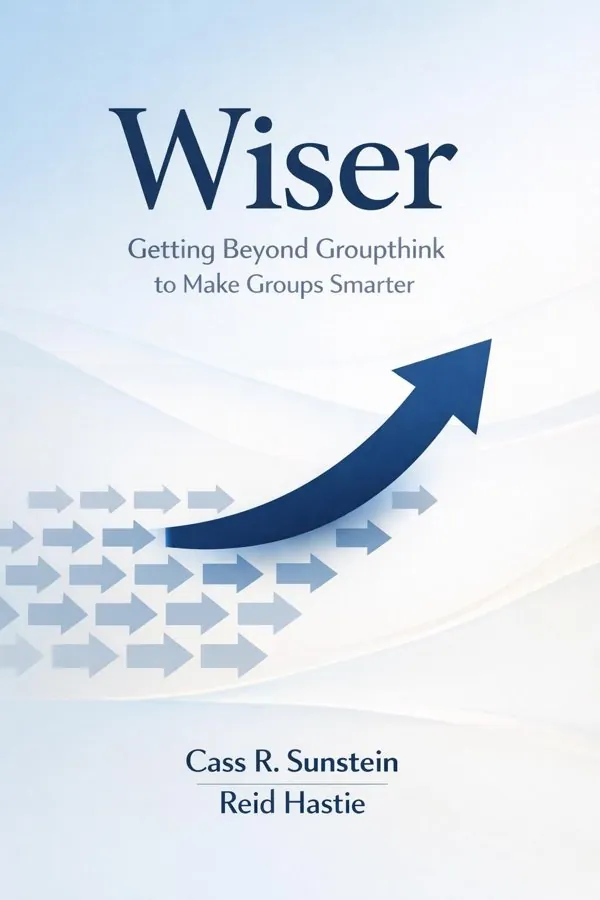
Wiser: Getting Beyond Groupthink to Make Groups Smarter: Summary & Key Insights
by Cass R. Sunstein, Reid Hastie
 10 min9 chaptersAudio available
What Is Wiser: Getting Beyond Groupthink to Make Groups Smarter About?
Wiser: Getting Beyond Groupthink to Make Groups Smarter by Cass R. Sunstein, Reid Hastie is a organization book spanning 9 pages. In this book, Cass R. Sunstein and Reid Hastie explore how groups make decisions and why they often fail to reach optimal outcomes. Drawing on behavioral economics and psychology, the authors analyze common pitfalls such as groupthink, polarization, and information cascades. They propose practical strategies to help teams and organizations make smarter, more effective collective decisions.
This FizzRead summary covers all 9 key chapters of Wiser: Getting Beyond Groupthink to Make Groups Smarter in approximately 10 minutes, distilling the most important ideas, arguments, and takeaways from Cass R. Sunstein, Reid Hastie's work. Also available as an audio summary and Key Quotes Podcast.
Wiser: Getting Beyond Groupthink to Make Groups Smarter
In this book, Cass R. Sunstein and Reid Hastie explore how groups make decisions and why they often fail to reach optimal outcomes. Drawing on behavioral economics and psychology, the authors analyze common pitfalls such as groupthink, polarization, and information cascades. They propose practical strategies to help teams and organizations make smarter, more effective collective decisions.
Who Should Read Wiser: Getting Beyond Groupthink to Make Groups Smarter?
This book is perfect for anyone interested in organization and looking to gain actionable insights in a short read. Whether you're a student, professional, or lifelong learner, the key ideas from Wiser: Getting Beyond Groupthink to Make Groups Smarter by Cass R. Sunstein, Reid Hastie will help you think differently.
- ✓Readers who enjoy organization and want practical takeaways
- ✓Professionals looking to apply new ideas to their work and life
- ✓Anyone who wants the core insights of Wiser: Getting Beyond Groupthink to Make Groups Smarter in just 10 minutes
Want the full summary?
Get instant access to this book summary and 100K+ more with Fizz Moment.
Get Free SummaryAvailable on App Store • Free to download
Key Chapters
There’s a seductive idea that groups, by their very nature, are smarter than individuals. It’s captured in the phrase “the wisdom of crowds.” When conditions are right—when independence is preserved, diversity of opinion is celebrated, and participants draw upon distinct pieces of information—groups do indeed outperform their members. Studies of market forecasts, political predictions, and even jelly bean counting contests show how aggregated judgments can yield remarkably accurate results.
But the romantic story of the “wise crowd” fails in most real-world settings, because those ideal conditions are quickly violated. Independence collapses when members hear what others think before offering their views. Diversity erodes as groups self-select or fall under the sway of dominant personalities. And instead of aggregating distinct insights, groups tend to amplify shared beliefs.
One of our key examples involves corporate forecasting and governmental decision-making. When analysts or policy advisors begin conforming their views to perceived group norms, errors multiply. It isn’t because they lack intelligence, but because they read cues of approval and disapproval in subtle ways: a nod from a superior, a hesitant pause, the early framing of a problem. In short, groups become echo chambers, not engines of discovery.
The myth of the wise crowd invites us to relax, to trust that collective processes will take care of themselves. We urge the opposite. Group wisdom is not automatic—it must be cultivated by preserving independence, encouraging informational diversity, and managing the influence of authority. Otherwise, the crowd becomes, quite literally, more foolish than the individuals within it.
At the heart of most group failures lies a deceptively simple dynamic: people focus on what everyone already knows. It is far easier to discuss familiar facts than to bring forth unique, potentially controversial information. Psychologists call this the *common information effect*. Imagine a hiring committee evaluating candidates. Each member has reviewed certain files and formed private impressions. During discussion, they naturally gravitate to shared experiences: the same impressive credential, the same recommendation letter. Rarely does someone insist on attention to a detail known only to them—perhaps a subtle warning in a reference—or persist long enough for it to influence collective judgment.
The result is surprisingly consistent: groups spend over 70 percent of their time discussing shared information, and only a small fraction on data known to a subset of members. The tragedy is that unique information is often decisive. By neglecting it, groups discard the very diversity that could make them smarter.
We saw this pattern vividly in research with juries deliberating complex evidence. Jurors arrived with distinctive pieces of memory and interpretation. Yet through discussion, their varied observations compressed into an artificial uniformity. Once a dominant narrative took root, disconfirming data was quickly dismissed. The same dynamic pervades boardrooms, think tanks, and crisis management teams.
The lesson is straightforward yet deeply challenging: groups must be designed to surface unshared information early and fully. Structured round-robin formats, deliberate calls for minority opinions, anonymized input systems—each of these can help. But at a cultural level, the group must send a clear message: the highest loyalty is not to consensus, but to truth.
+ 7 more chapters — available in the FizzRead app
All Chapters in Wiser: Getting Beyond Groupthink to Make Groups Smarter
About the Authors
Cass R. Sunstein is a legal scholar and professor at Harvard University, known for his work on behavioral economics and public policy, including coauthoring 'Nudge'. Reid Hastie is a professor of behavioral science at the University of Chicago Booth School of Business, specializing in judgment and decision-making.
Get This Summary in Your Preferred Format
Read or listen to the Wiser: Getting Beyond Groupthink to Make Groups Smarter summary by Cass R. Sunstein, Reid Hastie anytime, anywhere. FizzRead offers multiple formats so you can learn on your terms — all free.
Available formats: App · Audio · PDF · EPUB — All included free with FizzRead
Download Wiser: Getting Beyond Groupthink to Make Groups Smarter PDF and EPUB Summary
Key Quotes from Wiser: Getting Beyond Groupthink to Make Groups Smarter
“There’s a seductive idea that groups, by their very nature, are smarter than individuals.”
“At the heart of most group failures lies a deceptively simple dynamic: people focus on what everyone already knows.”
Frequently Asked Questions about Wiser: Getting Beyond Groupthink to Make Groups Smarter
Wiser: Getting Beyond Groupthink to Make Groups Smarter by Cass R. Sunstein, Reid Hastie is a organization book that explores key ideas across 9 chapters. In this book, Cass R. Sunstein and Reid Hastie explore how groups make decisions and why they often fail to reach optimal outcomes. Drawing on behavioral economics and psychology, the authors analyze common pitfalls such as groupthink, polarization, and information cascades. They propose practical strategies to help teams and organizations make smarter, more effective collective decisions.
You Might Also Like
A Guide to the Project Management Body of Knowledge (PMBOK® Guide)
Project Management Institute
10 min
Organizational Behavior
Stephen P. Robbins
10 min
Accelerate: The Science of Lean Software and DevOps – Building and Scaling High Performing Technology Organizations
Nicole Forsgren, Jez Humble, Gene Kim
10 min
Awakening Compassion at Work: The Quiet Power That Elevates People and Organizations
Monica C. Worline, Jane E. Dutton
10 min
Building an Inclusive Organization: Leveraging the Power of a Diverse Workforce
Stephen Frost
10 min
Collaborative Intelligence: Thinking with People Who Think Differently
Dawna Markova, Angie McArthur
10 minBrowse by Category
Ready to read Wiser: Getting Beyond Groupthink to Make Groups Smarter?
Get the full summary and 100K+ more books with Fizz Moment.