
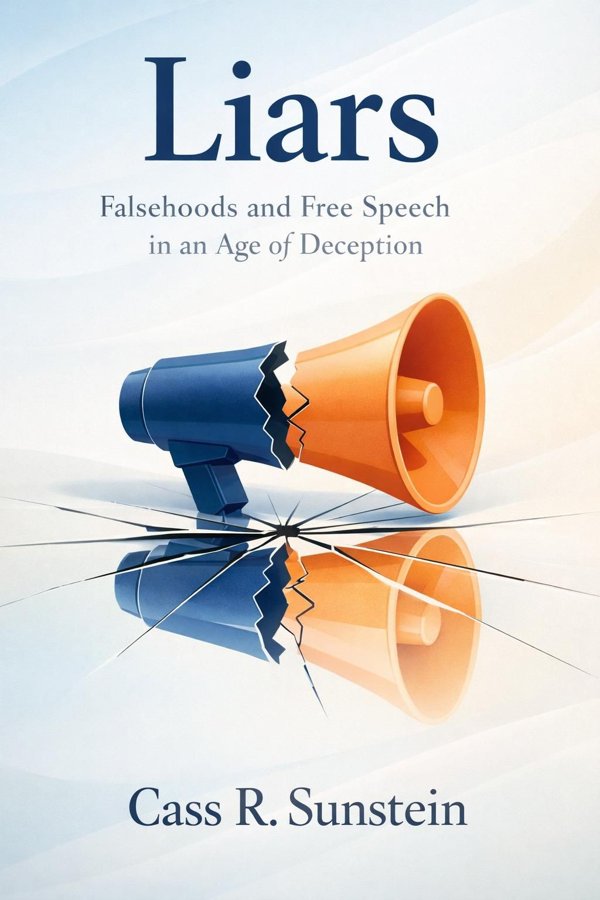
Liars: Falsehoods and Free Speech in an Age of Deception: Summary & Key Insights
 10 min7 chaptersAudio available
What Is Liars: Falsehoods and Free Speech in an Age of Deception About?
Liars: Falsehoods and Free Speech in an Age of Deception by Cass R. Sunstein is a politics book spanning 7 pages. In this book, Cass R. Sunstein explores how lies and misinformation spread rapidly in modern societies and examines the tension between free speech and the need to protect truth. He argues that while free societies must generally tolerate falsehoods, there are circumstances where regulation is justified to prevent harm to public health, democracy, and social trust. Drawing on law, psychology, and political theory, Sunstein proposes reforms to balance freedom of expression with the responsibility to curb deception.
This FizzRead summary covers all 7 key chapters of Liars: Falsehoods and Free Speech in an Age of Deception in approximately 10 minutes, distilling the most important ideas, arguments, and takeaways from Cass R. Sunstein's work. Also available as an audio summary and Key Quotes Podcast.
Liars: Falsehoods and Free Speech in an Age of Deception
In this book, Cass R. Sunstein explores how lies and misinformation spread rapidly in modern societies and examines the tension between free speech and the need to protect truth. He argues that while free societies must generally tolerate falsehoods, there are circumstances where regulation is justified to prevent harm to public health, democracy, and social trust. Drawing on law, psychology, and political theory, Sunstein proposes reforms to balance freedom of expression with the responsibility to curb deception.
Who Should Read Liars: Falsehoods and Free Speech in an Age of Deception?
This book is perfect for anyone interested in politics and looking to gain actionable insights in a short read. Whether you're a student, professional, or lifelong learner, the key ideas from Liars: Falsehoods and Free Speech in an Age of Deception by Cass R. Sunstein will help you think differently.
- ✓Readers who enjoy politics and want practical takeaways
- ✓Professionals looking to apply new ideas to their work and life
- ✓Anyone who wants the core insights of Liars: Falsehoods and Free Speech in an Age of Deception in just 10 minutes
Want the full summary?
Get instant access to this book summary and 100K+ more with Fizz Moment.
Get Free SummaryAvailable on App Store • Free to download
Key Chapters
The history of free speech is, at its core, a history of trust: trust that truth will emerge from the clash of ideas, not from governmental verdicts. The American constitutional tradition—through landmark cases such as *New York Times v. Sullivan*—established that even false statements about public officials deserve protection, unless made with actual malice. This doctrine, though controversial, rests on profound faith in democratic judgment. Suppressing lies too aggressively, courts have argued, risks suppressing dissent and chilling debate.
In reviewing this evolution, I show how thinkers like Justice Holmes introduced the metaphor of the marketplace of ideas, believing that the best test of truth is the capacity of thought to be accepted through competition. For centuries, societies oscillated between repression and openness. Even in times of war and crisis, the law generally erred on the side of allowing error to flourish, under the assumption that correction would follow through discourse.
Yet historical toleration assumed slowness—time for debate, verification, and rebuttal. The digital age annihilates these temporal buffers. A false tweet can spread worldwide before any counter-speech can catch up. What once was a manageable risk of error becomes an overwhelming flood. Still, I argue that understanding these historical precedents is essential: they remind us that free speech survived previous waves of panic. Our challenge today is not to abandon these foundations but to reinterpret them for a new technological and psychological environment.
Why do people believe lies even when evidence contradicts them? Behavioral science reveals a sobering truth: human cognition is far less rational than constitutional theories assume. We cling to stories that affirm identity, reward familiarity, and reduce cognitive dissonance. Falsehoods, once absorbed, resist eviction. Phenomena like confirmation bias, motivated reasoning, and availability heuristics mean that deception isn’t merely external—it arises from deep structures in our own minds.
Drawing from decades of behavioral research, I examine how repetition makes falsehoods feel true, how emotional triggers override analytical thought, and how social affiliation turns misinformation into tribal loyalty. These psychological processes explain why fact-checks rarely suffice. Correction is slow; belief is fast. Thus, any approach to falsehood must respect the intricacies of human psychology. It is not enough to supply truth; we must design systems that make truth easier, safer, and socially compatible to believe.
In this sense, I see regulation not as policing speech but as shaping choice architecture—the environment through which people encounter and assess information. When institutions structure testimony and disclosure wisely, citizens can retain autonomy while reducing deception’s influence. Understanding our psychological vulnerabilities is the first step toward a legally and ethically coherent response.
+ 5 more chapters — available in the FizzRead app
All Chapters in Liars: Falsehoods and Free Speech in an Age of Deception
About the Author
Cass R. Sunstein is an American legal scholar, behavioral economist, and professor at Harvard Law School. He has served in various governmental roles, including Administrator of the White House Office of Information and Regulatory Affairs. Sunstein is known for his influential work on law, behavioral economics, and public policy, and has authored numerous books on constitutional law, regulation, and human behavior.
Get This Summary in Your Preferred Format
Read or listen to the Liars: Falsehoods and Free Speech in an Age of Deception summary by Cass R. Sunstein anytime, anywhere. FizzRead offers multiple formats so you can learn on your terms — all free.
Available formats: App · Audio · PDF · EPUB — All included free with FizzRead
Download Liars: Falsehoods and Free Speech in an Age of Deception PDF and EPUB Summary
Key Quotes from Liars: Falsehoods and Free Speech in an Age of Deception
“The history of free speech is, at its core, a history of trust: trust that truth will emerge from the clash of ideas, not from governmental verdicts.”
“Why do people believe lies even when evidence contradicts them?”
Frequently Asked Questions about Liars: Falsehoods and Free Speech in an Age of Deception
Liars: Falsehoods and Free Speech in an Age of Deception by Cass R. Sunstein is a politics book that explores key ideas across 7 chapters. In this book, Cass R. Sunstein explores how lies and misinformation spread rapidly in modern societies and examines the tension between free speech and the need to protect truth. He argues that while free societies must generally tolerate falsehoods, there are circumstances where regulation is justified to prevent harm to public health, democracy, and social trust. Drawing on law, psychology, and political theory, Sunstein proposes reforms to balance freedom of expression with the responsibility to curb deception.
More by Cass R. Sunstein
You Might Also Like
Antifa: The Anti-Fascist Handbook
Mark Bray
10 min
Attack from Within: How Disinformation Is Sabotaging America
Barbara McQuade
10 min
Coercion, Capital, and European States, AD 990–1992
Charles Tilly
10 min
Digital Democracy: Concepts, Methodologies, Tools, and Applications
Various Authors
10 min
Fascism
Stanley G. Payne
10 min
Fire And Fury: Inside The Trump White House
Michael Wolff
10 minBrowse by Category
Ready to read Liars: Falsehoods and Free Speech in an Age of Deception?
Get the full summary and 100K+ more books with Fizz Moment.