
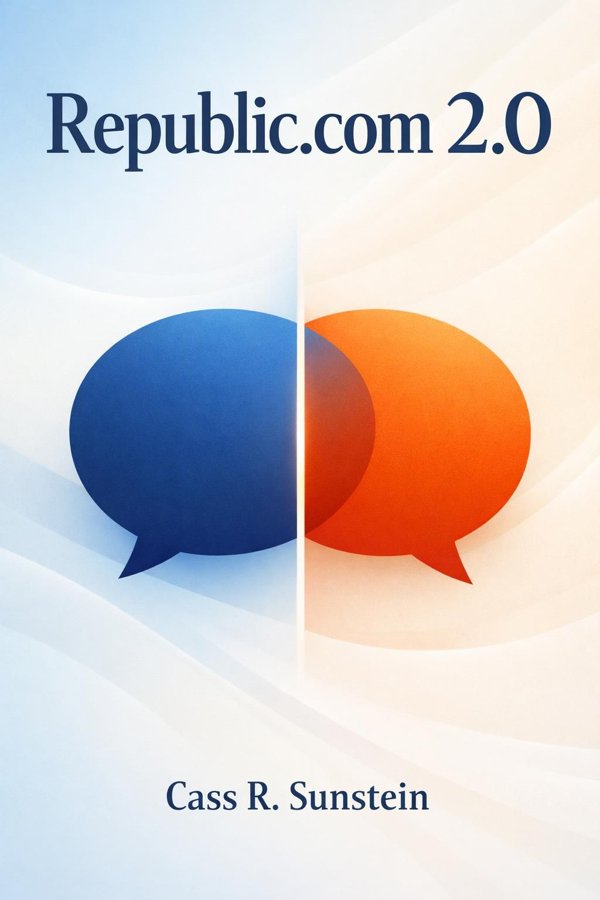
Republic.com 2.0: Summary & Key Insights
 10 min9 chaptersAudio available
What Is Republic.com 2.0 About?
Republic.com 2.0 by Cass R. Sunstein is a politics book spanning 9 pages. In Republic.com 2.0, legal scholar Cass R. Sunstein explores how the Internet, while empowering individuals to access information tailored to their preferences, also risks fragmenting public discourse. He argues that personalized news and online echo chambers can undermine democratic deliberation by isolating citizens from opposing viewpoints. Sunstein proposes ways to design digital environments that promote exposure to diverse perspectives and strengthen democratic engagement.
This FizzRead summary covers all 9 key chapters of Republic.com 2.0 in approximately 10 minutes, distilling the most important ideas, arguments, and takeaways from Cass R. Sunstein's work. Also available as an audio summary and Key Quotes Podcast.
Republic.com 2.0
In Republic.com 2.0, legal scholar Cass R. Sunstein explores how the Internet, while empowering individuals to access information tailored to their preferences, also risks fragmenting public discourse. He argues that personalized news and online echo chambers can undermine democratic deliberation by isolating citizens from opposing viewpoints. Sunstein proposes ways to design digital environments that promote exposure to diverse perspectives and strengthen democratic engagement.
Who Should Read Republic.com 2.0?
This book is perfect for anyone interested in politics and looking to gain actionable insights in a short read. Whether you're a student, professional, or lifelong learner, the key ideas from Republic.com 2.0 by Cass R. Sunstein will help you think differently.
- ✓Readers who enjoy politics and want practical takeaways
- ✓Professionals looking to apply new ideas to their work and life
- ✓Anyone who wants the core insights of Republic.com 2.0 in just 10 minutes
Want the full summary?
Get instant access to this book summary and 100K+ more with Fizz Moment.
Get Free SummaryAvailable on App Store • Free to download
Key Chapters
In the early days of digital communication, the internet was celebrated as a revolution for democracy. The dream was intoxicating: a world without gatekeepers, where every citizen could speak freely, organize effortlessly, and access virtually any idea. The earliest advocates saw in the web the possibility of a new Athens, a global forum for conversation and deliberation.
I shared some of that optimism. I believed that digital communication could do for democratic dialogue what the printing press did for literacy — it could amplify voices and widen participation. The capacity for citizens to post, comment, and connect across borders seemed to promise the renewal of public discourse.
But I quickly realized that new technologies rarely deliver their promise without distortion. Just as the printing press eventually led to propaganda as well as enlightenment, the internet’s openness also gave rise to fragmentation. The same tools that allowed greater self-expression also enabled self-isolation. People began to design their informational lives with precision—choosing what to read, whom to listen to, and which communities to join based on shared identities and beliefs.
That shift from openness to selective exposure quietly altered the meaning of the public sphere. The “republic” in *Republic.com* invokes not only democracy but a certain vision of citizenship: one that requires the capacity to hear others, to engage the unfamiliar, and to deliberate as part of a shared world. When citizens turn away from this engagement—preferring convenience over complexity—they risk transforming democracy into a federation of echo chambers, each sealed by algorithmic comfort.
The promise of the internet remains alive, but it depends on our capacity to preserve its democratic character—to resist the gravitational pull of personalization and to create spaces where civic dialogue can cross boundaries instead of deepening them.
Personalization is one of the great innovations of the digital age. It allows consumers to shape their experience of information with remarkable precision. The news you read, the music you listen to, the friends whose updates fill your feed—all can be tuned to suit your preferences. Yet, what happens when citizens begin to apply that same customization to politics and public life?
The early web was chaotic but public; one stumbled across divergent views simply by wandering from site to site. The later web—dominated by algorithms—became less accidental and more curated. Personalization tools began learning from our behavior, suggesting more of what we already liked and quietly filtering out what we didn’t. The technical term for this is ‘selective exposure,’ and in psychological terms, it satisfies a powerful need for cognitive comfort. We prefer information that aligns with what we already believe and unconsciously avoid what challenges it.
From a democratic standpoint, that’s dangerous. A society composed of millions of self-segmented users ceases to share a common informational foundation. When citizens no longer inhabit the same reality, the conditions for meaningful deliberation disappear. Democracy depends on what I call “shared spaces”—moments where different viewpoints meet and clash, revealing the complexity of our collective decisions. Personalization, while convenient, erodes those spaces.
Technology companies often defend personalization as an expression of freedom, and indeed it is—but freedom understood narrowly as consumer choice. Civic freedom demands more: it requires access to ideas and experiences that broaden our moral and intellectual horizons. The challenge, then, is to design systems that acknowledge both the pleasure of customization and the necessity of exposure. We need an architecture of information that encourages serendipity—a structure that doesn’t force disagreement but makes it likely that dissenting voices will be heard.
The internet’s architecture isn’t neutral. It reflects a series of design choices that shape the flow of information and, ultimately, the psychological landscape of its users. Understanding those design choices is the first step toward making the digital world more hospitable to democracy.
+ 7 more chapters — available in the FizzRead app
All Chapters in Republic.com 2.0
About the Author
Cass R. Sunstein is an American legal scholar, behavioral economist, and professor at Harvard Law School. He has written extensively on constitutional law, behavioral economics, and public policy, and served in the Obama administration as Administrator of the White House Office of Information and Regulatory Affairs.
Get This Summary in Your Preferred Format
Read or listen to the Republic.com 2.0 summary by Cass R. Sunstein anytime, anywhere. FizzRead offers multiple formats so you can learn on your terms — all free.
Available formats: App · Audio · PDF · EPUB — All included free with FizzRead
Download Republic.com 2.0 PDF and EPUB Summary
Key Quotes from Republic.com 2.0
“In the early days of digital communication, the internet was celebrated as a revolution for democracy.”
“Personalization is one of the great innovations of the digital age.”
Frequently Asked Questions about Republic.com 2.0
Republic.com 2.0 by Cass R. Sunstein is a politics book that explores key ideas across 9 chapters. In Republic.com 2.0, legal scholar Cass R. Sunstein explores how the Internet, while empowering individuals to access information tailored to their preferences, also risks fragmenting public discourse. He argues that personalized news and online echo chambers can undermine democratic deliberation by isolating citizens from opposing viewpoints. Sunstein proposes ways to design digital environments that promote exposure to diverse perspectives and strengthen democratic engagement.
More by Cass R. Sunstein

Nudge
Richard H. Thaler, Cass R. Sunstein
10 min
Impeachment: A Citizen's Guide
Cass R. Sunstein
10 min
Liars: Falsehoods and Free Speech in an Age of Deception
Cass R. Sunstein
10 min
Wiser: Getting Beyond Groupthink to Make Groups Smarter
Cass R. Sunstein, Reid Hastie
10 minYou Might Also Like

Antifa: The Anti-Fascist Handbook
Mark Bray
10 min
Attack from Within: How Disinformation Is Sabotaging America
Barbara McQuade
10 min
Coercion, Capital, and European States, AD 990–1992
Charles Tilly
10 min
Digital Democracy: Concepts, Methodologies, Tools, and Applications
Various Authors
10 min
Fascism
Stanley G. Payne
10 min
Fire And Fury: Inside The Trump White House
Michael Wolff
10 minBrowse by Category
Ready to read Republic.com 2.0?
Get the full summary and 100K+ more books with Fizz Moment.