
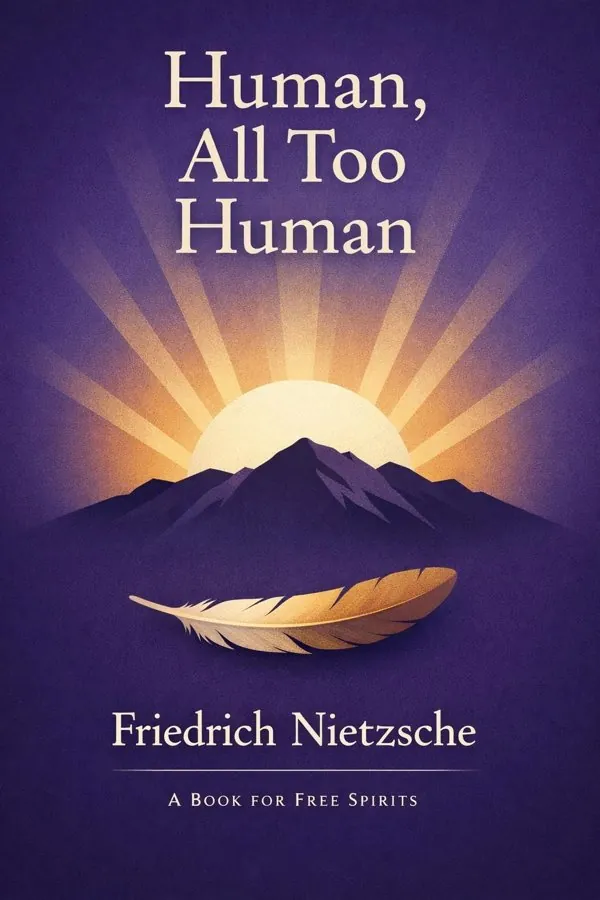
Human, All Too Human: A Book for Free Spirits: Summary & Key Insights
 10 min10 chaptersAudio available
Key Takeaways from Human, All Too Human: A Book for Free Spirits
We often trust an idea more when we imagine it came from heaven rather than history.
What if conscience is not the voice of God, but the echo of custom?
Religious belief often feels like revelation to the believer, yet Nietzsche asks us to look at the emotional machinery beneath faith.
We like to speak of genius as if it were lightning from another world.
A civilization can be judged by what kinds of minds it permits to grow.
What Is Human, All Too Human: A Book for Free Spirits About?
Human, All Too Human: A Book for Free Spirits by Friedrich Nietzsche is a western_phil book spanning 10 pages. Human, All Too Human is Friedrich Nietzsche’s bold attempt to retrain the mind. First published in 1878, the book marks a decisive break from his earlier admiration for grand metaphysical systems, artistic redemption, and romantic idealism. In their place, Nietzsche offers something sharper and more unsettling: a cool, aphoristic inquiry into how human beings actually think, desire, judge, worship, create, and obey. Rather than treating morality, religion, art, and politics as sacred domains, he examines them as historical and psychological products shaped by fear, habit, vanity, power, and necessity. That shift makes this book one of the founding texts of modern suspicion. Why does it still matter? Because Nietzsche asks readers to question the hidden motives behind their highest values. He does not merely attack old beliefs; he teaches intellectual independence. The “free spirit” of the title is not a rebel for rebellion’s sake, but someone willing to abandon comforting illusions in pursuit of greater honesty. As one of philosophy’s most influential stylists and critics of inherited morality, Nietzsche brings rare authority to this project. Human, All Too Human is both a diagnosis of culture and a training manual for thinking without crutches.
This FizzRead summary covers all 10 key chapters of Human, All Too Human: A Book for Free Spirits in approximately 10 minutes, distilling the most important ideas, arguments, and takeaways from Friedrich Nietzsche's work. Also available as an audio summary and Key Quotes Podcast.
Human, All Too Human: A Book for Free Spirits
Human, All Too Human is Friedrich Nietzsche’s bold attempt to retrain the mind. First published in 1878, the book marks a decisive break from his earlier admiration for grand metaphysical systems, artistic redemption, and romantic idealism. In their place, Nietzsche offers something sharper and more unsettling: a cool, aphoristic inquiry into how human beings actually think, desire, judge, worship, create, and obey. Rather than treating morality, religion, art, and politics as sacred domains, he examines them as historical and psychological products shaped by fear, habit, vanity, power, and necessity. That shift makes this book one of the founding texts of modern suspicion.
Why does it still matter? Because Nietzsche asks readers to question the hidden motives behind their highest values. He does not merely attack old beliefs; he teaches intellectual independence. The “free spirit” of the title is not a rebel for rebellion’s sake, but someone willing to abandon comforting illusions in pursuit of greater honesty. As one of philosophy’s most influential stylists and critics of inherited morality, Nietzsche brings rare authority to this project. Human, All Too Human is both a diagnosis of culture and a training manual for thinking without crutches.
Who Should Read Human, All Too Human: A Book for Free Spirits?
This book is perfect for anyone interested in western_phil and looking to gain actionable insights in a short read. Whether you're a student, professional, or lifelong learner, the key ideas from Human, All Too Human: A Book for Free Spirits by Friedrich Nietzsche will help you think differently.
- ✓Readers who enjoy western_phil and want practical takeaways
- ✓Professionals looking to apply new ideas to their work and life
- ✓Anyone who wants the core insights of Human, All Too Human: A Book for Free Spirits in just 10 minutes
Want the full summary?
Get instant access to this book summary and 100K+ more with Fizz Moment.
Get Free SummaryAvailable on App Store • Free to download
Key Chapters
We often trust an idea more when we imagine it came from heaven rather than history. Nietzsche’s opening move is to challenge this reflex. In “Of First and Last Things,” he argues that philosophy has too often invented pure origins—truth, goodness, reason, essence—as if noble things must come from a higher realm. But many of our loftiest ideals emerge from ordinary, mixed, and even ignoble conditions. Instead of asking what eternal truth is in itself, Nietzsche asks how beliefs arose, what needs they served, and why people became attached to them.
This is a profound methodological shift. Rather than accepting concepts at face value, Nietzsche treats them genealogically before he fully develops genealogy in later works. He invites us to examine the human roots of supposedly timeless claims. A moral rule may begin as a practical convenience. A religious doctrine may grow from fear of uncertainty. A philosophical system may reflect a thinker’s temperament more than the structure of reality.
This perspective does not automatically destroy value; it changes how we justify it. If an idea has a human origin, that does not make it false, but it does make it contestable. We can compare values, revise them, and stop pretending they descended intact from a transcendent world.
In everyday life, this means questioning inherited assumptions. Why do you call one career respectable and another frivolous? Why do you feel guilt in one context and pride in another? Trace the origin of the feeling before obeying it. Nietzsche’s lesson is simple but demanding: when confronted with any “absolute,” ask what human need produced it. Actionable takeaway: replace reverence with investigation—whenever a belief presents itself as eternal, first ask where it came from.
What if conscience is not the voice of God, but the echo of custom? In “The History of Moral Feelings,” Nietzsche argues that morality must be understood historically and psychologically, not as a divine command or self-evident truth. People call actions good or evil only after long social conditioning. Communities reward what preserves order and condemn what threatens it; over time, these practical judgments become moral convictions, and eventually they seem natural or sacred.
Nietzsche shows that moral feelings are not fixed. Compassion, justice, shame, guilt, duty, and virtue change across cultures and eras. This means our moral experience is shaped by training, imitation, fear of punishment, desire for approval, and the need to live with others. Even self-sacrifice may conceal subtle satisfactions such as prestige, self-image, or emotional superiority. Nietzsche is not saying every good deed is hypocrisy. He is saying that motives are layered, and moral language often hides this complexity.
This idea can be applied practically in relationships, workplaces, and public life. A company may treat punctuality as a moral issue when it is really an efficiency norm. Families may frame obedience as respect when it is partly about preserving hierarchy. Political groups often present local values as universal truths. Once we see morality historically, we become less dogmatic and better able to negotiate differences.
Nietzsche’s larger aim is intellectual maturity. Moral feelings deserve examination, not automatic obedience. To live honestly, we must distinguish between what is genuinely life-enhancing and what is merely inherited. Actionable takeaway: the next time you feel moral outrage or guilt, pause and ask which custom, institution, or past training may be speaking through you.
Religious belief often feels like revelation to the believer, yet Nietzsche asks us to look at the emotional machinery beneath faith. In “Religious Life,” he presents religion not as a supernatural disclosure but as a human response to suffering, uncertainty, dependence, and the longing for meaning. Gods, moral laws, and afterlives answer deep psychological needs: they comfort the weak, organize communities, explain misfortune, and convert chaos into purpose.
Nietzsche’s critique is subtle. He understands that religion has performed real cultural work. It can discipline conduct, sustain hope, and shape art and community. But he also believes it often thrives by exploiting fear and sanctifying obedience. The religious person may interpret inner experiences—guilt, awe, ecstasy, relief—as evidence of divine action when they are better understood as human psychological states. Priests and institutions then give these states a language and system that reinforce their authority.
Modern readers can apply this insight without reducing every spiritual impulse to fraud. The question is not whether religious experience feels powerful, but whether its interpretation is true and whether it promotes growth or dependence. Consider how people seek certainty in times of crisis: astrology surges, conspiratorial beliefs spread, charismatic leaders gain followers. Nietzsche would say this reveals the enduring human appetite for explanatory shelter.
His point is not simply anti-religious; it is emancipatory. If our consolations are humanly produced, we may be able to create more honest forms of meaning. We need not choose between piety and nihilism; we can learn to live without turning our fears into dogma. Actionable takeaway: when a belief gives you comfort, ask what need it satisfies before deciding whether to trust it.
We like to speak of genius as if it were lightning from another world. Nietzsche resists that mythology. In “Concerning the Soul of Artists and Writers,” he argues that art should not be mystified as pure inspiration or divine visitation. Artists are not magical exceptions to human nature; they are highly developed workers whose effects depend on temperament, discipline, illusion, and audience expectation. The aura of genius often hides the long labor behind creation.
This demystification changes how we understand beauty. Artistic works move us not because they reveal metaphysical truth, but because they skillfully organize feeling, memory, form, and symbol. They arise from human drives—ambition, vanity, longing, imitation, suffering, play—not from a supernatural source. Nietzsche also warns that art can seduce us into idealization. We may admire tragic or noble images and then falsely project nobility onto life itself.
The practical value of this idea is enormous. It frees creators from waiting for inspiration and frees audiences from reverent passivity. A novelist improves through revision; a musician sharpens expression through practice; a thinker develops style through attention and repetition. Even in business or teaching, “creative genius” is often just deep preparation plus courage to shape material well.
Nietzsche is not degrading art. On the contrary, he takes it seriously enough to explain it naturally. Art matters because it is one of the highest forms of human arrangement and reinterpretation, not because it floats above life. Once stripped of sacred haze, creation becomes more accessible and more demanding. Actionable takeaway: stop worshipping talent from afar—treat excellence as built, and commit to one disciplined creative practice this week.
A civilization can be judged by what kinds of minds it permits to grow. In “Signs of Higher and Lower Culture,” Nietzsche distinguishes between more advanced and less advanced cultural forms not by wealth or piety, but by their capacity for intellectual honesty, self-criticism, refinement, and plurality. A lower culture demands conformity, fears deviation, and clings to inherited certainties. A higher culture can tolerate ambiguity, cultivate individuality, and revise its own standards.
This is not a simple elitism of class or education. Nietzsche is interested in habits of mind. A person may be highly schooled yet spiritually servile, while another with less formal learning may display remarkable independence. Higher culture requires patience, historical awareness, and the ability to entertain uncomfortable truths. It values conversation over dogma and experimentation over inherited authority.
We can see this today in institutions and communities. A workplace that punishes dissent while preaching innovation is culturally lower in Nietzsche’s sense. A school that rewards memorization but not questioning produces obedient minds, not free spirits. Even personal culture matters: if your tastes, opinions, and ambitions are all borrowed from your environment, then your inner life remains colonized by convention.
Nietzsche also reminds us that refinement comes at a cost. More freedom means more uncertainty. Once easy certainties collapse, individuals must learn to orient themselves without metaphysical guarantees. That burden is precisely what stronger cultures and stronger people can bear.
The test of culture, then, is not moral purity but the quality of human formation it enables. Actionable takeaway: evaluate your environment by one question—does it reward honest inquiry, or does it mainly reward obedience? Then move one step closer to the former.
Social life depends less on sincerity than we like to admit. In “Man in Society,” Nietzsche examines how individuals adapt themselves to others through politeness, performance, restraint, bargaining, and hidden calculation. Much of what passes for virtue in society is really social technique: we learn tact because bluntness is costly, generosity because reciprocity stabilizes relations, modesty because open self-assertion provokes resistance.
Nietzsche does not condemn this outright. Society requires forms, masks, and compromises. Total transparency would be unbearable; constant honesty would often become cruelty. The problem arises when these conventions are mistaken for deep moral purity. We praise civility as goodness when it may just be strategic adaptation. We call someone principled when they are merely skilled at preserving reputation.
This insight can help us navigate modern networks of work, friendship, and public identity. Professional behavior on social media, networking rituals, office diplomacy, and even family gatherings all involve selective presentation. Recognizing this can make us less naive and less resentful. People are not always deceitful in a malicious sense; they are often managing the demands of coexistence.
Yet Nietzsche also warns against becoming wholly theatrical. The self can become so shaped by social approval that it loses all independent center. The free spirit must participate in society without being fully possessed by it. That requires intervals of solitude, self-observation, and deliberate refusal.
A mature social philosophy accepts two truths at once: we need others, and we become distorted by them. Wisdom lies in balancing adaptation with inward independence. Actionable takeaway: identify one role in your life where you are mostly performing for approval, and ask what a more honest but still skillful version of that role would look like.
Some of Nietzsche’s comments on women and family are historically bound and often troubling, but the underlying issue remains relevant: many intimate roles feel natural when they are actually socially produced. In “Woman and Child,” Nietzsche reflects on courtship, marriage, maternal influence, education, dependency, and the shaping power of early life. His observations are uneven, yet they consistently point to one theme: the family is one of the main workshops where values, habits, and illusions are formed.
Children do not inherit only genes or property; they inherit emotional vocabularies, expectations, fears, and models of authority. Adults, meanwhile, often mistake learned gender scripts for timeless nature. What counts as strength, tenderness, obedience, ambition, or sacrifice is heavily mediated by custom. Nietzsche’s broader method encourages readers to scrutinize domestic ideals with the same suspicion he applies to religion and morality.
That approach remains useful today. Consider how children absorb a family’s unspoken rules about money, conflict, affection, and success. Or think about how gendered expectations still shape who is expected to care, earn, lead, apologize, or endure. Once these roles are recognized as historical and contingent, they can be renegotiated rather than merely inherited.
To read this part well is not to accept every judgment Nietzsche makes, but to use his critical lens on the supposedly natural structures of intimacy. The family can cultivate strength and tenderness, but it can also reproduce dependency, hierarchy, and unexamined ideals.
Nietzsche’s deeper lesson is that what feels most personal is often where culture hides most effectively. Actionable takeaway: examine one family rule or gender expectation you live by, and ask whether it reflects your values or merely your conditioning.
Political communities often demand reverence by disguising force as destiny. In “A Glance at the State,” Nietzsche treats the state with the same suspicion he applies to religion and morality. Governments present themselves as guardians of justice, unity, and civilization, yet they are also instruments of order, coercion, administration, and collective self-interest. Patriotism can elevate common life, but it can also inflate the state into a moral idol that demands sacrifice without examination.
Nietzsche is wary of political romanticism. Nations tell stories about themselves—heroic origins, special missions, moral innocence—to bind citizens together. These stories may be emotionally powerful, but they often conceal the machinery of power. The state rewards loyalty, punishes deviation, and uses ideals to secure obedience. What people call public virtue may sometimes be organized conformity.
This analysis feels contemporary in an age of partisan identity, ideological branding, and culture-war nationalism. Citizens are encouraged to fuse morality with political membership, treating disagreement as treason or impurity. Nietzsche would urge distance. A thoughtful person should engage politics, but not surrender judgment to flags, slogans, or mass emotion.
At the same time, he is not proposing total withdrawal. The challenge is to remain politically aware without becoming politically possessed. Institutions are necessary, but they should be viewed soberly, as human constructions rather than sacred embodiments of truth.
For modern readers, this means resisting both cynical apathy and blind enthusiasm. Evaluate policies, incentives, and consequences rather than merely joining moralized camps. The free spirit is a difficult citizen: useful to society, but never fully absorbed by collective myth. Actionable takeaway: the next time political rhetoric stirs strong emotion, separate the concrete policy from the symbolic story being used to sell it.
Most people know themselves only in the language of their surroundings. In “Man Alone with Himself,” Nietzsche turns inward and shows why solitude is essential for any genuine independence. When constantly immersed in society, we absorb ready-made judgments about success, virtue, love, status, and meaning. We begin to mistake external noise for inner conviction. Solitude interrupts this process by creating the space in which thoughts can reveal their true sources.
For Nietzsche, being alone is not merely physical isolation; it is the capacity to endure one’s own company without rushing back to distraction. This is difficult because self-examination often exposes contradiction. We discover vanity inside generosity, fear inside conviction, dependence inside ambition. But such discoveries are not failures. They are the beginning of honesty.
In practical terms, solitude remains a neglected discipline. Constant connectivity makes it easy to live reactively, always responding, never digesting. Without periods of withdrawal—walking without devices, writing privately, thinking before speaking—we lose the ability to form judgments that are truly our own. Reflection sharpens perception and weakens conformity.
Nietzsche also implies that self-knowledge is never complete. The self is layered, changing, and partly opaque. Yet disciplined inwardness can make us less mechanical. We become more capable of choosing values rather than merely inheriting them.
This chapter’s importance lies in linking freedom to practice. Independence is not achieved once through a heroic act; it is cultivated through habits of distance, observation, and self-correction. Actionable takeaway: create one recurring period each week with no screens, no conversation, and no task but reflective thinking or writing.
Progress does not come from better dogmas, but from better kinds of minds. In “A Look at the Future,” Nietzsche imagines what may become possible when individuals outgrow metaphysical dependence and moral rigidity. The coming thinker is the “free spirit”: someone who has learned to question inherited truths, endure uncertainty, and construct a way of living grounded in intellectual courage rather than borrowed consolation.
This figure is not simply a skeptic who destroys. Nietzsche’s free spirit is experimental. He treats ideas as hypotheses, values as revisable, and life as something to be interpreted rather than obeyed according to fixed formulas. Such a person can appreciate art without idolizing it, engage morality without absolutizing it, and participate in society without worshipping it. Freedom here means disciplined openness.
Nietzsche knows this future is costly. The collapse of old certainties can produce loneliness, disorientation, and fatigue. It is easier to inherit than to create. Yet he believes cultural renewal depends on individuals willing to pass through this difficulty. New values will not emerge from pious repetition but from clear-sighted examination of human needs, powers, and possibilities.
In contemporary life, this ideal applies to anyone navigating fractured institutions and conflicting worldviews. The free spirit is the person who can think across tribes, revise opinions publicly, and live without demanding total certainty before acting. In science, leadership, education, or private life, that capacity is increasingly rare and valuable.
Nietzsche’s final invitation is demanding but liberating: become someone who can bear truth without resentment and uncertainty without surrender. Actionable takeaway: choose one strongly held belief of your own and deliberately expose it to the best opposing argument this month.
All Chapters in Human, All Too Human: A Book for Free Spirits
About the Author
Friedrich Nietzsche (1844–1900) was a German philosopher, classical philologist, and one of the most disruptive thinkers in modern intellectual history. Appointed a professor of philology at Basel at a young age, he later left academia due to illness and devoted himself to writing. His works challenged Christianity, metaphysics, conventional morality, nationalism, and cultural complacency, while exploring themes such as nihilism, self-overcoming, the will to power, and the creation of values. Major books include Human, All Too Human, Thus Spoke Zarathustra, Beyond Good and Evil, and On the Genealogy of Morality. Nietzsche’s style is famous for its aphorisms, intensity, and psychological insight. Though he wrote in the nineteenth century, his influence continues across philosophy, literature, psychology, political theory, and cultural criticism.
Get This Summary in Your Preferred Format
Read or listen to the Human, All Too Human: A Book for Free Spirits summary by Friedrich Nietzsche anytime, anywhere. FizzRead offers multiple formats so you can learn on your terms — all free.
Available formats: App · Audio · PDF · EPUB — All included free with FizzRead
Download Human, All Too Human: A Book for Free Spirits PDF and EPUB Summary
Key Quotes from Human, All Too Human: A Book for Free Spirits
“We often trust an idea more when we imagine it came from heaven rather than history.”
“What if conscience is not the voice of God, but the echo of custom?”
“Religious belief often feels like revelation to the believer, yet Nietzsche asks us to look at the emotional machinery beneath faith.”
“We like to speak of genius as if it were lightning from another world.”
“A civilization can be judged by what kinds of minds it permits to grow.”
Frequently Asked Questions about Human, All Too Human: A Book for Free Spirits
Human, All Too Human: A Book for Free Spirits by Friedrich Nietzsche is a western_phil book that explores key ideas across 10 chapters. Human, All Too Human is Friedrich Nietzsche’s bold attempt to retrain the mind. First published in 1878, the book marks a decisive break from his earlier admiration for grand metaphysical systems, artistic redemption, and romantic idealism. In their place, Nietzsche offers something sharper and more unsettling: a cool, aphoristic inquiry into how human beings actually think, desire, judge, worship, create, and obey. Rather than treating morality, religion, art, and politics as sacred domains, he examines them as historical and psychological products shaped by fear, habit, vanity, power, and necessity. That shift makes this book one of the founding texts of modern suspicion. Why does it still matter? Because Nietzsche asks readers to question the hidden motives behind their highest values. He does not merely attack old beliefs; he teaches intellectual independence. The “free spirit” of the title is not a rebel for rebellion’s sake, but someone willing to abandon comforting illusions in pursuit of greater honesty. As one of philosophy’s most influential stylists and critics of inherited morality, Nietzsche brings rare authority to this project. Human, All Too Human is both a diagnosis of culture and a training manual for thinking without crutches.
More by Friedrich Nietzsche

You Might Also Like
A Little History of Philosophy
Nigel Warburton
10 min
Areopagitica
John Milton
10 min
How To Think Like A Philosopher: Essential Principles For Clear Thinking
Peter Cave
10 min
Language, Truth and Logic
A. J. Ayer
10 min
The Age of Reason
Thomas Paine
10 min
The Essays
Michel De Montaigne
10 minBrowse by Category
Ready to read Human, All Too Human: A Book for Free Spirits?
Get the full summary and 100K+ more books with Fizz Moment.