

Helgoland: Summary & Key Insights
 10 min6 chaptersAudio available
What Is Helgoland About?
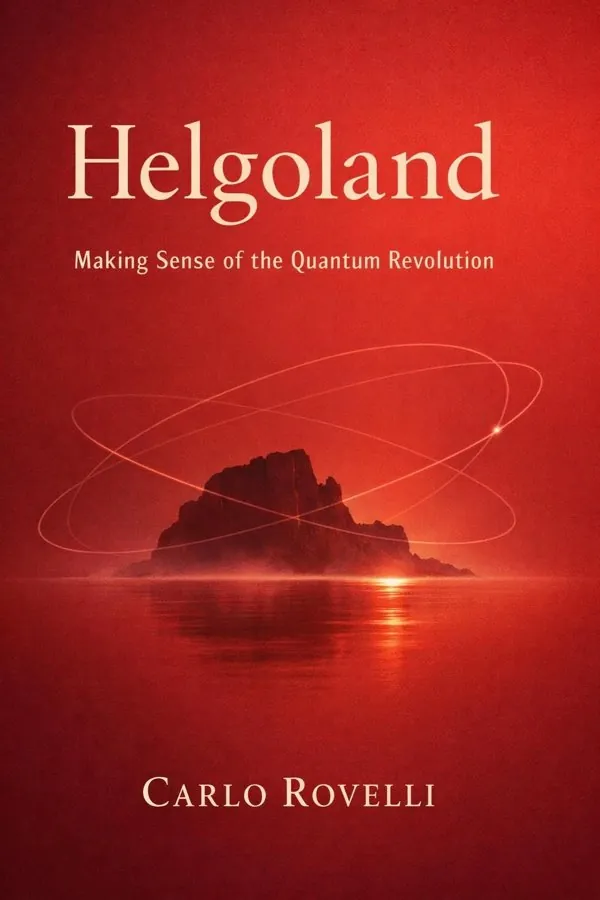
Helgoland by Carlo Rovelli is a space_physics book spanning 6 pages. Helgoland is a nonfiction work by theoretical physicist Carlo Rovelli that explores the origins and philosophical implications of quantum mechanics. Drawing inspiration from the German island of Helgoland, where Werner Heisenberg developed quantum theory in 1925, Rovelli presents a relational interpretation of reality, suggesting that objects do not possess absolute properties but exist only in relation to others. The book weaves together physics, philosophy, and reflections on the nature of knowledge and existence.
This FizzRead summary covers all 6 key chapters of Helgoland in approximately 10 minutes, distilling the most important ideas, arguments, and takeaways from Carlo Rovelli's work. Also available as an audio summary and Key Quotes Podcast.
Helgoland
Helgoland is a nonfiction work by theoretical physicist Carlo Rovelli that explores the origins and philosophical implications of quantum mechanics. Drawing inspiration from the German island of Helgoland, where Werner Heisenberg developed quantum theory in 1925, Rovelli presents a relational interpretation of reality, suggesting that objects do not possess absolute properties but exist only in relation to others. The book weaves together physics, philosophy, and reflections on the nature of knowledge and existence.
Who Should Read Helgoland?
This book is perfect for anyone interested in space_physics and looking to gain actionable insights in a short read. Whether you're a student, professional, or lifelong learner, the key ideas from Helgoland by Carlo Rovelli will help you think differently.
- ✓Readers who enjoy space_physics and want practical takeaways
- ✓Professionals looking to apply new ideas to their work and life
- ✓Anyone who wants the core insights of Helgoland in just 10 minutes
Want the full summary?
Get instant access to this book summary and 100K+ more with Fizz Moment.
Get Free SummaryAvailable on App Store • Free to download
Key Chapters
By the early twentieth century, physics was facing what felt like a quiet disaster. Newton’s mechanics had provided centuries of certainty; everything in motion, from planets to pendulums, could be predicted with precision and confidence. Yet as scientists probed smaller and smaller scales — the realm of atoms — those elegant equations collapsed under their own weight. Electrons refused to behave as tiny planets circling a nucleus; light refused to be simply a wave or a particle. The smallest building blocks of nature did not obey the laws that worked so beautifully for the world of tables and stones.
Heisenberg was among the young physicists disturbed by this breakdown. He felt classical models of electrons orbiting nuclei were visual fictions — convenient but false. When he withdrew to Helgoland, he made a decision that still stuns us: to discard the idea of an electron’s orbit altogether. Instead, he described atomic behavior purely through relationships between observable quantities, such as frequencies of emitted light. The mathematics he devised — 'matrix mechanics' — looked nothing like traditional physics, but it worked. It predicted spectra, explained mysterious atomic transitions, and began a revolution.
That leap represented the end of determinism in physics. No longer could we say that knowing the present state of the universe allows complete foresight of the future. Quantum mechanics, from its conception, insisted on indeterminacy: that we can only describe probabilities, not certainties. But this indeterminacy was not mere ignorance. It reflected something deeper — that reality itself might not possess definite properties in the absence of interaction. This was the foundation of the relational view I later refined: the idea that properties are not absolute facts but only emerge through relations.
Matrix mechanics introduced a radical departure from the physics of perceptible reality. Heisenberg’s matrices described transitions — how one state changes to another — without ever specifying what the 'object' itself is in isolation. Gone was the image of a miniature solar system within the atom; in its place, we found patterns of correlation, probabilities of occurrence, and relations between experimental outcomes.
For me, this was not a retreat from realism but a deepening of it. If reality behaves relationally, then what exists are not independent things, but networks of interaction. A photon does not have a predetermined polarization until it meets a detector; an electron does not have a precise location until something measures it. The world unfolds through acts of connection.
This insight was hard for many to accept — Einstein famously resisted it. Yet it is consistent with a long philosophical tradition that questions substance-based metaphysics. From Mach’s empiricism to the Buddhist philosophy of Nāgārjuna, thinkers have explored the idea that things are void of intrinsic essence. In quantum physics, this old intuition found its most concrete form. The mathematics of matrix mechanics showed that when we strip away metaphysical decorations, what remains are the relationships — the web of possibilities that tie events together.
+ 4 more chapters — available in the FizzRead app
All Chapters in Helgoland
About the Author
Carlo Rovelli is an Italian theoretical physicist known for his contributions to loop quantum gravity and for his work as a science communicator. A professor at Aix-Marseille University, he is the author of several internationally acclaimed books, including 'Seven Brief Lessons on Physics' and 'The Order of Time'.
Get This Summary in Your Preferred Format
Read or listen to the Helgoland summary by Carlo Rovelli anytime, anywhere. FizzRead offers multiple formats so you can learn on your terms — all free.
Available formats: App · Audio · PDF · EPUB — All included free with FizzRead
Download Helgoland PDF and EPUB Summary
Key Quotes from Helgoland
“By the early twentieth century, physics was facing what felt like a quiet disaster.”
“Matrix mechanics introduced a radical departure from the physics of perceptible reality.”
Frequently Asked Questions about Helgoland
Helgoland by Carlo Rovelli is a space_physics book that explores key ideas across 6 chapters. Helgoland is a nonfiction work by theoretical physicist Carlo Rovelli that explores the origins and philosophical implications of quantum mechanics. Drawing inspiration from the German island of Helgoland, where Werner Heisenberg developed quantum theory in 1925, Rovelli presents a relational interpretation of reality, suggesting that objects do not possess absolute properties but exist only in relation to others. The book weaves together physics, philosophy, and reflections on the nature of knowledge and existence.
More by Carlo Rovelli
You Might Also Like

The Means Of Prediction
Mark P. Silverman
10 min
AstroTech
Various Authors
10 min
Black Holes and Time Warps: Einstein’s Outrageous Legacy
Kip S. Thorne
10 min
Dark Matter and the Dinosaurs: The Astounding Interconnectedness of the Universe
Lisa Randall
10 min
Hyperspace: A Scientific Odyssey Through Parallel Universes, Time Warps, and the 10th Dimension
Michio Kaku
10 min
Quantum Physics: The Basics
Alastair I.M. Rae
10 minBrowse by Category
Ready to read Helgoland?
Get the full summary and 100K+ more books with Fizz Moment.