
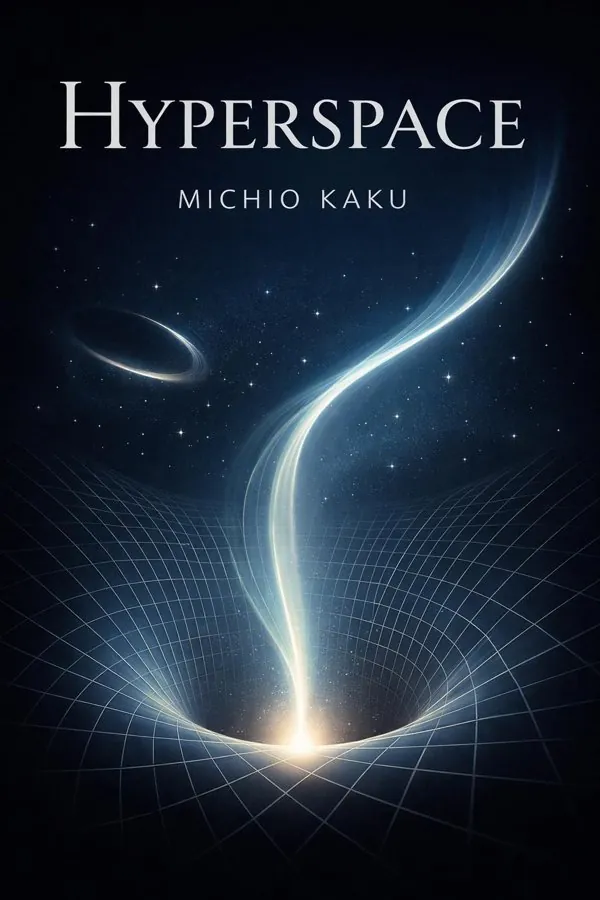
Hyperspace: A Scientific Odyssey Through Parallel Universes, Time Warps, and the 10th Dimension: Summary & Key Insights
by Michio Kaku
 10 min7 chaptersAudio available
What Is Hyperspace: A Scientific Odyssey Through Parallel Universes, Time Warps, and the 10th Dimension About?
Hyperspace: A Scientific Odyssey Through Parallel Universes, Time Warps, and the 10th Dimension by Michio Kaku is a space_physics book spanning 7 pages. In 'Hyperspace', theoretical physicist Michio Kaku explores the concept of higher dimensions and parallel universes, presenting complex ideas from string theory and cosmology in an accessible way. The book examines how the universe might consist of multiple dimensions beyond the familiar three of space and one of time, and how these ideas could explain fundamental forces and the origins of the cosmos.
This FizzRead summary covers all 7 key chapters of Hyperspace: A Scientific Odyssey Through Parallel Universes, Time Warps, and the 10th Dimension in approximately 10 minutes, distilling the most important ideas, arguments, and takeaways from Michio Kaku's work. Also available as an audio summary and Key Quotes Podcast.
Hyperspace: A Scientific Odyssey Through Parallel Universes, Time Warps, and the 10th Dimension
In 'Hyperspace', theoretical physicist Michio Kaku explores the concept of higher dimensions and parallel universes, presenting complex ideas from string theory and cosmology in an accessible way. The book examines how the universe might consist of multiple dimensions beyond the familiar three of space and one of time, and how these ideas could explain fundamental forces and the origins of the cosmos.
Who Should Read Hyperspace: A Scientific Odyssey Through Parallel Universes, Time Warps, and the 10th Dimension?
This book is perfect for anyone interested in space_physics and looking to gain actionable insights in a short read. Whether you're a student, professional, or lifelong learner, the key ideas from Hyperspace: A Scientific Odyssey Through Parallel Universes, Time Warps, and the 10th Dimension by Michio Kaku will help you think differently.
- ✓Readers who enjoy space_physics and want practical takeaways
- ✓Professionals looking to apply new ideas to their work and life
- ✓Anyone who wants the core insights of Hyperspace: A Scientific Odyssey Through Parallel Universes, Time Warps, and the 10th Dimension in just 10 minutes
Want the full summary?
Get instant access to this book summary and 100K+ more with Fizz Moment.
Get Free SummaryAvailable on App Store • Free to download
Key Chapters
To appreciate hyperspace, one must first revisit the foundations of classical physics. Newton's mechanics, with its fixed absolute space, ruled science for centuries. Space and time were independent backdrops, eternal and immutable. But this vision, though elegant, concealed profound limitations. It could not explain the peculiar behavior of light, nor could it encompass the unity of forces that nature seemed to suggest.
Einstein revolutionized this picture by merging space and time into a single four-dimensional continuum—spacetime. Gravity was no longer a mysterious attraction between masses but a consequence of curved geometry. Planets move not because they are pulled by invisible hands but because they follow the natural paths in the warped fabric of space-time around massive bodies. This insight reshaped physics, yet it also raised deeper questions. If the four dimensions could curve and twist, why stop there? Could higher dimensions exist, invisible yet fundamental?
In contemplating Einstein’s equations, I began to see that our universe might be only a shadow cast from a higher-dimensional space. Just as a three-dimensional object projects a two-dimensional shadow, perhaps our cosmos projects itself from an unseen structure of additional dimensions. These higher dimensions, folded tightly or extended far beyond our reach, may hold the key to phenomena we struggle to unite—such as quantum mechanics and gravity. Einstein’s curved spacetime was not the end, but a gateway to an even more intricate vision.
In the 1920s, Theodor Kaluza and Oskar Klein pursued one of the most daring ideas of modern physics: that electromagnetism and gravity—two of nature’s opposing forces—could emerge from a single geometric principle if we allowed space to possess a fifth dimension. Kaluza’s mathematical insight showed that when Einstein’s gravitational equations were extended into five dimensions, Maxwell’s equations of electromagnetism appeared naturally. Klein refined the idea by proposing that the fifth dimension might be curled into a tiny, imperceptible loop.
This sudden illumination was more than mathematical elegance—it was poetry written in equations. It hinted that the universe might weave all forces into geometry itself. Although Kaluza-Klein theory faded for decades, overshadowed by quantum mechanics, it laid down the conceptual foundation for future generations to revisit. I often think of Kaluza and Klein as visionaries ahead of their time, proposing a universe so rich that we human beings, confined to perceiving four dimensions, could barely grasp its beauty.
For me, the notion that physical laws could spring from the shape and structure of extra dimensions remains profoundly inspiring. It unites two human pursuits—the quest for mathematical simplicity and the yearning for cosmic unity. Their fifth-dimensional dream was the first whisper of hyperspace—a glimpse of a hidden order in which the universe’s diverse phenomena obey a single geometric harmony.
+ 5 more chapters — available in the FizzRead app
All Chapters in Hyperspace: A Scientific Odyssey Through Parallel Universes, Time Warps, and the 10th Dimension
About the Author
Michio Kaku is an American theoretical physicist, futurist, and popularizer of science. He is a professor of theoretical physics at the City College of New York and the CUNY Graduate Center, known for his work on string field theory and for authoring several best-selling books on physics and the future of science.
Get This Summary in Your Preferred Format
Read or listen to the Hyperspace: A Scientific Odyssey Through Parallel Universes, Time Warps, and the 10th Dimension summary by Michio Kaku anytime, anywhere. FizzRead offers multiple formats so you can learn on your terms — all free.
Available formats: App · Audio · PDF · EPUB — All included free with FizzRead
Download Hyperspace: A Scientific Odyssey Through Parallel Universes, Time Warps, and the 10th Dimension PDF and EPUB Summary
Key Quotes from Hyperspace: A Scientific Odyssey Through Parallel Universes, Time Warps, and the 10th Dimension
“To appreciate hyperspace, one must first revisit the foundations of classical physics.”
“Kaluza’s mathematical insight showed that when Einstein’s gravitational equations were extended into five dimensions, Maxwell’s equations of electromagnetism appeared naturally.”
Frequently Asked Questions about Hyperspace: A Scientific Odyssey Through Parallel Universes, Time Warps, and the 10th Dimension
Hyperspace: A Scientific Odyssey Through Parallel Universes, Time Warps, and the 10th Dimension by Michio Kaku is a space_physics book that explores key ideas across 7 chapters. In 'Hyperspace', theoretical physicist Michio Kaku explores the concept of higher dimensions and parallel universes, presenting complex ideas from string theory and cosmology in an accessible way. The book examines how the universe might consist of multiple dimensions beyond the familiar three of space and one of time, and how these ideas could explain fundamental forces and the origins of the cosmos.
More by Michio Kaku
Quantum Supremacy: How the Quantum Computer Revolution Will Change Everything
Michio Kaku
10 min
The Future of Humanity: Terraforming Mars, Interstellar Travel, Immortality, and Our Destiny Beyond Earth
Michio Kaku
10 min
The God Equation: The Quest for a Theory of Everything
Michio Kaku
10 min
Physics of the Impossible: A Scientific Exploration into the World of Phasers, Force Fields, Teleportation, and Time Travel
Michio Kaku
10 minYou Might Also Like
The Means Of Prediction
Mark P. Silverman
10 min
AstroTech
Various Authors
10 min
Black Holes and Time Warps: Einstein’s Outrageous Legacy
Kip S. Thorne
10 min
Dark Matter and the Dinosaurs: The Astounding Interconnectedness of the Universe
Lisa Randall
10 min
Helgoland
Carlo Rovelli
10 min
Quantum Physics: The Basics
Alastair I.M. Rae
10 minBrowse by Category
Ready to read Hyperspace: A Scientific Odyssey Through Parallel Universes, Time Warps, and the 10th Dimension?
Get the full summary and 100K+ more books with Fizz Moment.