
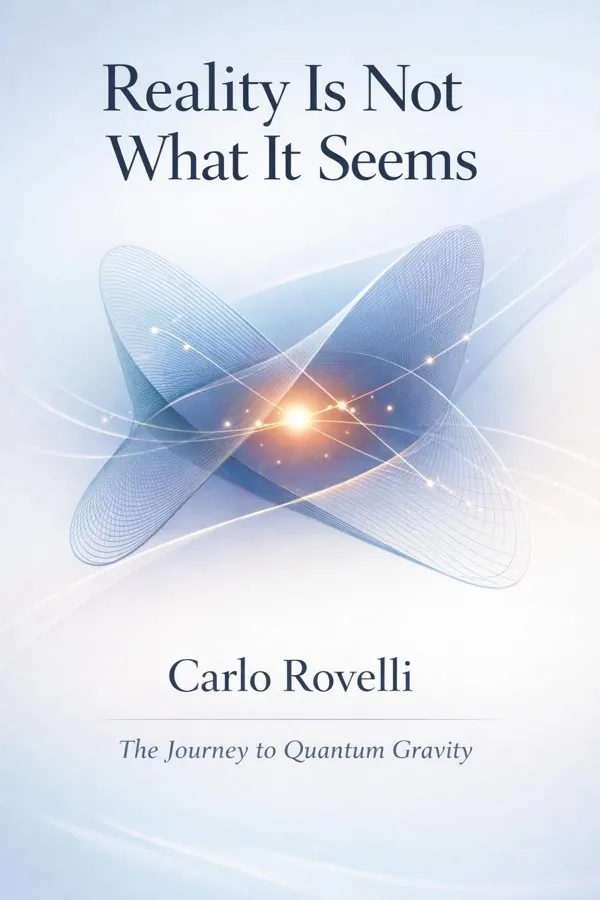
Reality Is Not What It Seems: The Journey to Quantum Gravity: Summary & Key Insights
 10 min9 chaptersAudio available
Key Takeaways from Reality Is Not What It Seems: The Journey to Quantum Gravity
The search for reality often begins when appearances stop being enough.
A revolution begins when observation becomes disciplined by mathematics.
One of the most shocking discoveries in physics is that space and time are not the fixed stage on which events unfold.
Reality becomes stranger still when we descend to the microscopic scale.
What if empty space is not truly empty?
What Is Reality Is Not What It Seems: The Journey to Quantum Gravity About?
Reality Is Not What It Seems: The Journey to Quantum Gravity by Carlo Rovelli is a space_physics book spanning 11 pages. Reality Is Not What It Seems is Carlo Rovelli’s sweeping attempt to answer one of the oldest and most unsettling human questions: what is the world really made of? Moving from ancient Greek atomism to Einstein’s relativity, quantum mechanics, and the modern search for quantum gravity, Rovelli shows how each scientific revolution has stripped away another layer of common sense. What seems stable, solid, and obvious turns out to be far stranger: space may be granular, time may not be fundamental, and reality may consist not of things but of relationships and events. The book matters because it does more than explain advanced physics. It challenges the assumptions that shape everyday thinking and invites readers to see the universe as dynamic, interconnected, and still deeply mysterious. Rovelli is uniquely qualified to guide this journey. As one of the leading figures in loop quantum gravity, he has helped develop one of the most ambitious theories aimed at unifying general relativity and quantum mechanics. Yet he also writes with unusual clarity and philosophical depth, making some of the hardest ideas in science feel intellectually thrilling rather than forbidding.
This FizzRead summary covers all 9 key chapters of Reality Is Not What It Seems: The Journey to Quantum Gravity in approximately 10 minutes, distilling the most important ideas, arguments, and takeaways from Carlo Rovelli's work. Also available as an audio summary and Key Quotes Podcast.
Reality Is Not What It Seems: The Journey to Quantum Gravity
Reality Is Not What It Seems is Carlo Rovelli’s sweeping attempt to answer one of the oldest and most unsettling human questions: what is the world really made of? Moving from ancient Greek atomism to Einstein’s relativity, quantum mechanics, and the modern search for quantum gravity, Rovelli shows how each scientific revolution has stripped away another layer of common sense. What seems stable, solid, and obvious turns out to be far stranger: space may be granular, time may not be fundamental, and reality may consist not of things but of relationships and events. The book matters because it does more than explain advanced physics. It challenges the assumptions that shape everyday thinking and invites readers to see the universe as dynamic, interconnected, and still deeply mysterious. Rovelli is uniquely qualified to guide this journey. As one of the leading figures in loop quantum gravity, he has helped develop one of the most ambitious theories aimed at unifying general relativity and quantum mechanics. Yet he also writes with unusual clarity and philosophical depth, making some of the hardest ideas in science feel intellectually thrilling rather than forbidding.
Who Should Read Reality Is Not What It Seems: The Journey to Quantum Gravity?
This book is perfect for anyone interested in space_physics and looking to gain actionable insights in a short read. Whether you're a student, professional, or lifelong learner, the key ideas from Reality Is Not What It Seems: The Journey to Quantum Gravity by Carlo Rovelli will help you think differently.
- ✓Readers who enjoy space_physics and want practical takeaways
- ✓Professionals looking to apply new ideas to their work and life
- ✓Anyone who wants the core insights of Reality Is Not What It Seems: The Journey to Quantum Gravity in just 10 minutes
Want the full summary?
Get instant access to this book summary and 100K+ more with Fizz Moment.
Get Free SummaryAvailable on App Store • Free to download
Key Chapters
A revolution begins when observation becomes disciplined by mathematics. Rovelli presents Galileo as a turning point because he changed not only what humans knew, but how they knew it. Instead of relying on inherited authority or pure speculation, Galileo tied careful measurement to mathematical description. This created modern science: a method capable of discovering patterns that senses alone cannot detect.
Galileo’s contribution was profound because he showed that nature can be read like a language written in quantitative relations. Falling bodies do not move according to medieval theories of purpose; they obey measurable regularities. The moon is not a perfect heavenly sphere but a physical object with mountains and craters. With this shift, the universe stopped being a symbolic order centered on human meaning and became a field of discoverable laws.
Rovelli highlights Galileo to show that scientific progress depends on humility. Reality does not adjust itself to our preferences. We must devise instruments, experiments, and equations that force us to correct ourselves. This method remains the backbone of physics today. Whether studying planetary motion, climate systems, or subatomic particles, the principle is the same: test ideas against the world.
In practical terms, Galileo’s lesson applies far beyond laboratories. Strong beliefs need evidence. Patterns should be measured, not merely assumed. If you want to improve a business process, a fitness plan, or a learning strategy, observation plus data beats guesswork. Reality is often more subtle than our first impressions.
Actionable takeaway: whenever you face uncertainty, imitate Galileo. Observe carefully, measure what you can, and let evidence refine your beliefs instead of defending assumptions out of habit.
One of the most shocking discoveries in physics is that space and time are not the fixed stage on which events unfold. Rovelli explains how Einstein overturned the Newtonian picture of an absolute universe with a universal clock and rigid background space. In relativity, measurements of distance, duration, and simultaneity depend on motion and gravity. There is no single cosmic viewpoint from which reality is cleanly ordered once and for all.
Special relativity shows that observers moving relative to one another do not agree on time intervals or lengths, yet the laws of physics remain consistent. General relativity goes further: gravity is not a force pulling objects through space, but the curvature of spacetime itself. Massive bodies shape the geometry around them, and that geometry guides motion. The Earth orbits the sun not because it is being tugged by an invisible string, but because it follows the curved structure of spacetime.
These ideas are not abstract curiosities. GPS satellites must account for relativistic effects or their location data would quickly become inaccurate. Clocks run differently at different speeds and gravitational strengths, and modern technology depends on recognizing that fact. Rovelli uses such examples to show that physics changes everyday life precisely because it dares to challenge common sense.
The deeper implication is philosophical. If there is no absolute frame, then perspective is built into the structure of reality. Knowledge becomes less about finding a God’s-eye view and more about understanding lawful relations among viewpoints. This prepares the reader for Rovelli’s later emphasis on relational reality.
Actionable takeaway: beware of assuming your perspective is the neutral one. In science and life alike, understanding often improves when you ask how the same situation looks from a different frame of reference.
Reality becomes stranger still when we descend to the microscopic scale. Rovelli describes quantum mechanics as the moment physics discovered that the world cannot be fully described in the neat, deterministic terms of classical thought. At small scales, particles behave like waves, outcomes can only be assigned probabilities, and observation is tied to interaction in ways that unsettle ordinary ideas about objects having definite properties at all times.
The key point is not that quantum theory says anything goes. On the contrary, it is one of the most precise and successful theories ever built. What it changes is the picture of what exists. An electron is not a tiny billiard ball with a fully determined path independent of all context. Quantum systems are described through possibilities, and what becomes actual depends on interactions. This is why quantum phenomena can look paradoxical when forced into classical language.
Rovelli’s gift is to keep the mystery without turning it into mysticism. Quantum mechanics powers lasers, semiconductors, MRI machines, and much of modern electronics. Our phones and computers work because nature is quantum, not because classical intuition was right. The lesson is practical as well as conceptual: useful understanding does not always require comforting imagery.
Quantum theory also teaches intellectual discipline. When reality violates inherited categories, the task is not to preserve the categories at any cost. It is to develop better ones. This is central to Rovelli’s broader argument that many features we take as basic, including time and space, may be emergent rather than fundamental.
Actionable takeaway: when a problem resists familiar models, do not force reality into old frameworks. Be willing to update the framework itself.
What if empty space is not truly empty? Rovelli explains how modern physics replaced the old image of isolated particles moving through a void with a world of fields. In this view, electromagnetic, gravitational, and matter phenomena are excitations of underlying fields spread throughout the universe. A particle is not a tiny standalone object so much as a localized quantum of a field.
This shift matters because it changes how we imagine substance. The vacuum is not a blank container. It has structure, fluctuations, and measurable effects. Quantum field theory reveals a universe woven from interacting fields, where what appears as solid matter emerges from deeper processes. Rovelli then extends this insight toward quantum gravity: if everything else is quantized, why should spacetime itself remain smooth and continuous?
Here the book points toward a radical possibility. Space may have an atomic structure of its own, composed of minimal units rather than infinitely divisible extension. Just as matter once seemed continuous until atomic theory matured, space may also be granular at the smallest scales. This idea helps address the conflict between general relativity, which treats spacetime as smooth geometry, and quantum theory, which insists that nature comes in discrete quanta.
Practical applications are indirect but powerful. Technologies built from quantum field theory already shape modern life. More broadly, the idea that apparent continuity may conceal discrete structure shows up in digital imaging, computing, and network science. Smooth surfaces on screens are made of pixels; continuous audio becomes samples. Scale changes understanding.
Actionable takeaway: whenever something looks seamless, consider whether it may emerge from smaller interacting units. Looking for hidden structure often reveals better explanations and better tools.
The heart of Rovelli’s book is a daring proposal: space itself may be made of tiny quanta linked in networks. This is the core of loop quantum gravity, the research program to which Rovelli has made major contributions. The theory tries to unify general relativity and quantum mechanics not by adding more dimensions or exotic entities first, but by quantizing geometry itself. In this picture, spacetime is not a smooth backdrop. It is built from discrete relational structures often described through spin networks and spin foams.
Why is this important? Because modern physics rests on two enormously successful theories that do not fit neatly together. General relativity describes gravity and the large-scale structure of the cosmos. Quantum mechanics describes the microscopic world. But at extreme conditions, such as the birth of the universe or the interior of black holes, both should matter at once. A quantum theory of gravity is needed.
Loop quantum gravity suggests that area and volume come in finite units, much like energy comes in quanta. This may help resolve infinities that appear when we assume spacetime is continuous all the way down. It also opens new ways of thinking about black holes and the early universe, where classical concepts break down.
Rovelli does not pretend this is settled final truth. He presents it as a serious, elegant attempt to follow existing physics where it leads. That honesty is part of the book’s strength: science advances through bold models tested against evidence, not through certainty before discovery.
Actionable takeaway: appreciate unfinished knowledge. In difficult fields, progress often comes from learning to work productively with incomplete but promising models rather than waiting for perfect answers.
Few ideas are more unsettling than the possibility that time is not a basic ingredient of the universe. Rovelli argues that our familiar sense of flowing time may arise from more fundamental processes rather than existing at the deepest level of reality. In certain formulations of quantum gravity, the equations describing the universe do not contain time in the ordinary sense. This does not mean change is unreal. It means change may not require a universal ticking background clock.
In everyday life, time feels obvious. We remember the past, anticipate the future, and experience a present moment. But physics complicates that experience. Relativity already tells us there is no single universal present shared by all observers. Thermodynamics explains part of time’s arrow through entropy: we distinguish past from future because disorder tends to increase. Rovelli pushes further, suggesting that temporal order may emerge from relations among events and from the limited perspective of systems like us.
This idea has practical resonance because much human stress comes from treating time as a rigid external master. Physics does not eliminate schedules or aging, but it does weaken the intuition that reality itself is built around the way human consciousness parcels moments. Many systems we use already rely on relational timing rather than absolute simultaneity: distributed computer networks, satellite coordination, and synchronization protocols all work by managing relations among clocks.
Rovelli’s broader lesson is intellectual flexibility. Concepts that feel indispensable may turn out to be local, useful approximations rather than universal truths. That is one of science’s most humbling achievements.
Actionable takeaway: separate direct experience from fundamental explanation. What feels basic in daily life may still be emergent, so hold even your deepest assumptions with curiosity rather than rigidity.
Perhaps the book’s most profound philosophical claim is that the world is made less of independent things than of interactions and relations. Rovelli’s relational approach grows out of both relativity and quantum theory. In relativity, properties like duration and distance depend on the relation between observer and observed. In quantum theory, what can be said about a system depends on the interactions through which information becomes defined. Reality, then, is not a warehouse of self-contained objects carrying all properties internally. It is a web of events in mutual connection.
This changes how we think about identity. A table seems like a thing, but physics describes it through forces, fields, particles, and interactions. A person is not merely a static object either, but an ongoing process linked biologically, socially, and environmentally to countless other processes. Rovelli does not erase the world of ordinary objects; he explains it as a higher-level stability emerging from deeper relational patterns.
This idea has wide application. In ecology, the health of one species depends on networks of interdependence. In economics, prices and value arise from systems of exchange rather than isolated essence. In personal life, meaning often comes less from possessions than from relationships and shared experiences. A relational ontology offers a scientific picture with ethical overtones: separation may be less fundamental than connection.
The concept also disciplines thought. When something seems puzzling, ask not only what it is, but what relations make it what it is. Many problems become clearer once framed in terms of networks, interactions, and context instead of isolated units.
Actionable takeaway: practice relational thinking. In any complex situation, map the key interactions shaping outcomes. You will often understand the system better than by focusing on individual parts alone.
The deepest science does not end mystery; it refines it. Rovelli closes with a blend of physics and philosophy, reminding readers that human knowledge is powerful precisely because it is limited, provisional, and self-correcting. We are finite beings on a small planet, yet we have uncovered astonishing truths about stars, atoms, black holes, and the possible quantum texture of space. The grandeur of science lies not in possessing final answers, but in extending understanding while preserving wonder.
Rovelli resists two temptations. One is dogmatism, the claim that science has already explained everything important. The other is anti-intellectual resignation, the idea that because ultimate reality is hard to grasp, inquiry is futile. His position is more subtle. We know a great deal, but every breakthrough also reveals deeper questions. The universe is intelligible in part, and that partial intelligibility is enough to inspire both rigor and awe.
This perspective has practical value in an age of certainty theater. Many public debates reward confidence over truth-seeking. Rovelli offers a healthier model: think boldly, test ideas carefully, and accept revision without humiliation. In education, leadership, and personal growth, this is a powerful habit. Curiosity plus humility beats certainty plus stagnation.
For readers, the final effect of the book is existential as much as scientific. If reality is stranger than it seems, then our task is not to defend comforting illusions, but to participate in the adventure of understanding. The unknown is not a threat to meaning; it is one of its richest sources.
Actionable takeaway: cultivate informed wonder. Learn deeply, question honestly, and let uncertainty motivate exploration rather than fear.
All Chapters in Reality Is Not What It Seems: The Journey to Quantum Gravity
About the Author
Carlo Rovelli is an Italian theoretical physicist best known for his pioneering work on loop quantum gravity, one of the leading approaches to unifying quantum mechanics and general relativity. He has taught and conducted research at major institutions in Europe, including Aix-Marseille University, and is widely recognized as both a serious scientist and an exceptional public intellectual. Rovelli has a rare gift for explaining difficult ideas in physics with clarity, elegance, and philosophical depth. His books, lectures, and essays have introduced broad audiences to concepts such as spacetime, quantum uncertainty, and the nature of time itself. In addition to his scientific achievements, he is admired for presenting science not as a collection of cold facts, but as a creative, human effort to understand a mysterious and beautiful universe.
Get This Summary in Your Preferred Format
Read or listen to the Reality Is Not What It Seems: The Journey to Quantum Gravity summary by Carlo Rovelli anytime, anywhere. FizzRead offers multiple formats so you can learn on your terms — all free.
Available formats: App · Audio · PDF · EPUB — All included free with FizzRead
Download Reality Is Not What It Seems: The Journey to Quantum Gravity PDF and EPUB Summary
Key Quotes from Reality Is Not What It Seems: The Journey to Quantum Gravity
“The search for reality often begins when appearances stop being enough.”
“A revolution begins when observation becomes disciplined by mathematics.”
“One of the most shocking discoveries in physics is that space and time are not the fixed stage on which events unfold.”
“Reality becomes stranger still when we descend to the microscopic scale.”
“Rovelli explains how modern physics replaced the old image of isolated particles moving through a void with a world of fields.”
Frequently Asked Questions about Reality Is Not What It Seems: The Journey to Quantum Gravity
Reality Is Not What It Seems: The Journey to Quantum Gravity by Carlo Rovelli is a space_physics book that explores key ideas across 9 chapters. Reality Is Not What It Seems is Carlo Rovelli’s sweeping attempt to answer one of the oldest and most unsettling human questions: what is the world really made of? Moving from ancient Greek atomism to Einstein’s relativity, quantum mechanics, and the modern search for quantum gravity, Rovelli shows how each scientific revolution has stripped away another layer of common sense. What seems stable, solid, and obvious turns out to be far stranger: space may be granular, time may not be fundamental, and reality may consist not of things but of relationships and events. The book matters because it does more than explain advanced physics. It challenges the assumptions that shape everyday thinking and invites readers to see the universe as dynamic, interconnected, and still deeply mysterious. Rovelli is uniquely qualified to guide this journey. As one of the leading figures in loop quantum gravity, he has helped develop one of the most ambitious theories aimed at unifying general relativity and quantum mechanics. Yet he also writes with unusual clarity and philosophical depth, making some of the hardest ideas in science feel intellectually thrilling rather than forbidding.
More by Carlo Rovelli
You Might Also Like
The Means Of Prediction
Mark P. Silverman
10 min
AstroTech
Various Authors
10 min
Black Holes and Time Warps: Einstein’s Outrageous Legacy
Kip S. Thorne
10 min
Dark Matter and the Dinosaurs: The Astounding Interconnectedness of the Universe
Lisa Randall
10 min
Helgoland
Carlo Rovelli
10 min
Hyperspace: A Scientific Odyssey Through Parallel Universes, Time Warps, and the 10th Dimension
Michio Kaku
10 minBrowse by Category
Ready to read Reality Is Not What It Seems: The Journey to Quantum Gravity?
Get the full summary and 100K+ more books with Fizz Moment.