
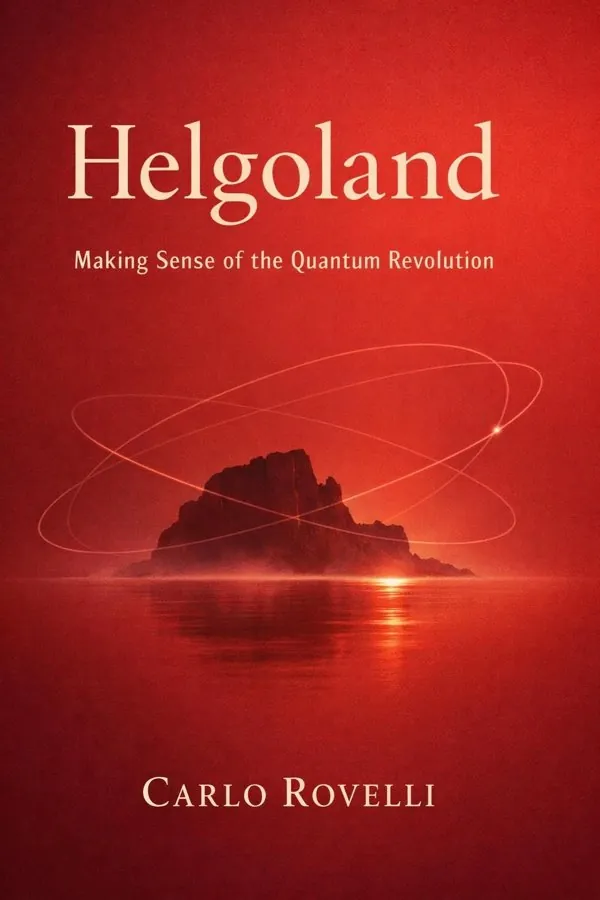
Helgoland: Making Sense of the Quantum Revolution: Summary & Key Insights
 10 min6 chaptersAudio available
What Is Helgoland: Making Sense of the Quantum Revolution About?
Helgoland: Making Sense of the Quantum Revolution by Carlo Rovelli is a popular_sci book spanning 6 pages. Helgoland is a work of popular science by theoretical physicist Carlo Rovelli that explores the origins of quantum mechanics. The book recounts how Werner Heisenberg, in 1925 on the island of Helgoland, developed the ideas that would revolutionize modern physics. Rovelli offers a philosophical and scientific reflection on the nature of reality, interpreting quantum theory as a relational view of the world.
This FizzRead summary covers all 6 key chapters of Helgoland: Making Sense of the Quantum Revolution in approximately 10 minutes, distilling the most important ideas, arguments, and takeaways from Carlo Rovelli's work. Also available as an audio summary and Key Quotes Podcast.
Helgoland: Making Sense of the Quantum Revolution
Helgoland is a work of popular science by theoretical physicist Carlo Rovelli that explores the origins of quantum mechanics. The book recounts how Werner Heisenberg, in 1925 on the island of Helgoland, developed the ideas that would revolutionize modern physics. Rovelli offers a philosophical and scientific reflection on the nature of reality, interpreting quantum theory as a relational view of the world.
Who Should Read Helgoland: Making Sense of the Quantum Revolution?
This book is perfect for anyone interested in popular_sci and looking to gain actionable insights in a short read. Whether you're a student, professional, or lifelong learner, the key ideas from Helgoland: Making Sense of the Quantum Revolution by Carlo Rovelli will help you think differently.
- ✓Readers who enjoy popular_sci and want practical takeaways
- ✓Professionals looking to apply new ideas to their work and life
- ✓Anyone who wants the core insights of Helgoland: Making Sense of the Quantum Revolution in just 10 minutes
Want the full summary?
Get instant access to this book summary and 100K+ more with Fizz Moment.
Get Free SummaryAvailable on App Store • Free to download
Key Chapters
At the turn of the twentieth century, physics stood at the height of triumph. Newton’s equations, Maxwell’s electromagnetic theory, and Einstein’s relativity seemed to have tamed the universe. Yet hidden in the atom, an unease stirred. Electrons refused to behave. They jumped, flickered, and scattered in ways no classical law could predict. The orbits that theorists drew could not explain the emission spectra observed in laboratories. Attempts to reconcile these failures left physicists trapped between intuition and the data. It was in this crisis that Heisenberg, retreating to Helgoland, undertook his radical simplification.
His idea was elemental: discard what we cannot observe. The electron’s path around the nucleus — who has ever seen it? He chose instead to describe only events that are measured: emissions and absorptions, transitions, and frequencies. The mathematics that emerged was nonvisual, abstract, strange. In his feverish notes, Heisenberg constructed what Max Born later recognized as matrix mechanics — an entirely new representation of physical reality. The world, as it turned out, could no longer be described as a collection of objects moving through space, but as a web of interactions represented through algebra. The very act of observation became woven into the fabric of what is observed.
I see this moment as not merely a technical leap, but a philosophical awakening. Through Heisenberg’s matrices, nature itself refused to submit to imagery. No longer could we imagine particles as tiny balls orbiting like planets. The quantum world is not made of objects but of relationships. That, I believe, is the true meaning of Helgoland: an island of clarity in a sea of old assumptions.
The young pioneers of quantum mechanics were, in truth, philosophers in disguise. Bohr insisted that the act of measurement is integral to reality: what is measured cannot be separated from how it is measured. Born formulated the probabilistic nature of quantum outcomes — not a hidden determinism, but a world built on possibilities. And Schrödinger, seeking continuity, proposed his wave equation, a new mathematical vision that seemed to restore the smoothness Heisenberg had abandoned. Yet even he found that his waves corresponded not to real physical undulations, but to probabilities — abstractions, conditional on observation.
Their debates were fierce and transformative. They forced physicists to ask: what does it mean to ‘be’? Is the cat alive or dead before we look? Do particles exist before being measured? In addressing such questions, quantum mechanics dissolved the last vestiges of classical objectivity. Where Newton saw universal laws that governed motion independently of observers, quantum theory revealed laws that depend on interaction. To measure is to define; to observe is to create a context in which properties appear.
In my own reflection, these voices converge toward the relational interpretation — what I have called ‘relational quantum mechanics’. Bohr’s complementarity, Born’s probabilities, Schrödinger’s waves — these were early forms of the idea that reality does not exist in isolation but only as the sum of interrelations. Helgoland thus becomes a metaphor for this interconnectedness: as Heisenberg stood on that rock, physically separated, he was preparing a theory that would unite all things through their relations.
+ 4 more chapters — available in the FizzRead app
All Chapters in Helgoland: Making Sense of the Quantum Revolution
About the Author
Carlo Rovelli is an Italian theoretical physicist known for his contributions to loop quantum gravity and for his work as a science communicator. He is a professor at Aix-Marseille University and the author of several acclaimed books, including 'Seven Brief Lessons on Physics' and 'The Order of Time'.
Get This Summary in Your Preferred Format
Read or listen to the Helgoland: Making Sense of the Quantum Revolution summary by Carlo Rovelli anytime, anywhere. FizzRead offers multiple formats so you can learn on your terms — all free.
Available formats: App · Audio · PDF · EPUB — All included free with FizzRead
Download Helgoland: Making Sense of the Quantum Revolution PDF and EPUB Summary
Key Quotes from Helgoland: Making Sense of the Quantum Revolution
“At the turn of the twentieth century, physics stood at the height of triumph.”
“The young pioneers of quantum mechanics were, in truth, philosophers in disguise.”
Frequently Asked Questions about Helgoland: Making Sense of the Quantum Revolution
Helgoland: Making Sense of the Quantum Revolution by Carlo Rovelli is a popular_sci book that explores key ideas across 6 chapters. Helgoland is a work of popular science by theoretical physicist Carlo Rovelli that explores the origins of quantum mechanics. The book recounts how Werner Heisenberg, in 1925 on the island of Helgoland, developed the ideas that would revolutionize modern physics. Rovelli offers a philosophical and scientific reflection on the nature of reality, interpreting quantum theory as a relational view of the world.
More by Carlo Rovelli

You Might Also Like

Structures: Or Why Things Don"t Fall Down
J.E. Gordon
10 min
The Road to Wigan Pier
George Orwell
10 min
Bonk: The Curious Coupling of Science and Sex
Mary Roach
10 min
First Bite: How We Learn to Eat
Bee Wilson
10 min
In Pursuit Of The Unknown: 17 Equations That Changed The World
Ian Stewart
10 min
Napoleon's Buttons: 17 Molecules That Changed History
Penny Le Couteur and Jay Burreson
10 minBrowse by Category
Ready to read Helgoland: Making Sense of the Quantum Revolution?
Get the full summary and 100K+ more books with Fizz Moment.