
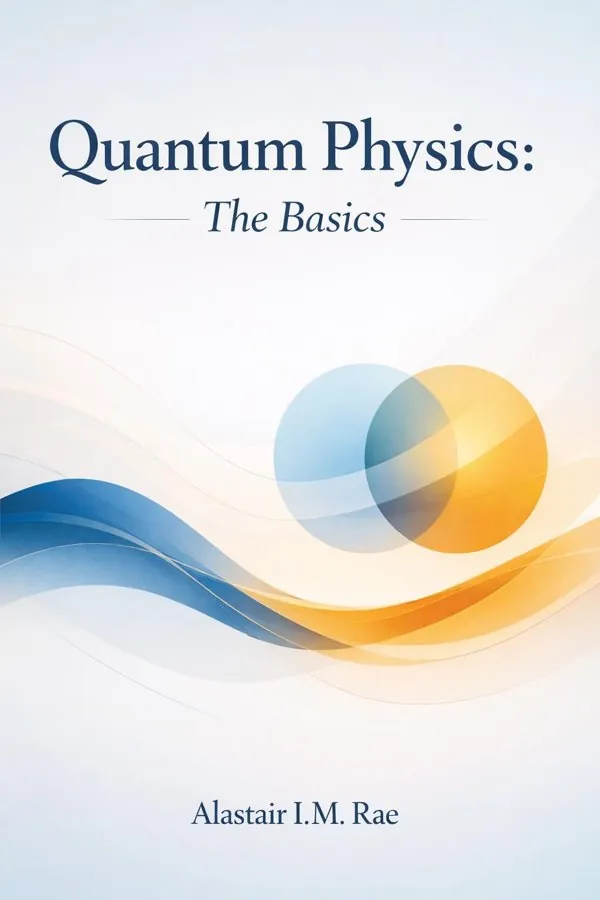
Quantum Physics: The Basics: Summary & Key Insights
 10 min7 chaptersAudio available
What Is Quantum Physics: The Basics About?
Quantum Physics: The Basics by Alastair I.M. Rae is a space_physics book spanning 7 pages. This introductory text provides a concise and accessible overview of quantum physics, explaining the fundamental principles and key experiments that underpin the field. It covers topics such as wave-particle duality, uncertainty, quantum states, and entanglement, offering clear explanations suitable for students and general readers seeking to understand the basics of quantum theory.
This FizzRead summary covers all 7 key chapters of Quantum Physics: The Basics in approximately 10 minutes, distilling the most important ideas, arguments, and takeaways from Alastair I.M. Rae's work. Also available as an audio summary and Key Quotes Podcast.
Quantum Physics: The Basics
This introductory text provides a concise and accessible overview of quantum physics, explaining the fundamental principles and key experiments that underpin the field. It covers topics such as wave-particle duality, uncertainty, quantum states, and entanglement, offering clear explanations suitable for students and general readers seeking to understand the basics of quantum theory.
Who Should Read Quantum Physics: The Basics?
This book is perfect for anyone interested in space_physics and looking to gain actionable insights in a short read. Whether you're a student, professional, or lifelong learner, the key ideas from Quantum Physics: The Basics by Alastair I.M. Rae will help you think differently.
- ✓Readers who enjoy space_physics and want practical takeaways
- ✓Professionals looking to apply new ideas to their work and life
- ✓Anyone who wants the core insights of Quantum Physics: The Basics in just 10 minutes
Want the full summary?
Get instant access to this book summary and 100K+ more with Fizz Moment.
Get Free SummaryAvailable on App Store • Free to download
Key Chapters
At the dawn of the twentieth century, classical physics seemed nearly complete. Scientists believed that the laws of mechanics and electromagnetism could explain all natural phenomena. Yet when they studied the radiation emitted by heated objects—so-called 'blackbody radiation'—they encountered something inexplicable. Classical theory predicted that energy radiated from such objects would increase indefinitely at high frequencies, an absurd result known as the 'ultraviolet catastrophe'. What was missing?
It was Max Planck who took the revolutionary step in 1900. To make sense of experimental data, he assumed that energy could exist only in discrete packets, or 'quanta'. This was not a gradual refinement but a radical departure: it meant that nature herself was quantized. The amount of energy emitted or absorbed by an atom was proportional to its frequency via Planck’s constant, h. That constant—tiny but fundamental—opened a new era. Planck did not yet grasp the full implications of his idea. But he had planted the seed of quantum theory.
This step forced physicists to question whether energy and matter behaved continuously, as classical physics insisted. Soon after, Einstein applied Planck’s idea to light itself, proposing that it could behave as if made of particles—photons. That insight explained the photoelectric effect: light striking metal could eject electrons, but only if its frequency was above a certain threshold. The energy came in quanta, not in waves spreading smoothly in space. Thus, quantum physics began as an answer to a simple but stubborn empirical puzzle, and it would grow to overturn the entire foundation of physical realism.
Einstein’s photon theory hinted that light could behave both like a wave and a particle, depending on how it was measured. Later experiments, such as those with electrons passing through a double slit, showed that matter itself exhibited this duality. When electrons are fired at a screen with two slits, they form an interference pattern typical of waves. Yet when we observe which slit they pass through, the pattern disappears—they behave like particles.
This dual character lies at the heart of quantum physics. What it tells us is that particles don’t possess definite properties independent of observation. Instead, quantum entities exist in states described by wavefunctions—mathematical objects encoding probabilities, not certainties. The wave nature of electrons explains why atoms have stable energy levels: their wavefunctions can form standing patterns around the nucleus. In this sense, quantum physics replaces the deterministic universe of Newton with one governed by probabilities and potentialities.
One must learn to accept that nature doesn’t reveal everything at once. Light, electrons, and even atoms can act like spread-out waves when unobserved and localized particles when measured. This idea is not mere abstraction—it has been verified countless times. In fact, technologies from electron microscopes to semiconductors depend on it. As you read this, you are already benefiting from the dual nature of matter every time you turn on a light or open your computer.
+ 5 more chapters — available in the FizzRead app
All Chapters in Quantum Physics: The Basics
About the Author
Alastair I.M. Rae is a British physicist and academic known for his work in quantum mechanics and science education. He has authored several books aimed at making complex physical concepts accessible to a broad audience and has served as a lecturer at the University of Birmingham.
Get This Summary in Your Preferred Format
Read or listen to the Quantum Physics: The Basics summary by Alastair I.M. Rae anytime, anywhere. FizzRead offers multiple formats so you can learn on your terms — all free.
Available formats: App · Audio · PDF · EPUB — All included free with FizzRead
Download Quantum Physics: The Basics PDF and EPUB Summary
Key Quotes from Quantum Physics: The Basics
“At the dawn of the twentieth century, classical physics seemed nearly complete.”
“Einstein’s photon theory hinted that light could behave both like a wave and a particle, depending on how it was measured.”
Frequently Asked Questions about Quantum Physics: The Basics
Quantum Physics: The Basics by Alastair I.M. Rae is a space_physics book that explores key ideas across 7 chapters. This introductory text provides a concise and accessible overview of quantum physics, explaining the fundamental principles and key experiments that underpin the field. It covers topics such as wave-particle duality, uncertainty, quantum states, and entanglement, offering clear explanations suitable for students and general readers seeking to understand the basics of quantum theory.
You Might Also Like
The Means Of Prediction
Mark P. Silverman
10 min
AstroTech
Various Authors
10 min
Black Holes and Time Warps: Einstein’s Outrageous Legacy
Kip S. Thorne
10 min
Dark Matter and the Dinosaurs: The Astounding Interconnectedness of the Universe
Lisa Randall
10 min
Helgoland
Carlo Rovelli
10 min
Hyperspace: A Scientific Odyssey Through Parallel Universes, Time Warps, and the 10th Dimension
Michio Kaku
10 minBrowse by Category
Ready to read Quantum Physics: The Basics?
Get the full summary and 100K+ more books with Fizz Moment.