
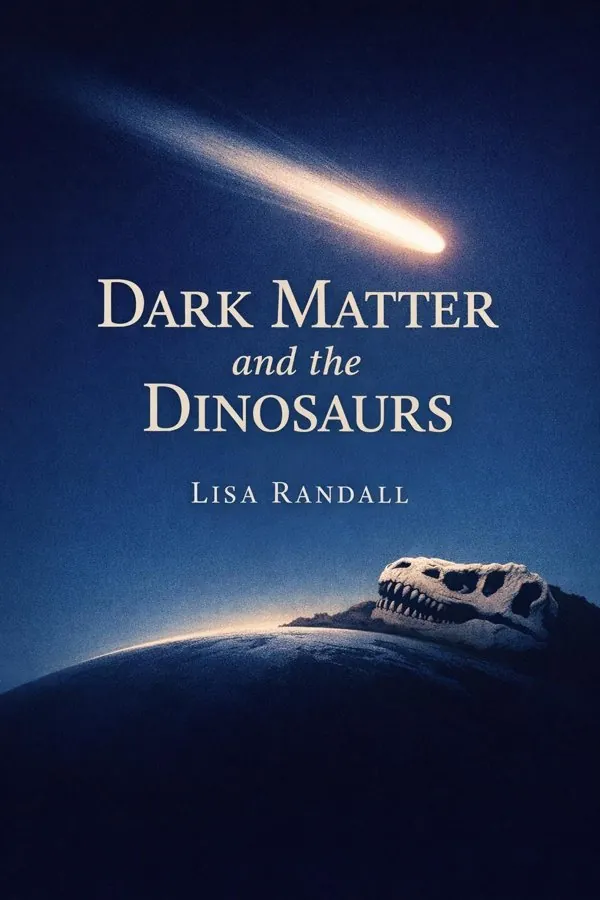
Dark Matter and the Dinosaurs: The Astounding Interconnectedness of the Universe: Summary & Key Insights
by Lisa Randall
 10 min9 chaptersAudio available
Key Takeaways from Dark Matter and the Dinosaurs: The Astounding Interconnectedness of the Universe
Life on Earth often feels self-contained, as if biology unfolds according to local rules alone.
Some of the universe’s most important ingredients cannot be seen directly.
We often picture the solar system as stable and isolated, but Randall reminds us that the Sun is on a long, complex journey through the Milky Way.
One of Randall’s most distinctive proposals is that dark matter might not be distributed only in a diffuse halo around the galaxy.
A comet impact can appear like pure chance from the perspective of any one century, but Randall asks whether comet showers may have deeper causes.
What Is Dark Matter and the Dinosaurs: The Astounding Interconnectedness of the Universe About?
Dark Matter and the Dinosaurs: The Astounding Interconnectedness of the Universe by Lisa Randall is a space_physics book spanning 9 pages. In Dark Matter and the Dinosaurs, Lisa Randall takes an audacious scientific question and turns it into an unforgettable intellectual journey: could an invisible form of matter in our galaxy have helped trigger the asteroid impact that ended the age of dinosaurs? Blending cosmology, particle physics, astronomy, geology, and paleontology, Randall argues that Earth’s history cannot be fully understood in isolation. Our planet moves through a dynamic galactic environment, and that larger cosmic setting may occasionally shape the course of life itself. Rather than presenting a sensational claim, she carefully walks readers through the evidence, the uncertainties, and the logic that connects seemingly unrelated fields. The result is both a mystery story and a lesson in how modern science works. Randall is uniquely qualified to lead this exploration. As a Harvard theoretical physicist renowned for her work in particle physics and cosmology, she brings deep expertise along with a rare ability to explain complex ideas clearly. This book matters because it expands our sense of causation, showing that the history of life may be linked to structures far beyond Earth.
This FizzRead summary covers all 9 key chapters of Dark Matter and the Dinosaurs: The Astounding Interconnectedness of the Universe in approximately 10 minutes, distilling the most important ideas, arguments, and takeaways from Lisa Randall's work. Also available as an audio summary and Key Quotes Podcast.
Dark Matter and the Dinosaurs: The Astounding Interconnectedness of the Universe
In Dark Matter and the Dinosaurs, Lisa Randall takes an audacious scientific question and turns it into an unforgettable intellectual journey: could an invisible form of matter in our galaxy have helped trigger the asteroid impact that ended the age of dinosaurs? Blending cosmology, particle physics, astronomy, geology, and paleontology, Randall argues that Earth’s history cannot be fully understood in isolation. Our planet moves through a dynamic galactic environment, and that larger cosmic setting may occasionally shape the course of life itself. Rather than presenting a sensational claim, she carefully walks readers through the evidence, the uncertainties, and the logic that connects seemingly unrelated fields. The result is both a mystery story and a lesson in how modern science works. Randall is uniquely qualified to lead this exploration. As a Harvard theoretical physicist renowned for her work in particle physics and cosmology, she brings deep expertise along with a rare ability to explain complex ideas clearly. This book matters because it expands our sense of causation, showing that the history of life may be linked to structures far beyond Earth.
Who Should Read Dark Matter and the Dinosaurs: The Astounding Interconnectedness of the Universe?
This book is perfect for anyone interested in space_physics and looking to gain actionable insights in a short read. Whether you're a student, professional, or lifelong learner, the key ideas from Dark Matter and the Dinosaurs: The Astounding Interconnectedness of the Universe by Lisa Randall will help you think differently.
- ✓Readers who enjoy space_physics and want practical takeaways
- ✓Professionals looking to apply new ideas to their work and life
- ✓Anyone who wants the core insights of Dark Matter and the Dinosaurs: The Astounding Interconnectedness of the Universe in just 10 minutes
Want the full summary?
Get instant access to this book summary and 100K+ more with Fizz Moment.
Get Free SummaryAvailable on App Store • Free to download
Key Chapters
Life on Earth often feels self-contained, as if biology unfolds according to local rules alone. Randall challenges that comforting intuition by showing that the history of life is repeatedly interrupted by events whose causes may originate far beyond our atmosphere. The fossil record is not a smooth tale of gradual change. It includes mass extinctions, sudden disruptions, and long recoveries that reshaped which organisms survived and evolved. The extinction of the dinosaurs is the most famous example, but it is part of a broader pattern in which planetary life remains vulnerable to forces outside ordinary ecological competition.
This matters because it changes how we think about causation. If a single asteroid impact can redirect evolution, then biology is inseparable from astronomy. Earth’s surface, climate, and ecosystems may be influenced not only by volcanoes, oceans, and tectonic plates, but also by orbital dynamics, comet reservoirs, and galactic motion. Randall invites readers to see natural history as a layered system in which small local processes and enormous cosmic structures interact.
A practical example is how scientists study extinction events today. Paleontologists do not only examine fossils and sediment; they also look for impact craters, iridium layers, isotope shifts, and timing patterns that might indicate extraterrestrial triggers. This interdisciplinary approach has already transformed our understanding of the end-Cretaceous extinction.
Randall’s broader point is not that every catastrophe comes from space, but that Earth is part of a larger physical network. To understand the past well, we must widen the frame. Actionable takeaway: when evaluating big historical changes, look beyond the immediate system and ask what external forces may be shaping outcomes from the outside.
Some of the universe’s most important ingredients cannot be seen directly. That is the paradox at the center of dark matter. Randall explains that dark matter does not emit, absorb, or reflect light the way ordinary matter does, which is why it remains invisible to telescopes. Yet its gravitational influence is unmistakable. Galaxies rotate too quickly for their visible mass alone to hold them together. Light bends around unseen mass in gravitational lensing. Large-scale cosmic structure forms in ways that strongly suggest a hidden scaffold of matter.
This idea is profound because it teaches a central scientific lesson: absence of direct visibility is not absence of reality. Science often works by inference. We believe in electrons, black holes, and ancient climates not because we can always observe them directly, but because their effects are measurable and consistent. Dark matter is one of the strongest examples of this method in modern physics.
Randall also emphasizes that dark matter is not just a theoretical convenience. It appears to make up far more of the universe’s matter than the familiar atoms in stars, planets, and people. In other words, the stuff we know best may be the exception rather than the rule. That shift in perspective is intellectually humbling.
A useful application of this idea is broader than astronomy. In medicine, economics, and climate science, major causes are often inferred from patterns rather than directly seen. Hidden variables matter. Randall uses dark matter to demonstrate how rigorous evidence can uncover an unseen world.
Actionable takeaway: do not dismiss a phenomenon simply because it is invisible; ask what measurable effects reveal its presence and what hidden structures might explain the data.
We often picture the solar system as stable and isolated, but Randall reminds us that the Sun is on a long, complex journey through the Milky Way. It orbits the galactic center while also bobbing up and down relative to the galactic plane. That motion means Earth’s environment is not fixed on the largest scales. Over millions of years, our solar system passes through regions of different density, gravitational influence, and cosmic surroundings.
This movement matters because periodic changes in the Sun’s galactic position could alter conditions in the outer solar system. Randall focuses especially on the idea that as the Sun crosses denser regions near the galactic midplane, gravitational disturbances may be more likely to shake distant icy bodies from their stable orbits. Those disturbed objects can become comets heading inward toward the planets.
The key insight is that long-term planetary risk may have a galactic rhythm. Not a simple clock, and not a guarantee, but a pattern created by motion through a structured galaxy. This reframes Earth’s history. Instead of seeing impact events as completely random, scientists can ask whether some are statistically linked to where the solar system is in its orbit.
A practical example is how researchers combine astronomical models with crater ages and extinction timelines. By comparing Earth’s geological record with models of solar motion, they test whether impact frequencies cluster at regular intervals. This is difficult work because dating uncertainties are large, but the approach demonstrates how one field can generate testable predictions in another.
Actionable takeaway: when something seems random over short timescales, consider whether a larger cycle becomes visible when you zoom out far enough.
One of Randall’s most distinctive proposals is that dark matter might not be distributed only in a diffuse halo around the galaxy. Some portion of it, she suggests, could form a thinner disk embedded within the Milky Way, somewhat analogous to the visible disk made of stars and gas. This idea depends on the possibility that dark matter is more complex than the simplest models assume. If part of it can interact with itself in certain ways, it could cool and settle into a denser layer.
Why does that matter? Because a denser dark matter disk would strengthen gravitational effects when the solar system passes through the galactic midplane. That extra pull could disturb the distant Oort Cloud, a vast reservoir of icy bodies at the solar system’s edge, increasing the chance that some comets are nudged inward. In Randall’s framework, the disk becomes a plausible mechanism linking galactic structure to periodic bombardment on Earth.
What makes this idea compelling is not certainty but testability. Randall does not present the dark matter disk as established fact. She presents it as a hypothesis that could explain multiple observations and that can be evaluated using improved astronomical data. For example, more precise mapping of stellar motions in the Milky Way can reveal how much unseen mass is concentrated near the galactic plane.
This is a useful illustration of how science progresses. Bold ideas are valuable when they generate predictions. In business, engineering, or research, the best hypotheses are not merely imaginative; they are structured so evidence can confirm or reject them.
Actionable takeaway: favor theories that do more than sound clever—choose ones that expose themselves to measurement, testing, and possible disproof.
A comet impact can appear like pure chance from the perspective of any one century, but Randall asks whether comet showers may have deeper causes. The Oort Cloud contains countless icy objects far from the Sun, loosely bound and vulnerable to disturbance. Passing stars, molecular clouds, and galactic tides can perturb these objects. If enough of them are deflected inward, the inner solar system may experience a heightened period of comet traffic rather than isolated accidents.
Randall’s argument is that galactic conditions may periodically increase the odds of such disturbances. If the solar system crosses a denser region of the galaxy, especially one containing a dark matter disk, gravitational nudges could cascade through the Oort Cloud. Most comets would still miss Earth entirely, but the statistical risk of impacts could rise.
This matters because it changes the way we think about rare events. Some catastrophes are not evenly distributed through time. They may cluster when a larger system enters a more dangerous phase. That concept applies far beyond astronomy. Financial crises, disease outbreaks, and infrastructure failures often look random until hidden structural conditions are examined.
A practical application is planetary defense. Understanding whether impact risk varies over geological timescales sharpens our picture of how solar system dynamics work and why continued observation of near-Earth objects matters. Even if Randall’s exact mechanism proves incomplete, the broader lesson stands: low-probability events deserve serious modeling when their consequences are enormous.
Actionable takeaway: treat rare but high-impact risks as systems problems—ask what background conditions make unlikely events more likely, and monitor those conditions before disaster arrives.
The asteroid or comet impact that ended the dinosaurs’ reign is one of the best-supported catastrophic events in Earth’s history. Evidence such as the Chicxulub crater, global iridium layers, shocked quartz, and abrupt fossil turnover makes the case for an impact overwhelmingly strong. Randall does not dispute that consensus. Instead, she asks a more ambitious question: what set the impactor on its path in the first place?
That distinction is crucial. Science often explains one layer of a problem while leaving deeper layers open. We know a large object struck Earth about 66 million years ago. But why then? Was it a statistical fluke, or part of a larger dynamical pattern in the solar system and galaxy? Randall proposes that the impact may have been connected to a comet shower triggered by the solar system’s passage through a denser galactic region.
This hypothesis adds context rather than replacing existing evidence. It links paleontology and geology to astrophysics, suggesting that extinction events may be understood at multiple scales: the local damage on Earth, the solar system dynamics that delivered the object, and the galactic structure that disturbed distant comet reservoirs.
A practical example of this layered thinking appears in modern hazard analysis. To understand a flood, wildfire, or blackout, we do not stop at the immediate trigger. We examine upstream systems, climate conditions, infrastructure design, and long-term patterns. Randall applies the same logic to deep time.
Actionable takeaway: when a major event seems explained, ask whether you have identified only the immediate cause or also the higher-level system that made the event possible.
One of the book’s most impressive achievements is methodological rather than speculative: it shows how real breakthroughs often happen at the borders between disciplines. Randall’s case depends on astronomy, particle physics, geology, paleontology, and statistics working together. No single field contains enough information to evaluate the hypothesis on its own. Fossils reveal extinctions, craters reveal impacts, galactic models reveal solar motion, and cosmology reveals the possible behavior of dark matter.
This interdisciplinary structure is both powerful and difficult. Each domain has uncertainties in dating, measurement, and interpretation. Geological records are incomplete. Crater ages have error bars. Galactic mass distributions are not known with perfect precision. Statistical patterns can be overinterpreted. Randall is careful to acknowledge these limitations, and that honesty strengthens the argument. Science becomes more credible when uncertainty is treated as information rather than embarrassment.
The practical significance is enormous. Many of the hardest modern questions—climate change, pandemics, AI safety, biodiversity collapse—cannot be solved within one intellectual silo. They require synthesis across methods, languages, and data sources. Randall’s work is a case study in how to build a broad explanatory framework without pretending certainty where none exists.
For readers, this is also a lesson in consuming scientific claims. Strong ideas are not made persuasive by confidence alone. They are persuasive when they integrate different kinds of evidence coherently while remaining open to revision.
Actionable takeaway: when confronting a complex problem, intentionally gather perspectives from multiple disciplines and pay close attention to how their evidence converges, conflicts, or leaves unresolved gaps.
Randall’s hypothesis points toward a broader frontier: understanding dark matter is not only a cosmological puzzle but a gateway to explaining structures and events throughout the universe. Physicists have proposed many candidates for dark matter, from weakly interacting particles to more intricate hidden-sector models. Experiments on Earth, observations of galaxies, and measurements of the cosmic microwave background all contribute pieces of the puzzle.
In the context of this book, better dark matter knowledge could help answer whether a dark disk exists, how much unseen mass lies near the galactic plane, and whether dark matter has interactions beyond gravity. Missions that map stellar positions and motions with great precision can reveal the Milky Way’s gravitational structure. Underground detectors can search for rare particle interactions. Collider experiments can constrain possible dark matter models. Each advance narrows the range of plausible explanations.
The larger insight is that fundamental science often produces unexpected downstream value. A question that sounds abstract—what is most of the matter in the universe made of?—can eventually influence how we understand galaxy formation, solar system history, and even the conditions that shaped life on Earth. Curiosity-driven research is not disconnected from reality; it expands reality.
A practical application for readers is intellectual patience. Some of the most important questions do not yield quick answers. Long-term research programs matter because they build cumulative power over decades.
Actionable takeaway: support and follow foundational research, especially when it seems abstract, because today’s basic science often becomes tomorrow’s explanatory framework for entirely different mysteries.
Perhaps the deepest message of the book is philosophical. Randall argues that the universe is not a collection of isolated compartments but an interconnected system in which events at one scale can influence outcomes at another. A galactic structure may shape comet trajectories; comet trajectories may alter Earth’s biological history; biological history eventually produces creatures capable of asking how any of this happened. The chain is astonishingly long, but it is not meaningless.
This perspective carries both humility and wonder. Humility, because human life is not insulated from the cosmos. Wonder, because the same laws of physics that govern invisible matter in the Milky Way may also help explain why mammals, and eventually humans, had the evolutionary opportunities they did after the dinosaurs disappeared. Randall does not turn this into mysticism. Her point is scientific: reality is more entangled across scales than common sense suggests.
This has practical value in everyday thinking. People often divide problems into separate boxes—personal, social, environmental, global—when in fact those boxes leak into one another. Systems thinking, whether applied to ecology, public health, or organizational design, starts with the recognition that distant causes can have local consequences.
The book therefore leaves readers with more than a hypothesis about dark matter. It offers a mental habit: widen the causal map. Ask what larger framework surrounds the event you care about and what hidden connections might be shaping it.
Actionable takeaway: practice systems thinking by tracing any major outcome through multiple scales, from immediate trigger to deeper structure, before deciding you fully understand it.
All Chapters in Dark Matter and the Dinosaurs: The Astounding Interconnectedness of the Universe
About the Author
Lisa Randall is an American theoretical physicist and professor at Harvard University, recognized as one of the most prominent voices in modern particle physics and cosmology. Her research has explored fundamental questions about the universe, including extra dimensions, dark matter, and the basic structure of matter and forces. In addition to her academic work, Randall is widely admired for translating complex scientific ideas into clear, engaging prose for general readers. Her books combine technical authority with intellectual curiosity, making frontier physics accessible without losing rigor. In Dark Matter and the Dinosaurs, she brings together expertise in cosmology and particle theory with a broad scientific outlook, showing how the invisible architecture of the universe may be connected to the history of life on Earth.
Get This Summary in Your Preferred Format
Read or listen to the Dark Matter and the Dinosaurs: The Astounding Interconnectedness of the Universe summary by Lisa Randall anytime, anywhere. FizzRead offers multiple formats so you can learn on your terms — all free.
Available formats: App · Audio · PDF · EPUB — All included free with FizzRead
Download Dark Matter and the Dinosaurs: The Astounding Interconnectedness of the Universe PDF and EPUB Summary
Key Quotes from Dark Matter and the Dinosaurs: The Astounding Interconnectedness of the Universe
“Life on Earth often feels self-contained, as if biology unfolds according to local rules alone.”
“Some of the universe’s most important ingredients cannot be seen directly.”
“We often picture the solar system as stable and isolated, but Randall reminds us that the Sun is on a long, complex journey through the Milky Way.”
“One of Randall’s most distinctive proposals is that dark matter might not be distributed only in a diffuse halo around the galaxy.”
“A comet impact can appear like pure chance from the perspective of any one century, but Randall asks whether comet showers may have deeper causes.”
Frequently Asked Questions about Dark Matter and the Dinosaurs: The Astounding Interconnectedness of the Universe
Dark Matter and the Dinosaurs: The Astounding Interconnectedness of the Universe by Lisa Randall is a space_physics book that explores key ideas across 9 chapters. In Dark Matter and the Dinosaurs, Lisa Randall takes an audacious scientific question and turns it into an unforgettable intellectual journey: could an invisible form of matter in our galaxy have helped trigger the asteroid impact that ended the age of dinosaurs? Blending cosmology, particle physics, astronomy, geology, and paleontology, Randall argues that Earth’s history cannot be fully understood in isolation. Our planet moves through a dynamic galactic environment, and that larger cosmic setting may occasionally shape the course of life itself. Rather than presenting a sensational claim, she carefully walks readers through the evidence, the uncertainties, and the logic that connects seemingly unrelated fields. The result is both a mystery story and a lesson in how modern science works. Randall is uniquely qualified to lead this exploration. As a Harvard theoretical physicist renowned for her work in particle physics and cosmology, she brings deep expertise along with a rare ability to explain complex ideas clearly. This book matters because it expands our sense of causation, showing that the history of life may be linked to structures far beyond Earth.
More by Lisa Randall
You Might Also Like
The Means Of Prediction
Mark P. Silverman
10 min
AstroTech
Various Authors
10 min
Black Holes and Time Warps: Einstein’s Outrageous Legacy
Kip S. Thorne
10 min
Helgoland
Carlo Rovelli
10 min
Hyperspace: A Scientific Odyssey Through Parallel Universes, Time Warps, and the 10th Dimension
Michio Kaku
10 min
Quantum Physics: The Basics
Alastair I.M. Rae
10 minBrowse by Category
Ready to read Dark Matter and the Dinosaurs: The Astounding Interconnectedness of the Universe?
Get the full summary and 100K+ more books with Fizz Moment.