
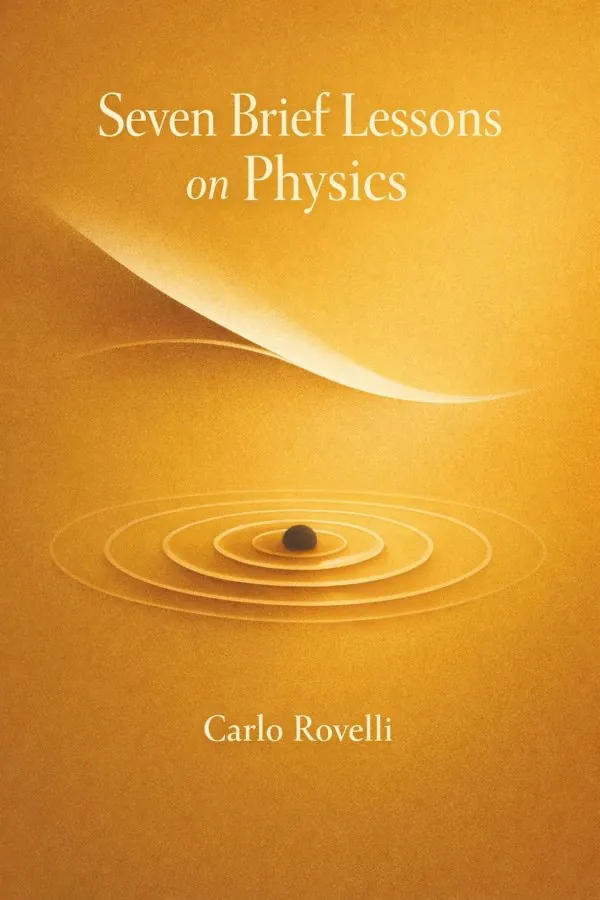
Seven Brief Lessons on Physics: Summary & Key Insights
 10 min9 chaptersAudio available
Key Takeaways from Seven Brief Lessons on Physics
What if space and time are not the fixed backdrop of the universe, but active participants in what happens?
At the smallest scales, reality stops behaving the way common sense expects.
The universe is not a static container filled with stars.
The deeper physics goes, the less the world resembles the objects of everyday experience.
The greatest theories of modern physics are both magnificent and incomplete.
What Is Seven Brief Lessons on Physics About?
Seven Brief Lessons on Physics by Carlo Rovelli is a popular_sci book spanning 8 pages. Seven Brief Lessons on Physics is a short book with an unusually large ambition: to help ordinary readers grasp the deepest ideas of modern science without reducing them to dry formulas or technical jargon. In just a handful of compact chapters, Carlo Rovelli introduces relativity, quantum mechanics, the structure of the cosmos, elementary particles, black holes, quantum gravity, and the strange nature of time. But this is not merely a simplified science lesson. It is also an invitation to wonder. Rovelli shows that physics is not a finished catalog of facts but a living human effort to understand a universe far more subtle, dynamic, and surprising than common sense suggests. The book matters because these theories do more than explain stars or atoms; they change how we think about reality, certainty, and our place in the cosmos. Rovelli is uniquely qualified to guide this journey. As a leading theoretical physicist and one of the founders of loop quantum gravity, he combines scientific authority with lyrical clarity, making some of the hardest ideas in science feel intimate, vivid, and profoundly meaningful.
This FizzRead summary covers all 9 key chapters of Seven Brief Lessons on Physics in approximately 10 minutes, distilling the most important ideas, arguments, and takeaways from Carlo Rovelli's work. Also available as an audio summary and Key Quotes Podcast.
Seven Brief Lessons on Physics
Seven Brief Lessons on Physics is a short book with an unusually large ambition: to help ordinary readers grasp the deepest ideas of modern science without reducing them to dry formulas or technical jargon. In just a handful of compact chapters, Carlo Rovelli introduces relativity, quantum mechanics, the structure of the cosmos, elementary particles, black holes, quantum gravity, and the strange nature of time. But this is not merely a simplified science lesson. It is also an invitation to wonder. Rovelli shows that physics is not a finished catalog of facts but a living human effort to understand a universe far more subtle, dynamic, and surprising than common sense suggests. The book matters because these theories do more than explain stars or atoms; they change how we think about reality, certainty, and our place in the cosmos. Rovelli is uniquely qualified to guide this journey. As a leading theoretical physicist and one of the founders of loop quantum gravity, he combines scientific authority with lyrical clarity, making some of the hardest ideas in science feel intimate, vivid, and profoundly meaningful.
Who Should Read Seven Brief Lessons on Physics?
This book is perfect for anyone interested in popular_sci and looking to gain actionable insights in a short read. Whether you're a student, professional, or lifelong learner, the key ideas from Seven Brief Lessons on Physics by Carlo Rovelli will help you think differently.
- ✓Readers who enjoy popular_sci and want practical takeaways
- ✓Professionals looking to apply new ideas to their work and life
- ✓Anyone who wants the core insights of Seven Brief Lessons on Physics in just 10 minutes
Want the full summary?
Get instant access to this book summary and 100K+ more with Fizz Moment.
Get Free SummaryAvailable on App Store • Free to download
Key Chapters
What if space and time are not the fixed backdrop of the universe, but active participants in what happens? That is the revolutionary insight at the heart of Einstein’s general theory of relativity, and it is the first great lesson Rovelli explores. Before Einstein, physics largely followed Newton’s picture of the world: objects moved through a rigid arena called space, while time flowed uniformly everywhere, independent of matter. Einstein shattered that image. He showed that space and time are woven together into a flexible fabric, space-time, and that this fabric bends in the presence of mass and energy. Gravity is not a mysterious pulling force acting at a distance; it is the effect of curved space-time guiding the motion of bodies.
This idea explains why planets orbit stars, why light bends near massive objects, and why time itself passes differently depending on speed and gravity. GPS technology is a practical example. Satellites experience time slightly differently from clocks on Earth, and without corrections based on relativity, navigation systems would quickly drift off course. The theory is therefore not just philosophically stunning; it is operationally essential.
Rovelli’s gift is to make this upheaval feel both elegant and human. He reminds us that scientific progress often requires abandoning what seems obvious. The Earth does not sit at the center of the cosmos, and neither do our everyday intuitions. General relativity reveals a universe that is fluid, relational, and responsive.
Actionable takeaway: When confronting complex problems, question the “background assumptions” you take for granted. Progress often begins when you realize the stage itself may be changing.
At the smallest scales, reality stops behaving the way common sense expects. That is the disorienting and liberating lesson of quantum mechanics. Rovelli presents quantum theory not as a bag of odd tricks but as a profound revision of how nature works. In the quantum world, particles are not tiny billiard balls with fixed locations and predictable paths. They behave like waves, appear in probabilistic states, and become definite only through interactions. The universe, at its foundation, is not made of solid certainty but of possibilities that crystallize in specific events.
This does not mean “anything goes.” Quantum mechanics is one of the most accurate theories ever developed. It predicts phenomena with astonishing precision and underlies much of modern technology. Semiconductors, lasers, MRI machines, and much of contemporary electronics depend on quantum principles. Your smartphone exists because engineers learned how quantum behavior governs electrons inside materials.
Rovelli emphasizes the humility quantum theory demands. We cannot always ask where a particle “really is” in classical terms, because those terms may not apply before measurement or interaction. The theory does not simply reveal hidden details; it challenges the categories through which we try to describe nature.
The practical value of this lesson reaches beyond physics. Quantum mechanics teaches comfort with uncertainty and precision without absolute certainty. In medicine, economics, and personal decision-making, we often work with probabilities rather than guarantees. The right response is not paralysis but better judgment.
Actionable takeaway: Learn to think probabilistically. In life as in physics, sound decisions often come from managing uncertainty intelligently rather than demanding impossible certainty.
The universe is not a static container filled with stars. It has a history, a structure, and an ongoing evolution. Rovelli’s discussion of the architecture of the cosmos brings readers from the familiar night sky into the astonishing scale of modern cosmology. We now know that the universe is expanding, that galaxies are moving apart, and that the visible matter around us is only a small fraction of what exists. The cosmos is ancient, dynamic, and still unfolding.
This picture emerged from combining observation with theory. Telescopes revealed that galaxies are receding from one another, leading to the idea that the universe began in a hot, dense state. The cosmic microwave background provided a lingering afterglow of that early epoch. At the same time, astronomers discovered that much of the universe appears to be made of dark matter and influenced by dark energy, neither of which is yet fully understood. Rovelli uses these mysteries to show that science is powerful precisely because it does not pretend to know everything.
The practical applications of cosmology may seem remote, yet its influence is real. Research into the universe drives advances in imaging, data analysis, detectors, and computing. More importantly, cosmology reshapes perspective. Our personal concerns often feel absolute because they fill our field of vision. Seen against billions of years and billions of galaxies, they become smaller, though not meaningless.
Rovelli invites readers to hold two truths together: we are tiny in cosmic scale, and yet capable of understanding something of the whole. That combination of humility and dignity is one of science’s greatest gifts.
Actionable takeaway: Regularly zoom out from immediate pressures. A broader perspective can reduce anxiety, sharpen priorities, and reconnect you with what truly matters.
The deeper physics goes, the less the world resembles the objects of everyday experience. Rovelli’s discussion of elementary particles shows that matter is not ultimately made of miniature hard pieces stacked together like grains of sand. Instead, what we call particles are better understood as excitations of fields, fleeting events in a web of interactions. Electrons, quarks, photons, and other entities of particle physics are not little marbles hidden inside things; they are manifestations of underlying processes.
This view is central to the Standard Model of particle physics, one of science’s most successful achievements. It explains how fundamental particles interact through forces and predicts outcomes confirmed in experiments, including those performed at the Large Hadron Collider. The discovery of the Higgs boson, for example, was not merely the finding of another particle; it confirmed a key part of how particles acquire mass through interaction with the Higgs field.
A practical way to think about this is through modern technology. Particle physics has contributed to medical imaging, radiation therapies, detector design, and even the development of the World Wide Web, which was originally created to help physicists share data. The abstract search for basic structure often yields surprisingly concrete benefits.
Rovelli also uses particle physics to unsettle a comforting but simplistic picture of permanence. If matter is fundamentally interaction, then the world is less a collection of isolated things than a dance of relations. This idea echoes through biology, ecology, and social life, where systems often matter more than the supposedly independent units within them.
Actionable takeaway: Focus less on isolated objects and more on patterns of interaction. In organizations, relationships and flows often explain outcomes better than static categories do.
The greatest theories of modern physics are both magnificent and incomplete. Relativity explains gravity and the large-scale structure of space-time. Quantum mechanics explains the microscopic world with extraordinary success. Yet the two frameworks do not fit comfortably together in extreme conditions such as the center of black holes or the earliest moments of the universe. Rovelli’s lesson on quantum gravity is about this unfinished frontier: the search for a theory that unites the large and the small.
As one of the founders of loop quantum gravity, Rovelli is especially well placed to describe this effort. In this approach, space itself may be granular rather than continuous, woven from tiny discrete units at the Planck scale. Time, too, may not be fundamental in the smooth way we experience it. The familiar fabric of the universe could emerge from deeper quantum relationships.
This chapter matters because it shows science as an open adventure rather than a completed monument. Students often encounter physics as settled knowledge, but the edges are full of unanswered questions. What is space made of? Is time fundamental or emergent? What happens at the birth of the universe? Quantum gravity asks these radical questions not out of speculation alone but because existing theories point toward their necessity.
The practical application here is intellectual rather than technological, at least for now. Quantum gravity trains the mind to tolerate unresolved tension and to keep exploring when two successful models conflict. Innovation in any field often begins at such points of contradiction.
Actionable takeaway: Treat contradictions as clues, not merely obstacles. When two useful ways of understanding reality clash, that tension may point toward a deeper insight.
Few scientific ideas capture the imagination like black holes, yet Rovelli treats them as more than cosmic curiosities. They are laboratories for the deepest laws of physics. A black hole forms when matter becomes so concentrated that space-time curves dramatically inward, creating a region from which not even light can escape. In Einstein’s theory, black holes arise naturally from gravity pushed to its limits.
What makes black holes especially important is that they sit at the intersection of relativity, thermodynamics, and quantum theory. They are not merely dark traps in space. They have temperature, entropy, and, according to Stephen Hawking’s work, they can slowly emit radiation and evaporate over immense timescales. These surprising features suggest that black holes store information in ways we do not yet fully understand, making them central to the search for quantum gravity.
Real-world science has moved black holes from theory to observation. Astronomers have tracked stars orbiting invisible massive objects, detected gravitational waves from black hole mergers, and even captured shadow-like images of black holes through global telescope networks. These achievements demonstrate the reach of human inquiry: we can infer and observe the behavior of objects that seem almost beyond imagination.
On a personal level, black holes remind us that the universe contains realities far beyond the scale of ordinary experience. They teach intellectual courage. Instead of dismissing what seems strange, physics investigates it with disciplined curiosity.
Actionable takeaway: Don’t avoid extreme cases when trying to understand a system. Stress points, failures, and anomalies often reveal the hidden rules governing the whole.
Time feels obvious because we live inside it, but Rovelli argues that this familiarity is deceptive. One of the book’s most memorable lessons is that time may not exist in the simple, universal way we instinctively imagine. In relativity, time passes differently depending on speed and gravitational field. There is no single cosmic clock ticking identically for everyone. In thermodynamics, the arrow of time seems tied to entropy, the tendency of systems to move from ordered states to more probable disordered ones. At the quantum level, time may become even less fundamental.
Rovelli pushes readers to separate lived experience from physical description. We remember the past and not the future, but this asymmetry may arise from our perspective as beings embedded in a particular part of the universe, not from a universal temporal flow. The sensation that time “passes” could be linked to memory, information, and our coarse-grained view of reality.
This lesson has practical implications. Many people treat time as an external enemy—something scarce, rushing, and absolute. Physics offers a subtler picture. While deadlines remain real in human life, our subjective experience of time is flexible. Attention, routine, novelty, emotion, and bodily states all shape it. Understanding this can improve how we structure work, rest, and reflection.
Rovelli does not erase the human meaning of time; he enriches it. The mystery of time is not a reason for confusion but an invitation to curiosity. The world is stranger than our clocks suggest.
Actionable takeaway: Notice the difference between clock time and experienced time. Design your days with attention to rhythm, focus, and memory, not just schedules.
One of the quietest but most important themes in the book is that science is not a machine for producing final certainty. It is a human practice of asking better questions. Rovelli frames physics as both rigorous and humble. Each great theory expands understanding while exposing new mysteries. The more we learn, the more clearly we see the edges of the unknown.
This matters because many people misunderstand science in two opposite ways. Some imagine it as a collection of fixed dogmas handed down by experts. Others dismiss it whenever uncertainty appears, as if incomplete knowledge were failure. Rovelli rejects both views. Scientific knowledge is powerful precisely because it remains open to correction, refinement, and surprise. Einstein revised Newton. Quantum theory challenged classical intuitions. Future theories will likely revise our present framework too.
In practical life, this attitude is invaluable. Good leaders, researchers, teachers, and decision-makers know that confidence should be paired with revision. You can act decisively while staying willing to learn. In medicine, this means using the best available evidence without pretending it is eternal. In business, it means testing assumptions rather than clinging to outdated models. In personal growth, it means being teachable.
Rovelli also connects humility with wonder. To admit we do not fully understand the universe is not depressing; it is exhilarating. Mystery is not the enemy of knowledge but its source. The proper response to not knowing is disciplined curiosity.
Actionable takeaway: Replace the need to be right with the desire to understand. Ask, “What would change my mind?” and let that question sharpen both your thinking and your openness.
Modern physics can seem abstract, but Rovelli repeatedly brings it back to a deeply human insight: we are not outside the universe looking in. We are made of the same matter, governed by the same laws, and woven into the same cosmic story as stars, oceans, and galaxies. The atoms in our bodies were forged in ancient stars. The rhythms of our lives unfold within the curved space-time of the cosmos. Far from diminishing humanity, physics places us within a grand continuity.
This perspective has ethical and emotional significance. In daily life, people often feel detached—from nature, from each other, from history, even from their own bodies. A scientific view of the universe can counter that alienation. It reveals interdependence at every level: ecological systems, planetary conditions, biological evolution, and the shared physical processes that connect all living beings. The story of matter is also, in part, our story.
There are practical consequences to this way of seeing. Environmental responsibility becomes harder to ignore when we understand how tightly human life depends on broader planetary systems. Intellectual humility becomes easier when we realize how small we are in scale. Gratitude can deepen when we appreciate the improbability and fragility of conscious life emerging within a vast, ancient universe.
Rovelli’s final effect is not cold detachment but lucid awe. Physics does not strip meaning from existence; it can intensify meaning by showing how extraordinary it is that the universe has become aware of itself through us.
Actionable takeaway: Use scientific perspective to cultivate connection. Let your understanding of interdependence shape how you treat nature, other people, and the brief life you have.
All Chapters in Seven Brief Lessons on Physics
About the Author
Carlo Rovelli is an Italian theoretical physicist, essayist, and one of the most respected public voices in contemporary science. He is best known as a founder of loop quantum gravity, a major research program that seeks to reconcile quantum mechanics with Einstein’s general relativity. Rovelli has taught and conducted research at several leading institutions and has long been associated with Aix-Marseille University in France. In addition to his academic work, he is widely admired for making complex scientific ideas accessible to general readers without sacrificing depth. His books combine rigorous physics with philosophical reflection and literary elegance, helping audiences see science not as a collection of dry facts but as a human adventure of discovery. Through works like Seven Brief Lessons on Physics, he has introduced millions of readers to the beauty and mystery of the universe.
Get This Summary in Your Preferred Format
Read or listen to the Seven Brief Lessons on Physics summary by Carlo Rovelli anytime, anywhere. FizzRead offers multiple formats so you can learn on your terms — all free.
Available formats: App · Audio · PDF · EPUB — All included free with FizzRead
Download Seven Brief Lessons on Physics PDF and EPUB Summary
Key Quotes from Seven Brief Lessons on Physics
“What if space and time are not the fixed backdrop of the universe, but active participants in what happens?”
“At the smallest scales, reality stops behaving the way common sense expects.”
“The universe is not a static container filled with stars.”
“The deeper physics goes, the less the world resembles the objects of everyday experience.”
“The greatest theories of modern physics are both magnificent and incomplete.”
Frequently Asked Questions about Seven Brief Lessons on Physics
Seven Brief Lessons on Physics by Carlo Rovelli is a popular_sci book that explores key ideas across 9 chapters. Seven Brief Lessons on Physics is a short book with an unusually large ambition: to help ordinary readers grasp the deepest ideas of modern science without reducing them to dry formulas or technical jargon. In just a handful of compact chapters, Carlo Rovelli introduces relativity, quantum mechanics, the structure of the cosmos, elementary particles, black holes, quantum gravity, and the strange nature of time. But this is not merely a simplified science lesson. It is also an invitation to wonder. Rovelli shows that physics is not a finished catalog of facts but a living human effort to understand a universe far more subtle, dynamic, and surprising than common sense suggests. The book matters because these theories do more than explain stars or atoms; they change how we think about reality, certainty, and our place in the cosmos. Rovelli is uniquely qualified to guide this journey. As a leading theoretical physicist and one of the founders of loop quantum gravity, he combines scientific authority with lyrical clarity, making some of the hardest ideas in science feel intimate, vivid, and profoundly meaningful.
More by Carlo Rovelli


You Might Also Like

Structures: Or Why Things Don"t Fall Down
J.E. Gordon
10 min
The Road to Wigan Pier
George Orwell
10 min
Bonk: The Curious Coupling of Science and Sex
Mary Roach
10 min
First Bite: How We Learn to Eat
Bee Wilson
10 min
In Pursuit Of The Unknown: 17 Equations That Changed The World
Ian Stewart
10 min
Napoleon's Buttons: 17 Molecules That Changed History
Penny Le Couteur and Jay Burreson
10 minBrowse by Category
Ready to read Seven Brief Lessons on Physics?
Get the full summary and 100K+ more books with Fizz Moment.