
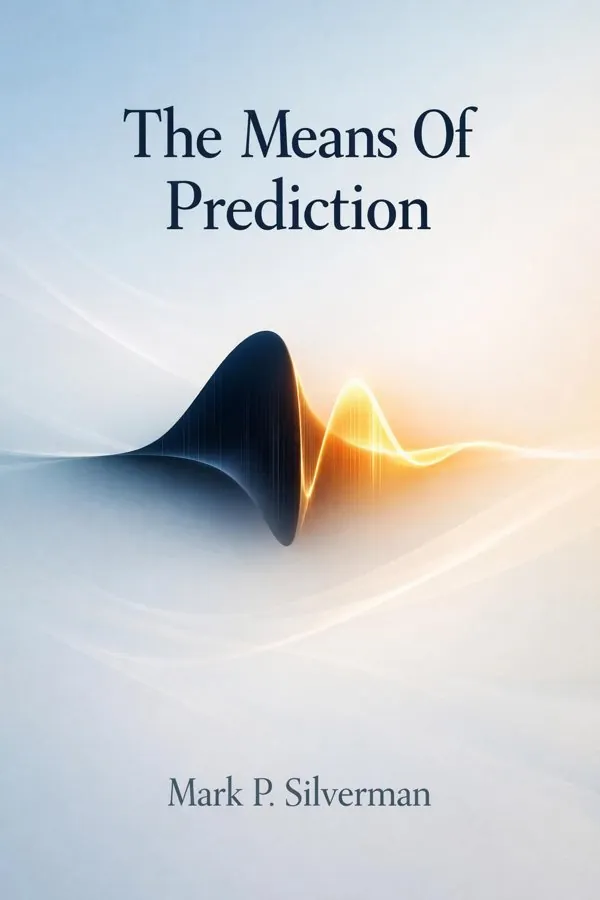
The Means Of Prediction: Summary & Key Insights
 10 min9 chaptersAudio available
Key Takeaways from The Means Of Prediction
A prediction is never stronger than the observations that make it possible.
No model captures the whole world, yet without models we cannot predict it.
The most responsible predictions are often those that admit what they do not know.
Scientific prediction becomes easier to understand when seen as a historical achievement rather than a timeless ability.
Data can reveal patterns, but theory explains why those patterns should persist.
What Is The Means Of Prediction About?
The Means Of Prediction by Mark P. Silverman is a space_physics book. What allows scientists to say something meaningful about the future of a system as vast, unstable, and intricate as the natural world? In The Means Of Prediction, Mark P. Silverman examines that question with unusual clarity, tracing how prediction emerges from observation, theory, measurement, and mathematical modeling. Although the subject naturally touches physics and astronomy, the book reaches beyond equations to ask a deeper question: what does it really mean to predict anything with confidence? Silverman explores prediction not as a magical act of foresight, but as a disciplined human achievement built from patterns, assumptions, and limits. That makes the book especially valuable in fields such as space physics, where researchers must work with incomplete data, chaotic processes, and systems that cannot be controlled in a laboratory. Silverman writes with the authority of a scholar deeply engaged with the history and philosophy of science, showing how predictive success depends as much on method and interpretation as on raw data. The result is a thoughtful and intellectually rewarding work that helps readers understand both the power and the boundaries of scientific knowledge.
This FizzRead summary covers all 9 key chapters of The Means Of Prediction in approximately 10 minutes, distilling the most important ideas, arguments, and takeaways from Mark P. Silverman's work. Also available as an audio summary and Key Quotes Podcast.
The Means Of Prediction
What allows scientists to say something meaningful about the future of a system as vast, unstable, and intricate as the natural world? In The Means Of Prediction, Mark P. Silverman examines that question with unusual clarity, tracing how prediction emerges from observation, theory, measurement, and mathematical modeling. Although the subject naturally touches physics and astronomy, the book reaches beyond equations to ask a deeper question: what does it really mean to predict anything with confidence? Silverman explores prediction not as a magical act of foresight, but as a disciplined human achievement built from patterns, assumptions, and limits. That makes the book especially valuable in fields such as space physics, where researchers must work with incomplete data, chaotic processes, and systems that cannot be controlled in a laboratory. Silverman writes with the authority of a scholar deeply engaged with the history and philosophy of science, showing how predictive success depends as much on method and interpretation as on raw data. The result is a thoughtful and intellectually rewarding work that helps readers understand both the power and the boundaries of scientific knowledge.
Who Should Read The Means Of Prediction?
This book is perfect for anyone interested in space_physics and looking to gain actionable insights in a short read. Whether you're a student, professional, or lifelong learner, the key ideas from The Means Of Prediction by Mark P. Silverman will help you think differently.
- ✓Readers who enjoy space_physics and want practical takeaways
- ✓Professionals looking to apply new ideas to their work and life
- ✓Anyone who wants the core insights of The Means Of Prediction in just 10 minutes
Want the full summary?
Get instant access to this book summary and 100K+ more with Fizz Moment.
Get Free SummaryAvailable on App Store • Free to download
Key Chapters
A prediction is never stronger than the observations that make it possible. One of the central ideas in The Means Of Prediction is that forecasting does not begin with theory alone; it begins with the disciplined collection of patterns from the world. Before scientists can explain a phenomenon, they must identify regularities, measure change, and decide which features deserve attention. In this sense, prediction grows out of a practical craft: noticing what repeats, what varies, and what can be quantified reliably.
Silverman emphasizes that observation is not passive. Scientists do not simply look at nature and receive meaning automatically. They build instruments, define categories, calibrate measurements, and decide what counts as a signal rather than noise. In space physics, this is especially important. Solar activity, magnetic disturbances, and atmospheric interactions cannot be understood by casual inspection. Researchers rely on satellites, telescopes, magnetometers, and long-term records to convert fleeting events into usable data. Only then can they begin to anticipate events such as geomagnetic storms or variations in solar radiation.
This idea matters far beyond science. In finance, medicine, climate research, and engineering, accurate prediction depends on the quality of inputs. If data are sparse, biased, or poorly interpreted, even elegant models fail. Practical prediction therefore demands patience before confidence. It requires asking: what exactly are we measuring, how stable is the measurement, and what hidden assumptions shape the dataset?
The actionable takeaway is simple: before trusting any forecast, examine the observation system behind it. Better prediction starts with better measurement, cleaner records, and sharper attention to how evidence is gathered.
No model captures the whole world, yet without models we cannot predict it. Silverman treats models as purposeful simplifications, not defective copies of reality. Their strength lies precisely in what they leave out. A good model strips away irrelevant detail so that the relationships that matter become visible. Prediction is possible because nature often contains stable structures beneath its complexity, and models are the tools we use to uncover them.
The book shows that scientists create models by balancing realism and usability. If a model includes every variable, it becomes impossible to work with. If it ignores too much, it becomes useless. This tension is especially familiar in space physics, where solar winds, plasma dynamics, magnetic fields, and atmospheric interactions create systems of enormous complexity. Researchers often rely on idealized models to understand one mechanism at a time, then test whether those simplified structures still produce reliable forecasts under changing conditions.
Silverman also highlights that models do more than generate numbers. They organize thinking. They help researchers decide what counts as a cause, what should be measured next, and where uncertainty is likely to emerge. In practical terms, a weather forecast, a spacecraft trajectory calculation, or a prediction of satellite drag all depend on models that are not perfect but are useful enough to guide action.
The key lesson is to judge models by fitness, not perfection. Ask whether a model clarifies, predicts, and can be tested against reality. The actionable takeaway: when using any forecast, learn what the model simplifies, because its omissions often reveal both its value and its limits.
The most responsible predictions are often those that admit what they do not know. A powerful theme in The Means Of Prediction is that uncertainty is not the enemy of science; it is one of its defining disciplines. Silverman argues that prediction becomes trustworthy not when it claims certainty, but when it identifies margins of error, conditions of failure, and the range within which expectations are justified.
This is crucial in scientific work because natural systems rarely behave in perfectly repeatable ways. Measurements contain errors. Models depend on assumptions. Initial conditions may be only partially known. In space physics, tiny differences in solar activity or magnetospheric conditions can produce significantly different downstream effects. A forecast of auroral intensity, satellite risk, or communication disruption is therefore never a simple yes-or-no statement. It is a probability-shaped judgment informed by evidence and bounded by uncertainty.
Silverman’s deeper point is philosophical as well as practical. Uncertainty does not weaken knowledge when it is honestly represented. Instead, it makes knowledge more useful. A forecast that says there is a 70 percent chance of a geomagnetic disturbance is far more informative than one that pretends to be exact without justification. The same principle applies to medicine, economics, and engineering: decisions improve when uncertainty is visible rather than hidden.
Readers can apply this insight immediately. Whenever encountering a prediction, ask what the confidence interval is, what assumptions underlie it, and how sensitive the result is to missing data. The actionable takeaway: treat uncertainty as an essential feature of serious prediction, and favor forecasts that explain their limits over those that merely sound decisive.
Scientific prediction becomes easier to understand when seen as a historical achievement rather than a timeless ability. Silverman uses the history of science to show that predictive power emerges gradually through failures, revisions, and improved methods. People often imagine prediction as a straightforward application of laws already known, but the book makes clear that reliable forecasting is usually the result of long sequences of correction.
This historical perspective matters because it prevents us from treating current predictive systems as final. Astronomical prediction, for example, became more accurate only through centuries of improved observation, mathematical refinement, and conceptual change. Similar developments occurred in electromagnetism, meteorology, and solar-terrestrial science. In each case, progress depended on scientists learning which variables mattered, inventing better instruments, and abandoning frameworks that no longer matched the evidence.
For space physics, history is especially instructive. Early understandings of solar activity and Earth’s magnetic environment were limited by sparse data and weak theoretical integration. Over time, observatories, satellites, and computational tools transformed the field, allowing patterns once hidden to become predictable. Yet even now, predictive success remains uneven, reminding us that science is an evolving practice rather than a finished map.
The practical value of this idea is humility. Whether one is reading a scientific paper, using a forecast, or building a model, it helps to remember that every predictive framework has a history and therefore a future revision. The actionable takeaway: study how a predictive method developed, because its past errors and improvements often reveal where it is strong, where it remains fragile, and where innovation is still needed.
Data can reveal patterns, but theory explains why those patterns should persist. In The Means Of Prediction, Silverman underscores that genuine predictive strength comes from the union of empirical evidence and theoretical understanding. A repeated correlation may help anticipate an outcome, but without theory it remains vulnerable to collapse when conditions change. Theory gives prediction depth by identifying mechanisms rather than merely tracking appearances.
This distinction is central in the sciences. Suppose scientists observe a recurring relationship between solar emissions and geomagnetic responses. A purely statistical approach might generate useful short-term forecasts, but theory helps explain how charged particles, magnetic fields, and atmospheric interactions produce those effects. With theory, prediction becomes more resilient because it can extend beyond observed cases to new situations. It also helps researchers detect when an apparent pattern is accidental rather than causal.
Silverman’s point is especially relevant in an era rich in data and algorithms. Pattern-finding tools can be powerful, but predictive reliability increases when those patterns are anchored in a coherent explanation of how the system works. The same logic applies in biology, economics, and social science. Correlation can guide inquiry, but theory is what turns isolated signals into structured understanding.
For readers and researchers, this means predictions should be evaluated not only by whether they work today, but by whether they rest on plausible mechanisms. A model that predicts well yet cannot explain itself may still be useful, but it should be treated cautiously. The actionable takeaway: seek forecasts that combine strong data with clear causal reasoning, because explanation is often what makes prediction durable.
The dream of complete prediction fades when systems become highly interconnected, sensitive, and dynamic. Silverman makes clear that some of the most important domains of science involve complexity that cannot be fully mastered by simple deterministic expectations. This does not mean prediction is impossible; it means prediction must be adjusted to the character of the system being studied.
In space physics, complexity is unavoidable. The Sun, Earth’s magnetosphere, the ionosphere, and technological systems such as satellites and power grids all interact across multiple scales. A disturbance in one region can trigger consequences elsewhere, while feedback loops can amplify or dampen effects. Even with excellent instruments and sophisticated models, scientists may still face limits imposed by incomplete knowledge of initial conditions or by nonlinear interactions. As a result, forecasts often focus on probable ranges, risk levels, or scenario planning rather than exact outcomes.
Silverman’s treatment of complexity has broad practical relevance. Many readers encounter similar issues in fields like climate analysis, public policy, ecosystems, or market behavior. In such domains, prediction works best when it becomes adaptive rather than absolute. Instead of asking for one certain future, decision-makers ask what futures are most plausible and what signals would indicate changing conditions.
This perspective encourages more intelligent use of forecasts. Rather than demanding impossible precision, we can ask whether predictions help us prepare, allocate resources, or reduce vulnerability. The actionable takeaway: in complex systems, use prediction as a guide for resilience and readiness, not as a promise of exact certainty.
A forecast becomes scientific only when it can be checked against what actually happens. Silverman repeatedly reinforces the idea that prediction is not just a mental exercise or a display of theoretical elegance. It is a public commitment that invites comparison with reality. This accountability is what separates scientific prediction from vague speculation.
The importance of testing lies in its power to discipline thought. A model may appear convincing, but only repeated confrontation with evidence can show whether it deserves trust. In scientific fields, predictive claims must therefore be specific enough to fail. If a theory can explain every outcome after the fact, it predicts nothing in a meaningful sense. In space physics, for example, a useful model of solar storm impacts must produce forecasts that can be compared with later observations of magnetic disturbances, radiation levels, or technological disruptions.
Silverman’s emphasis on accountability also reveals why prediction drives scientific progress. Failed forecasts are not merely embarrassing; they are informative. They reveal hidden variables, flawed assumptions, or limits in instrumentation. A predictive system becomes more robust when it learns from its misses as carefully as from its successes.
This principle can improve everyday judgment too. In business, policy, or personal planning, people often make predictions without recording them clearly enough to evaluate later. That encourages overconfidence. A better approach is to define expectations, track outcomes, and revise methods accordingly. The actionable takeaway: make predictions in a way that allows honest testing, because only measurable accountability turns expectation into learning.
Human beings do not predict the world with their minds alone; they predict through instruments that expand perception. Silverman gives important attention to the role of tools in making prediction possible. Telescopes, sensors, detectors, satellites, clocks, and computational systems do more than gather information. They redefine what can be known in advance by revealing processes that would otherwise remain invisible.
This is especially striking in the context of space physics. Much of the relevant activity occurs far beyond direct human experience: solar emissions, magnetic fluctuations, charged particle flows, and upper-atmospheric responses. Without instruments, these phenomena would be inaccessible or only dimly inferred. With them, scientists can monitor changing conditions in near real time, compare present behavior with historical records, and improve forecasts of space weather that affect navigation, communications, and infrastructure.
Silverman’s broader insight is that predictive capability is inseparable from technological capability. As instruments become more precise, frequent, and wide-ranging, they do not merely improve old forecasts. They create entirely new forms of prediction. New measurements can reveal variables that were previously ignored, expose hidden structures, and support better theories. Yet instruments also introduce challenges: calibration issues, data overload, and dependence on interpretation.
Readers can apply this lesson by paying closer attention to the tools behind any forecast. Whether the subject is weather, health tracking, or scientific research, better tools can produce better foresight only when their outputs are understood critically. The actionable takeaway: examine the instruments behind prediction, because advances in measurement often determine the boundary between ignorance and reliable anticipation.
The value of prediction lies not only in knowing what may happen, but in deciding what to do before it happens. Silverman shows that prediction is deeply practical: it matters because people and institutions act on it. Forecasts influence scientific planning, technological design, public warning systems, and broader judgments about risk. This gives prediction an ethical as well as intellectual dimension.
In space physics, the stakes are concrete. Predictions about solar storms can affect satellite operations, astronaut safety, communication networks, aviation routes, and power grid protection. Even when forecasts are uncertain, they can guide precautionary action. This means the usefulness of prediction is not measured only by exactness, but by how effectively it supports timely decisions under uncertainty.
Silverman’s treatment implies that forecasters carry a responsibility to communicate clearly. Overstating confidence can lead to complacency or misguided action, while excessive vagueness can make forecasts unusable. Good predictive practice therefore involves balancing technical sophistication with intelligibility. Decision-makers need to know not just what might happen, but how likely it is, what evidence supports the judgment, and what consequences follow from being wrong.
This lesson applies in everyday life as well. From financial planning to health decisions, the point of forecasting is to improve preparation, not to satisfy curiosity. Readers can ask whether a prediction changes behavior, clarifies risk, or helps allocate attention and resources wisely. The actionable takeaway: evaluate predictions by their decision value, and communicate uncertainty in ways that help people act responsibly rather than react blindly.
All Chapters in The Means Of Prediction
About the Author
Mark P. Silverman is a physicist and science writer recognized for combining technical insight with philosophical and historical reflection. His work often explores how scientific knowledge is formed, tested, and interpreted, making him particularly well suited to examine topics such as prediction, measurement, and uncertainty. Silverman has written in a way that appeals to both scientifically trained readers and thoughtful general audiences, bridging the gap between formal scientific practice and broader questions about what science can truly know. In The Means Of Prediction, he draws on this interdisciplinary perspective to illuminate the logic behind forecasting and the limits that complex natural systems impose. His writing stands out for its clarity, intellectual rigor, and ability to connect abstract scientific ideas to enduring questions about evidence, explanation, and human understanding.
Get This Summary in Your Preferred Format
Read or listen to the The Means Of Prediction summary by Mark P. Silverman anytime, anywhere. FizzRead offers multiple formats so you can learn on your terms — all free.
Available formats: App · Audio · PDF · EPUB — All included free with FizzRead
Download The Means Of Prediction PDF and EPUB Summary
Key Quotes from The Means Of Prediction
“A prediction is never stronger than the observations that make it possible.”
“No model captures the whole world, yet without models we cannot predict it.”
“The most responsible predictions are often those that admit what they do not know.”
“Scientific prediction becomes easier to understand when seen as a historical achievement rather than a timeless ability.”
“Data can reveal patterns, but theory explains why those patterns should persist.”
Frequently Asked Questions about The Means Of Prediction
The Means Of Prediction by Mark P. Silverman is a space_physics book that explores key ideas across 9 chapters. What allows scientists to say something meaningful about the future of a system as vast, unstable, and intricate as the natural world? In The Means Of Prediction, Mark P. Silverman examines that question with unusual clarity, tracing how prediction emerges from observation, theory, measurement, and mathematical modeling. Although the subject naturally touches physics and astronomy, the book reaches beyond equations to ask a deeper question: what does it really mean to predict anything with confidence? Silverman explores prediction not as a magical act of foresight, but as a disciplined human achievement built from patterns, assumptions, and limits. That makes the book especially valuable in fields such as space physics, where researchers must work with incomplete data, chaotic processes, and systems that cannot be controlled in a laboratory. Silverman writes with the authority of a scholar deeply engaged with the history and philosophy of science, showing how predictive success depends as much on method and interpretation as on raw data. The result is a thoughtful and intellectually rewarding work that helps readers understand both the power and the boundaries of scientific knowledge.
You Might Also Like

AstroTech
Various Authors
10 min
Black Holes and Time Warps: Einstein’s Outrageous Legacy
Kip S. Thorne
10 min
Dark Matter and the Dinosaurs: The Astounding Interconnectedness of the Universe
Lisa Randall
10 min
Helgoland
Carlo Rovelli
10 min
Hyperspace: A Scientific Odyssey Through Parallel Universes, Time Warps, and the 10th Dimension
Michio Kaku
10 min
Quantum Physics: The Basics
Alastair I.M. Rae
10 minBrowse by Category
Ready to read The Means Of Prediction?
Get the full summary and 100K+ more books with Fizz Moment.