
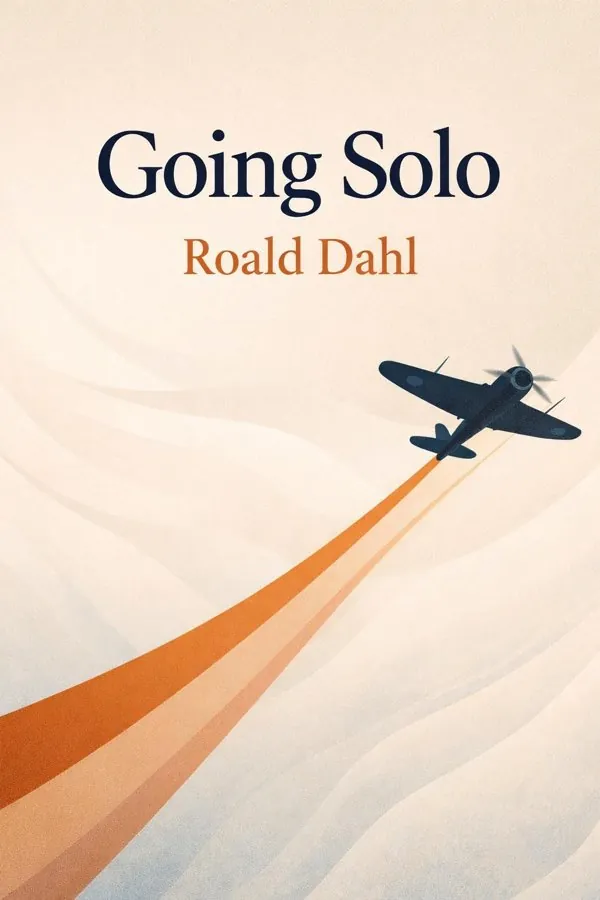
Going Solo: Summary & Key Insights
by Roald Dahl
 10 min9 chaptersAudio available
Key Takeaways from Going Solo
A young life often changes not through a grand plan, but through one decisive departure.
Before crisis reveals who we are, routine quietly shapes us.
History often feels distant until it enters your own schedule, your own body, and your own future.
Confidence is rarely a natural gift; more often, it is fear that has been drilled into discipline.
Some moments divide a life into before and after, and they arrive without warning.
What Is Going Solo About?
Going Solo by Roald Dahl is a biographies book spanning 5 pages. Going Solo is Roald Dahl’s thrilling, sharply observed account of the years that carried him from adventurous young salesman to wartime fighter pilot. Published in 1986 as the sequel to Boy, the book follows Dahl from his posting with Shell in East Africa through the outbreak of World War II, his training in the Royal Air Force, a near-fatal crash in the desert, and the brutal air battles over Greece and the Mediterranean. It is not a formal military history and not a conventional autobiography either. Instead, it is a vivid personal record of youth under pressure, where exotic landscapes, danger, humor, loneliness, and sudden loss all collide. What makes the book matter is Dahl’s remarkable ability to turn memory into story without losing its emotional truth. He writes with the eye of a born storyteller and the authority of someone who lived every improbable episode himself. For readers, Going Solo offers more than adventure: it reveals how character is tested by uncertainty, how war distorts ordinary lives, and how resilience often grows in the least predictable circumstances.
This FizzRead summary covers all 9 key chapters of Going Solo in approximately 10 minutes, distilling the most important ideas, arguments, and takeaways from Roald Dahl's work. Also available as an audio summary and Key Quotes Podcast.
Going Solo
Going Solo is Roald Dahl’s thrilling, sharply observed account of the years that carried him from adventurous young salesman to wartime fighter pilot. Published in 1986 as the sequel to Boy, the book follows Dahl from his posting with Shell in East Africa through the outbreak of World War II, his training in the Royal Air Force, a near-fatal crash in the desert, and the brutal air battles over Greece and the Mediterranean. It is not a formal military history and not a conventional autobiography either. Instead, it is a vivid personal record of youth under pressure, where exotic landscapes, danger, humor, loneliness, and sudden loss all collide. What makes the book matter is Dahl’s remarkable ability to turn memory into story without losing its emotional truth. He writes with the eye of a born storyteller and the authority of someone who lived every improbable episode himself. For readers, Going Solo offers more than adventure: it reveals how character is tested by uncertainty, how war distorts ordinary lives, and how resilience often grows in the least predictable circumstances.
Who Should Read Going Solo?
This book is perfect for anyone interested in biographies and looking to gain actionable insights in a short read. Whether you're a student, professional, or lifelong learner, the key ideas from Going Solo by Roald Dahl will help you think differently.
- ✓Readers who enjoy biographies and want practical takeaways
- ✓Professionals looking to apply new ideas to their work and life
- ✓Anyone who wants the core insights of Going Solo in just 10 minutes
Want the full summary?
Get instant access to this book summary and 100K+ more with Fizz Moment.
Get Free SummaryAvailable on App Store • Free to download
Key Chapters
A young life often changes not through a grand plan, but through one decisive departure. At twenty-two, Roald Dahl leaves England to work for the Shell Company in East Africa, and the journey itself signals the beginning of a wider, riskier life. The voyage by ship is not merely transportation; it marks a shift from schoolboy dependence to adult independence. Dahl captures the glamour of travel in the late colonial world, but he also reveals its emotional undertone: uncertainty, excitement, and the pressure of proving oneself far from home.
In Dar es Salaam and later in other parts of East Africa, Dahl encounters a setting unlike anything he had known in Britain. The landscapes are immense, the climate intense, and the social structure shaped by empire. He is suddenly responsible for work, reputation, and adaptation. This matters because Going Solo begins as a story about entering adulthood before it becomes a story about war. Dahl’s early African chapters show that growth often starts when familiar comforts disappear.
Modern readers can apply this idea to any life transition: a first job in a new city, study abroad, moving countries, or taking on adult responsibilities without a clear script. The lesson is not that adventure is always glamorous, but that unfamiliar environments force us to notice more, learn faster, and rely on ourselves in new ways.
Actionable takeaway: Think of one area of your life where you are waiting to feel fully ready before beginning. Start before certainty arrives. Growth often begins the moment you board the metaphorical ship.
Before crisis reveals who we are, routine quietly shapes us. One of the overlooked strengths of Going Solo is its portrayal of Dahl as a young employee learning how to function in a demanding professional world. His work for Shell is not romantic heroism; it involves travel, discipline, relationship-building, and paying close attention to local conditions. Yet these experiences train him in habits that later matter enormously: observation, composure, and the ability to operate in unfamiliar circumstances.
Dahl’s descriptions of business life in East Africa are full of texture. He notices people’s manners, the mechanics of transport, the unwritten codes of colonial society, and the absurdities of bureaucratic systems. These details are not filler. They show that storytelling begins with noticing and that competence often develops through ordinary tasks. Even before he becomes a pilot, Dahl is learning to move through complexity, assess situations quickly, and remember what others miss.
This idea translates easily beyond the book. Many people dismiss early-career work as irrelevant if it is not tied directly to their long-term ambitions. Dahl’s story suggests the opposite. The skills you gain in one environment may become decisive in another. A job in sales can build resilience. Managing logistics can improve judgment. Living among strangers can sharpen empathy and social intelligence.
Actionable takeaway: Make a list of three practical skills your current role is teaching you, even if the role feels temporary. Treat them as preparation, not distraction. Seemingly ordinary experience may become the foundation for extraordinary performance later.
History often feels distant until it enters your own schedule, your own body, and your own future. In Going Solo, the outbreak of World War II initially reaches Dahl and others in Africa through slow, filtered channels. It seems remote, almost abstract. But that distance does not last. The war gradually transforms from news into obligation, rearranging careers, expectations, and identities. Dahl is no longer simply a company employee building a life abroad; he is drawn toward military service in a world where neutrality becomes harder to maintain.
What Dahl captures especially well is the strange emotional lag between global events and personal understanding. People continue with routines even as the ground shifts beneath them. This is true in wartime, but also in many large-scale disruptions: economic crises, political upheaval, pandemics, technological change. Human beings rarely grasp the full meaning of events the moment they begin. We adapt in stages.
Dahl’s decision to join the Royal Air Force also highlights the moral complexity of response. He does not present himself as a perfect symbol of patriotic certainty. Rather, he shows a young man entering an immense conflict with limited information but growing seriousness. That realism gives the book credibility. Courage is not the absence of ambiguity; it is action despite ambiguity.
Actionable takeaway: When major change begins to affect your life, do not wait for perfect clarity before responding. Identify the part of the situation you can act on now, and take one concrete step. Adaptation starts with acknowledgment.
Confidence is rarely a natural gift; more often, it is fear that has been drilled into discipline. When Dahl enters RAF training, he moves from civilian life into a world where skill can determine whether one lives for another day. Flying demands technical knowledge, bodily control, rapid judgment, and the ability to stay functional while frightened. The transformation is not magical. It comes through repetition, instruction, mistakes, and growing familiarity with danger.
Dahl makes clear that aviation in wartime was unforgiving, especially for inexperienced pilots. Aircraft could be difficult, navigation unreliable, and communication poor. Training was therefore not just educational but existential. It taught pilots how to think under pressure and how to rely on procedure when instinct might fail. This is one of the book’s broader insights: systems and habits matter most when emotion runs highest.
The idea applies well beyond military aviation. In medicine, emergency response, athletics, entrepreneurship, and even public speaking, people perform best under stress when they have practiced deeply enough for key actions to become reliable. You do not eliminate fear first and then act well. You train so thoroughly that fear cannot fully derail you.
Dahl’s account also reminds readers that beginners often feel unqualified at the exact moment they must begin. That feeling does not mean growth is impossible. It means you are in the real classroom.
Actionable takeaway: Choose one area where pressure tends to overwhelm you. Build a simple training routine around it: rehearse, repeat, and review. Preparedness does not erase anxiety, but it can turn panic into usable action.
Some moments divide a life into before and after, and they arrive without warning. One of the most unforgettable episodes in Going Solo is Dahl’s crash in the Libyan desert after being given poor directions on an unfamiliar route. The event is chaotic, violent, and nearly fatal. He suffers serious injuries, loses consciousness, and wakes in a condition of confusion and pain. The episode is gripping as adventure writing, but its deeper force lies in what it reveals about vulnerability.
Until this point, flying has been associated with challenge, excitement, and growing competence. The crash exposes the brutal truth that skill does not guarantee safety. Error can come from bad information, flawed systems, or sheer circumstance. Dahl’s survival depends not on control but on endurance, rescue, and luck. This is a humbling lesson: in extreme conditions, human beings are not omnipotent protagonists but fragile participants.
Yet the chapter is not simply about helplessness. It also shows the mind’s stubborn will to continue. Recovery is painful and uneven, but Dahl persists. Readers can draw from this a practical understanding of resilience. Resilience is not looking heroic in crisis. It is surviving confusion, accepting dependence when necessary, and returning to purpose after trauma.
In everyday life, crashes may take other forms: burnout, illness, career failure, sudden grief. The specifics differ, but the pattern is similar. Plans shatter; identity wavers; rebuilding begins slowly.
Actionable takeaway: After any major setback, resist the urge to measure yourself by immediate recovery. Focus first on stabilization, support, and the next manageable step. Survival and rebuilding are achievements in their own right.
War strips glamour from heroism by attaching it to exhaustion, randomness, and grief. In Dahl’s account of aerial combat over Greece, readers see the difference between romantic ideas of battle and the lived reality of it. Flying combat missions means facing not only enemy aircraft, but confusion, mechanical uncertainty, overwhelming odds, and the constant possibility that friends may not return. The sky becomes a place of both fellowship and sudden disappearance.
One of the most powerful aspects of these chapters is Dahl’s portrayal of companionship. Pilots depend on one another intensely, yet they have little protection against loss. Bonds form quickly because circumstances demand trust, but war gives no guarantee of duration. This tension deepens the book’s emotional force. Dahl does not present courage as loud or theatrical. Often it is simply showing up again, climbing back into the aircraft, and doing the task despite knowing exactly what can happen.
This idea resonates beyond war. In any high-pressure collective effort, teams are built through shared risk. Trust matters most where outcomes are uncertain. The book also reminds readers to value people while they are present. Fragility is not only a wartime truth.
For leaders, the lesson is practical: morale is not sustained by slogans but by competence, honesty, and mutual reliance. For individuals, courage often looks less like fearlessness and more like commitment in the presence of fear.
Actionable takeaway: In your own team or relationships, do not wait for crisis to build trust. Practice reliability now. Shared confidence is created before pressure arrives, not during it.
One of the most surprising forms of strength is the ability to notice absurdity in the middle of danger. Roald Dahl’s narrative voice in Going Solo is filled with wit, sharp comic timing, and a fascination with eccentric human behavior. This does not trivialize the seriousness of what he experiences. Instead, humor becomes a way of preserving perspective. It keeps terror from becoming the only lens through which events are seen.
Throughout the book, Dahl recounts bizarre personalities, social rituals, logistical blunders, and the strange theatricality of official institutions. The result is a memoir that feels alive rather than solemn. Readers trust Dahl because he can hold multiple truths at once: a scene can be terrifying and ridiculous, heartbreaking and oddly funny. That tonal complexity reflects real life more honestly than a purely heroic or purely tragic account would.
There is a practical insight here. Humor, used well, can reduce panic, create connection, and make painful experiences narratable. In families, workplaces, hospitals, and crisis environments, people often use laughter not to deny suffering but to stay mentally flexible inside it. The key is not mockery or denial. It is the capacity to remain human under pressure.
Dahl’s later fame as a storyteller also becomes easier to understand through this lens. The writer was already present in the young man who could observe absurd detail even in extreme situations.
Actionable takeaway: When facing stress, deliberately look for one element of perspective or absurdity without minimizing the seriousness of the issue. A well-placed moment of humor can restore clarity and emotional stamina.
Experience alone does not create wisdom; reflection gives experience shape. Going Solo is not just a sequence of dramatic events. It is a crafted act of remembering. Dahl revisits youth from the vantage point of maturity, selecting details, pacing incidents, and emphasizing what was emotionally true. In doing so, he shows how storytelling helps transform raw events into meaning.
This matters because autobiography is never just a record of facts. It is an interpretation of a life. Dahl’s gift lies in making scenes immediate while also quietly suggesting what they revealed about character, luck, fear, and survival. He does not over-explain. Instead, he lets episodes carry their own weight. The result is a memoir that invites readers to examine their own lives not merely as a chain of events, but as stories with patterns, turning points, and lessons.
For modern readers, this has practical value. Personal reflection can deepen self-understanding, especially after intense periods of change. Writing down what happened, what surprised you, what you feared, and what you learned can clarify experience that otherwise remains emotionally tangled. Dahl demonstrates that the stories we tell about ourselves influence what we carry forward.
This key idea also explains the book’s lasting appeal. Going Solo is memorable not only because extraordinary things happen, but because Dahl knows how to render them in language that keeps their urgency alive.
Actionable takeaway: Spend fifteen minutes writing about one pivotal moment in your life. Focus on concrete details, what changed, and what it taught you. Meaning often emerges when memory is shaped into narrative.
Lives rarely unfold in a straight line; one identity often ends so another can begin. The closing movement of Going Solo shows Dahl reaching the limits of his flying career. Injury, strain, and circumstance alter his path, bringing an end to one kind of adventure. Yet this ending is not presented as simple defeat. It becomes part of the long process through which the future writer is formed.
What makes this idea compelling is its challenge to conventional ideas of success. Many people imagine that a valuable life requires uninterrupted progress in a single direction. Dahl’s story suggests otherwise. Detours, forced endings, and interrupted ambitions may become the material for later creation. His wartime experiences did not merely happen before his literary career; they fed it. They gave him images, emotional range, and a firsthand understanding of danger, absurdity, and resilience.
This is especially useful for readers undergoing transition. A career may stall. A role may end unexpectedly. Health, family, or historical events may change the available options. Such moments can feel like the collapse of identity. Dahl’s example shows that while one chapter may close permanently, the skills, stories, and depth gained from it do not disappear. They can be converted into a different kind of work.
In that sense, Going Solo is not only a wartime memoir. It is also a portrait of reinvention. The future author emerges from the pilot’s shattered plans.
Actionable takeaway: If something important in your life has ended, ask not only, “What have I lost?” but also, “What has this prepared me to do next?” A closed door may also be accumulated material for a new beginning.
All Chapters in Going Solo
About the Author
Roald Dahl (1916–1990) was a British novelist, memoirist, screenwriter, and short-story writer whose work has captivated generations of readers. Born in Wales to Norwegian parents, he was educated in England and later worked for the Shell Company in East Africa before serving as a Royal Air Force pilot during World War II. His wartime experiences informed both his autobiographical writing and his fiction. Dahl became internationally famous for children’s classics including Charlie and the Chocolate Factory, Matilda, The BFG, and James and the Giant Peach, as well as for his darkly witty short stories for adults. Known for his inventive imagination, macabre humor, and unforgettable characters, Dahl remains one of the most widely read and influential authors of the twentieth century.
Get This Summary in Your Preferred Format
Read or listen to the Going Solo summary by Roald Dahl anytime, anywhere. FizzRead offers multiple formats so you can learn on your terms — all free.
Available formats: App · Audio · PDF · EPUB — All included free with FizzRead
Download Going Solo PDF and EPUB Summary
Key Quotes from Going Solo
“A young life often changes not through a grand plan, but through one decisive departure.”
“Before crisis reveals who we are, routine quietly shapes us.”
“History often feels distant until it enters your own schedule, your own body, and your own future.”
“Confidence is rarely a natural gift; more often, it is fear that has been drilled into discipline.”
“Some moments divide a life into before and after, and they arrive without warning.”
Frequently Asked Questions about Going Solo
Going Solo by Roald Dahl is a biographies book that explores key ideas across 9 chapters. Going Solo is Roald Dahl’s thrilling, sharply observed account of the years that carried him from adventurous young salesman to wartime fighter pilot. Published in 1986 as the sequel to Boy, the book follows Dahl from his posting with Shell in East Africa through the outbreak of World War II, his training in the Royal Air Force, a near-fatal crash in the desert, and the brutal air battles over Greece and the Mediterranean. It is not a formal military history and not a conventional autobiography either. Instead, it is a vivid personal record of youth under pressure, where exotic landscapes, danger, humor, loneliness, and sudden loss all collide. What makes the book matter is Dahl’s remarkable ability to turn memory into story without losing its emotional truth. He writes with the eye of a born storyteller and the authority of someone who lived every improbable episode himself. For readers, Going Solo offers more than adventure: it reveals how character is tested by uncertainty, how war distorts ordinary lives, and how resilience often grows in the least predictable circumstances.
More by Roald Dahl




You Might Also Like

An American Marriage
Tayari Jones
10 min
Benjamin Franklin: An American Life
Walter Isaacson
10 min
I Know Why The Caged Bird Sings
Maya Angelou
10 min
Long Walk to Freedom
Nelson Mandela
10 min
Persepolis
Marjane Satrapi
10 min
Surely You're Joking, Mr. Feynman!
Richard P. Feynman
10 minBrowse by Category
Ready to read Going Solo?
Get the full summary and 100K+ more books with Fizz Moment.