
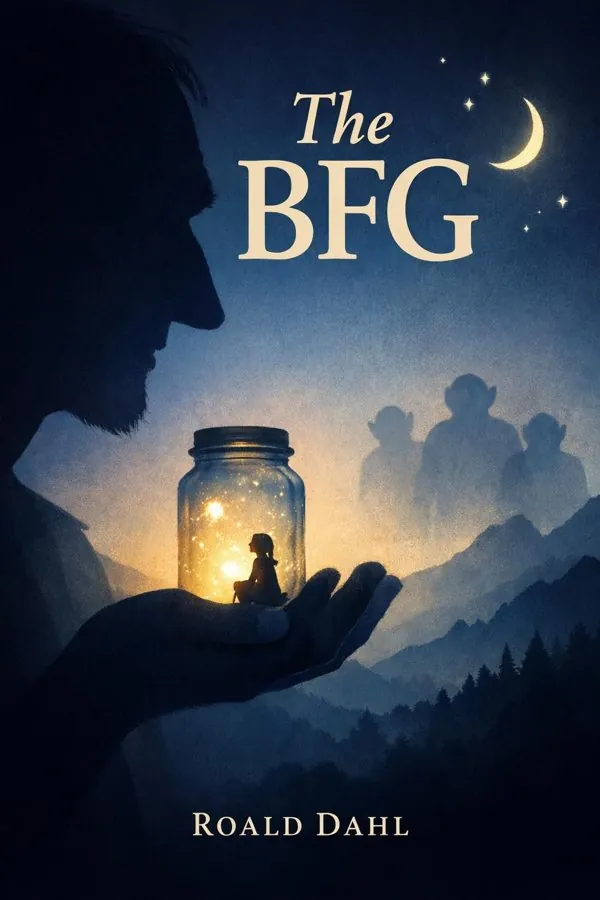
The BFG: Summary & Key Insights
by Roald Dahl
 10 min9 chaptersAudio available
Key Takeaways from The BFG
Fear often begins with a glimpse of the unknown, and The BFG opens by showing how quickly imagination can turn mystery into terror.
Character is revealed not by appearance but by choices, and nowhere is that clearer than in Sophie’s first real encounter with the BFG.
Some of the deepest friendships begin not in similarity but in shared loneliness.
When brute strength belongs to the cruel, imagination becomes a form of resistance.
A friendship becomes transformative when it evolves into shared purpose.
What Is The BFG About?
The BFG by Roald Dahl is a classics book spanning 5 pages. What if the thing that terrifies you at first sight turns out to be your safest friend? Roald Dahl’s The BFG begins with exactly that thrilling reversal. Sophie, a lonely orphan, sees a giant in the dead of night and is swept away into a hidden world far beyond ordinary human life. But the giant who takes her is not a monster. He is the Big Friendly Giant, a dream-catching, word-twisting, kind-hearted being who stands apart from the man-eating giants around him. Together, Sophie and the BFG form an unlikely alliance that grows into a mission to protect children everywhere. The novel matters because it does more than entertain. Beneath its playful language and fantastical setting, it explores loneliness, moral courage, intelligence, and the power of compassion. Dahl had a rare gift for writing stories that feel mischievous and magical while speaking directly to children’s fears and hopes. One of the most beloved authors of modern children’s literature, he fills The BFG with humor, suspense, and emotional truth, creating a classic that still invites readers of all ages to believe that gentleness can be stronger than brute force.
This FizzRead summary covers all 9 key chapters of The BFG in approximately 10 minutes, distilling the most important ideas, arguments, and takeaways from Roald Dahl's work. Also available as an audio summary and Key Quotes Podcast.
The BFG
What if the thing that terrifies you at first sight turns out to be your safest friend? Roald Dahl’s The BFG begins with exactly that thrilling reversal. Sophie, a lonely orphan, sees a giant in the dead of night and is swept away into a hidden world far beyond ordinary human life. But the giant who takes her is not a monster. He is the Big Friendly Giant, a dream-catching, word-twisting, kind-hearted being who stands apart from the man-eating giants around him. Together, Sophie and the BFG form an unlikely alliance that grows into a mission to protect children everywhere.
The novel matters because it does more than entertain. Beneath its playful language and fantastical setting, it explores loneliness, moral courage, intelligence, and the power of compassion. Dahl had a rare gift for writing stories that feel mischievous and magical while speaking directly to children’s fears and hopes. One of the most beloved authors of modern children’s literature, he fills The BFG with humor, suspense, and emotional truth, creating a classic that still invites readers of all ages to believe that gentleness can be stronger than brute force.
Who Should Read The BFG?
This book is perfect for anyone interested in classics and looking to gain actionable insights in a short read. Whether you're a student, professional, or lifelong learner, the key ideas from The BFG by Roald Dahl will help you think differently.
- ✓Readers who enjoy classics and want practical takeaways
- ✓Professionals looking to apply new ideas to their work and life
- ✓Anyone who wants the core insights of The BFG in just 10 minutes
Want the full summary?
Get instant access to this book summary and 100K+ more with Fizz Moment.
Get Free SummaryAvailable on App Store • Free to download
Key Chapters
Fear often begins with a glimpse of the unknown, and The BFG opens by showing how quickly imagination can turn mystery into terror. Sophie’s journey begins in a dormitory wrapped in midnight silence. Awake during the forbidden “witching hour,” she peers out the window and sees something impossible: a giant figure moving down the empty street, pausing at windows, and carrying a long trumpet-like object. In that instant, the ordinary world breaks apart. Before she can fully understand what she has seen, the giant notices her and carries her away to Giant Country.
This scene matters because Dahl captures a universal childhood experience: the sense that the night holds secrets adults do not understand. Sophie is small, vulnerable, and powerless in a world run by rules she did not make. Yet her fear is not foolish. It is the beginning of discovery. Instead of dismissing her terror, the story honors it, then transforms it. The giant’s kidnapping is frightening, but it also pushes Sophie toward a wider truth: not everything that looks dangerous is evil, and not every familiar system is truly safe.
In everyday life, children and adults alike often face their own “midnight window” moments: starting a new school, entering a new job, meeting someone very different, or confronting a change that feels overwhelming. First impressions can be dramatic and misleading. Sophie’s experience reminds us that courage does not mean feeling calm; it means continuing to observe, think, and respond even while afraid.
The opening also establishes Sophie as more than a passive child. She notices details, asks questions, and tries to make sense of what she sees. That alertness becomes one of her greatest strengths throughout the book.
Actionable takeaway: When something unfamiliar scares you, pause before deciding what it means. Stay observant, ask questions, and remember that fear can be the first step toward understanding.
Character is revealed not by appearance but by choices, and nowhere is that clearer than in Sophie’s first real encounter with the BFG. Once in Giant Country, she expects cruelty. Instead, she discovers an enormous being who is awkward, gentle, and deeply unlike the other giants. He does not eat humans, whom he calls “human beans,” and survives on the foul-tasting snozzcumbers rather than harming people. Most importantly, his nightly work is not destruction but wonder: he catches dreams and blows them into children’s bedrooms.
This is the heart of the book’s central paradox. The BFG is physically gigantic yet emotionally tender. He speaks in hilarious, scrambled language, making him seem comical rather than majestic, but his moral clarity is strong. He knows the other giants are brutal. He knows he is mocked and excluded because he refuses to live as they do. In him, Dahl creates a hero whose goodness is quiet rather than flashy. The BFG has no grand social status and no physical dominance among his own kind, yet he possesses empathy and imagination.
This idea has practical relevance far beyond the story. Many people are judged first by how they look, sound, or fit into social expectations. A person may appear intimidating, odd, or unsophisticated and still be wise and trustworthy. Conversely, someone polished and familiar may prove far less kind. The BFG teaches readers to look at patterns of behavior: Does this person protect others? Do they tell the truth? Do they use their power gently?
Sophie’s willingness to revise her first assumptions is what allows friendship to begin. She listens, observes, and notices the difference between the BFG and the others. That shift from fear to discernment is one of the book’s most important emotional movements.
Actionable takeaway: Judge people by their values and actions, not by their appearance, accent, or social awkwardness. Make room for the possibility that kindness can arrive in unexpected forms.
Some of the deepest friendships begin not in similarity but in shared loneliness. Sophie is an orphan with little control over her life, and the BFG is an outsider among giants, ridiculed because he refuses to join their cruelty. Although one is a human child and the other a giant, both know what it feels like to be small in a hostile world. That emotional kinship allows their relationship to grow quickly and convincingly.
Dahl does not present friendship as instant perfection. At first, Sophie is frightened and suspicious, while the BFG is defensive and unsure how to connect with a human. But they speak honestly. Sophie questions him directly. The BFG, despite his clumsy language, answers with sincerity. Through these exchanges, trust develops. The giant protects Sophie from the other giants, and Sophie begins to see that he needs companionship just as much as she does. Their bond is built on mutual recognition: each sees the other’s vulnerability.
This friendship matters because it shows that meaningful relationships often cross expected boundaries. Age, background, education, culture, and temperament may differ greatly, yet empathy can bridge those gaps. In schools, workplaces, and families, people often sort themselves into familiar groups. The BFG suggests that some of life’s most nourishing connections come from noticing someone who seems out of place and taking them seriously.
A practical example is mentoring. A younger person may find wisdom and encouragement in an older, unusual, or socially overlooked figure. Likewise, someone isolated may be transformed simply by being believed and befriended. Sophie and the BFG both become stronger because neither remains alone.
The novel also reminds us that friendship includes advocacy. Sophie does not merely enjoy the BFG’s company; she helps him imagine a better future. Real friendship often means helping another person live more safely and fully.
Actionable takeaway: Look for connection beyond the obvious. When you notice shared honesty or vulnerability, invest in it—unlikely friendships can become life-changing alliances.
When brute strength belongs to the cruel, imagination becomes a form of resistance. Sophie and the BFG face a terrifying problem: the other giants are larger, more violent, and seemingly impossible to stop. A direct physical fight would fail. What changes the situation is not force but creativity. Their world of dreams, stories, and inventive thinking becomes the basis for a plan that can outwit stronger enemies.
The BFG’s profession as a dream-catcher is not just a whimsical detail. It reveals a deeper truth about the book: unseen things shape visible reality. Dreams affect how people feel, what they fear, and what they hope for. The BFG stores dreams in jars, studies them, and delivers them carefully. This gives him access to a different kind of power—symbolic, psychological, and imaginative. Sophie quickly understands that this unusual skill can be used strategically.
In ordinary life, imagination is often underestimated because it does not look practical. Yet many real solutions begin this way. A child who cannot win by shouting learns to speak persuasively. A student overwhelmed by a difficult assignment breaks it into a game or visual plan. A small team facing a major competitor finds a creative niche rather than copying what stronger rivals do. Innovation often matters most when resources are limited.
Sophie’s contribution is especially important here. She is not physically powerful, socially important, or wealthy. But she can think clearly, identify patterns, and imagine possibilities the BFG has not considered. This makes her an active partner, not merely a rescued child. Dahl quietly honors intelligence as a practical force.
The lesson is not that fantasy replaces reality, but that imagination helps us interact with reality more effectively. It opens options where fear sees only walls.
Actionable takeaway: When facing a problem that seems too big, stop asking only, “How do I fight this?” Ask, “What creative angle have I not considered yet?” Imagination can create leverage where force cannot.
A friendship becomes transformative when it evolves into shared purpose. Once Sophie understands that the BFG is kind and that the man-eating giants regularly raid human lands, their relationship deepens from companionship into mission. They are no longer simply comforting each other in isolation. They decide that something must be done.
This turning point matters because it shows how moral awareness creates responsibility. Sophie cannot unknow what she has learned. The BFG, for all his gentleness, has accepted the giants’ cruelty as a fact he is too weak to change alone. Sophie challenges that resignation. She asks the obvious but difficult question: if these giants are murdering children, how can they be allowed to continue? Her moral clarity energizes the BFG’s conscience and courage. In return, his knowledge of dreams and giant behavior gives her ideas a path into action.
In real life, many people stop at sympathy. They feel bad about injustice, bullying, or suffering, but do not move beyond private concern. The pact between Sophie and the BFG illustrates the next step: identifying one another’s strengths and joining them. One person brings urgency, another experience. One sees the problem clearly, another knows the system. Together, they become capable of more than either would alone.
This is true in schools, communities, and workplaces. A student witnessing exclusion may not know how to intervene alone, but with a teacher or friend, they can act. A team member who sees an ethical problem may need an ally to speak up effectively. Shared purpose turns isolated discomfort into coordinated change.
The emotional beauty of this section is that Sophie does not pity the BFG from above, nor does he patronize her as a child. They become collaborators. Their size difference remains huge, but their moral partnership is equal.
Actionable takeaway: When you see a problem that should not be ignored, find one trustworthy ally and define a shared goal. Purpose becomes stronger, clearer, and more achievable when carried together.
Institutions often seem unreachable until someone dares to approach them with clarity and imagination. Sophie and the BFG realize they cannot stop the giants by themselves, so they devise an extraordinary plan: use a dream to warn the Queen of England. This move blends fantasy with strategy. Rather than trying to force their way into power, they communicate through the one medium the BFG understands perfectly—dreams.
The plan succeeds because it respects both symbolism and practical authority. The dream creates urgency; the Queen’s position allows for action. Dahl uses this episode to show that courage is not merely enduring danger. It also means presenting the truth to those with the power to help, even when doing so seems absurd or impossible. Sophie and the BFG do not let the grandeur of the monarchy silence them. They prepare carefully, take a risk, and trust that the truth, delivered creatively, can break through disbelief.
The Queen’s response is equally important. She listens. Rather than dismissing Sophie or mocking the BFG’s appearance and language, she assesses the situation and mobilizes resources. This offers a refreshing model of leadership: wise authority remains open to unusual messengers. Good leaders are not defined by never encountering strange information, but by taking responsibility when credible danger is brought before them.
In everyday settings, this lesson applies whenever a serious issue requires escalation. A child may need to tell a teacher about bullying. An employee may need to report misconduct. A citizen may need to contact local officials about a community problem. The method matters. Presenting facts clearly, choosing the right channel, and acting before harm grows are all forms of courage.
Dahl turns a whimsical royal scene into a lesson about advocacy. Even the smallest voice can reach the highest authority when guided by preparation and conviction.
Actionable takeaway: If a problem is too large to solve alone, identify who has the authority to act and bring them the truth clearly, respectfully, and creatively.
Justice is most effective when it stops harm without becoming cruel itself. After the Queen and the army accept Sophie and the BFG’s warning, a coordinated operation is launched to capture the man-eating giants. They are transported away and prevented from continuing their raids on humans. The resolution satisfies a child’s desire for safety and fairness, but it also raises deeper questions about how evil should be handled.
Dahl does not romanticize the giants’ brutality. They are dangerous predators who delight in terror. Yet the story’s answer is not chaotic revenge. Instead, the giants are restrained, contained, and denied access to victims. This distinction matters. Justice in The BFG is protective and corrective rather than sadistic. The focus remains on ending their power to harm others.
This has practical relevance in how we think about consequences. In schools, discipline should aim not merely to humiliate wrongdoers but to protect others and change the conditions that allow harm. In parenting, setting boundaries is not the same as harsh punishment. In public life, accountability should ideally stop abuse and restore safety, not simply satisfy anger.
The story also underlines that justice usually requires systems. The BFG and Sophie can identify the danger, but larger action requires institutions, logistics, and collective will. This is an important corrective to the fantasy that heroes always solve everything alone. Individual courage matters, but durable safety often depends on communities acting together.
At the same time, justice in the novel feels emotionally complete because the vulnerable are finally believed and defended. The children of the world, previously hunted while asleep and unaware, are protected by adults who step in at last.
Actionable takeaway: When responding to wrongdoing, aim first to protect the vulnerable and prevent further harm. Fair consequences should create safety, not simply express outrage.
Sometimes the most serious truths are best carried by laughter. One of the enduring pleasures of The BFG is Dahl’s playful use of language. The BFG mangles words, invents expressions, and speaks in comic verbal bursts that are instantly memorable. This is not mere silliness. His unusual speech shapes the emotional texture of the book, making a giant less frightening and inviting readers into a child-centered world where language itself can be stretched, broken, and remade.
This stylistic choice matters because children often experience language as alive and unstable. They mishear words, invent phrases, and enjoy sounds before definitions. Dahl honors that playful relationship. At the same time, he subtly challenges conventional ideas about intelligence. The BFG does not speak “properly,” yet he possesses wisdom, gentleness, technical dream-catching knowledge, and moral seriousness. His language marks him as different, but not lesser.
Humor also helps the novel hold difficult material. The threat of child-eating giants is genuinely dark, but comic speech, absurd foods like snozzcumbers, and exaggerated giant names create enough distance for young readers to process fear safely. This is one of Dahl’s great strengths: he acknowledges danger without overwhelming his audience.
In everyday life, humor and accessible language can make hard subjects easier to discuss. A teacher explaining a challenging topic, a parent helping a child through anxiety, or a leader trying to communicate under stress can often do more with warmth and vivid phrasing than with stiff formality. Playfulness can support understanding.
Sophie’s role as listener is also key. She learns how to hear beyond grammatical errors and focus on meaning. That is an important social skill in a diverse world.
Actionable takeaway: Do not mistake polished language for the only form of intelligence. Listen for meaning, use humor wisely, and remember that playfulness can help people face difficult truths.
The most radical idea in The BFG may be that gentleness is not weakness but discipline. The BFG lives among creatures who measure worth by appetite, violence, and domination. By those standards, he appears inferior. He is smaller than the other giants, mocked by them, and unwilling to join their raids. Yet the story gradually reveals that his refusal to harm humans is not softness in the trivial sense. It is moral strength.
Kindness in this book is active. The BFG protects Sophie, catches and delivers dreams, tells the truth, and participates in stopping evil. He does not simply avoid wrongdoing; he chooses good. This distinction is important. Passive harmlessness can come from fear. The BFG’s behavior comes from conscience. Even when isolated, he keeps his values.
That lesson applies widely. In competitive environments, people may assume that empathy, patience, or decency will be exploited. Sometimes kindness is indeed risky. But The BFG suggests that real strength includes the ability to remain humane without surrendering judgment. A good manager can be firm and fair. A student can resist cruelty without becoming cruel. A parent can set boundaries with warmth instead of humiliation.
Sophie recognizes this strength before the wider world does. Her trust in the BFG helps reframe him not as an oddity but as a hero. This shows how important it is to name and affirm goodness when we see it. Kind people are often underestimated because they do not advertise themselves.
By the novel’s end, the BFG’s gentleness has not made him powerless. It has made him worthy of loyalty, friendship, and public honor. His strength lies in what he refuses to become.
Actionable takeaway: Treat kindness as a practice of courage. In situations that reward harshness, ask yourself what it would look like to stay humane, truthful, and firm at the same time.
All Chapters in The BFG
About the Author
Roald Dahl (1916–1990) was a British novelist, short story writer, poet, and screenwriter whose work transformed children’s literature. Born in Wales to Norwegian parents, he first gained recognition as a writer of stories for adults before becoming one of the most beloved children’s authors in the world. His books are known for their dark humor, vivid imagination, unforgettable characters, and deep understanding of childhood fears and delights. Dahl wrote enduring classics such as Charlie and the Chocolate Factory, Matilda, James and the Giant Peach, The Witches, and The BFG. His storytelling often pits clever, brave children against cruelty, foolishness, or greed. Decades after their publication, his books remain widely read for their wit, warmth, inventiveness, and emotional honesty.
Get This Summary in Your Preferred Format
Read or listen to the The BFG summary by Roald Dahl anytime, anywhere. FizzRead offers multiple formats so you can learn on your terms — all free.
Available formats: App · Audio · PDF · EPUB — All included free with FizzRead
Download The BFG PDF and EPUB Summary
Key Quotes from The BFG
“Fear often begins with a glimpse of the unknown, and The BFG opens by showing how quickly imagination can turn mystery into terror.”
“Character is revealed not by appearance but by choices, and nowhere is that clearer than in Sophie’s first real encounter with the BFG.”
“Some of the deepest friendships begin not in similarity but in shared loneliness.”
“When brute strength belongs to the cruel, imagination becomes a form of resistance.”
“A friendship becomes transformative when it evolves into shared purpose.”
Frequently Asked Questions about The BFG
The BFG by Roald Dahl is a classics book that explores key ideas across 9 chapters. What if the thing that terrifies you at first sight turns out to be your safest friend? Roald Dahl’s The BFG begins with exactly that thrilling reversal. Sophie, a lonely orphan, sees a giant in the dead of night and is swept away into a hidden world far beyond ordinary human life. But the giant who takes her is not a monster. He is the Big Friendly Giant, a dream-catching, word-twisting, kind-hearted being who stands apart from the man-eating giants around him. Together, Sophie and the BFG form an unlikely alliance that grows into a mission to protect children everywhere. The novel matters because it does more than entertain. Beneath its playful language and fantastical setting, it explores loneliness, moral courage, intelligence, and the power of compassion. Dahl had a rare gift for writing stories that feel mischievous and magical while speaking directly to children’s fears and hopes. One of the most beloved authors of modern children’s literature, he fills The BFG with humor, suspense, and emotional truth, creating a classic that still invites readers of all ages to believe that gentleness can be stronger than brute force.
More by Roald Dahl


You Might Also Like




Browse by Category
Ready to read The BFG?
Get the full summary and 100K+ more books with Fizz Moment.