
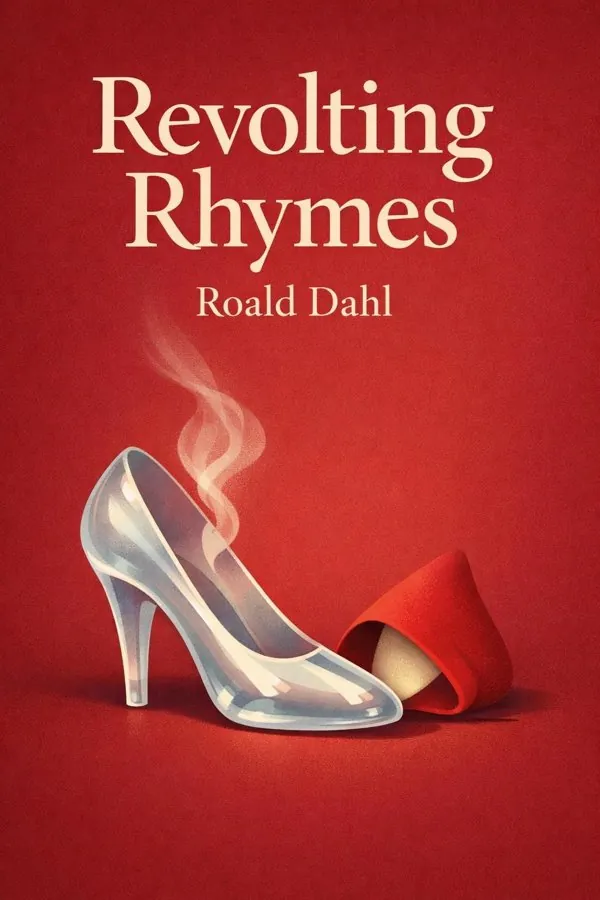
Revolting Rhymes: Summary & Key Insights
by Roald Dahl
 10 min9 chaptersAudio available
Key Takeaways from Revolting Rhymes
The most memorable stories are often the ones that betray our expectations.
Laughter is not always gentle; sometimes it is the fastest route to truth.
Not everyone who looks harmless actually is.
Fairy tales often claim that virtue wins, but Dahl suggests that wit usually gets there first.
Before Revolting Rhymes is anything else, it is a performance in sound.
What Is Revolting Rhymes About?
Revolting Rhymes by Roald Dahl is a general book. Revolting Rhymes is Roald Dahl at his most mischievous: a dazzling collection of six familiar fairy tales rewritten in punchy, playful verse and turned inside out with dark humor, surprise endings, and a sharp eye for human folly. Instead of offering neat morals and comforting resolutions, Dahl transforms stories like Cinderella, Little Red Riding Hood, Jack and the Beanstalk, Goldilocks, Snow White, and The Three Little Pigs into fast-moving comic performances filled with greed, vanity, violence, and wit. The result is not simply parody. It is a clever challenge to the polished innocence of traditional fairy tales and a reminder that stories shape how we think about goodness, danger, justice, and power. The book matters because it invites readers to question what they have inherited from familiar stories. Dahl shows that childhood literature can be entertaining while also subversive, intelligent, and unexpectedly honest about the messiness of life. As one of the most beloved children's authors of the twentieth century, Dahl brought unmatched rhythm, comic timing, and imaginative boldness to everything he wrote. In Revolting Rhymes, those gifts combine to create a book that delights children, amuses adults, and rewards anyone who enjoys language with bite.
This FizzRead summary covers all 9 key chapters of Revolting Rhymes in approximately 10 minutes, distilling the most important ideas, arguments, and takeaways from Roald Dahl's work. Also available as an audio summary and Key Quotes Podcast.
Revolting Rhymes
Revolting Rhymes is Roald Dahl at his most mischievous: a dazzling collection of six familiar fairy tales rewritten in punchy, playful verse and turned inside out with dark humor, surprise endings, and a sharp eye for human folly. Instead of offering neat morals and comforting resolutions, Dahl transforms stories like Cinderella, Little Red Riding Hood, Jack and the Beanstalk, Goldilocks, Snow White, and The Three Little Pigs into fast-moving comic performances filled with greed, vanity, violence, and wit. The result is not simply parody. It is a clever challenge to the polished innocence of traditional fairy tales and a reminder that stories shape how we think about goodness, danger, justice, and power.
The book matters because it invites readers to question what they have inherited from familiar stories. Dahl shows that childhood literature can be entertaining while also subversive, intelligent, and unexpectedly honest about the messiness of life. As one of the most beloved children's authors of the twentieth century, Dahl brought unmatched rhythm, comic timing, and imaginative boldness to everything he wrote. In Revolting Rhymes, those gifts combine to create a book that delights children, amuses adults, and rewards anyone who enjoys language with bite.
Who Should Read Revolting Rhymes?
This book is perfect for anyone interested in general and looking to gain actionable insights in a short read. Whether you're a student, professional, or lifelong learner, the key ideas from Revolting Rhymes by Roald Dahl will help you think differently.
- ✓Readers who enjoy general and want practical takeaways
- ✓Professionals looking to apply new ideas to their work and life
- ✓Anyone who wants the core insights of Revolting Rhymes in just 10 minutes
Want the full summary?
Get instant access to this book summary and 100K+ more with Fizz Moment.
Get Free SummaryAvailable on App Store • Free to download
Key Chapters
The most memorable stories are often the ones that betray our expectations. That is the central pleasure of Revolting Rhymes: Roald Dahl takes tales readers think they know by heart and then gleefully overturns every comfortable assumption. Cinderella does not move toward sentimental romance. Little Red Riding Hood is not merely innocent. The Three Little Pigs do not stay inside a moral fable about hard work and safety. By breaking the expected pattern, Dahl forces readers to pay attention again.
This matters because familiarity can make stories feel invisible. Traditional fairy tales are often absorbed passively, as if their values and outcomes are natural. Dahl reactivates them. He exposes how formulaic many fairy tales can be and turns that formula into comic fuel. The rhyme and rhythm pull readers forward, but the real engine is shock. We keep reading because we want to know how far he will go.
That technique has a practical lesson beyond literature. In communication, teaching, and creative work, surprise is a powerful way to restore attention. A teacher who introduces a familiar topic through an unexpected question, or a writer who challenges a cliché rather than repeating it, creates a stronger connection with an audience. Even in everyday conversation, revisiting old assumptions can open new insight.
Dahl also demonstrates that retelling is not a lesser form of creativity. Working with known material can be an opportunity to reveal hidden contradictions, update old values, or expose the absurdity of what people accept without question. Readers of all ages can learn to approach familiar narratives more critically.
Actionable takeaway: Take one story, belief, or routine you know well and ask, “What if the opposite happened?” Use that question to spark more original thinking.
Laughter is not always gentle; sometimes it is the fastest route to truth. In Revolting Rhymes, Roald Dahl uses comedy not just to entertain but to highlight vanity, foolishness, greed, gullibility, and hypocrisy. His jokes are exaggerated, his twists outrageous, and his violence cartoonishly abrupt, yet beneath the fun lies a clear satirical purpose. He mocks people who are smug, superficial, weak-minded, or blindly obedient to convention.
This is one reason the collection feels richer than a simple set of silly poems. Dahl understands that humor disarms readers. A moral lecture can feel heavy-handed, but a comic reversal invites reflection without preaching. When a supposedly noble prince turns out to be disappointing, or when a vulnerable character reveals ruthless resourcefulness, readers laugh first and then reconsider what they assumed about heroism, innocence, or justice.
In practical terms, this shows how satire can be used to question accepted norms. Comedians, teachers, parents, and writers often use humor to make difficult ideas easier to approach. A workplace leader might use a light anecdote to expose an inefficient habit. A parent might playfully challenge a child’s excuses rather than escalating conflict. Humor lowers defenses, and once defenses are lowered, people can think more honestly.
Dahl’s approach also reminds us that comedy can coexist with seriousness. Even when the book feels gleefully wicked, it keeps pointing to real human tendencies: our attraction to appearances, our appetite for shortcuts, and our eagerness to believe in tidy endings. The laughter is not an escape from reality; it is a way into it.
Actionable takeaway: The next time you want to challenge a stale idea or bad habit, try using wit or irony rather than direct criticism to make the lesson stick.
Not everyone who looks harmless actually is. One of Dahl’s most provocative moves in Revolting Rhymes is to strip away the simplistic innocence that often defines fairy-tale characters. His versions of familiar protagonists are not always pure, passive, or helpless. They can be shrewd, self-interested, unexpectedly tough, or morally ambiguous. Little Red Riding Hood, for example, becomes far more dangerous than tradition suggests.
This shift matters because classic fairy tales often divide the world into easy categories: good girls, bad wolves, noble rescuers, wicked stepmothers. Dahl rejects those clean boundaries. He presents a world in which appearances mislead and survival may depend on intelligence rather than purity. That makes the stories funnier, but it also makes them more psychologically convincing. Real people are rarely all one thing.
The practical value of this idea is significant. In everyday life, people constantly make judgments based on image: the polished speaker must be competent, the quiet person must be weak, the charming person must be trustworthy. Dahl encourages skepticism toward those instinctive labels. In education, media literacy, and personal relationships, learning to question surface appearances is essential. Children especially benefit from stories that teach caution without becoming solemn.
The collection also invites a broader discussion about agency. Rather than waiting to be rescued, some of Dahl’s characters seize control of events. Even when their choices are morally messy, they are active rather than decorative. That disruption of fairy-tale passivity can be especially energizing for readers who are tired of predictable roles.
Actionable takeaway: When you meet a person, problem, or story that seems simple, pause and ask what hidden motives, strengths, or risks might lie beneath the surface.
Fairy tales often claim that virtue wins, but Dahl suggests that wit usually gets there first. Across Revolting Rhymes, survival and success tend to go not to the prettiest, kindest, or highest-born characters, but to those who are alert, inventive, and willing to act decisively. His world rewards cunning over ceremony.
This does not mean the book celebrates cruelty for its own sake. Instead, it points out that conventional fairy tales can be naïve about how power operates. Princes, woodcutters, and benevolent endings often appear on cue as if justice were automatic. Dahl removes that safety net. In his retellings, danger is real, rescue is unreliable, and cleverness becomes a practical tool. Characters who adapt tend to prevail; those who remain trapped in old expectations often suffer.
There is a modern application here. Whether in school, work, or creative life, rigid dependence on ideal outcomes can leave people unprepared. The ability to improvise, question assumptions, and notice opportunities is often more valuable than simply following rules. A student who understands how to frame an unusual argument may outperform one who only memorizes facts. An entrepreneur who adjusts quickly to changing conditions may succeed where a more respectable but inflexible competitor fails.
At the same time, Dahl’s treatment of cunning raises useful ethical questions. Is cleverness admirable if it is selfish? When does resourcefulness become manipulation? The poems do not offer neat answers, but that ambiguity makes them ideal for discussion. Readers are invited to enjoy the victories while still debating their cost.
Actionable takeaway: Build the habit of adaptive thinking by asking in any challenge, “What options exist beyond the obvious script?”
Before Revolting Rhymes is anything else, it is a performance in sound. Roald Dahl’s rhyming couplets, brisk pacing, punchline timing, and conversational energy are not decorative extras; they are the mechanism that makes the book irresistible. The poems race forward with the confidence of someone telling a scandalous secret. Even readers who know the ending of the original fairy tale are swept along by the pleasure of the telling.
This is a crucial part of the book’s achievement. Dahl proves that poetry can be accessible, comic, and dramatically alive. He does not present verse as something solemn to decode. Instead, rhyme becomes a tool of momentum, memory, and surprise. Because the lines are musical, they lodge in the mind. Because they are funny, they invite rereading. For children especially, this turns language into play.
The practical lesson is clear: form matters. The way an idea is delivered can be as important as the idea itself. A strong speech uses rhythm and repetition. A memorable lesson uses phrasing people can recall. A persuasive presentation depends not only on information but on energy, structure, and timing. Dahl’s work is a reminder that language has physical force when it moves well.
His verse also rewards reading aloud. Tone, pause, and emphasis unlock more of the humor than silent reading alone can capture. For families and classrooms, the book becomes a shared performance rather than a private text, which helps explain its lasting appeal.
Actionable takeaway: If you want your words to be remembered, read them aloud and revise for rhythm, clarity, and punch rather than meaning alone.
Children’s literature does not have to be sanitized to be meaningful. One of the boldest qualities of Revolting Rhymes is its willingness to be dark, even shocking, while remaining playful. Wolves eat people, characters die abruptly, and happy endings are frequently denied or distorted. Yet the tone stays buoyant, almost conspiratorial, as though Dahl is trusting readers with a sharper, less sentimental version of storytelling.
This approach matters because traditional tales were often much darker than the softened versions many modern readers know. Dahl is, in a strange way, restoring some of that original edge while filtering it through comedy. He acknowledges that fear, cruelty, appetite, and injustice are part of the imaginative world children inhabit. Rather than pretending danger does not exist, he frames it in a way that can be laughed at, processed, and mastered.
In practical settings, this offers an important insight into how people engage difficult material. Shielding readers from all discomfort can reduce resilience and flatten emotional experience. Age-appropriate darkness, especially when balanced with humor and control, can help readers explore fear safely. Teachers and parents often find that children are more capable of handling unsettling ideas than adults expect, provided the storytelling offers enough distance and playfulness.
Dahl’s darkness also keeps the poems from becoming bland moral exercises. The shocks create stakes. We feel that anything might happen, and that uncertainty gives the collection its electric charge. It is not cruelty for cruelty’s sake; it is narrative honesty sharpened into comic form.
Actionable takeaway: Do not automatically avoid difficult themes in stories or conversations; instead, frame them with care, context, and imagination so they can be faced rather than feared.
A happy ending can hide lazy thinking. Revolting Rhymes repeatedly questions the idea that stories should resolve in the most comforting possible way. In many classic fairy tales, virtue is rewarded, beauty is recognized, love arrives on schedule, and evil is punished with mechanical fairness. Dahl delights in disrupting that machinery. His endings are often abrupt, ironic, morally crooked, or satisfyingly improper.
This matters because endings teach values. If every story rewards obedience, beauty, and passivity, readers absorb those standards whether they notice it or not. Dahl’s revisions expose the artificiality of those formulas. He suggests that what society labels “happy” may actually be shallow or foolish. A prince may be a poor prize. A practical life may be better than a glamorous one. Justice may not look elegant, but it can still feel earned.
There is a broader application here in how people imagine success. Many adults live by inherited scripts: the ideal career, the ideal relationship, the ideal image of achievement. Like fairy-tale endings, these scripts can be attractive but empty. Dahl encourages readers to examine whether the ending they have been taught to want is truly desirable.
This does not mean rejecting happiness. It means refusing prefab definitions of it. By twisting the expected conclusions, the book opens space for alternative outcomes that are funnier, stranger, and sometimes more sensible than the traditional reward. That is part of what makes the collection feel liberating.
Actionable takeaway: Revisit one “successful” outcome you have always assumed you should want, and ask whether it genuinely suits your values or merely follows an inherited script.
When a culture rewrites its old stories, it reveals what it wants to preserve and what it is ready to mock. Revolting Rhymes is more than a set of comic spoofs; it is a commentary on how stories evolve with changing attitudes. Dahl revisits canonical fairy tales from a modern, irreverent perspective, exposing the assumptions hidden inside them: idealized royalty, passive heroines, simplistic morality, and tidy justice.
This is why the book remains culturally interesting as well as entertaining. Each retelling becomes a conversation between past and present. Dahl is not discarding the original tales entirely; he is using them as raw material to test new tones and values. His versions are faster, harsher, more skeptical, and more psychologically mischievous. In doing so, they reflect a twentieth-century sensibility less willing to bow to inherited authority.
Readers can apply this idea widely. Films, advertisements, political speeches, and social-media trends often recycle familiar stories and symbols. Asking how a story has been updated can reveal the priorities of the moment. Why does one era prefer innocent princesses while another celebrates subversive heroines? Why are some villains softened while others are exaggerated? Retellings are cultural diagnostics.
Dahl’s work is especially useful for showing children and adults that no story is completely fixed. Interpretation is active. Readers are not merely receivers of tradition; they can become participants in reshaping it. That insight encourages creativity, criticism, and a healthier relationship with cultural inheritance.
Actionable takeaway: The next time you encounter a remake or retelling, compare it with the original and ask what new values, anxieties, or desires the changes reveal.
The best children’s books do not speak down to children, and they often give adults a second layer to enjoy. Revolting Rhymes is a perfect example of this double audience. Younger readers are drawn to the rhyme, speed, irreverence, and deliciously naughty twists. Older readers notice the satire, literary play, and critique of old narrative conventions. The book succeeds because it entertains on both levels at once.
This cross-generational quality is part of Dahl’s authority as a storyteller. He understands childhood appetite for mischief, exaggeration, and justice delivered with style. But he also trusts adult readers to appreciate the sophistication beneath the fun. The result is a rare kind of text that can be shared aloud in a family or classroom without feeling watered down for anyone involved.
In practical terms, books like this show the value of layered communication. The strongest messages often work for different audiences simultaneously. A teacher can design a lesson that is immediately engaging while still rich enough for deeper analysis. A speaker can tell a simple story that carries complexity for those ready to hear it. Good art invites entry at more than one level.
Revolting Rhymes also creates opportunities for conversation across ages. Children may respond to who was funniest or most shocking, while adults may bring in questions about morality, power, gender roles, and tradition. That shared interpretive space is one reason the collection endures.
Actionable takeaway: Choose stories, lessons, or creative works that offer both immediate enjoyment and deeper meaning so they can grow with the audience rather than talk down to them.
All Chapters in Revolting Rhymes
About the Author
Roald Dahl was a British author born in 1916 in Wales to Norwegian parents. He became one of the most celebrated writers of children’s literature in the twentieth century, known for blending wild imagination, dark comedy, and a deep understanding of childhood fears and pleasures. Before his literary career, Dahl worked for Shell and later served as a Royal Air Force pilot during the Second World War. He eventually turned to writing fiction, screenplays, and memoirs, producing classics such as Charlie and the Chocolate Factory, Matilda, The BFG, James and the Giant Peach, and Fantastic Mr Fox. His writing is marked by vivid villains, clever children, inventive language, and irreverent humor. Dahl died in 1990, but his books remain globally popular and widely influential.
Get This Summary in Your Preferred Format
Read or listen to the Revolting Rhymes summary by Roald Dahl anytime, anywhere. FizzRead offers multiple formats so you can learn on your terms — all free.
Available formats: App · Audio · PDF · EPUB — All included free with FizzRead
Download Revolting Rhymes PDF and EPUB Summary
Key Quotes from Revolting Rhymes
“The most memorable stories are often the ones that betray our expectations.”
“Laughter is not always gentle; sometimes it is the fastest route to truth.”
“Not everyone who looks harmless actually is.”
“Fairy tales often claim that virtue wins, but Dahl suggests that wit usually gets there first.”
“Before Revolting Rhymes is anything else, it is a performance in sound.”
Frequently Asked Questions about Revolting Rhymes
Revolting Rhymes by Roald Dahl is a general book that explores key ideas across 9 chapters. Revolting Rhymes is Roald Dahl at his most mischievous: a dazzling collection of six familiar fairy tales rewritten in punchy, playful verse and turned inside out with dark humor, surprise endings, and a sharp eye for human folly. Instead of offering neat morals and comforting resolutions, Dahl transforms stories like Cinderella, Little Red Riding Hood, Jack and the Beanstalk, Goldilocks, Snow White, and The Three Little Pigs into fast-moving comic performances filled with greed, vanity, violence, and wit. The result is not simply parody. It is a clever challenge to the polished innocence of traditional fairy tales and a reminder that stories shape how we think about goodness, danger, justice, and power. The book matters because it invites readers to question what they have inherited from familiar stories. Dahl shows that childhood literature can be entertaining while also subversive, intelligent, and unexpectedly honest about the messiness of life. As one of the most beloved children's authors of the twentieth century, Dahl brought unmatched rhythm, comic timing, and imaginative boldness to everything he wrote. In Revolting Rhymes, those gifts combine to create a book that delights children, amuses adults, and rewards anyone who enjoys language with bite.
More by Roald Dahl
You Might Also Like
Duct Tape Marketing: The World's Most Practical Small Business Marketing Guide
John Jantsch
10 minDusk, Night, Dawn: On Revival and Courage
Anne Lamott
10 minFinish Big: How Great Entrepreneurs Exit Their Companies on Top
Bo Burlingham
10 minFirst As Tragedy, Then As Farce
Slavoj Zizek
10 minFirst Principles: What America's Founders Learned from the Greeks and Romans and How That Shaped Our Country
Thomas E. Ricks
10 minGood Habits, Bad Habits: The Science of Making Positive Changes That Stick
Wendy Wood
10 minBrowse by Category
Ready to read Revolting Rhymes?
Get the full summary and 100K+ more books with Fizz Moment.