
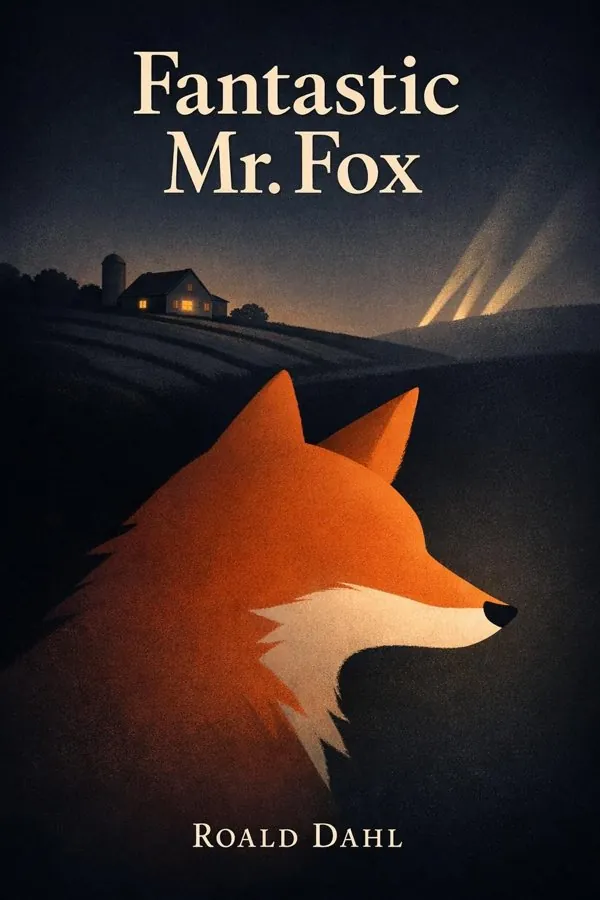
Fantastic Mr. Fox: Summary & Key Insights
by Roald Dahl
 10 min9 chaptersAudio available
Key Takeaways from Fantastic Mr. Fox
A memorable villain often represents more than personal nastiness; he becomes a living symbol of a deeper moral failure.
Courage becomes most meaningful when it protects something tender.
Some of the most important turning points in stories and in life happen when comfort disappears.
Power looks impressive, but intelligence often proves more decisive.
A meal can be more than food; it can become proof that fear has not won.
What Is Fantastic Mr. Fox About?
Fantastic Mr. Fox by Roald Dahl is a classics book spanning 5 pages. Fantastic Mr. Fox is Roald Dahl’s witty, fast-moving classic about survival, family loyalty, and the power of intelligence over brute force. On a hill above a network of burrows live three grotesque farmers—Boggis, Bunce, and Bean—men defined by greed, cruelty, and excess. Beneath them lives Mr. Fox, a daring thief who steals food to feed his wife and children. When the farmers decide they have had enough and launch an all-out attack, what begins as a playful contest turns into a desperate struggle underground. Mr. Fox must use courage, timing, and imagination to save not only his own family but an entire hidden community of animals. What makes the book endure is its unusual balance of mischief and meaning. Dahl turns a simple adventure into a story about resilience under pressure, leadership in crisis, and solidarity among the vulnerable. His language is sharp, funny, and highly memorable, making the novel accessible to children while giving adults plenty to reflect on. As one of the twentieth century’s most beloved storytellers, Dahl had a rare gift for creating villains children instantly recognize and heroes whose cleverness feels deeply satisfying.
This FizzRead summary covers all 9 key chapters of Fantastic Mr. Fox in approximately 10 minutes, distilling the most important ideas, arguments, and takeaways from Roald Dahl's work. Also available as an audio summary and Key Quotes Podcast.
Fantastic Mr. Fox
Fantastic Mr. Fox is Roald Dahl’s witty, fast-moving classic about survival, family loyalty, and the power of intelligence over brute force. On a hill above a network of burrows live three grotesque farmers—Boggis, Bunce, and Bean—men defined by greed, cruelty, and excess. Beneath them lives Mr. Fox, a daring thief who steals food to feed his wife and children. When the farmers decide they have had enough and launch an all-out attack, what begins as a playful contest turns into a desperate struggle underground. Mr. Fox must use courage, timing, and imagination to save not only his own family but an entire hidden community of animals.
What makes the book endure is its unusual balance of mischief and meaning. Dahl turns a simple adventure into a story about resilience under pressure, leadership in crisis, and solidarity among the vulnerable. His language is sharp, funny, and highly memorable, making the novel accessible to children while giving adults plenty to reflect on. As one of the twentieth century’s most beloved storytellers, Dahl had a rare gift for creating villains children instantly recognize and heroes whose cleverness feels deeply satisfying.
Who Should Read Fantastic Mr. Fox?
This book is perfect for anyone interested in classics and looking to gain actionable insights in a short read. Whether you're a student, professional, or lifelong learner, the key ideas from Fantastic Mr. Fox by Roald Dahl will help you think differently.
- ✓Readers who enjoy classics and want practical takeaways
- ✓Professionals looking to apply new ideas to their work and life
- ✓Anyone who wants the core insights of Fantastic Mr. Fox in just 10 minutes
Want the full summary?
Get instant access to this book summary and 100K+ more with Fizz Moment.
Get Free SummaryAvailable on App Store • Free to download
Key Chapters
A memorable villain often represents more than personal nastiness; he becomes a living symbol of a deeper moral failure. In Fantastic Mr. Fox, Boggis, Bunce, and Bean are not merely unpleasant men standing in the hero’s way. Each one embodies a different form of greed, gluttony, or meanness, and together they create a world in which power is hoarded and used without mercy. Boggis is a grotesque eater of boiled chickens, Bunce is a sour and suspicious goose-and-duck farmer, and Bean is lean, cold, and calculating. Dahl makes them exaggerated on purpose. Their physical appearance mirrors their inner corruption, allowing young readers to grasp instantly that these are men ruled by appetite rather than decency.
This matters because the story’s conflict is not simply about stolen food. It is about what happens when those with resources refuse to share and become obsessed with punishing the weak. The farmers have more than enough, yet they cannot tolerate losing even a little. Instead of defending necessity, they defend pride. Their rage grows so large that they devote enormous effort to trapping one fox. In modern life, we recognize similar patterns whenever people use status, money, or authority to crush others over small slights.
The farmers also show how cruelty becomes ridiculous. Their obsession blinds them, wastes their energy, and ultimately leads them into humiliation. Dahl suggests that unchecked greed is not only immoral but foolish. When people let resentment govern them, they lose proportion, judgment, and humanity.
Actionable takeaway: When you face someone with outsized power or arrogance, look beyond the surface conflict and identify the vice driving them. Understanding whether you are dealing with greed, pride, or fear helps you respond more wisely instead of reacting emotionally.
Courage becomes most meaningful when it protects something tender. Mr. Fox is bold, cunning, and daring, but Dahl never presents him as a reckless trickster who steals simply for excitement. He is rooted in the life of his burrow, where Mrs. Fox and the young foxes depend on him. That domestic center gives the story its emotional strength. The underground home is modest, vulnerable, and constantly threatened, yet it is also warm, orderly, and loving. In contrast to the farmers’ abundance above ground, the fox family’s world is defined by care rather than possession.
This contrast explains why readers instinctively side with Mr. Fox. He may be a thief by the standards of the farmers, but his actions are tied to survival and responsibility. He risks himself so his family can eat. When the farmers attack and shoot off his tail, the danger becomes real. Suddenly the story is no longer a game of clever raids. It is about whether a father can continue leading after failing, being wounded, and bringing disaster to his door.
Mrs. Fox deepens this idea. She worries, questions, and warns, but she is not merely timid. She voices the cost of risk. Her presence reminds us that bravery without responsibility can become selfishness. Mr. Fox’s best qualities emerge only when his courage is disciplined by love and accountability.
In daily life, the same principle applies. Ambition, bold decisions, and risk-taking seem admirable, but they become truly worthwhile when they serve people and values beyond the self. A parent working late to provide stability, a leader defending a team during a crisis, or a student persevering for a long-term goal all reflect courage rooted in care.
Actionable takeaway: Before making a bold move, ask what you are protecting or building. Courage is strongest when it is tied to responsibility, not ego.
Power looks impressive, but intelligence often proves more decisive. That idea sits at the heart of Mr. Fox’s great tunneling plan. Once trapped underground, he does not try to overpower the farmers or charge heroically into danger. Instead, he changes the terms of the contest. He tunnels sideways rather than upward, using knowledge of the land and the farmers’ storehouses to turn weakness into advantage. This is a classic Dahl move: the small and hunted do not win by becoming larger and harsher; they win by thinking differently.
The brilliance of the plan lies in its practicality. Mr. Fox identifies the resources around him, maps a route, and solves one problem at a time. First he reaches Boggis’s chicken house. Then Bunce’s store of ducks and geese. Then Bean’s secret cider cellar. In each case, he relies on observation, timing, and persistence rather than force. The farmers remain above ground, heavily armed and utterly certain of themselves, while the real victory unfolds beneath their feet.
This lesson translates well beyond fiction. In work, school, or personal conflict, many people assume they need more money, authority, or influence to succeed. Often what they actually need is a better approach. A student who cannot study longer may need a smarter study method. A small business competing with larger rivals may need better service rather than bigger advertising. A family under financial pressure may need more intentional planning rather than simply more effort.
Ingenuity also requires emotional restraint. Panic narrows the imagination. Mr. Fox succeeds because he pauses long enough to think. Cleverness is not random inspiration; it is applied problem-solving under pressure.
Actionable takeaway: When facing a problem that seems too big, stop asking, “How do I fight harder?” and ask, “How can I change the game?” A strategic shift often matters more than raw force.
Stories often teach most effectively when they entertain first. Roald Dahl’s genius in Fantastic Mr. Fox lies in his ability to present hunger, danger, cruelty, and class imbalance through comedy so sharp that readers laugh even while absorbing serious ideas. The farmers are grotesque and ridiculous. Their habits are extreme, their tempers absurd, and their determination to catch one fox becomes almost cartoonishly obsessive. This exaggeration is not decorative. It is the mechanism that makes the book readable for children while preserving its moral force.
Humor gives readers distance. It allows them to face frightening realities without becoming overwhelmed. A child can understand that the farmers are dangerous without being crushed by the darkness of the situation. An adult can see the satire more clearly: Dahl mocks not only individual villains but a whole mentality of ownership, superiority, and revenge. By making cruelty look ridiculous, he weakens its glamour.
This is useful beyond literature. Humor can help families discuss difficult situations, teachers introduce complex themes, and leaders ease tension in stressful environments. That does not mean making light of suffering. It means using wit to create enough openness for honesty. A thoughtful joke in a tense meeting, a playful explanation during a hard lesson, or a light tone while solving a domestic challenge can help people stay engaged rather than shut down.
Dahl also reminds us that the oppressed often use humor as a survival tool. Laughter can be an act of resistance. It says that fear has not conquered the imagination.
Actionable takeaway: When facing a hard truth, consider whether appropriate humor could help people process it more openly. Used wisely, wit can reduce fear, preserve perspective, and make difficult conversations more bearable.
Many characters can be brave in a crisis; fewer can lead. Mr. Fox becomes a compelling hero not simply because he is clever, but because his cleverness evolves into leadership. Early in the story, his daring raids place his own family at risk. He acts decisively, but not yet broadly. Once the siege begins, however, he must become more than a bold individual. He must read the room, absorb criticism, encourage the frightened, and create a plan that serves a wider group.
This shift is crucial. Leadership begins where self-centered competence ends. Mr. Fox notices that Badger and the other animals are starving too. He speaks with confidence when morale is low. He offers not just an idea but a direction others can follow. Most importantly, he shares the results of his plan. He does not use crisis to elevate himself above the others. He uses his gifts in service of the community.
That pattern appears in every healthy form of leadership. The best manager in an office is not merely the smartest one, but the one who can calm a team, distribute credit, and create conditions where others can succeed. The strongest older sibling in a family is not always the most outspoken, but the one who helps everyone stay steady. Leadership asks, “What do these people need from me now?” rather than “How can I prove myself?”
Mr. Fox also shows that leaders do not need perfection. He makes mistakes. He gets trapped. He loses his tail. Yet he remains useful because he stays adaptive. Respected leaders are often those who recover well, not those who never fail.
Actionable takeaway: In moments of pressure, shift your mindset from personal performance to collective responsibility. Ask how your skills can reduce fear, create clarity, and help others move forward.
Children’s stories often simplify reality, but the best ones do so in a way that reveals deeper truths. The underground world in Fantastic Mr. Fox is not just an exciting setting; it operates like a miniature society. Different animals occupy the tunnels, each with their own needs, vulnerabilities, and temperaments. When the farmers attack, the threat is not confined to one household. It ripples outward through a whole interconnected network. Dahl quietly shows that survival is social.
This matters because many people imagine hardship as a private event. But in practice, one person’s crisis often affects many others. If a workplace collapses, entire families feel it. If one community loses resources, neighboring communities absorb the strain. Likewise, one person’s creativity or generosity can have multiplying effects. Mr. Fox’s tunneling plan feeds not just his cubs but a wider underground population. The tunnel becomes a symbol of connection: unseen, essential, and stronger than surface appearances suggest.
The story also challenges assumptions about visibility and value. Above ground, the farmers appear to control everything. Below ground, another reality exists that they neither understand nor respect. This mirrors real life, where important labor, care work, and community networks are often overlooked because they are less visible. Yet these hidden structures are what keep people alive when official systems fail.
Readers can apply this insight by paying attention to the networks around them. Families, neighborhoods, schools, and teams are all ecosystems. Supporting one part strengthens the whole. Ignoring interdependence creates fragility.
Actionable takeaway: Map the hidden support systems in your own life—people, routines, and relationships that quietly sustain you. Strengthen them intentionally, because resilience often depends on what others never see.
One of the deepest satisfactions in Fantastic Mr. Fox comes from watching physically vulnerable characters refuse the role of victim. Dahl never pretends the animals are equal to the farmers in conventional terms. They are smaller, less armed, and constantly at risk. Yet the novel insists that being vulnerable is not the same as being helpless. This distinction is one of the book’s most powerful lessons.
Mr. Fox and the other animals cannot win on the farmers’ terms. They cannot outshoot, outdig, or outmuscle them. What they can do is remain alert, cooperative, and imaginative. Their weakness becomes survivable because they do not accept the identity that their enemies assign to them. The farmers see them as pests to be exterminated. The story sees them as thinking, feeling beings with homes, relationships, and dignity.
That message resonates strongly for readers of any age. Children often feel small in a world run by adults. Employees may feel powerless in rigid institutions. Marginalized people may feel unseen by systems designed without them in mind. Dahl’s answer is not naive optimism. He does not say vulnerability disappears. He says agency can still exist inside it. A good plan, a loyal network, and a refusal to surrender mentally can shift outcomes.
This is why the novel remains emotionally satisfying. It offers hope without denying reality. The world may be unfair. Powerful people may be petty. Danger may be real. But none of those facts cancels the possibility of clever, brave, meaningful action.
Actionable takeaway: If you feel outmatched, separate what you cannot control from what you still can. Your influence may begin small, but strategic action, alliance-building, and self-belief can turn small advantages into real change.
All Chapters in Fantastic Mr. Fox
About the Author
Roald Dahl (1916–1990) was one of the most celebrated children’s authors of the twentieth century. Born in Wales to Norwegian parents, he first worked in business and later served as a fighter pilot during the Second World War. He began his writing career with stories for adults before turning to children’s literature, where his imagination, comic boldness, and unforgettable voice made him world-famous. Dahl wrote enduring classics such as Charlie and the Chocolate Factory, Matilda, James and the Giant Peach, The BFG, and Fantastic Mr. Fox. His books are known for their grotesque villains, resilient young heroes, and dark humor balanced with warmth and justice. Though his work remains beloved worldwide, it is also often discussed critically, reflecting both his enormous influence and the complexity of his legacy.
Get This Summary in Your Preferred Format
Read or listen to the Fantastic Mr. Fox summary by Roald Dahl anytime, anywhere. FizzRead offers multiple formats so you can learn on your terms — all free.
Available formats: App · Audio · PDF · EPUB — All included free with FizzRead
Download Fantastic Mr. Fox PDF and EPUB Summary
Key Quotes from Fantastic Mr. Fox
“A memorable villain often represents more than personal nastiness; he becomes a living symbol of a deeper moral failure.”
“Courage becomes most meaningful when it protects something tender.”
“Some of the most important turning points in stories and in life happen when comfort disappears.”
“Power looks impressive, but intelligence often proves more decisive.”
“A meal can be more than food; it can become proof that fear has not won.”
Frequently Asked Questions about Fantastic Mr. Fox
Fantastic Mr. Fox by Roald Dahl is a classics book that explores key ideas across 9 chapters. Fantastic Mr. Fox is Roald Dahl’s witty, fast-moving classic about survival, family loyalty, and the power of intelligence over brute force. On a hill above a network of burrows live three grotesque farmers—Boggis, Bunce, and Bean—men defined by greed, cruelty, and excess. Beneath them lives Mr. Fox, a daring thief who steals food to feed his wife and children. When the farmers decide they have had enough and launch an all-out attack, what begins as a playful contest turns into a desperate struggle underground. Mr. Fox must use courage, timing, and imagination to save not only his own family but an entire hidden community of animals. What makes the book endure is its unusual balance of mischief and meaning. Dahl turns a simple adventure into a story about resilience under pressure, leadership in crisis, and solidarity among the vulnerable. His language is sharp, funny, and highly memorable, making the novel accessible to children while giving adults plenty to reflect on. As one of the twentieth century’s most beloved storytellers, Dahl had a rare gift for creating villains children instantly recognize and heroes whose cleverness feels deeply satisfying.
More by Roald Dahl

You Might Also Like




Browse by Category
Ready to read Fantastic Mr. Fox?
Get the full summary and 100K+ more books with Fizz Moment.