
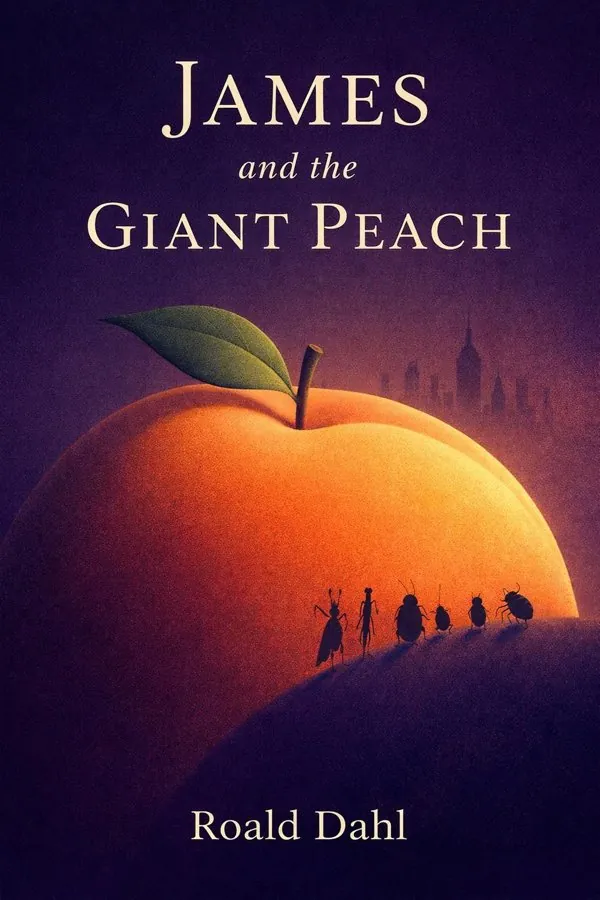
James and the Giant Peach: Summary & Key Insights
by Roald Dahl
 10 min9 chaptersAudio available
Key Takeaways from James and the Giant Peach
The power of James and the Giant Peach begins with an uncomfortable truth: before hope can feel real, loss must feel real too.
One of the most important shifts in the novel happens when the impossible enters James’s ordinary misery.
A home is not defined by walls, ownership, or appearance; it is defined by safety and belonging.
Friendship often begins where prejudice ends.
Freedom is exhilarating, but it is never free of risk.
What Is James and the Giant Peach About?
James and the Giant Peach by Roald Dahl is a classics book spanning 4 pages. James and the Giant Peach is one of Roald Dahl’s most enduring classics: a strange, funny, and surprisingly moving story about a lonely child who discovers freedom, friendship, and courage in the most unlikely place imaginable. The novel follows James Henry Trotter, an orphan forced to live with his cruel aunts, Aunt Sponge and Aunt Spiker, until a burst of magic causes an enormous peach to grow in their garden. Inside it, James finds a group of oversized talking insects, and together they begin a wildly inventive journey that carries them far beyond the world of neglect and fear he has known. What makes the book matter is not only its unforgettable fantasy, but the emotional truth beneath it. Dahl captures a child’s sense of powerlessness, then transforms it into adventure, belonging, and self-discovery. The novel blends menace with humor, wonder with danger, and absurdity with tenderness, making it appealing to both children and adults. Dahl, one of the 20th century’s most celebrated children’s authors, was a master at telling stories in which vulnerable young protagonists outwit cruel adults and find their own strength. This book remains a vivid example of that gift.
This FizzRead summary covers all 9 key chapters of James and the Giant Peach in approximately 10 minutes, distilling the most important ideas, arguments, and takeaways from Roald Dahl's work. Also available as an audio summary and Key Quotes Podcast.
James and the Giant Peach
James and the Giant Peach is one of Roald Dahl’s most enduring classics: a strange, funny, and surprisingly moving story about a lonely child who discovers freedom, friendship, and courage in the most unlikely place imaginable. The novel follows James Henry Trotter, an orphan forced to live with his cruel aunts, Aunt Sponge and Aunt Spiker, until a burst of magic causes an enormous peach to grow in their garden. Inside it, James finds a group of oversized talking insects, and together they begin a wildly inventive journey that carries them far beyond the world of neglect and fear he has known.
What makes the book matter is not only its unforgettable fantasy, but the emotional truth beneath it. Dahl captures a child’s sense of powerlessness, then transforms it into adventure, belonging, and self-discovery. The novel blends menace with humor, wonder with danger, and absurdity with tenderness, making it appealing to both children and adults. Dahl, one of the 20th century’s most celebrated children’s authors, was a master at telling stories in which vulnerable young protagonists outwit cruel adults and find their own strength. This book remains a vivid example of that gift.
Who Should Read James and the Giant Peach?
This book is perfect for anyone interested in classics and looking to gain actionable insights in a short read. Whether you're a student, professional, or lifelong learner, the key ideas from James and the Giant Peach by Roald Dahl will help you think differently.
- ✓Readers who enjoy classics and want practical takeaways
- ✓Professionals looking to apply new ideas to their work and life
- ✓Anyone who wants the core insights of James and the Giant Peach in just 10 minutes
Want the full summary?
Get instant access to this book summary and 100K+ more with Fizz Moment.
Get Free SummaryAvailable on App Store • Free to download
Key Chapters
The power of James and the Giant Peach begins with an uncomfortable truth: before hope can feel real, loss must feel real too. Roald Dahl opens James’s story in deep sadness. James Henry Trotter loses his parents in a shocking accident and is sent to live with Aunt Sponge and Aunt Spiker, two selfish, abusive guardians who reduce his world to fear, labor, and loneliness. This dark beginning is not there for shock alone. It establishes the emotional stakes of the story. James does not simply want adventure; he needs escape, dignity, and love.
Dahl understands that children recognize unfairness immediately. By showing James trapped in a life ruled by cruelty, the book validates feelings many readers know in smaller ways: being ignored, underestimated, or powerless. That is why the later magic feels earned. The giant peach matters because James has first known a life with no room for wonder.
This idea also applies beyond fiction. In everyday life, periods of difficulty often sharpen our awareness of what truly matters. A child who feels excluded may value friendship more deeply. An adult stuck in a draining routine may finally recognize the importance of joy, creativity, or community. Hardship can become a lens that clarifies need.
Dahl’s opening reminds us not to rush past pain in stories or in life. Sometimes transformation begins when we fully acknowledge what is wrong. Actionable takeaway: when facing a difficult season, name the source of the pain honestly, because clarity about what hurts is often the first step toward meaningful change.
One of the most important shifts in the novel happens when the impossible enters James’s ordinary misery. After meeting a mysterious old man, James receives a bag of enchanted green crystals. He spills them, and soon an enormous peach begins growing on the barren tree near his aunts’ house. In an instant, the world James thought he understood becomes unstable in the best possible way. The laws of dreary daily life no longer fully apply.
This moment matters because magic in Dahl is rarely just decoration. It symbolizes the sudden return of possibility. James has been living inside a closed system: cruelty, chores, hunger, insults, and isolation. The giant peach breaks that system open. It suggests that reality may contain hidden doors, and that despair is never the whole story.
Children often experience imagination this way. A game, a story, a drawing, or a secret place can interrupt fear and create mental freedom before real circumstances change. Adults do something similar when they dare to imagine a better career, a healthier relationship, or a different future. New possibilities often begin as acts of imagination before they become practical plans.
Dahl does not say that fantasy alone solves everything. James still has to act, adapt, and face danger. But the first breakthrough is psychological: he begins to believe that another life might exist. That belief is transformative.
In practical terms, this idea encourages us to protect imagination rather than dismiss it as childish. Creativity can be a serious survival tool. It helps us see options where routine shows only walls. Actionable takeaway: when life feels trapped, deliberately create one small opening for possibility by asking, “What if things could be different?” and follow the most hopeful answer.
A home is not defined by walls, ownership, or appearance; it is defined by safety and belonging. The giant peach first appears as a spectacle for Aunt Sponge and Aunt Spiker, who immediately see money-making potential in it. They fence it off, charge visitors, and treat the miracle as another way to exploit others. But for James, the peach becomes something entirely different. When he climbs inside, he discovers not a piece of fruit but a warm, glowing, hidden world where transformation is possible.
Inside the peach, James finds giant insects: Old-Green-Grasshopper, Miss Spider, Ladybug, Earthworm, Centipede, Silkworm, and Glowworm. Their presence turns the peach into a social space rather than a mere object. The peach is no longer a bizarre fruit in a garden. It becomes a vessel of refuge, a place where James is seen and heard.
This is one of the story’s most moving ideas. Many people spend part of their lives searching for a place where they can breathe more freely and become more fully themselves. That “place” may be a family, a friendship circle, a classroom, a club, or a creative community. Like James, we often discover home in unexpected forms.
The novel also shows that external beauty and internal meaning are not the same. To the crowd, the peach is a curiosity. To James, it is sanctuary. In modern life, social media often encourages us to admire appearances, but our real well-being depends on spaces where we feel accepted and useful.
Actionable takeaway: identify one environment in your life that truly feels safe and nourishing, and invest more energy there, because belonging grows where attention is given.
Friendship often begins where prejudice ends. When James first meets the enormous insects inside the peach, he is frightened. Their size and species make them seem alarming, and at first glance they are hardly conventional companions for a lonely boy. Yet these unusual figures quickly reveal personalities, virtues, flaws, and warmth. Old-Green-Grasshopper is wise and cultured, Ladybug is gentle and kind, Miss Spider is resourceful, and even the boastful Centipede contributes energy and humor. James gradually realizes that what matters is not how someone looks, but how they treat others.
This is a central moral strength of the novel. Dahl takes creatures that many children are taught to fear or dislike and turns them into allies. In doing so, he widens the reader’s moral imagination. The unfamiliar becomes lovable. The odd becomes valuable. The supposedly unpleasant gains individuality.
The idea extends naturally into real life. We often make quick judgments based on appearance, accent, age, background, profession, or personality style. Yet some of the most meaningful relationships form when we move beyond first impressions. A quiet classmate may become a loyal friend. A difficult coworker may reveal hidden generosity. A person from a very different background may understand us better than expected.
James also flourishes because these companions meet needs his old life ignored. They listen, include him, and eventually rely on him. That mutual reliance turns companionship into chosen family. The book suggests that family is not only inherited; it can be built through care, trust, and shared struggle.
Actionable takeaway: challenge one snap judgment this week by having a fuller conversation with someone you might normally overlook, because belonging often starts with curiosity.
Freedom is exhilarating, but it is never free of risk. Once the giant peach breaks loose, James and his companions are thrown into a thrilling chain of dangers: rolling away from the aunts, traveling across the landscape, drifting into the ocean, facing sharks, surviving hunger, and confronting the uncertainty of where they will end up. The journey is exciting because it is unpredictable, but it is meaningful because no one survives it alone.
Dahl shows that courage is not the absence of fear. James and the insects are often frightened. Earthworm complains constantly, Centipede provokes trouble, and everyone has moments of doubt. What matters is that they continue acting despite anxiety. James in particular grows from passive victim to active problem-solver. He devises plans, persuades others, and assumes responsibility when the group needs direction.
One of the clearest examples is the shark crisis. Surrounded by sharks that threaten to devour the peach, the travelers must think creatively. James proposes using strands of silk to attach seagulls to the peach so it can rise into the air. The plan sounds ridiculous, but the group works together to make it happen. Individual skills combine into collective survival.
This dynamic mirrors real life. Families, teams, and communities often confront problems too large for any one person: illness, financial difficulty, school pressure, or major transitions. Progress usually comes when someone contributes vision, someone else contributes patience, and another contributes practical ability. Teamwork does not require perfect harmony; it requires shared purpose.
Actionable takeaway: in your next challenge, stop asking only “What can I do?” and also ask “Who can help, and what strengths can we combine?” because difficult journeys are easier when responsibility is shared.
A recurring delight in James and the Giant Peach is the way apparent disadvantages become assets. Earthworm seems annoying and fragile, but he becomes essential bait for the seagulls. Silkworm and Miss Spider produce the threads needed for James’s aerial rescue plan. The peach itself, soft and improbable, becomes a vehicle. Dahl repeatedly suggests that what looks useless in one context may become indispensable in another.
This idea gives the novel much of its optimistic intelligence. James does not win because he is the strongest character in the story. He wins because he learns to think. He observes the situation, recognizes hidden resources, and imagines unusual solutions. That is a powerful lesson for readers of any age. Many problems are not solved by force alone, but by reframing what is available.
In everyday life, this principle can be surprisingly practical. A shy person may become an excellent listener and mediator. A small team with limited funds may outperform a larger competitor through creativity. A student who struggles in traditional exams may thrive in project-based work. The trait or limitation that seems inconvenient in one setting may become a strength in another.
Dahl’s storytelling also gently resists narrow standards of value. Characters do not need to be polished or perfect to matter. Even quirks and weaknesses can serve the group. This creates a more generous understanding of contribution, especially helpful for young readers still figuring out where they fit.
When we stop sorting qualities into rigid categories of “good” and “bad,” we become more inventive. We look again. We adapt. We build with what we have instead of waiting for ideal conditions. Actionable takeaway: list one personal weakness or frustrating circumstance, then ask how it might be used differently as a strength in a new context.
Adventure stories often focus on external movement, but the deepest travel in James and the Giant Peach is internal. James begins the novel as a frightened, isolated child who has been taught by experience to expect pain. He speaks little, obeys quickly, and has almost no reason to believe his ideas matter. By the end, he has become brave, inventive, compassionate, and capable of leadership. The giant peach carries him across the world, but the greater distance is the one he travels within himself.
What makes this transformation believable is that it happens through participation. James does not become confident because someone simply praises him. He becomes confident because he acts. He solves problems, comforts others, contributes to the group, and learns that his decisions have real impact. Confidence, in Dahl’s telling, is not a magical gift; it is built through useful action.
This is a valuable message for readers at any age. We often wait to feel ready before taking initiative, but many forms of growth work in reverse. A child becomes more secure by trying. An adult becomes more capable by practicing. A nervous speaker becomes better by speaking, not by waiting until fear disappears.
James’s emotional growth is also relational. Being treated with respect helps him become someone who can respect himself. This reflects a basic human truth: environments shape identity. Supportive communities do not merely make us feel better; they can help us become better versions of ourselves.
Actionable takeaway: if you want to grow in confidence, choose one small responsibility slightly beyond your comfort zone and complete it well, because self-belief grows fastest through evidence.
The ending of James and the Giant Peach delivers more than a happy conclusion; it offers a vision of renewal. After surviving their voyage, James and his insect companions arrive in New York City, where the peach becomes a public marvel and James’s life changes completely. The same world that once trapped him now opens outward into recognition, security, and possibility. He is no longer hidden, neglected, or powerless. He is welcomed.
This matters because the novel does not treat wonder as private escapism alone. The journey changes James’s social reality. Fantasy leads back into the world, but into a world transformed. That pattern gives the story emotional resonance. Imagination is not merely a retreat from suffering. It can become a bridge to a fuller life.
The insects also find new roles and new meaning, which reinforces the book’s inclusive spirit. Everyone who was strange, overlooked, or underestimated now has a place. The ending suggests that there are communities in which difference is not punished but celebrated.
In real life, moments of wonder often do something similar. A book, a teacher, a friendship, or a creative breakthrough can alter how we see ourselves and what we believe is possible. The result is not just temporary delight, but a changed future. Wonder can reorder identity.
Dahl leaves readers with a hopeful claim: the child who suffers now is not condemned to suffer forever. Life can expand suddenly. Goodness can arrive unexpectedly. The future can be kinder than the past. Actionable takeaway: protect experiences that awaken awe—stories, art, nature, play—because wonder is not a luxury; it can help shape a more hopeful life.
All Chapters in James and the Giant Peach
About the Author
Roald Dahl (1916–1990) was a British novelist, short-story writer, screenwriter, and one of the most influential children’s authors of the modern era. Born in Wales to Norwegian parents, he served in the Royal Air Force during World War II before turning to writing. Dahl became famous for children’s classics such as James and the Giant Peach, Charlie and the Chocolate Factory, Matilda, The BFG, and Fantastic Mr. Fox. His work is known for its inventive plots, dark humor, grotesque villains, and clever child protagonists who confront unfair adult worlds. He also wrote acclaimed short fiction for adults. Dahl’s storytelling remains widely loved because it combines mischief, danger, warmth, and imagination in a style that feels both playful and unforgettable.
Get This Summary in Your Preferred Format
Read or listen to the James and the Giant Peach summary by Roald Dahl anytime, anywhere. FizzRead offers multiple formats so you can learn on your terms — all free.
Available formats: App · Audio · PDF · EPUB — All included free with FizzRead
Download James and the Giant Peach PDF and EPUB Summary
Key Quotes from James and the Giant Peach
“The power of James and the Giant Peach begins with an uncomfortable truth: before hope can feel real, loss must feel real too.”
“One of the most important shifts in the novel happens when the impossible enters James’s ordinary misery.”
“A home is not defined by walls, ownership, or appearance; it is defined by safety and belonging.”
“Friendship often begins where prejudice ends.”
“Freedom is exhilarating, but it is never free of risk.”
Frequently Asked Questions about James and the Giant Peach
James and the Giant Peach by Roald Dahl is a classics book that explores key ideas across 9 chapters. James and the Giant Peach is one of Roald Dahl’s most enduring classics: a strange, funny, and surprisingly moving story about a lonely child who discovers freedom, friendship, and courage in the most unlikely place imaginable. The novel follows James Henry Trotter, an orphan forced to live with his cruel aunts, Aunt Sponge and Aunt Spiker, until a burst of magic causes an enormous peach to grow in their garden. Inside it, James finds a group of oversized talking insects, and together they begin a wildly inventive journey that carries them far beyond the world of neglect and fear he has known. What makes the book matter is not only its unforgettable fantasy, but the emotional truth beneath it. Dahl captures a child’s sense of powerlessness, then transforms it into adventure, belonging, and self-discovery. The novel blends menace with humor, wonder with danger, and absurdity with tenderness, making it appealing to both children and adults. Dahl, one of the 20th century’s most celebrated children’s authors, was a master at telling stories in which vulnerable young protagonists outwit cruel adults and find their own strength. This book remains a vivid example of that gift.
More by Roald Dahl



You Might Also Like




Browse by Category
Ready to read James and the Giant Peach?
Get the full summary and 100K+ more books with Fizz Moment.