
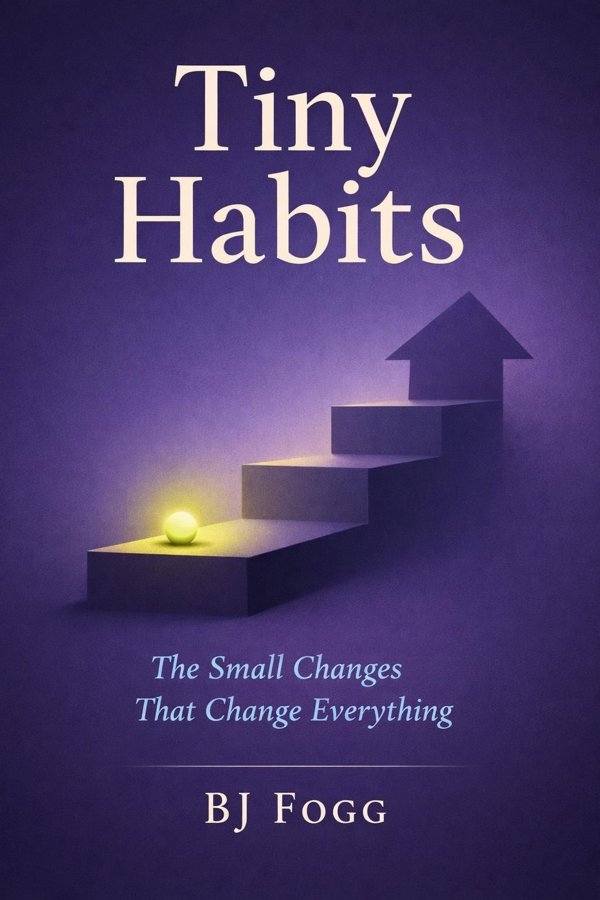
Tiny Habits: Summary & Key Insights
by BJ Fogg
 10 min9 chaptersAudio available
Key Takeaways from Tiny Habits
If one of these is missing, the behavior usually will not occur.
The fastest way to make change sustainable is often to make it almost laughably small.
A surprising lesson from Tiny Habits is that habits do not form simply because we repeat a behavior many times.
People often fail with habits because they try to import someone else’s perfect routine into their imperfect life.
One of Fogg’s most practical contributions is the idea of anchoring a new habit to an existing routine.
What Is Tiny Habits About?
Tiny Habits by BJ Fogg is a productivity book published in 2019 spanning 9 pages. Tiny Habits argues that lasting personal change does not begin with willpower, guilt, or grand ambition. It begins with behaviors so small that they feel almost effortless. In this practical and research-based book, behavior scientist BJ Fogg explains why people often fail when they try to transform their lives through intensity alone, and why success becomes far more likely when new actions are simple, well-timed, and emotionally rewarding. Rather than asking readers to become more disciplined, Fogg shows them how to design habits that fit naturally into daily routines. Drawing on decades of work at Stanford University and his experience leading the Behavior Design Lab, Fogg offers a clear framework for understanding behavior and shaping it deliberately. His method centers on tiny actions, reliable prompts, and immediate celebration, creating a system that feels humane instead of punishing. The result is a book that replaces self-criticism with curiosity and practical design. For anyone who wants to exercise more, stress less, improve productivity, or break unhelpful routines, Tiny Habits provides a simple but powerful blueprint for change that can actually last.
This FizzRead summary covers all 9 key chapters of Tiny Habits in approximately 10 minutes, distilling the most important ideas, arguments, and takeaways from BJ Fogg's work. Also available as an audio summary and Key Quotes Podcast.
Tiny Habits
Tiny Habits argues that lasting personal change does not begin with willpower, guilt, or grand ambition. It begins with behaviors so small that they feel almost effortless. In this practical and research-based book, behavior scientist BJ Fogg explains why people often fail when they try to transform their lives through intensity alone, and why success becomes far more likely when new actions are simple, well-timed, and emotionally rewarding. Rather than asking readers to become more disciplined, Fogg shows them how to design habits that fit naturally into daily routines.
Drawing on decades of work at Stanford University and his experience leading the Behavior Design Lab, Fogg offers a clear framework for understanding behavior and shaping it deliberately. His method centers on tiny actions, reliable prompts, and immediate celebration, creating a system that feels humane instead of punishing. The result is a book that replaces self-criticism with curiosity and practical design. For anyone who wants to exercise more, stress less, improve productivity, or break unhelpful routines, Tiny Habits provides a simple but powerful blueprint for change that can actually last.
Who Should Read Tiny Habits?
This book is perfect for anyone interested in productivity and looking to gain actionable insights in a short read. Whether you're a student, professional, or lifelong learner, the key ideas from Tiny Habits by BJ Fogg will help you think differently.
- ✓Readers who enjoy productivity and want practical takeaways
- ✓Professionals looking to apply new ideas to their work and life
- ✓Anyone who wants the core insights of Tiny Habits in just 10 minutes
Want the full summary?
Get instant access to this book summary and 100K+ more with Fizz Moment.
Get Free SummaryAvailable on App Store • Free to download
Key Chapters
Most people think behavior is driven mainly by motivation, but BJ Fogg’s central insight is that behavior happens only when three elements come together at the same moment: motivation, ability, and a prompt. If one of these is missing, the behavior usually will not occur. This is the foundation of Fogg’s Behavior Model, and it explains why so many self-improvement efforts collapse. People often wait until they feel inspired, but motivation is unreliable. What matters more is designing behaviors that are easy to do and linked to prompts that already exist in daily life.
Imagine someone who wants to read every night. If they set a goal of reading for an hour, they may need high motivation to begin. But if the behavior is reduced to reading one paragraph after putting their phone on the charger, the required effort drops dramatically. The prompt is clear, and the behavior becomes much more likely. The same model applies to exercising, saving money, meditating, or reducing distractions at work.
Fogg’s model is powerful because it shifts the conversation away from character flaws. If a habit is not sticking, the problem is not necessarily you. The design may be wrong. Perhaps the action is too difficult, the prompt is weak, or you are relying too heavily on temporary enthusiasm.
Actionable takeaway: When a behavior fails, do not judge yourself. Diagnose it. Ask: Is the action too hard, is the prompt unclear, or am I depending too much on motivation?
The fastest way to make change sustainable is often to make it almost laughably small. Fogg defines a tiny habit as a behavior reduced to its simplest possible version, something so easy that resistance has little room to appear. This approach works because consistency matters more than intensity in the early stages of habit formation. A habit grows from repetition and emotional success, not heroic effort.
People usually sabotage themselves by setting goals that are admirable but too demanding. They decide to do fifty push-ups a day, write for an hour every morning, or cook healthy meals every night. These plans can work briefly, but they often depend on ideal conditions. Tiny habits are different. Instead of “work out every day,” the habit becomes “do two push-ups after using the bathroom.” Instead of “journal every night,” it becomes “write one sentence after sitting on the bed.” The smallness is not a weakness. It is the strategy.
Fogg emphasizes that tiny does not mean trivial. Tiny behaviors are seeds. Once the habit is anchored and automatic, it can naturally expand. Some days, two push-ups become ten. Other days, they remain two, and that still counts as success. This protects consistency and prevents the all-or-nothing thinking that derails progress.
Actionable takeaway: Choose one behavior you want to build and shrink it until it feels nearly effortless. If it still sounds demanding, make it smaller.
A surprising lesson from Tiny Habits is that habits do not form simply because we repeat a behavior many times. They form when the brain associates the behavior with a positive feeling. Fogg argues that emotion is the glue of habit formation. When people feel successful, proud, relieved, or energized immediately after a behavior, the brain marks that action as worth remembering.
This is why celebration plays such a central role in Fogg’s method. After completing a tiny habit, you should do something that creates an authentic positive emotion. That might mean saying “Yes!” to yourself, smiling, pumping your fist, or pausing to feel a sense of accomplishment. The celebration may seem silly at first, but Fogg insists that it is neurologically important. We are not just performing a behavior; we are teaching the brain to want it again.
Consider someone building a habit of opening a difficult work document each morning. After doing it, they might take one deep breath and say, “Good. I’m the kind of person who starts.” That emotional reinforcement matters. Or someone trying to floss can immediately smile in the mirror and acknowledge the win. The key is immediacy. Delayed rewards are far less effective than instant emotional reinforcement.
This idea also explains why harsh self-criticism weakens change. If your habit routine is surrounded by guilt or pressure, your brain may associate the behavior with discomfort, making repetition less appealing.
Actionable takeaway: After every tiny habit, create an immediate positive feeling. Use a celebration that feels genuine, because emotion helps wire the habit into your brain.
People often fail with habits because they try to import someone else’s perfect routine into their imperfect life. Fogg’s method is different: build habits that fit your actual circumstances, energy levels, schedule, and personality. Good behavior design does not demand a new identity overnight. It works with what is already true.
This means matching habits to your current ability. If mornings are chaotic, do not force a complicated morning ritual. If evenings leave you drained, do not promise an hour of focused learning after dinner. Instead, design habits that align with your environment and natural rhythms. Someone who wants to stretch more might place the habit right after brushing their teeth. A busy parent who wants to practice gratitude might say one thankful thought while buckling a child into the car seat. A manager who wants to become more organized might review one priority immediately after opening their laptop.
Fogg also highlights the importance of making behaviors easier through environmental design. Keep healthy snacks visible. Leave your book on the pillow. Put your running shoes by the door. Remove friction where possible and add friction to behaviors you want to reduce.
Habit design is not about idealism. It is about realism. The best habit is not the one that sounds impressive. It is the one you can reliably perform in the life you actually have. This lowers frustration and raises the odds of long-term success.
Actionable takeaway: Audit your routine and build one new habit that fits your real schedule, location, and energy instead of the life you wish you had.
One of Fogg’s most practical contributions is the idea of anchoring a new habit to an existing routine. Rather than relying on vague intentions such as “I’ll do it later,” he encourages readers to attach a tiny behavior to something they already do consistently. This existing action becomes the prompt, or anchor, that triggers the new habit.
The formula is simple: “After I do X, I will do Y.” For example: after I pour my morning coffee, I will take one deep breath. After I sit at my desk, I will write the first sentence of my report. After I wash my face at night, I will floss one tooth. The anchor should already be stable in your life. By linking the new behavior to an established routine, you remove the need to remember, decide, or wait for motivation.
This method works because memory is often the missing piece in habit formation. Many good intentions fail not because we refuse to act, but because the moment passes. Anchors place the behavior exactly where it belongs in the flow of daily life.
Choosing the right anchor matters. It should occur reliably, happen in the right location, and feel naturally connected to the new behavior. If the pairing feels awkward, the habit may not stick. Fogg encourages experimentation until the match feels seamless.
Actionable takeaway: Build your next habit using Fogg’s formula: “After I [existing routine], I will [tiny behavior].” Choose an anchor that happens every day without fail.
We tend to celebrate only major achievements, but Fogg argues that tiny wins deserve immediate recognition because they are what build habits in the first place. Celebration is not childish self-congratulation. It is a deliberate way to reinforce identity and increase the likelihood of repetition. The feeling of success tells your brain, “This behavior matters. Do it again.”
Many people skip this step because they think results should speak for themselves. But when a habit is new, the external results may still be invisible. One push-up does not change your body. One glass of water does not transform your health. One focused minute does not complete a project. Celebration bridges that gap. It gives you a sense of success before the larger rewards arrive.
For example, if you are trying to reduce procrastination, opening the project file can be celebrated as a meaningful win. If you are building a habit of tidying, putting away one item deserves acknowledgment. Over time, this creates momentum. Small actions feel satisfying rather than burdensome.
The most effective celebration is personal and believable. It might be a smile, a quick victory gesture, a phrase like “That’s like me,” or a moment of gratitude. What matters is that it generates a real positive emotion in the moment. Forced praise is less effective than authentic satisfaction.
Actionable takeaway: Stop waiting for big milestones. Identify a simple celebration you can use immediately after each tiny habit, and practice it until success starts to feel natural.
One of the most encouraging ideas in Tiny Habits is that change does not remain isolated. A small successful habit often spills into other areas of life, creating what Fogg describes as ripple effects. When you prove to yourself that change is possible, your confidence grows. Your identity begins to shift. Other behaviors start to feel more achievable.
For instance, a person who begins with one tiny walk after lunch may start sleeping better, which improves mood and focus, which then makes healthy eating and better work habits easier. Someone who starts by writing one sentence per day may rediscover their creative identity and eventually build a regular writing practice. A tiny tidying habit can make a home feel calmer, which reduces stress and improves relationships.
This matters because many people dismiss small actions as insignificant. Fogg asks readers to see them differently: as entry points into larger transformation. Tiny habits are not just micro-behaviors. They are proof that momentum can be built gently. Growth often happens organically once the habit is stable. There is no need to force expansion too early.
The ripple effect also changes self-perception. Instead of seeing yourself as inconsistent or undisciplined, you begin to see evidence that you are capable of follow-through. That identity shift can be more powerful than the habit itself.
Actionable takeaway: Respect the power of small wins. Focus on consistency first and allow your habit to grow naturally, trusting that one small change can influence many others.
When habits break, people often respond with shame. Fogg strongly rejects this reaction. In his view, setbacks are not evidence that you lack discipline. They are information. If a habit is not working, the design needs adjustment. This mindset makes change far more sustainable because it replaces self-blame with problem-solving.
Suppose you intend to meditate after lunch but keep forgetting. The issue may be the prompt. If your lunch routine varies, the anchor is unstable. Or maybe the behavior is still too ambitious. A ten-minute meditation may be too difficult on busy days, while one calming breath could work. If evening reading never happens, perhaps you are too tired and need to anchor the habit earlier.
Fogg encourages what might be called compassionate iteration. You test, observe, and revise. You make the behavior smaller, choose a better anchor, change the environment, or use a different celebration. This turns habit building into a design process rather than a moral struggle.
This principle is especially important for perfectionists, who often abandon routines after missing a day. Tiny Habits offers a more forgiving model. Missing once is not failure. It is feedback. Progress comes from staying engaged and adapting the system until it fits.
Actionable takeaway: The next time a habit slips, do not ask, “What’s wrong with me?” Ask, “What can I redesign?” Then adjust size, timing, prompt, or environment and try again.
Tiny Habits is not only about creating positive routines. Fogg also shows how the same principles can help dismantle unwanted behaviors. Bad habits do not usually disappear through sheer resistance. They weaken when prompts are disrupted, ability is reduced, and motivation shifts. In other words, the behavior design changes.
If you want to check social media less, make the habit harder. Log out after each use, remove apps from your home screen, or keep your phone in another room while working. If you snack mindlessly at night, do not rely only on self-control. Change the environment by removing trigger foods or storing them out of reach. If you want to reduce impulse spending, make purchases less immediate by deleting saved payment details.
Fogg also recommends creating replacement behaviors. When the old prompt appears, insert a tiny alternative. Instead of opening a distracting app when bored, take one breath or stand up and stretch. Instead of reacting defensively in conversation, pause and say one curious sentence. The replacement should be easier and more desirable than white-knuckling your way through the urge.
This approach is compassionate because it acknowledges that unwanted behaviors often persist for structural reasons, not because a person is weak. Once you redesign the situation, change becomes much more realistic.
Actionable takeaway: Pick one behavior you want to reduce and redesign the environment around it. Remove prompts, increase friction, and create a tiny replacement action for moments of temptation.
All Chapters in Tiny Habits
About the Author
BJ Fogg is an American behavior scientist, teacher, and founder of the Behavior Design Lab at Stanford University. He is widely known for his pioneering work on how habits form and how behavior can be changed through thoughtful design rather than willpower alone. Over the course of his career, Fogg has researched the relationship between motivation, ability, prompts, and technology, and his ideas have influenced entrepreneurs, health professionals, coaches, and product designers around the world. In addition to his academic work, he has trained thousands of people in practical behavior design methods. Tiny Habits brings together decades of his research into an accessible framework for creating small, sustainable changes that can grow into meaningful life transformation.
Get This Summary in Your Preferred Format
Read or listen to the Tiny Habits summary by BJ Fogg anytime, anywhere. FizzRead offers multiple formats so you can learn on your terms — all free.
Available formats: App · Audio · PDF · EPUB — All included free with FizzRead
Download Tiny Habits PDF and EPUB Summary
Key Quotes from Tiny Habits
“If one of these is missing, the behavior usually will not occur.”
“The fastest way to make change sustainable is often to make it almost laughably small.”
“A surprising lesson from Tiny Habits is that habits do not form simply because we repeat a behavior many times.”
“People often fail with habits because they try to import someone else’s perfect routine into their imperfect life.”
“One of Fogg’s most practical contributions is the idea of anchoring a new habit to an existing routine.”
Frequently Asked Questions about Tiny Habits
Tiny Habits by BJ Fogg is a productivity book that explores key ideas across 9 chapters. Tiny Habits argues that lasting personal change does not begin with willpower, guilt, or grand ambition. It begins with behaviors so small that they feel almost effortless. In this practical and research-based book, behavior scientist BJ Fogg explains why people often fail when they try to transform their lives through intensity alone, and why success becomes far more likely when new actions are simple, well-timed, and emotionally rewarding. Rather than asking readers to become more disciplined, Fogg shows them how to design habits that fit naturally into daily routines. Drawing on decades of work at Stanford University and his experience leading the Behavior Design Lab, Fogg offers a clear framework for understanding behavior and shaping it deliberately. His method centers on tiny actions, reliable prompts, and immediate celebration, creating a system that feels humane instead of punishing. The result is a book that replaces self-criticism with curiosity and practical design. For anyone who wants to exercise more, stress less, improve productivity, or break unhelpful routines, Tiny Habits provides a simple but powerful blueprint for change that can actually last.
Compare Tiny Habits
You Might Also Like
Featured In
Browse by Category
Ready to read Tiny Habits?
Get the full summary and 100K+ more books with Fizz Moment.