
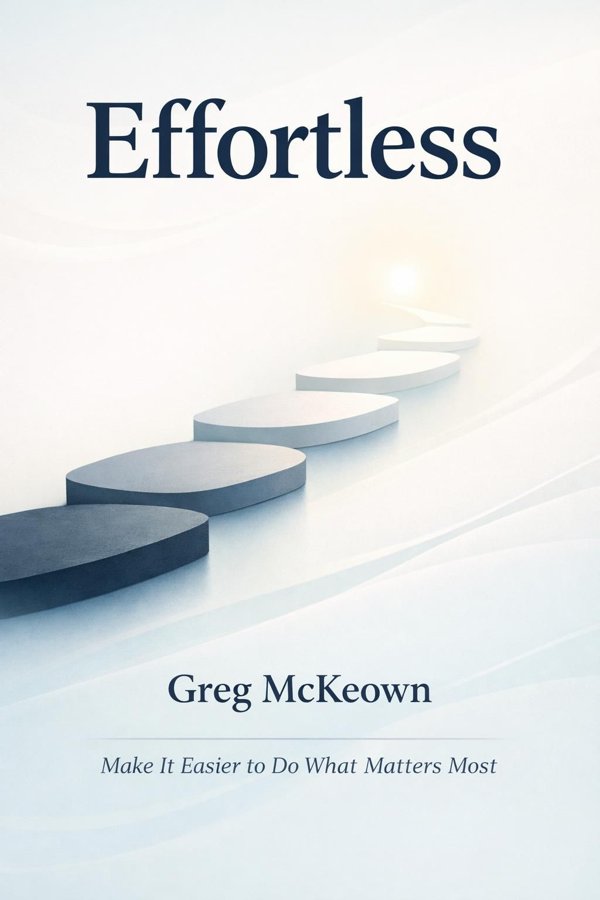
Effortless: Summary & Key Insights
by Greg McKeown
 10 min9 chaptersAudio available
Key Takeaways from Effortless
The hardest part of important work is often not the work itself, but the burdened state from which we try to do it.
When something matters, our instinct is usually to try harder.
Many people have been taught to treat struggle as proof of seriousness.
Work becomes exhausting when success is vague.
Willpower is unreliable, especially when life gets busy.
What Is Effortless About?
Effortless by Greg McKeown is a productivity book published in 2021 spanning 3 pages. What if the path to meaningful achievement did not require constant strain? In Effortless, Greg McKeown challenges one of modern productivity’s most deeply held assumptions: that important work must be difficult, draining, and relentless. Instead, he argues that once we have identified what truly matters, the next step is to make it easier to do. The goal is not laziness or lower standards, but a smarter, more sustainable way of operating—one that reduces friction, simplifies decisions, and creates systems that allow progress to happen with less stress. McKeown is uniquely qualified to make this argument. Best known for Essentialism, his influential book on focusing on the vital few instead of the trivial many, he has spent years helping leaders, teams, and individuals work with greater clarity. In Effortless, he goes one step further: choosing the right things is not enough if those things are still approached in the hardest possible way. This book matters because burnout has become normalized. McKeown offers a practical alternative—one that helps readers produce high-quality results, preserve energy, and make consistency easier in work, relationships, and everyday life.
This FizzRead summary covers all 9 key chapters of Effortless in approximately 10 minutes, distilling the most important ideas, arguments, and takeaways from Greg McKeown's work. Also available as an audio summary and Key Quotes Podcast.
Effortless
What if the path to meaningful achievement did not require constant strain? In Effortless, Greg McKeown challenges one of modern productivity’s most deeply held assumptions: that important work must be difficult, draining, and relentless. Instead, he argues that once we have identified what truly matters, the next step is to make it easier to do. The goal is not laziness or lower standards, but a smarter, more sustainable way of operating—one that reduces friction, simplifies decisions, and creates systems that allow progress to happen with less stress.
McKeown is uniquely qualified to make this argument. Best known for Essentialism, his influential book on focusing on the vital few instead of the trivial many, he has spent years helping leaders, teams, and individuals work with greater clarity. In Effortless, he goes one step further: choosing the right things is not enough if those things are still approached in the hardest possible way. This book matters because burnout has become normalized. McKeown offers a practical alternative—one that helps readers produce high-quality results, preserve energy, and make consistency easier in work, relationships, and everyday life.
Who Should Read Effortless?
This book is perfect for anyone interested in productivity and looking to gain actionable insights in a short read. Whether you're a student, professional, or lifelong learner, the key ideas from Effortless by Greg McKeown will help you think differently.
- ✓Readers who enjoy productivity and want practical takeaways
- ✓Professionals looking to apply new ideas to their work and life
- ✓Anyone who wants the core insights of Effortless in just 10 minutes
Want the full summary?
Get instant access to this book summary and 100K+ more with Fizz Moment.
Get Free SummaryAvailable on App Store • Free to download
Key Chapters
The hardest part of important work is often not the work itself, but the burdened state from which we try to do it. Greg McKeown argues that before we can act effectively, we must first create an “effortless state”—a condition in which the mind is clear, the body is supported, and emotional pressure is reduced. When we operate from stress, guilt, perfectionism, or fatigue, even simple tasks feel heavy. We confuse urgency with importance and friction with virtue. But when we pause long enough to breathe, rest, reflect, and reset, we make intelligent action possible.
This idea is powerful because it reverses a common assumption. Many people think they must push through exhaustion in order to earn rest later. McKeown suggests the opposite: rest and clarity are not rewards after productivity; they are prerequisites for better productivity. That might mean taking a walk before a difficult meeting, getting more sleep before making a major decision, or asking, “What would make this feel lighter?” before starting a project. It also includes noticing emotional noise such as resentment, fear, or self-criticism, since these internal states amplify effort.
In practical terms, the effortless state can be supported through small rituals: a few moments of silence before opening email, a short list of top priorities instead of a chaotic task dump, and boundaries that protect recovery. Even in family life, a calmer state can transform conflict into constructive conversation.
Actionable takeaway: Before asking, “How do I get this done?” ask, “What state am I in right now, and what would help me return to ease?”
When something matters, our instinct is usually to try harder. McKeown invites us to ask a better question: can this be made simpler first? Too often, people respond to complexity with more force instead of more intelligence. They add meetings to fix communication, layers to fix errors, and extra hours to fix poor design. Yet many problems do not require greater effort; they require less unnecessary complication.
Simplification is not cutting corners. It is removing what does not contribute to the result. A team writing a proposal, for example, may assume excellence requires dozens of revisions, stakeholder loops, and long debates. But sometimes one clear template, a shared definition of success, and a deadline for decisions will produce better output with less strain. A parent trying to create peaceful mornings may not need more discipline, only fewer choices: clothes laid out the night before, simple breakfasts, and one departure checklist.
McKeown’s point is that friction accumulates silently. Unclear instructions, hidden assumptions, disorganized materials, and too many options all make action harder than it needs to be. Once we see this, we begin to redesign our workflows. We turn recurring tasks into checklists, large projects into first steps, and vague expectations into visible standards.
The principle works especially well in personal productivity. Instead of building a complicated routine you cannot sustain, create one so simple it becomes almost automatic. Reduce activation energy. Make the desired action obvious and easy.
Actionable takeaway: Choose one recurring task this week and identify three sources of needless friction you can remove before trying to work harder.
Many people have been taught to treat struggle as proof of seriousness. If the process feels hard, we assume we must be doing something worthwhile. McKeown questions that belief. In Effortless Action, he shows how progress can come from designing work so that the next step is smaller, clearer, and easier to repeat. The aim is not to eliminate all effort, but to stop making things harder than necessary.
A central tactic is reducing a task to the minimum viable action. Instead of “write the report,” the next move might be “draft three bullet points.” Instead of “exercise every day,” it could be “put on running shoes and walk for five minutes.” These tiny actions matter because they lower resistance. Once in motion, momentum often carries us further. But even when it does not, consistency beats sporadic heroic effort.
McKeown also emphasizes setting limits that force simplicity. A short time block, a one-page summary, or a strict deadline can prevent overthinking and perfectionism. Constraints can liberate action by narrowing the field of possibilities. In organizations, effortless action might mean creating a default process so people do not reinvent the wheel each time. In creative work, it may mean deciding in advance what “good enough for now” looks like.
This mindset is especially valuable for ambitious people who stall because they imagine the full complexity of what lies ahead. By shrinking the next action and trusting repetition, they stop waiting for ideal conditions.
Actionable takeaway: Take one important goal and rewrite it as the smallest concrete action you can complete in ten minutes or less.
Work becomes exhausting when success is vague. One reason people overwork is that they begin without a clear picture of what “done” actually means. McKeown highlights the importance of defining the desired outcome in a simple, concrete way before diving into execution. Clarity reduces wasted motion. Ambiguity creates rework, indecision, and endless tinkering.
Consider how often projects drag on because expectations were never aligned. A manager asks for a presentation but does not specify audience, length, or purpose. The employee produces too much, then revises repeatedly. Or someone decides to “get healthy” without choosing measurable behaviors such as walking four times a week or cooking at home on weekdays. Without definition, effort expands endlessly.
Defining done means creating a target that is specific enough to guide action, but simple enough to remember. It may be a one-sentence objective, a checklist, a model example, or a list of criteria that separates essentials from extras. In team settings, this can prevent misunderstanding and save enormous time. In personal life, it can quiet the perfectionist voice that keeps saying, “Not yet.”
This principle also helps with emotional relief. When done is clear, you can stop with confidence. You know when the task has met its purpose. That protects energy and prevents the all-too-common habit of polishing work beyond the point of meaningful return.
Actionable takeaway: Before starting your next project, write a one-sentence definition of done and three criteria that would make the result clearly successful.
Willpower is unreliable, especially when life gets busy. McKeown argues that the most sustainable form of productivity comes not from repeated self-discipline, but from building systems that carry part of the load for us. When the right action is the default action, progress no longer depends on motivation alone.
This is the logic behind checklists, routines, templates, automation, and habits. A recurring meeting agenda saves cognitive energy. A prepared grocery list makes healthy eating easier. Auto-paying bills eliminates forgetfulness and stress. A standard onboarding process prevents teams from repeatedly explaining the same basics. Systems reduce the need to decide, remember, and improvise every time.
The beauty of systems is that they preserve quality while lowering effort. They turn one thoughtful decision into many future benefits. If you create a document template for client proposals, for instance, every proposal afterward becomes faster and more consistent. If you establish a nightly shutdown ritual—reviewing tomorrow’s priorities, clearing your workspace, and setting one key intention—you reduce morning confusion and improve focus.
McKeown’s approach reminds us that an effortless life is not built in dramatic moments. It is built through design. We ask: where am I repeatedly struggling with the same thing? That often signals a missing system, not a personal flaw. Once the system is in place, the work feels lighter because less mental energy is consumed by preventable friction.
Actionable takeaway: Identify one repeated decision or recurring frustration in your life and build a simple system, checklist, or default rule to handle it automatically.
Perfectionism is often disguised as diligence. McKeown shows that many people waste energy by doing far more than is necessary to create value. The effortless alternative is not carelessness, but discernment: doing the minimum amount required to make meaningful progress. This frees time and attention for what truly matters.
The idea can feel uncomfortable because ambitious people fear lower standards. But the point is not to reduce quality everywhere. It is to match the level of effort to the purpose. A quick internal update does not need the polish of a keynote speech. A first draft should not be judged by final-draft criteria. A family dinner on a busy weeknight does not need to resemble a special occasion meal. When we overinvest in low-leverage tasks, we rob important work of energy.
One practical method is to ask, “What is the simplest version that serves the need?” In writing, that may mean producing a rough outline first. In decision-making, it may mean gathering enough information to make a reasonable choice rather than seeking impossible certainty. In administration, it can mean using reusable formats instead of custom-making every output.
This principle is especially useful when momentum has stalled. Lowering the threshold helps restart movement. Once something exists, it can be improved. But waiting for the ideal version often results in delay, fatigue, and avoidance.
Actionable takeaway: Pick one task you have been overcomplicating and ask, “What is the minimum viable version that would still be useful?” Then complete that version first.
Many people solve the same problem over and over because they never capture what they learned the first time. McKeown emphasizes that effortless results come from codifying useful knowledge so it can be reused, shared, and scaled. If something worked once, do not rely on memory. Turn it into a process others can follow, including your future self.
This could mean documenting a sales script that reliably opens conversations, writing down the exact steps for closing the month’s accounts, or saving a repeatable sequence for launching a new project. In households, it might look like a travel packing list, a set of family routines, or a standard plan for busy weekdays. The payoff is cumulative: each documented insight reduces future effort.
This principle is especially important in teams. When critical know-how remains trapped in one person’s head, progress is fragile. Work slows when that person is unavailable, and others must recreate solutions from scratch. But when knowledge is made visible through playbooks, templates, and shared documents, effectiveness becomes more durable. The result is not only efficiency, but resilience.
McKeown’s broader point is that many wins are wasted because they are treated as isolated events rather than repeatable assets. The effortless path turns breakthroughs into systems. Instead of asking, “How did we survive that?” we ask, “What did we learn that we can make easier next time?”
Actionable takeaway: After completing a successful task or project, spend ten minutes documenting the key steps, decisions, and lessons so the next version requires less effort.
Burnout rarely comes from a single difficult day. It usually comes from repeated overexertion without recovery, often in the name of commitment. McKeown argues that sustainable excellence depends on pacing. The most effective people are not those who constantly sprint, but those who can continue producing over time without collapsing under the weight of their own ambition.
This idea matters because modern culture rewards visible busyness. Long hours are often mistaken for dedication, and exhaustion is worn like a badge of honor. But over the long term, constant pushing reduces judgment, creativity, patience, and quality. What seems productive in the short run becomes costly in the long run. Effortless does not deny that some seasons are demanding. It insists that rest, renewal, and sensible limits are part of high performance, not obstacles to it.
Pacing can take many forms: scheduling breaks before you feel depleted, setting upper limits on work hours, alternating cognitively intense tasks with lighter ones, and protecting sleep as a strategic asset. It also means noticing when a goal has become self-defeating because the method of pursuit is damaging the person pursuing it. In relationships, pacing may mean creating rhythms of connection instead of waiting for rare grand gestures.
Sustainability is a competitive advantage. People who preserve energy can think more clearly, adapt faster, and stay engaged longer. The point is not to do less in every moment, but to work in a way that remains possible.
Actionable takeaway: Audit one area of your life where you have been sprinting and add a built-in recovery rhythm that makes continued progress sustainable.
True effectiveness is not just personal; it is relational. McKeown extends the effortless mindset beyond individual productivity to the way we support teams, families, and communities. One of the most generous things we can do is reduce unnecessary complexity for others. When instructions are clearer, expectations simpler, and systems easier to follow, everyone benefits.
This principle is easy to overlook because people often optimize only for themselves. But a leader who sends vague requests creates extra labor downstream. A parent who changes routines constantly creates stress for children. A colleague who withholds context forces others to guess. In contrast, making things effortless for others may involve writing concise communication, creating a clear onboarding guide, summarizing decisions after meetings, or removing steps from an approval process.
What makes this idea powerful is that it multiplies impact. A small improvement in clarity can save many people repeated effort. Imagine a manager who creates a standard brief for every project: objective, deadline, audience, owner, and definition of done. That five-minute structure could save hours of confusion across the team. Or think of a household where everyone knows the evening routine because it has been simplified and posted visibly.
McKeown suggests that effortless systems are often acts of care. They respect people’s time, attention, and energy. They reduce dependence on memory, mood, and improvisation. In this sense, making work easier is not a shortcut; it is a service.
Actionable takeaway: Choose one person or group you work with regularly and ask, “What confusion or friction do they repeatedly face that I could remove with one simple change?”
All Chapters in Effortless
About the Author
Greg McKeown is a British-American author, public speaker, and advisor known for his work on productivity, leadership, and strategic simplicity. He rose to international prominence with Essentialism: The Disciplined Pursuit of Less, a bestselling book that encouraged readers to focus on the vital few priorities instead of being overwhelmed by the trivial many. In Effortless, he expands that philosophy by exploring how important work can be made easier and more sustainable. McKeown has worked with executives, organizations, and teams around the world, helping them improve clarity, decision-making, and effectiveness. His ideas are especially valued for combining practical tools with a broader challenge to modern overwork culture. Through his writing and teaching, he advocates a more intentional, humane approach to achievement.
Get This Summary in Your Preferred Format
Read or listen to the Effortless summary by Greg McKeown anytime, anywhere. FizzRead offers multiple formats so you can learn on your terms — all free.
Available formats: App · Audio · PDF · EPUB — All included free with FizzRead
Download Effortless PDF and EPUB Summary
Key Quotes from Effortless
“The hardest part of important work is often not the work itself, but the burdened state from which we try to do it.”
“When something matters, our instinct is usually to try harder.”
“Many people have been taught to treat struggle as proof of seriousness.”
“Work becomes exhausting when success is vague.”
“Willpower is unreliable, especially when life gets busy.”
Frequently Asked Questions about Effortless
Effortless by Greg McKeown is a productivity book that explores key ideas across 9 chapters. What if the path to meaningful achievement did not require constant strain? In Effortless, Greg McKeown challenges one of modern productivity’s most deeply held assumptions: that important work must be difficult, draining, and relentless. Instead, he argues that once we have identified what truly matters, the next step is to make it easier to do. The goal is not laziness or lower standards, but a smarter, more sustainable way of operating—one that reduces friction, simplifies decisions, and creates systems that allow progress to happen with less stress. McKeown is uniquely qualified to make this argument. Best known for Essentialism, his influential book on focusing on the vital few instead of the trivial many, he has spent years helping leaders, teams, and individuals work with greater clarity. In Effortless, he goes one step further: choosing the right things is not enough if those things are still approached in the hardest possible way. This book matters because burnout has become normalized. McKeown offers a practical alternative—one that helps readers produce high-quality results, preserve energy, and make consistency easier in work, relationships, and everyday life.
More by Greg McKeown
You Might Also Like
Featured In
Browse by Category
Ready to read Effortless?
Get the full summary and 100K+ more books with Fizz Moment.