
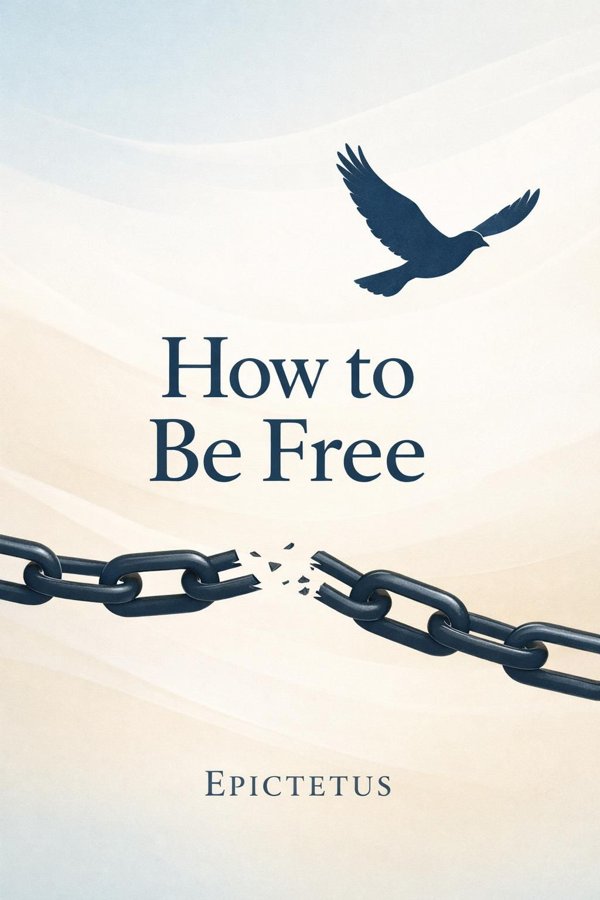
How to Be Free: Summary & Key Insights
by Epictetus
 10 min9 chaptersAudio available
Key Takeaways from How to Be Free
Most suffering begins with a simple confusion: we try to command what was never ours to command.
A person may appear successful and still be inwardly captive.
Freedom is not the power to do whatever impulse suggests; it is the ability to live according to reason.
People spend their lives decorating the cage.
Loss reveals what philosophy has truly taught us.
What Is How to Be Free About?
How to Be Free by Epictetus is a eastern_wisdom book spanning 8 pages. How to Be Free is a compact but powerful guide to inner liberty from the Stoic philosopher Epictetus, a man who understood bondage in both the literal and psychological sense. Born into slavery and later becoming one of the most influential moral teachers of the ancient world, Epictetus argued that freedom has little to do with status, wealth, or circumstance. Real freedom, he insists, begins when we stop trying to control what is not ours to command and learn instead to govern our judgments, choices, and character. This book distills the heart of Stoic ethics into a practical philosophy of everyday life: distinguish between what depends on you and what does not; train desire so it does not enslave you; meet loss, insult, and uncertainty with reason rather than panic. Its message remains urgent because modern life multiplies distractions, anxieties, and false measures of success. Epictetus offers an antidote: a disciplined inner stance that cannot be shaken by fortune. For anyone seeking calm, self-mastery, and moral clarity, How to Be Free is timeless reading.
This FizzRead summary covers all 9 key chapters of How to Be Free in approximately 10 minutes, distilling the most important ideas, arguments, and takeaways from Epictetus's work. Also available as an audio summary and Key Quotes Podcast.
How to Be Free
How to Be Free is a compact but powerful guide to inner liberty from the Stoic philosopher Epictetus, a man who understood bondage in both the literal and psychological sense. Born into slavery and later becoming one of the most influential moral teachers of the ancient world, Epictetus argued that freedom has little to do with status, wealth, or circumstance. Real freedom, he insists, begins when we stop trying to control what is not ours to command and learn instead to govern our judgments, choices, and character. This book distills the heart of Stoic ethics into a practical philosophy of everyday life: distinguish between what depends on you and what does not; train desire so it does not enslave you; meet loss, insult, and uncertainty with reason rather than panic. Its message remains urgent because modern life multiplies distractions, anxieties, and false measures of success. Epictetus offers an antidote: a disciplined inner stance that cannot be shaken by fortune. For anyone seeking calm, self-mastery, and moral clarity, How to Be Free is timeless reading.
Who Should Read How to Be Free?
This book is perfect for anyone interested in eastern_wisdom and looking to gain actionable insights in a short read. Whether you're a student, professional, or lifelong learner, the key ideas from How to Be Free by Epictetus will help you think differently.
- ✓Readers who enjoy eastern_wisdom and want practical takeaways
- ✓Professionals looking to apply new ideas to their work and life
- ✓Anyone who wants the core insights of How to Be Free in just 10 minutes
Want the full summary?
Get instant access to this book summary and 100K+ more with Fizz Moment.
Get Free SummaryAvailable on App Store • Free to download
Key Chapters
Most suffering begins with a simple confusion: we try to command what was never ours to command. Epictetus builds his entire philosophy on one foundational distinction: some things are within our control, and some are not. Our judgments, intentions, choices, and responses belong to us. Our reputation, health, possessions, the behavior of others, political events, and even the eventual fate of our bodies do not. When we treat externals as if they were ours to govern, we become anxious, angry, and perpetually vulnerable. When we return our attention to what is truly ours, we recover stability.
This idea is not passive resignation. It is an invitation to invest energy where it can actually bear fruit. If a colleague criticizes you unfairly, you cannot control their opinion, but you can control whether you react defensively, reflect calmly, or respond with dignity. If you apply for a job, the outcome is uncertain, but the preparation, honesty, and effort you bring are fully yours. Epictetus teaches that peace is not found by securing the world but by understanding the limits of your authority within it.
The practical power of this insight is enormous. It reduces blame, panic, and helplessness. It also increases responsibility, because once you stop blaming fate for everything, you must confront your own habits of thought and action. Freedom begins not when life becomes manageable, but when you stop demanding that it obey you.
Actionable takeaway: In any stressful situation, pause and make two columns: what is up to me and what is not. Direct your effort only toward the first column.
A person may appear successful and still be inwardly captive. Epictetus warns that every uncontrolled desire creates dependence, because whatever you crave gains power over your peace. If you need praise to feel secure, then criticism rules you. If you must have comfort, luxury, romance, or status, then fortune can threaten you at any moment. The chain is psychological, not visible, and for that reason it is often stronger than iron.
Stoicism does not demand that we become emotionless or indifferent to all human goods. Rather, it asks us to examine what we seek and how tightly we cling to it. There is a profound difference between preferring health and being unable to bear illness, between enjoying love and making another person the basis of your worth, between appreciating success and believing failure destroys you. Desire becomes dangerous when it turns preference into necessity.
In daily life, this means learning to want wisely. A student can aim for excellent grades without collapsing if one exam goes badly. A professional can pursue advancement without sacrificing integrity or mental peace. A parent can love deeply without attempting to control every aspect of a child’s future. Epictetus encourages us to transfer our deepest desire away from unstable externals and toward what cannot be taken from us: good judgment, courage, justice, and self-command.
By disciplining desire, you do not make life smaller; you make your freedom larger. You become able to enjoy what comes without being broken when it leaves. That is emotional independence in its strongest form.
Actionable takeaway: Identify one thing you strongly want right now and ask, “If I do not get this, can I still remain honorable, calm, and whole?” Practice loosening your grip.
Freedom is not the power to do whatever impulse suggests; it is the ability to live according to reason. For Epictetus, human beings are distinguished by their capacity to examine impressions before surrendering to them. An event occurs, a thought arises, an emotion surges—and in that interval between impression and response, our freedom lives. The untrained person reacts automatically. The wise person asks: Is this true? Is it within my control? What judgment am I adding to this event?
This is one of Stoicism’s most practical insights. We are rarely upset by things alone; we are upset by the meanings we attach to them. Missing a train becomes “My whole day is ruined.” A friend’s silence becomes “They must be angry with me.” A setback becomes “I am a failure.” Reason interrupts these interpretations and tests them. It does not suppress feeling by force, but clarifies it by inquiry.
In modern terms, Epictetus anticipates cognitive discipline. Before sending an angry message, before spiraling over a mistake, before assuming the worst, he asks us to inspect the thought itself. Is it factual or imagined? Helpful or destructive? Noble or petty? Reason aligns us with reality instead of fantasy.
This also means choosing principles over moods. A person guided by reason can be tired, disappointed, or provoked and still decide to act fairly. That is far more powerful than emotional volatility masquerading as authenticity. Rational self-command is not coldness; it is maturity.
Actionable takeaway: The next time a strong emotion hits, delay your reaction and ask three questions: What happened? What am I telling myself about it? What response would reason recommend?
People spend their lives decorating the cage. Epictetus repeatedly reminds us that wealth, health, social standing, comfort, and even the body itself are external to the core self. They may be preferred, enjoyed, protected, and used wisely, but they are not the source of goodness or freedom. When we treat externals as ultimate, we become fragile. When we see them as temporary tools entrusted to us by fortune, we become steadier.
This does not mean poverty, sickness, or humiliation are pleasant. Stoicism is not denial. It is a reordering of values. Money can buy convenience, but not integrity. Fame can create visibility, but not wisdom. Physical beauty may attract attention, but not peace. Epictetus asks us to stop confusing conditions with character. What matters most is not what happens around us, but what kind of person we become in response.
A practical example: two people lose a valuable opportunity. One sees it as proof that life is unfair and collapses into bitterness. The other grieves the loss but uses it to practice patience, resilience, and humility. Outwardly they suffered the same event; inwardly they lived different philosophies. Externals test us, but they do not define us unless we allow them to.
Seeing externals correctly also makes gratitude easier. You can appreciate a home, a healthy body, or public respect more deeply when you stop treating them as permanent possessions. You enjoy them as gifts, not guarantees. This perspective reduces entitlement and panic at the same time.
Actionable takeaway: Choose one external you highly value—money, image, comfort, or status—and remind yourself daily: “This is preferred, not essential. My character matters more.”
Loss reveals what philosophy has truly taught us. Anyone can speak calmly in comfort, but adversity exposes whether our peace depends on circumstances or on inner training. Epictetus does not promise that grief, illness, exile, insult, or disappointment will vanish. His claim is more radical: even in hardship, the mind can remain free if it refuses false judgments and accepts reality as it is.
He advises us to remember the transient nature of everything we love. This is not morbid pessimism but preparation. If you kiss your child, he suggests, remember that you kiss a mortal. If you cherish a possession, remember it is breakable. If you enjoy a season of success, remember it may end. Such awareness is meant to deepen appreciation while softening shock. We suffer less violently when we stop pretending that change is an outrage.
In ordinary life, this teaching helps with breakups, bereavement, job loss, aging, and uncertainty. It does not tell us not to mourn. It tells us not to add rebellion against reality to the pain that already exists. A person facing illness may not control the diagnosis, but can still choose courage, truthfulness, and presence. Someone grieving can honor sorrow without concluding that life has become meaningless.
Adversity also offers a chance to exercise virtue. Patience is useless in theory unless something frustrates you. Courage is meaningless unless something frightens you. Self-command cannot develop without temptation or distress. Epictetus sees hardship not merely as misfortune, but as training.
Actionable takeaway: When faced with a setback, replace “Why is this happening to me?” with “What quality does this situation call me to practice now?”
Inner freedom is not selfish withdrawal. Epictetus teaches that human beings are social by nature, and no one becomes wise in isolation from moral responsibility. To be free is not to ignore others, but to relate to them without being ruled by their approval, hostility, or demands. This balance is subtle: care for others deeply, yet do not surrender your judgment to them.
Stoic duty begins with roles. You are someone’s parent, child, friend, coworker, neighbor, citizen. Each role carries obligations of fairness, honesty, patience, and goodwill. Freedom therefore includes discipline in speech, restraint in anger, reliability in action, and generosity in interpretation. If someone behaves badly, their conduct is their problem; your responsibility is to respond in a way consistent with your character.
This teaching is especially useful in difficult relationships. Suppose a family member is controlling or a colleague is irritating. Epictetus would not ask you to approve of harmful behavior or abandon boundaries. He would ask you to stop letting another person’s faults dictate your inner state. You can be firm without hatred, helpful without servility, detached without cruelty.
There is also humility here. Just as you want understanding when you fail, others act from ignorance, fear, habit, and confusion. Recognizing this reduces resentment and makes compassion more possible. Stoic duty does not mean emotional softness at all costs; it means moral steadiness.
The paradox is that the person least dependent on others’ validation is often the one best able to love them well. Freedom creates room for virtue.
Actionable takeaway: In your most difficult relationship, define your role clearly and ask, “What would integrity look like here, regardless of how the other person behaves?”
Two people can inhabit the same world and live in entirely different realities. For Epictetus, the distinction between the wise and the unwise is not intelligence, education, or social rank. It is the quality of their judgments. The unwise person treats external events as if they contain good and evil in themselves. The wise person knows that events are raw material, while virtue and vice arise from how we use them.
This difference explains why one person is ruined by a minor insult while another remains untroubled in serious hardship. The unwise constantly blame, complain, envy, and seek control over what is not theirs. Their mood rises and falls with opinion, luck, and appetite. The wise examine themselves first. They ask whether they are acting justly, thinking clearly, and desiring what is proper. Their attention is inward in the best sense: not narcissistic, but disciplined.
Epictetus is clear that wisdom is a practice, not an identity badge. Most people fluctuate between clarity and foolishness. We may know the Stoic principle in the morning and forget it by lunch. The point is not perfection but progress. Each irritation, temptation, or fear reveals whether we are moving toward wisdom or away from it.
In practical terms, the wise person reframes life’s disruptions as occasions to train. Traffic becomes a chance for patience. Criticism becomes a chance for humility and discernment. Success becomes a chance for moderation. This does not romanticize every inconvenience; it redeems it.
Actionable takeaway: At the end of the day, ask yourself in one difficult moment: Did I react like someone ruled by externals, or like someone guided by principle? Use the answer as training, not self-condemnation.
No one becomes free by admiring philosophy. Epictetus insists that wisdom must be practiced daily, the way an athlete trains a body or a musician trains the ear. Ideas alone do not transform character; repeated exercises do. If you wait until a crisis arrives to learn composure, you will likely discover that your habits have already chosen for you.
Daily Stoic practice begins with attention. Notice your impressions as they arise. Catch the complaint before it hardens into resentment. Catch the craving before it becomes compulsion. Catch the fear before it writes a story about the future. Then review your day honestly. Where did you confuse externals with what truly matters? Where were you ruled by anger, vanity, or comfort-seeking? Where did you act with courage or restraint?
Preparation matters too. Epictetus recommends mentally rehearsing difficulties so they do not shock you when they arrive. Before entering a crowded place, expect rudeness, delays, or foolishness. Before beginning an ambitious project, expect setbacks. This does not produce cynicism; it produces readiness. The unexpected loses some of its power when you have already accepted its possibility.
Small disciplines also matter: speaking less impulsively, tolerating discomfort without complaint, simplifying desires, and pausing before reacting. Over time, these practices reshape the self. Freedom becomes less an inspiring idea and more a stable habit.
Modern readers can adapt this through journaling, morning intention-setting, digital restraint, mindful pauses, and evening self-examination. The form may change, but the principle remains ancient and exacting: character is built through repetition.
Actionable takeaway: Begin a five-minute daily review. Ask: What was in my control today? Where did I lose composure? What will I practice better tomorrow?
One of Epictetus’s boldest claims is that acceptance and strength are not opposites. Many people assume that accepting reality means becoming passive, defeated, or compliant. Stoicism says the opposite: resistance to reality wastes energy, while acceptance clarifies where action is possible. You do not have to like an event to accept that it has occurred. Once you stop arguing with the fact itself, you are free to act well within it.
This distinction is crucial. If you are laid off, acceptance means acknowledging the loss without denial or self-pity. It does not mean refusing to look for work. If a relationship ends, acceptance means admitting it has changed instead of clinging to fantasy. It does not mean closing yourself to future love. If society is unjust, acceptance means seeing the truth clearly. It does not mean abandoning moral effort. Epictetus never asks us to surrender character; he asks us to surrender illusion.
There is great dignity in this stance. It prevents frantic attempts to reverse the irreversible, while preserving agency where agency remains. You may not choose your starting conditions, but you can still choose honesty over deceit, courage over cowardice, restraint over rage. In this sense, character is the last and greatest domain of freedom.
Acceptance also quiets the exhausting fantasy that life must match our preferences before we can be at peace. Peace becomes possible now, in imperfect conditions, because it rests on alignment with reality rather than on victory over it.
Actionable takeaway: When something painful happens, say first, “This is what is.” Then ask, “Given that this is true, what is the most honorable next step?”
All Chapters in How to Be Free
About the Author
Epictetus was a Greek Stoic philosopher born around 50 CE in Hierapolis, Phrygia. He began life as a slave, an experience that profoundly shaped his philosophy of inner freedom. After gaining his liberty, he studied and taught Stoicism in Rome until philosophers were expelled by the emperor Domitian. He then settled in Nicopolis, Greece, where he founded a school and became known for his rigorous moral instruction. Epictetus wrote nothing himself; his teachings were recorded by his student Arrian in works that later became the Discourses and the Enchiridion. His philosophy emphasizes self-mastery, rational judgment, acceptance of fate, and the distinction between what we can and cannot control. Across centuries, he has remained one of the most practical and influential voices in ethical philosophy.
Get This Summary in Your Preferred Format
Read or listen to the How to Be Free summary by Epictetus anytime, anywhere. FizzRead offers multiple formats so you can learn on your terms — all free.
Available formats: App · Audio · PDF · EPUB — All included free with FizzRead
Download How to Be Free PDF and EPUB Summary
Key Quotes from How to Be Free
“Most suffering begins with a simple confusion: we try to command what was never ours to command.”
“A person may appear successful and still be inwardly captive.”
“Freedom is not the power to do whatever impulse suggests; it is the ability to live according to reason.”
“People spend their lives decorating the cage.”
“Loss reveals what philosophy has truly taught us.”
Frequently Asked Questions about How to Be Free
How to Be Free by Epictetus is a eastern_wisdom book that explores key ideas across 9 chapters. How to Be Free is a compact but powerful guide to inner liberty from the Stoic philosopher Epictetus, a man who understood bondage in both the literal and psychological sense. Born into slavery and later becoming one of the most influential moral teachers of the ancient world, Epictetus argued that freedom has little to do with status, wealth, or circumstance. Real freedom, he insists, begins when we stop trying to control what is not ours to command and learn instead to govern our judgments, choices, and character. This book distills the heart of Stoic ethics into a practical philosophy of everyday life: distinguish between what depends on you and what does not; train desire so it does not enslave you; meet loss, insult, and uncertainty with reason rather than panic. Its message remains urgent because modern life multiplies distractions, anxieties, and false measures of success. Epictetus offers an antidote: a disciplined inner stance that cannot be shaken by fortune. For anyone seeking calm, self-mastery, and moral clarity, How to Be Free is timeless reading.
More by Epictetus
You Might Also Like
A New Earth
Eckhart Tolle
10 min
The Daily Stoic
Ryan Holiday, Stephen Hanselman
10 min
Buddhism: Plain and Simple
Steve Hagen
10 min
Enchiridion
Epictetus
10 min
The Book of Tea
Kakuzō Okakura
10 min
The Light We Give: How Sikh Wisdom Can Transform Your Life
Simran Jeet Singh
10 minBrowse by Category
Ready to read How to Be Free?
Get the full summary and 100K+ more books with Fizz Moment.