
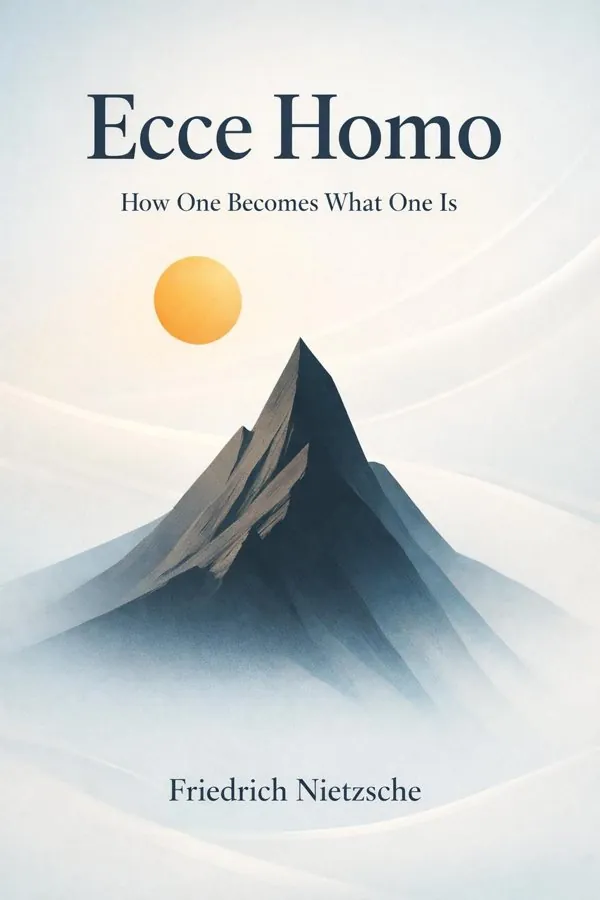
Ecce Homo: How One Becomes What One Is: Summary & Key Insights
 10 min9 chaptersAudio available
Key Takeaways from Ecce Homo: How One Becomes What One Is
Real wisdom may have less to do with abstract knowledge than with learning how to hear oneself accurately.
Intelligence becomes powerful only when it can detect the lies hidden inside respectable ideas.
The most powerful writing does not come from the wish to impress; it comes from necessity.
A person becomes significant not by fitting into history but by changing its direction.
Nietzsche turns health into a spiritual and intellectual concept.
What Is Ecce Homo: How One Becomes What One Is About?
Ecce Homo: How One Becomes What One Is by Friedrich Nietzsche is a western_phil book spanning 4 pages. Ecce Homo: How One Becomes What One Is is Friedrich Nietzsche’s final completed book, written in 1888 just before his mental collapse and published after his death. Part autobiography, part philosophical manifesto, and part literary self-portrait, it is one of the strangest and most revealing works in modern thought. Nietzsche does not tell his life story in a conventional way. Instead, he turns his own life, habits, illnesses, books, and instincts into evidence for a larger claim: a great human being is not manufactured by society’s rules but formed through self-overcoming, discipline, suffering, and radical honesty. What makes the book so important is that it offers Nietzsche’s clearest interpretation of himself. Here he explains why he rejects Christian morality, herd values, resentment, and false humility, while affirming life, strength, creativity, and the courage to become what one is. The tone is provocative, ironic, and often outrageous, yet behind the theatrical self-praise lies a serious philosophical experiment in self-knowledge. As one of the most influential philosophers of the modern age, Nietzsche writes with unusual authority about individuality, culture, morality, and the cost of greatness.
This FizzRead summary covers all 9 key chapters of Ecce Homo: How One Becomes What One Is in approximately 10 minutes, distilling the most important ideas, arguments, and takeaways from Friedrich Nietzsche's work. Also available as an audio summary and Key Quotes Podcast.
Ecce Homo: How One Becomes What One Is
Ecce Homo: How One Becomes What One Is is Friedrich Nietzsche’s final completed book, written in 1888 just before his mental collapse and published after his death. Part autobiography, part philosophical manifesto, and part literary self-portrait, it is one of the strangest and most revealing works in modern thought. Nietzsche does not tell his life story in a conventional way. Instead, he turns his own life, habits, illnesses, books, and instincts into evidence for a larger claim: a great human being is not manufactured by society’s rules but formed through self-overcoming, discipline, suffering, and radical honesty.
What makes the book so important is that it offers Nietzsche’s clearest interpretation of himself. Here he explains why he rejects Christian morality, herd values, resentment, and false humility, while affirming life, strength, creativity, and the courage to become what one is. The tone is provocative, ironic, and often outrageous, yet behind the theatrical self-praise lies a serious philosophical experiment in self-knowledge. As one of the most influential philosophers of the modern age, Nietzsche writes with unusual authority about individuality, culture, morality, and the cost of greatness.
Who Should Read Ecce Homo: How One Becomes What One Is?
This book is perfect for anyone interested in western_phil and looking to gain actionable insights in a short read. Whether you're a student, professional, or lifelong learner, the key ideas from Ecce Homo: How One Becomes What One Is by Friedrich Nietzsche will help you think differently.
- ✓Readers who enjoy western_phil and want practical takeaways
- ✓Professionals looking to apply new ideas to their work and life
- ✓Anyone who wants the core insights of Ecce Homo: How One Becomes What One Is in just 10 minutes
Want the full summary?
Get instant access to this book summary and 100K+ more with Fizz Moment.
Get Free SummaryAvailable on App Store • Free to download
Key Chapters
Real wisdom may have less to do with abstract knowledge than with learning how to hear oneself accurately. In “Why I Am So Wise,” Nietzsche presents wisdom not as obedience to moral commandments or scholarly accumulation, but as a refined sensitivity to one’s own constitution. He treats the body, health, instinct, climate, diet, and daily rhythm as philosophical matters. For him, thought is never detached from life; ideas grow out of a person’s physical and psychological condition. A philosopher who ignores this is not profound but disconnected.
This is one of Nietzsche’s most radical moves. He refuses the traditional image of wisdom as self-denial, humility, or submission to universal truth. Instead, he argues that wisdom emerges when a person stops fighting their deepest nature and begins organizing life around what strengthens them. He discusses his own habits, illnesses, and need for solitude not as trivial details but as part of his philosophy. Suffering, in this view, can become formative when one uses it as material for insight rather than as proof that life is meaningless.
In practical terms, Nietzsche invites readers to ask uncomfortable questions: What environments weaken me? What habits distort my thinking? Which relationships nourish my strength, and which encourage conformity? Modern examples are easy to find. Someone may discover that constant digital noise makes them anxious and imitative, while quiet, walking, and focused work make them clearer and more original. Another may realize that the pursuit of approval has become a substitute for genuine conviction.
Nietzsche’s point is not self-indulgence. It is disciplined self-attunement. To become who you are, you must stop borrowing standards from the crowd and start studying the conditions under which your best self can actually grow. Actionable takeaway: keep a “strength journal” for one week, noting which activities, people, and routines leave you more alive, clear, and capable—and begin adjusting your life accordingly.
Intelligence becomes powerful only when it can detect the lies hidden inside respectable ideas. In “Why I Am So Clever,” Nietzsche defines cleverness less as clever argument and more as independence of vision. To be clever is to see through inherited moral language, social vanity, and philosophical pretension. Most people, in his view, do not think for themselves; they repeat the values of their culture while imagining they are being sincere. Nietzsche’s cleverness lies in his suspicion toward everything that presents itself as self-evidently good, noble, or true.
This suspicion leads him to challenge morality, religion, nationalism, and academic seriousness. He shows how ideals such as humility, pity, and sacrifice can hide resentment, weakness, or the desire to control others. He also insists that many intellectual systems are less about truth than about the temperament of the thinker who creates them. Philosophy often disguises biography.
For contemporary readers, this idea remains strikingly relevant. In workplaces, people may praise “team spirit” while punishing originality. On social media, users may perform moral outrage not from conviction but from a hunger for attention or belonging. In politics, noble slogans often conceal power struggles. Nietzsche does not ask us to become cynics who believe in nothing. He asks us to become sharper readers of motives, including our own.
To practice this kind of cleverness, one must learn to ask: What desire is hiding behind this ideal? Who benefits from this moral language? What do I avoid seeing because the illusion flatters me? Cleverness is not verbal brilliance; it is a disciplined refusal to be duped.
Actionable takeaway: the next time you strongly agree with a moral or cultural claim, pause and list three possible hidden motives behind it—including one motive of your own.
The most powerful writing does not come from the wish to impress; it comes from necessity. In “Why I Write Such Good Books,” Nietzsche argues that his books matter because they are not academic exercises or products of literary vanity. Each emerges from a struggle, an insight, a turning point in his own becoming. His works are not neutral treatises. They are interventions, diagnoses, and acts of war against deadening values. This is why he discusses them with such dramatic confidence: he believes they were written because something essential demanded expression.
Nietzsche also emphasizes style. For him, style is not decoration but the embodiment of thought. A sentence should move with force, precision, rhythm, and temperament. A philosopher’s style reveals the rank of their spirit. He praises compression, music, irony, and attack because he wants language to awaken rather than anesthetize. This helps explain why Ecce Homo reads unlike a standard autobiography. It is a performance of philosophy, not merely a report about it.
There is a practical lesson here for anyone who creates—whether writing, teaching, leading, or building something new. Work becomes compelling when it is rooted in genuine pressure: a problem you cannot ignore, a truth you need to articulate, an experience you have transformed into form. Compare a generic presentation assembled to satisfy expectations with one built from deep conviction and clear insight; audiences can usually feel the difference.
Nietzsche’s self-commentary on books like Thus Spoke Zarathustra and Beyond Good and Evil also models a useful practice: interpret your own work according to the problem it solves, not just the category it fits into. Ask not “Does this look respectable?” but “What necessity gave birth to this?”
Actionable takeaway: choose one current project and write a short note answering two questions—what urgent need does this work come from, and what style would best express that need with force and clarity?
A person becomes significant not by fitting into history but by changing its direction. In “Why I Am a Destiny,” Nietzsche reaches the most explosive claim of Ecce Homo: he sees himself not as a private thinker with opinions, but as a turning point in the history of values. This sounds like pure arrogance, and Nietzsche knows it. Yet beneath the provocation is a serious idea. A “destiny” is someone who names what an age refuses to face and thereby forces a reckoning. Nietzsche believes he has exposed the hidden sickness of Western morality—especially the life-denying effects of Christian guilt, ressentiment, and herd thinking.
To call oneself a destiny is therefore not merely to boast. It is to claim responsibility for a cultural diagnosis. Nietzsche does not want followers who admire him from a distance; he wants readers who can withstand the consequences of his critique. If old values collapse, new forms of life must be created. That is the burden of destiny: not comfort, but transformation.
In ordinary life, most people do not aim to become historical figures. Still, the principle applies on a smaller scale. You become “a destiny” in your own sphere when you stop living as a passive product of expectations and begin acting from a clarified center. A teacher who rejects stale formulas and awakens independent thought in students, or a founder who builds a company around genuine excellence rather than fashionable slogans, can alter the values of a community.
Nietzsche’s challenge is severe. He asks whether you are merely reacting to inherited scripts or actively shaping the meaning of your life. Destiny is not something mystical handed to you. It is what emerges when courage meets insight and is sustained over time.
Actionable takeaway: identify one inherited value you live by without examination, and rewrite it in your own terms based on what truly strengthens, deepens, and clarifies your life.
Nietzsche turns health into a spiritual and intellectual concept. He does not mean simple physical fitness or the absence of illness. In Ecce Homo, health refers to the capacity to transform adversity into strength, to recover one’s equilibrium, and to keep saying yes to life even after pain. This is why Nietzsche’s reflections on sickness are so important. He suffered from chronic illness, isolation, and exhaustion, yet he insists that these experiences sharpened his perception. Illness taught him to discriminate, to conserve energy, and to identify what genuinely nourished him.
This does not mean suffering is automatically valuable. Nietzsche never romanticizes weakness for its own sake. Rather, he asks what kind of person one becomes in response to suffering. Some use pain to justify bitterness, victimhood, or revenge. Others use it as material for refinement and self-overcoming. The difference is decisive. Great health is not fragile comfort; it is resilience with style.
Today this insight speaks to burnout, emotional overload, and identity built around wounds. Many people define themselves entirely by stress, trauma, or depletion. Nietzsche offers a harder but more empowering question: what practices, interpretations, and disciplines would allow me to metabolize hardship instead of worshiping it? This might mean better boundaries, time in solitude, exercise, therapy, artistic expression, or simply refusing environments that continually degrade one’s vitality.
His view also challenges the modern separation between wellness and meaning. The way you sleep, eat, work, move, and rest affects how you think and what you can become. Philosophy is not just what you believe. It is the form your life takes.
Actionable takeaway: pick one recurring source of depletion in your life and make a concrete experiment for the next seven days to reduce it and replace it with one strengthening practice.
The highest form of strength may be the ability to love one’s fate. Although Ecce Homo ranges widely, one of its deepest themes is amor fati: the love of fate. Nietzsche does not merely recommend accepting what happens. Acceptance can still contain resignation. Amor fati means willing one’s life so fully that one would not want it erased, even in its pain, accidents, and humiliations, because these too belong to one’s becoming.
This idea opposes both self-pity and metaphysical consolation. Nietzsche does not seek redemption in another world or excuse in victimhood. He asks for a stronger response: to affirm life as it is, in all its contingency, and to shape oneself through it. This is not passive fatalism. It is active interpretation. One cannot control every event, but one can decide whether to turn events into chains or into material for growth.
In practical life, amor fati can change how we relate to setbacks. Losing a job, ending a relationship, facing failure, or discovering a limitation often feels like life has gone wrong. Nietzsche asks whether these experiences might also reveal capacities, values, or directions that comfort had hidden. The point is not to pretend pain is pleasant, but to refuse the fantasy that a meaningful life must be smooth.
This perspective is especially helpful in a culture obsessed with optimization. Many people think happiness means eliminating friction. Nietzsche suggests the opposite: depth often comes through encounters we did not choose but can learn to affirm. To love your fate is to stop arguing with the fact that your life is your raw material.
Actionable takeaway: write about one event you usually describe as a mistake or misfortune, and identify two ways it shaped your strength, clarity, or direction.
What if many accepted moral ideals are not signs of goodness but strategies of weakness? A central force behind Ecce Homo is Nietzsche’s attack on herd morality—the value system that prizes sameness, obedience, safety, pity, and guilt while distrusting excellence, strength, and difference. He argues that much of Western morality, especially in its Christian form, was shaped by ressentiment: the psychological revenge of the powerless against the powerful. Unable to create greatness, the resentful person condemns it. Unable to act freely, they call freedom selfish. Moral language becomes a weapon.
Nietzsche is not simply defending brute force or cruelty. His target is a moral framework that rewards mediocrity by making distinction feel shameful. Herd morality asks people to shrink so that no one stands too far above the group. It treats ambition with suspicion and often mistakes weakness for virtue. In this sense, resentment is deeply creative: it can build whole systems of praise and blame that invert natural rank.
Modern examples appear everywhere. A competent colleague is criticized as “too intense.” A student who thinks independently is labeled difficult. Excellence is tolerated only when it remains modest enough not to disturb collective comfort. Even online discourse often rewards denunciation more than creation. It is easier to tear down than to build.
Nietzsche’s remedy is not selfishness in the shallow sense. It is noble self-respect: the courage to develop one’s powers without asking permission from resentful standards. This requires learning to distinguish legitimate ethical concern from moralizing envy. Not every criticism is resentment, but much social judgment hides the pain of comparison.
Actionable takeaway: notice one area where you downplay your strength to remain acceptable, and take one small step this week to express your standards more openly and unapologetically.
For Nietzsche, greatness is never accidental; it is shaped through rank, taste, and discipline. Ecce Homo repeatedly suggests that a higher type of person differs not merely by opinions but by standards. Such a person chooses carefully—what to read, whom to spend time with, what rhythms to follow, which battles to fight, and which vulgarities to avoid. Rank is not social class. It is an inner order of valuation. Some things elevate life, others cheapen it, and the noble soul learns to tell the difference.
This is why Nietzsche cares so much about style. Style reflects self-command. A person of rank does not scatter energy in every direction or seek universal approval. They cultivate form. This can apply to writing, speech, work, clothing, movement, leadership, and thought itself. In every case, style expresses a disciplined relation to one’s own power. One does not merely have impulses; one shapes them.
In a distracted age, this idea has practical force. Many people live without hierarchy in their values. Everything is treated as equally urgent, equally interesting, equally deserving of attention. The result is exhaustion and mediocrity. Nietzsche would see this as a failure of rank. To become what one is, one must learn selection—the art of saying no. Greatness requires exclusion as much as ambition.
A modern application could be a professional who stops accepting every meeting, every trend, and every request, and instead organizes life around a few high priorities. It could be an artist who narrows influences in order to develop a singular voice. It could be anyone who replaces reactive living with deliberate standards.
Actionable takeaway: define your top three non-negotiable standards for how you want to think, work, and spend attention, then eliminate one recurring distraction that violates them.
Becoming oneself is impossible without a willingness to destroy flattering illusions. Ecce Homo is often read as extravagant self-celebration, but beneath the theatrical tone lies a fierce commitment to self-interpretation. Nietzsche is not interested in the socially approved self, the morally edited self, or the psychologically comforting self. He wants to know what forces, drives, sufferings, strengths, and necessities actually made him. That is why the book feels so unusual: he uses autobiography as philosophical excavation.
This honesty is not confession in the Christian sense. Nietzsche rejects confession as a ritual of guilt and self-abasement. Instead, he practices disclosure as clarification. He examines his books, habits, illnesses, moods, and turning points to reveal a pattern of becoming. The self is not discovered as a fixed essence hidden inside; it is shaped through interpretation, selection, and struggle. To know oneself is therefore to understand one’s process, not just one’s traits.
For readers, this is both liberating and demanding. Many people cling to identities that protect them from change: “I’m just not ambitious,” “I’m bad at relationships,” “I’m the responsible one,” “I’m the victim,” “I’m the helper.” Nietzsche would ask whether these labels are truths or shelters. The person you think you are may be a compromise with fear, fatigue, or social reward. Ruthless honesty means seeing where you are still performing a version of yourself that keeps you small.
This process should not become self-hatred. Nietzsche’s honesty serves creation, not punishment. The point is to remove what is false so that a stronger form can emerge. Self-creation begins where self-deception ends.
Actionable takeaway: write down one identity statement you often repeat about yourself, then ask: when did I learn this, how does it limit me, and what stronger interpretation might replace it?
All Chapters in Ecce Homo: How One Becomes What One Is
About the Author
Friedrich Nietzsche (1844–1900) was a German philosopher, classical philologist, and cultural critic whose writings transformed modern thought. Appointed a professor of philology at Basel at just twenty-four, he later left academia due to poor health and devoted himself to independent writing. His major works include The Birth of Tragedy, Thus Spoke Zarathustra, Beyond Good and Evil, On the Genealogy of Morality, and Ecce Homo. Nietzsche challenged Christianity, conventional morality, nationalism, and the complacency of modern culture, while advancing ideas such as self-overcoming, the will to power, amor fati, and the critique of ressentiment. Though often controversial and widely misunderstood, his influence on existentialism, psychology, literature, and post-structuralist thought has been immense. He suffered a mental collapse in 1889 and spent his final years incapacitated.
Get This Summary in Your Preferred Format
Read or listen to the Ecce Homo: How One Becomes What One Is summary by Friedrich Nietzsche anytime, anywhere. FizzRead offers multiple formats so you can learn on your terms — all free.
Available formats: App · Audio · PDF · EPUB — All included free with FizzRead
Download Ecce Homo: How One Becomes What One Is PDF and EPUB Summary
Key Quotes from Ecce Homo: How One Becomes What One Is
“Real wisdom may have less to do with abstract knowledge than with learning how to hear oneself accurately.”
“Intelligence becomes powerful only when it can detect the lies hidden inside respectable ideas.”
“The most powerful writing does not come from the wish to impress; it comes from necessity.”
“A person becomes significant not by fitting into history but by changing its direction.”
“Nietzsche turns health into a spiritual and intellectual concept.”
Frequently Asked Questions about Ecce Homo: How One Becomes What One Is
Ecce Homo: How One Becomes What One Is by Friedrich Nietzsche is a western_phil book that explores key ideas across 9 chapters. Ecce Homo: How One Becomes What One Is is Friedrich Nietzsche’s final completed book, written in 1888 just before his mental collapse and published after his death. Part autobiography, part philosophical manifesto, and part literary self-portrait, it is one of the strangest and most revealing works in modern thought. Nietzsche does not tell his life story in a conventional way. Instead, he turns his own life, habits, illnesses, books, and instincts into evidence for a larger claim: a great human being is not manufactured by society’s rules but formed through self-overcoming, discipline, suffering, and radical honesty. What makes the book so important is that it offers Nietzsche’s clearest interpretation of himself. Here he explains why he rejects Christian morality, herd values, resentment, and false humility, while affirming life, strength, creativity, and the courage to become what one is. The tone is provocative, ironic, and often outrageous, yet behind the theatrical self-praise lies a serious philosophical experiment in self-knowledge. As one of the most influential philosophers of the modern age, Nietzsche writes with unusual authority about individuality, culture, morality, and the cost of greatness.
More by Friedrich Nietzsche

You Might Also Like
A Little History of Philosophy
Nigel Warburton
10 min
Areopagitica
John Milton
10 min
How To Think Like A Philosopher: Essential Principles For Clear Thinking
Peter Cave
10 min
Language, Truth and Logic
A. J. Ayer
10 min
The Age of Reason
Thomas Paine
10 min
The Essays
Michel De Montaigne
10 minBrowse by Category
Ready to read Ecce Homo: How One Becomes What One Is?
Get the full summary and 100K+ more books with Fizz Moment.