
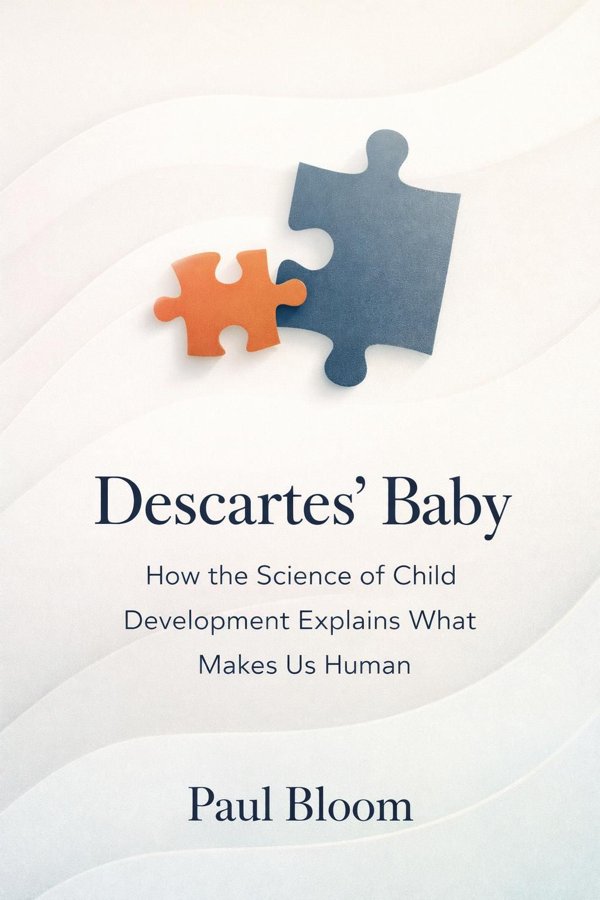
Descartes’ Baby: How the Science of Child Development Explains What Makes Us Human: Summary & Key Insights
by Paul Bloom
 10 min10 chaptersAudio available
What Is Descartes’ Baby: How the Science of Child Development Explains What Makes Us Human About?
Descartes’ Baby: How the Science of Child Development Explains What Makes Us Human by Paul Bloom is a cognition book spanning 10 pages. In this book, Yale psychologist Paul Bloom explores how the human mind develops from infancy, arguing that our moral sense, empathy, and understanding of others are rooted in early cognitive structures. Drawing on developmental psychology and philosophy, Bloom shows how babies’ innate capacities for understanding the physical and social world form the foundation of adult thought, morality, and culture.
This FizzRead summary covers all 10 key chapters of Descartes’ Baby: How the Science of Child Development Explains What Makes Us Human in approximately 10 minutes, distilling the most important ideas, arguments, and takeaways from Paul Bloom's work. Also available as an audio summary and Key Quotes Podcast.
Descartes’ Baby: How the Science of Child Development Explains What Makes Us Human
In this book, Yale psychologist Paul Bloom explores how the human mind develops from infancy, arguing that our moral sense, empathy, and understanding of others are rooted in early cognitive structures. Drawing on developmental psychology and philosophy, Bloom shows how babies’ innate capacities for understanding the physical and social world form the foundation of adult thought, morality, and culture.
Who Should Read Descartes’ Baby: How the Science of Child Development Explains What Makes Us Human?
This book is perfect for anyone interested in cognition and looking to gain actionable insights in a short read. Whether you're a student, professional, or lifelong learner, the key ideas from Descartes’ Baby: How the Science of Child Development Explains What Makes Us Human by Paul Bloom will help you think differently.
- ✓Readers who enjoy cognition and want practical takeaways
- ✓Professionals looking to apply new ideas to their work and life
- ✓Anyone who wants the core insights of Descartes’ Baby: How the Science of Child Development Explains What Makes Us Human in just 10 minutes
Want the full summary?
Get instant access to this book summary and 100K+ more with Fizz Moment.
Get Free SummaryAvailable on App Store • Free to download
Key Chapters
For centuries, philosophers have debated whether the mind starts as a blank slate—John Locke’s tabula rasa—or whether some knowledge is built in. Today, evidence from developmental psychology forces us to reconsider. From their first months, babies already grasp aspects of how the world works. They expect objects to persist when hidden, they anticipate that unsupported things will fall, and they can distinguish between quantities long before formal counting. These aren’t learned illusions; they are reflections of an evolved cognitive structure.
When I observe infants struggling with simple puzzles—a box that hides a toy, a face that appears and disappears—I see not confusion, but curiosity within constraint. Babies make predictions; when violated, they seem surprised, eyes widening, mouths opening in shock. This reaction shows cognitive expectation. Such findings shape a vision of innate knowledge: systems wired into the human brain for understanding objects, numbers, and other minds. These represent the base notes of our mental symphony.
This doesn’t mean that experience plays no role. Culture and learning fill in the details, refine instincts into concepts. But beneath all language lies intuition. We don’t teach children that two plus two equals four when they first notice quantities; we teach them symbols for what they already sense. We don’t instruct them that an object continues to exist when out of sight; we give names to the permanence they’ve already perceived.
The idea of innate knowledge unites Plato’s vision of eternal forms with modern neuroscience. It implies that morality, empathy, and reason don’t emerge from emptiness—they evolve from structure. Recognizing this helps us honor what is universal in humanity: the cognitive bedrock we all share.
Even before they can talk or crawl, babies grasp the rules of physical reality with remarkable sophistication. They understand object permanence—the notion that things exist even when unseen. They track motion, anticipate trajectory, and know that objects cannot pass through one another. These intuitions tell us that our perception of the world is not constructed solely from experience but guided by early expectations.
I recall watching an infant repeatedly drop a spoon and stare as it falls. To an outsider, this seems playful, but it is an experiment as profound as any physicist’s test of gravity. The child is testing invariance: she knows that unsupported objects should fall, and she is confirming the rule. This curiosity marks the development of causal reasoning. It is the seed of science.
From these small acts, we understand that humans are engineers by nature. We anticipate outcomes; we seek explanations. When an outcome surprises—a toy that seems to float, an object that disappears without reason—the mind demands reconciliation. This drive defines us as thinkers. Our earliest moments of awe before physical impossibility mirror the same fascination adults experience when questioning the boundaries of reality.
These early encounters with physics form a map that guides all later inquiry. When a child learns that a ball rolls down a slope, she’s not just learning about play; she’s practicing the logic of cause and effect. That logic becomes the foundation of science, of belief in a lawful universe, and of faith in understanding itself.
+ 8 more chapters — available in the FizzRead app
All Chapters in Descartes’ Baby: How the Science of Child Development Explains What Makes Us Human
About the Author
Paul Bloom is a professor of psychology at the University of Toronto and Yale University, known for his research on moral psychology, empathy, and the origins of pleasure. He has written extensively on how humans develop moral and emotional understanding from infancy.
Get This Summary in Your Preferred Format
Read or listen to the Descartes’ Baby: How the Science of Child Development Explains What Makes Us Human summary by Paul Bloom anytime, anywhere. FizzRead offers multiple formats so you can learn on your terms — all free.
Available formats: App · Audio · PDF · EPUB — All included free with FizzRead
Download Descartes’ Baby: How the Science of Child Development Explains What Makes Us Human PDF and EPUB Summary
Key Quotes from Descartes’ Baby: How the Science of Child Development Explains What Makes Us Human
“For centuries, philosophers have debated whether the mind starts as a blank slate—John Locke’s tabula rasa—or whether some knowledge is built in.”
“Even before they can talk or crawl, babies grasp the rules of physical reality with remarkable sophistication.”
Frequently Asked Questions about Descartes’ Baby: How the Science of Child Development Explains What Makes Us Human
Descartes’ Baby: How the Science of Child Development Explains What Makes Us Human by Paul Bloom is a cognition book that explores key ideas across 10 chapters. In this book, Yale psychologist Paul Bloom explores how the human mind develops from infancy, arguing that our moral sense, empathy, and understanding of others are rooted in early cognitive structures. Drawing on developmental psychology and philosophy, Bloom shows how babies’ innate capacities for understanding the physical and social world form the foundation of adult thought, morality, and culture.
More by Paul Bloom

The Sweet Spot: The Pleasures of Suffering and the Search for Meaning
Paul Bloom
10 min
Against Empathy: The Case for Rational Compassion
Paul Bloom
10 min
The Human Mind: How We Think, Feel, and Experience the World
Paul Bloom
10 min
How Pleasure Works: The New Science of Why We Like What We Like
Paul Bloom
10 minYou Might Also Like
A Field Guide to Lies: Critical Thinking in the Information Age
Daniel J. Levitin
10 min
A Theory of Cognitive Dissonance
Leon Festinger
10 min
Black-And-White Thinking: The Burden of a Binary Brain in a Complex World
Kevin Dutton
10 min
Born Liars: Why We Can’t Live Without Deceit
Ian Leslie
10 min
Collective Illusions: Conformity, Complicity, and the Science of Why We Make Bad Decisions
Todd Rose
10 min
Concrete Mathematics: A Foundation for Computer Science
Ronald L. Graham, Donald E. Knuth, Oren Patashnik
10 minBrowse by Category
Ready to read Descartes’ Baby: How the Science of Child Development Explains What Makes Us Human?
Get the full summary and 100K+ more books with Fizz Moment.