
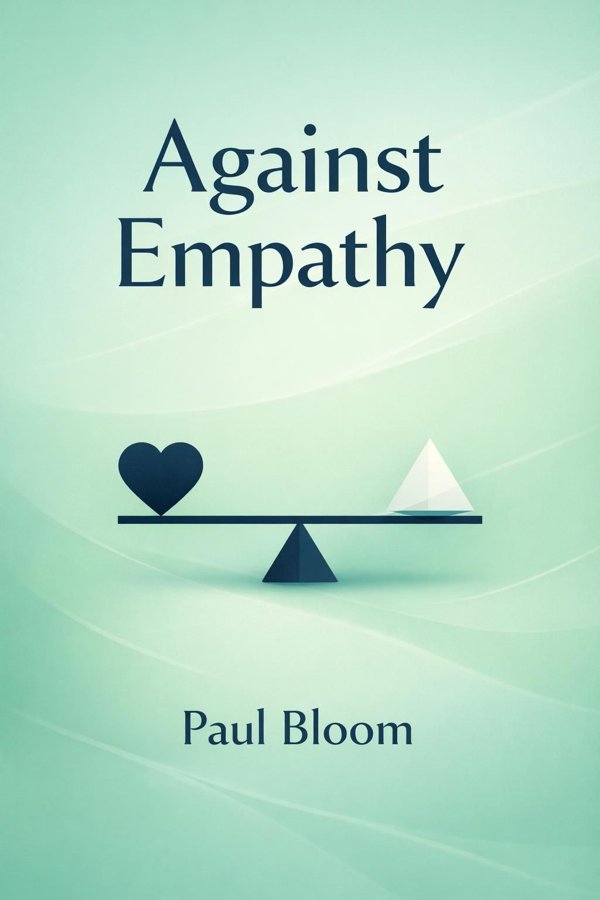
Against Empathy: The Case for Rational Compassion: Summary & Key Insights
by Paul Bloom
 10 min10 chaptersAudio available
What Is Against Empathy: The Case for Rational Compassion About?
Against Empathy: The Case for Rational Compassion by Paul Bloom is a psychology book spanning 10 pages. In this provocative work, psychologist Paul Bloom argues that empathy—the act of feeling what others feel—can lead to biased and harmful decisions. He proposes that rational compassion, grounded in reason and moral principles rather than emotional contagion, offers a better foundation for justice and kindness. Drawing on research from psychology, neuroscience, and philosophy, Bloom challenges conventional wisdom about empathy’s role in morality and explores how reasoned compassion can improve personal relationships, social policy, and global ethics.
This FizzRead summary covers all 10 key chapters of Against Empathy: The Case for Rational Compassion in approximately 10 minutes, distilling the most important ideas, arguments, and takeaways from Paul Bloom's work. Also available as an audio summary and Key Quotes Podcast.
Against Empathy: The Case for Rational Compassion
In this provocative work, psychologist Paul Bloom argues that empathy—the act of feeling what others feel—can lead to biased and harmful decisions. He proposes that rational compassion, grounded in reason and moral principles rather than emotional contagion, offers a better foundation for justice and kindness. Drawing on research from psychology, neuroscience, and philosophy, Bloom challenges conventional wisdom about empathy’s role in morality and explores how reasoned compassion can improve personal relationships, social policy, and global ethics.
Who Should Read Against Empathy: The Case for Rational Compassion?
This book is perfect for anyone interested in psychology and looking to gain actionable insights in a short read. Whether you're a student, professional, or lifelong learner, the key ideas from Against Empathy: The Case for Rational Compassion by Paul Bloom will help you think differently.
- ✓Readers who enjoy psychology and want practical takeaways
- ✓Professionals looking to apply new ideas to their work and life
- ✓Anyone who wants the core insights of Against Empathy: The Case for Rational Compassion in just 10 minutes
Want the full summary?
Get instant access to this book summary and 100K+ more with Fizz Moment.
Get Free SummaryAvailable on App Store • Free to download
Key Chapters
When people talk about empathy, they often mean many different things. To advance a clear argument, I draw an important distinction between *emotional empathy* and *cognitive empathy.* Emotional empathy is the ability to feel another person’s emotions as your own—if you see someone in pain, you literally feel a semblance of that pain. Cognitive empathy, by contrast, is understanding what another person feels without necessarily sharing their feelings—it is perspective-taking and comprehension rather than emotional contagion.
My case is against emotional empathy. This type of empathy is seductive and often praised as the essence of kindness, but in practice it is narrow and unstable. It consumes attention and blurs moral judgment. Cognitive empathy, however, is a skill—a tool we can use to understand people better, anticipate reactions, and build communication. Emotional empathy makes us lose ourselves in others’ moods; cognitive empathy helps us understand others’ minds while keeping our own moral bearings.
When you feel someone’s pain as your own, your moral reasoning naturally contracts. You care deeply for the one person in front of you but may disregard the thousands you cannot see. This is precisely how empathy begins leading us astray: it misdirects moral energy toward the visible and the immediate. Recognizing this distinction allows us to see that while understanding others is essential, *feeling their pain exactly* is not.
Empathy is selective—it fixates on faces, stories, and voices that touch us emotionally, not on abstract numbers or distant statistics. Consider how easily we feel moved by a photo of one suffering child, but how quickly our concern fades when we hear of thousands affected by famine or war. This is known as the *identifiable victim effect*, and countless studies confirm that empathy leads to partiality and inconsistency.
Empathy favors those who are close to us: friends, family, and members of our own community. It rarely rises to the level of impartiality needed for social justice. Moreover, empathy is vulnerable to manipulation. Media outlets, politicians, and advertisers know how to trigger our empathic impulses to provoke outrage or sentimentality. Once our emotions are engaged, reason often retreats.
Through neuroscience, we see that empathy activates pain regions in the brain—it literally makes us suffer in parallel with others. This makes us impatient for relief, often at the expense of truly effective solutions. We give impulsively rather than thoughtfully; we focus on emotionally salient cases rather than systemic change. The bias of empathy doesn’t simply make us less rational—it makes us less fair. Moral consistency requires abstraction, but empathy pulls us constantly back into the emotional immediacy of the moment.
+ 8 more chapters — available in the FizzRead app
All Chapters in Against Empathy: The Case for Rational Compassion
About the Author
Paul Bloom is a Canadian-American psychologist and professor at Yale University, known for his research on morality, pleasure, and the origins of human understanding. His work often explores how cognitive and emotional processes shape moral judgment and human behavior.
Get This Summary in Your Preferred Format
Read or listen to the Against Empathy: The Case for Rational Compassion summary by Paul Bloom anytime, anywhere. FizzRead offers multiple formats so you can learn on your terms — all free.
Available formats: App · Audio · PDF · EPUB — All included free with FizzRead
Download Against Empathy: The Case for Rational Compassion PDF and EPUB Summary
Key Quotes from Against Empathy: The Case for Rational Compassion
“When people talk about empathy, they often mean many different things.”
“Empathy is selective—it fixates on faces, stories, and voices that touch us emotionally, not on abstract numbers or distant statistics.”
Frequently Asked Questions about Against Empathy: The Case for Rational Compassion
Against Empathy: The Case for Rational Compassion by Paul Bloom is a psychology book that explores key ideas across 10 chapters. In this provocative work, psychologist Paul Bloom argues that empathy—the act of feeling what others feel—can lead to biased and harmful decisions. He proposes that rational compassion, grounded in reason and moral principles rather than emotional contagion, offers a better foundation for justice and kindness. Drawing on research from psychology, neuroscience, and philosophy, Bloom challenges conventional wisdom about empathy’s role in morality and explores how reasoned compassion can improve personal relationships, social policy, and global ethics.
More by Paul Bloom

The Sweet Spot: The Pleasures of Suffering and the Search for Meaning
Paul Bloom
10 min
The Human Mind: How We Think, Feel, and Experience the World
Paul Bloom
10 min
How Pleasure Works: The New Science of Why We Like What We Like
Paul Bloom
10 min
Psych
Paul Bloom
10 minYou Might Also Like
The Body Keeps the Score
Bessel van der Kolk
10 min
Surrounded by Idiots
Thomas Erikson
10 min
Emotional Intelligence
Daniel Goleman
10 min
Attached
Amir Levine
10 min
Why Does He Do That
Lundy Bancroft
10 min
Women Who Run with the Wolves
Clarissa Pinkola Estés
10 minBrowse by Category
Ready to read Against Empathy: The Case for Rational Compassion?
Get the full summary and 100K+ more books with Fizz Moment.