
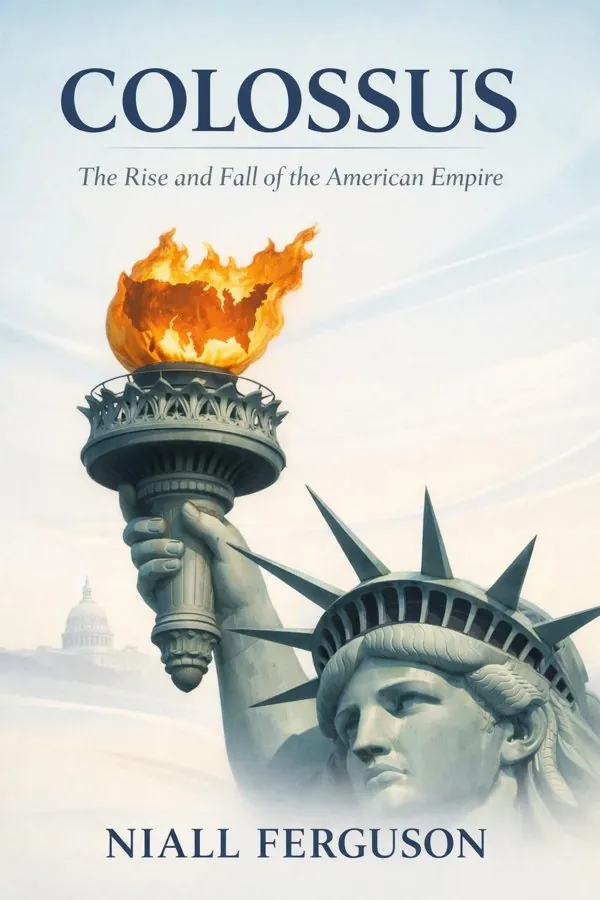
Colossus: The Rise and Fall of the American Empire: Summary & Key Insights
 10 min6 chaptersAudio available
What Is Colossus: The Rise and Fall of the American Empire About?
Colossus: The Rise and Fall of the American Empire by Niall Ferguson is a politics book spanning 6 pages. In this work, historian Niall Ferguson examines the United States as a modern empire, arguing that in both military and economic terms it is the most powerful empire the world has ever seen. He explores the paradoxes of American power, its global influence, and the challenges that threaten its sustainability, offering a critical analysis of the rise and potential decline of the American imperial project.
This FizzRead summary covers all 6 key chapters of Colossus: The Rise and Fall of the American Empire in approximately 10 minutes, distilling the most important ideas, arguments, and takeaways from Niall Ferguson's work. Also available as an audio summary and Key Quotes Podcast.
Colossus: The Rise and Fall of the American Empire
In this work, historian Niall Ferguson examines the United States as a modern empire, arguing that in both military and economic terms it is the most powerful empire the world has ever seen. He explores the paradoxes of American power, its global influence, and the challenges that threaten its sustainability, offering a critical analysis of the rise and potential decline of the American imperial project.
Who Should Read Colossus: The Rise and Fall of the American Empire?
This book is perfect for anyone interested in politics and looking to gain actionable insights in a short read. Whether you're a student, professional, or lifelong learner, the key ideas from Colossus: The Rise and Fall of the American Empire by Niall Ferguson will help you think differently.
- ✓Readers who enjoy politics and want practical takeaways
- ✓Professionals looking to apply new ideas to their work and life
- ✓Anyone who wants the core insights of Colossus: The Rise and Fall of the American Empire in just 10 minutes
Want the full summary?
Get instant access to this book summary and 100K+ more with Fizz Moment.
Get Free SummaryAvailable on App Store • Free to download
Key Chapters
Every empire sees itself as exceptional, but when viewed through the long lens of history, empires share common patterns of expansion, rule, and eventual retrenchment. To understand America’s global role, we must first see it within that continuum. The parallels with Britain are obvious: both are maritime powers, both see themselves as exporters of liberty and commerce, and both have experienced the tension between self-interest and moral mission. Yet there are critical differences. The British Empire was formal, with colonies ruled directly under the Crown. The American empire is informal, exercised through markets, alliances, and military bases rather than colonial flags.
The United States inherited global responsibilities not by design but by historical accident—after 1945, as Britain relinquished its imperial mantle, America filled the vacuum. The institutions it built—the United Nations, the IMF, the World Bank—function as veiled instruments of American influence. Its network of security alliances, from NATO to bilateral pacts in East Asia, replicates the strategic web once woven from London but now controlled from Washington.
Yet the analogy between Britain and America is not perfect. The British Empire had administrators, clerks, and missionaries willing to devote lifetimes to foreign lands. The American system relies on short rotations of troops, contractors, and diplomats; its citizens lack the staying power of empire builders. As I argue, what differentiates Britain’s imperial achievement from America’s predicament is not strength but stamina—the will to maintain order over the long term.
The empire of the United States rests not on colonies but on credit. Its dominance derives from its financial capitalism—the ability to mobilize global wealth through its markets and the preeminence of the dollar. Historically, empires required gold, trade routes, and naval protection; in the modern age, the American imperium is sustained by capital flows, debt instruments, and consumer confidence. Wall Street has become as crucial to America’s global power as the Pentagon.
This economic order benefits from symbiotic relationships. Emerging nations hold vast reserves in U.S. Treasury bonds, financing American consumption, while American firms penetrate their markets with investment and technology. Yet this system is not cost-free. The twin deficits—current account and fiscal—reveal how America has become dependent on foreign savings to maintain its empire. Whereas the British could draw upon imperial revenues, America must borrow from those it defends. Never before has an empire financed itself on the savings of its supposed dependents.
The 1990s and early twenty-first century showed the paradox of American wealth: the spread of free-market capitalism reinforced U.S. influence but also created vulnerabilities. Financial crises, debt dependence, and structural imbalances could easily undermine the foundations of empire. History teaches that fiscal overreach has preceded the collapse of empires before—from Habsburg Spain to Victorian Britain—and unless the United States learns fiscal discipline, its economic empire may prove as transient as those that came before.
+ 4 more chapters — available in the FizzRead app
All Chapters in Colossus: The Rise and Fall of the American Empire
About the Author
Niall Ferguson is a British historian known for his works on economic and political history, including studies of empire, finance, and international relations. He has taught at Harvard, Oxford, and Stanford, and is recognized for his accessible yet scholarly approach to global history.
Get This Summary in Your Preferred Format
Read or listen to the Colossus: The Rise and Fall of the American Empire summary by Niall Ferguson anytime, anywhere. FizzRead offers multiple formats so you can learn on your terms — all free.
Available formats: App · Audio · PDF · EPUB — All included free with FizzRead
Download Colossus: The Rise and Fall of the American Empire PDF and EPUB Summary
Key Quotes from Colossus: The Rise and Fall of the American Empire
“Every empire sees itself as exceptional, but when viewed through the long lens of history, empires share common patterns of expansion, rule, and eventual retrenchment.”
“The empire of the United States rests not on colonies but on credit.”
Frequently Asked Questions about Colossus: The Rise and Fall of the American Empire
Colossus: The Rise and Fall of the American Empire by Niall Ferguson is a politics book that explores key ideas across 6 chapters. In this work, historian Niall Ferguson examines the United States as a modern empire, arguing that in both military and economic terms it is the most powerful empire the world has ever seen. He explores the paradoxes of American power, its global influence, and the challenges that threaten its sustainability, offering a critical analysis of the rise and potential decline of the American imperial project.
More by Niall Ferguson
Doom: The Politics of Catastrophe
Niall Ferguson
10 min
The Square and the Tower: Networks and Power, from the Freemasons to Facebook
Niall Ferguson
10 min
Empire: How Britain Made the Modern World
Niall Ferguson
10 min
The Ascent Of Money: A Financial History Of The World
Niall Ferguson
10 minYou Might Also Like
Antifa: The Anti-Fascist Handbook
Mark Bray
10 min
Attack from Within: How Disinformation Is Sabotaging America
Barbara McQuade
10 min
Coercion, Capital, and European States, AD 990–1992
Charles Tilly
10 min
Digital Democracy: Concepts, Methodologies, Tools, and Applications
Various Authors
10 min
Fascism
Stanley G. Payne
10 min
Fire And Fury: Inside The Trump White House
Michael Wolff
10 minBrowse by Category
Ready to read Colossus: The Rise and Fall of the American Empire?
Get the full summary and 100K+ more books with Fizz Moment.