
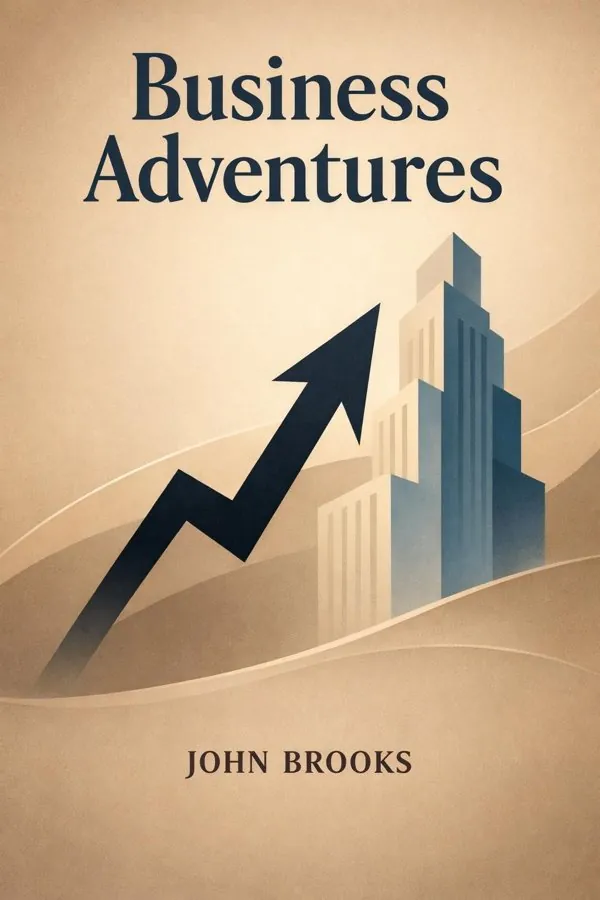
Business Adventures: Summary & Key Insights
by John Brooks
 10 min10 chaptersAudio available
Key Takeaways from Business Adventures
A stock market decline is never only about numbers; it is also about the speed with which confidence can evaporate.
The Edsel is remembered as a punchline, but Brooks treats it as something more useful: a case study in how large organizations can mistake planning for understanding.
One of Brooks’s most surprising achievements is making administrative machinery feel dramatic.
Pressure does not create character so much as expose it.
A breakthrough technology is not the same thing as a breakthrough business.
What Is Business Adventures About?
Business Adventures by John Brooks is a economics book published in 2014 spanning 11 pages. Business Adventures by John Brooks is a masterful collection of twelve narrative essays about some of the most revealing episodes in twentieth-century American business. First published in The New Yorker and later collected in book form, these stories move from market panics and product failures to currency crises, shareholder battles, and the hidden systems that keep modern capitalism running. Although the events took place decades ago, the book remains strikingly current because Brooks was never really writing only about stocks, cars, taxes, or corporate meetings. He was writing about people under pressure: executives defending bad decisions, investors chasing confidence, bureaucracies wrestling with complexity, and institutions trying to preserve credibility when events turn against them. That is why the book still resonates with leaders, founders, investors, and curious readers today. Brooks had a rare gift: he combined the reporting discipline of a financial journalist with the narrative grace of a novelist. The result is a business book that does not lecture in abstractions, but reveals enduring truths through vivid stories. Business Adventures matters because it shows that markets change, technologies evolve, but human nature in business barely does.
This FizzRead summary covers all 10 key chapters of Business Adventures in approximately 10 minutes, distilling the most important ideas, arguments, and takeaways from John Brooks's work. Also available as an audio summary and Key Quotes Podcast.
Business Adventures
Business Adventures by John Brooks is a masterful collection of twelve narrative essays about some of the most revealing episodes in twentieth-century American business. First published in The New Yorker and later collected in book form, these stories move from market panics and product failures to currency crises, shareholder battles, and the hidden systems that keep modern capitalism running. Although the events took place decades ago, the book remains strikingly current because Brooks was never really writing only about stocks, cars, taxes, or corporate meetings. He was writing about people under pressure: executives defending bad decisions, investors chasing confidence, bureaucracies wrestling with complexity, and institutions trying to preserve credibility when events turn against them. That is why the book still resonates with leaders, founders, investors, and curious readers today. Brooks had a rare gift: he combined the reporting discipline of a financial journalist with the narrative grace of a novelist. The result is a business book that does not lecture in abstractions, but reveals enduring truths through vivid stories. Business Adventures matters because it shows that markets change, technologies evolve, but human nature in business barely does.
Who Should Read Business Adventures?
This book is perfect for anyone interested in economics and looking to gain actionable insights in a short read. Whether you're a student, professional, or lifelong learner, the key ideas from Business Adventures by John Brooks will help you think differently.
- ✓Readers who enjoy economics and want practical takeaways
- ✓Professionals looking to apply new ideas to their work and life
- ✓Anyone who wants the core insights of Business Adventures in just 10 minutes
Want the full summary?
Get instant access to this book summary and 100K+ more with Fizz Moment.
Get Free SummaryAvailable on App Store • Free to download
Key Chapters
A stock market decline is never only about numbers; it is also about the speed with which confidence can evaporate. In “The Fluctuation,” Brooks examines the market break of 1962, an event far smaller than the crash of 1929 but psychologically powerful enough to remind America that prosperity is never as stable as it appears. Prices fell sharply, experts searched for causes, and the public reacted as though a hidden truth had suddenly been exposed. Brooks’s deeper point is that markets are not cold machines. They are social systems driven by expectation, fear, imitation, and narrative.
The lesson matters because people often assume that if the fundamentals are solid, price movements will remain reasonable. Yet markets regularly overshoot in both directions. A rumor, a policy signal, or a broad feeling of unease can become self-reinforcing. Investors sell because others are selling; executives panic because the market’s verdict seems to carry moral authority. We still see this today in sudden tech selloffs, meme stock surges, crypto crashes, and banking scares. The instruments change, but the psychology does not.
For individuals, the practical implication is clear: do not confuse price movement with truth. A falling market may reveal real weakness, but it may also reflect temporary emotion. For leaders, it means preparing in advance for volatility rather than improvising during panic. Build cash reserves, communicate clearly, and separate long-term value from short-term noise.
Actionable takeaway: Create a written decision rule for moments of market stress so fear does not become your strategy.
The Edsel is remembered as a punchline, but Brooks treats it as something more useful: a case study in how large organizations can mistake planning for understanding. Ford invested enormous resources into the Edsel. Research teams, strategic committees, market forecasts, dealer networks, and elaborate launch campaigns all pointed toward success. Yet when the car arrived in 1957, it failed badly. Why? Because the company had built a product around internal confidence and statistical logic while missing the mood of the market and the tastes of actual buyers.
Brooks shows that business failure is rarely caused by one catastrophic error. More often, it comes from a chain of reasonable decisions made inside a system that rewards consensus, optimism, and commitment. Once a big project gains momentum, dissent becomes difficult. Executives become emotionally attached. Marketing compensates for uncertainty with louder promises. By launch day, the organization is no longer testing whether customers want the product; it is trying to prove that it was right all along.
This pattern appears everywhere today. Companies overbuild features users never asked for, founders scale too early because investors expect growth, and large teams interpret data through the lens of ambition. The Edsel warns against believing that money, analytics, and expertise automatically produce demand.
The practical lesson is not to avoid ambition, but to remain brutally honest about customer reality. Validate with real users, keep pilots small, and treat hesitation as signal rather than resistance.
Actionable takeaway: Before a major launch, ask one uncomfortable question—what evidence would convince us this product should not exist?
One of Brooks’s most surprising achievements is making administrative machinery feel dramatic. In “The Federal Income Tax,” he explores the American tax system not as a dry policy topic, but as a vast human enterprise balancing fairness, complexity, enforcement, and sheer scale. Millions of returns must be processed, errors must be interpreted, rules must be applied consistently, and public trust must be preserved even when the system itself is bewildering. The point is larger than taxation: modern society depends on complex institutions that most people only notice when they malfunction.
Brooks reveals how fragile these systems are. The tax code may appear impersonal, but its operation depends on judgment, workflow, incentives, and compliance. If rules become too complicated, ordinary citizens lose confidence. If enforcement becomes arbitrary, legitimacy erodes. If the machinery gets overloaded, delays and confusion ripple outward. The same is true of payroll systems, healthcare billing, banking regulation, logistics software, and any operation where scale creates opacity.
For managers, the key insight is that complexity is not proof of sophistication. Often it is a hidden cost. A process can be technically sound and still fail because users cannot navigate it. For citizens and investors, the essay is a reminder that institutions matter more than headlines suggest. Strong systems create predictability; weak systems generate mistrust.
In practical terms, organizations should audit not only outcomes but usability. If employees or customers regularly need workarounds, the system is sending a warning. Simplicity is a strategic advantage, not a cosmetic preference.
Actionable takeaway: Identify one process in your work that people comply with but do not truly understand, and simplify it before the friction becomes a risk.
Pressure does not create character so much as expose it. In “A Reasonable Amount of Time,” Brooks follows a corporate legal and operational drama in which schedules, obligations, and institutional demands collide. The essay shows how organizations talk about timing as though it were neutral, yet every deadline is really a test of judgment: when to rush, when to delay, when to satisfy procedure, and when to admit that reality is moving slower than the plan.
Brooks is especially good at showing that delays are not always signs of incompetence. Sometimes they reveal the conflict between legal caution and commercial urgency, or between engineering truth and executive optimism. Businesses often suffer because they define timeliness too narrowly. A decision made fast but poorly can create years of downstream damage, while a well-judged delay can preserve trust, quality, and solvency.
This insight applies to product releases, hiring, fundraising, compliance reviews, acquisitions, and crisis response. Teams that fear admitting uncertainty tend to re-label hope as a timeline. Leaders then pressure subordinates to confirm impossible dates, and the organization becomes trapped by its own promises. What starts as motivation becomes collective self-deception.
The practical lesson is to create a culture where schedule risk can be spoken about honestly. Build buffers into important projects. Distinguish between externally imposed deadlines and internally invented ones. Reward transparency, not just speed. The best operators know that timing is strategic, not cosmetic.
Actionable takeaway: For your next major project, define in advance what would justify extending the timeline, and communicate those conditions before pressure builds.
A breakthrough technology is not the same thing as a breakthrough business. In “Xerox Xerox Xerox Xerox,” Brooks tells the story of a company whose invention transformed office work. Xerox’s copying technology seemed almost magical compared with older methods, and demand surged because the product solved a real, universal problem. Yet Brooks does not present innovation as a fairy tale. He shows how success creates new managerial burdens: production scaling, service reliability, internal organization, competition, and the temptation to believe that one great idea guarantees permanent dominance.
The enduring lesson is that invention earns attention, but systems earn profits. Many companies stumble after finding product-market fit because they underestimate the disciplines required to support growth. Manufacturing must become dependable. Customer service must become repeatable. Hiring standards must mature. Capital allocation must remain rational even when optimism is overflowing. Xerox flourished because the underlying technology was powerful, but the story also reveals how fragile leadership judgment becomes when a company starts to believe in its own inevitability.
Modern parallels are everywhere: software startups that go viral but cannot retain users, biotech firms with promising science but weak commercialization, and AI companies racing ahead before building governance or customer support. The market rewards novelty first, then punishes poor execution.
For founders and operators, the practical message is to treat scaling as a second invention. The first invention is the product; the second is the company capable of delivering it repeatedly and profitably.
Actionable takeaway: If your business is growing fast, spend as much time strengthening operations and service as you spend celebrating innovation.
Financial institutions often appear powerful right up until the moment trust disappears. In “Making the Customers Whole,” Brooks recounts the 1963 salad oil scandal, in which deception at a commodities company triggered losses that spread outward to banks, brokers, and counterparties. Warehouses seemed full, documentation seemed legitimate, and respected institutions appeared protected—until it became clear that much of the collateral behind the loans did not truly exist as assumed. The scandal revealed how much of finance depends not just on contracts, but on belief in verification systems.
Brooks’s central insight is that fraud rarely succeeds because everyone is foolish. It succeeds because institutions become comfortable with routines that seem to confirm one another. Paperwork substitutes for inspection. Reputation substitutes for scrutiny. Scale creates distance from underlying reality. Once confidence breaks, the damage exceeds the direct losses because every participant starts wondering what else has been accepted without enough checking.
This is not an old lesson. It applies to modern accounting scandals, venture valuations, crypto exchanges, and even ordinary business relationships. If a company cannot clearly explain its assets, cash flows, controls, or custody arrangements, trust is resting on fragile ground. Customers and partners do not need perfection, but they need evidence that claims are testable.
The practical lesson is to build and demand verification. Audit trails, independent oversight, reconciliation processes, and plain-language disclosures are not bureaucratic annoyances; they are defenses against catastrophe. And when harm does occur, swift efforts to make customers whole are essential for preserving legitimacy.
Actionable takeaway: In any financial decision, ask not only “What are we being told?” but “How is this being independently verified?”
The market often rewards audacity just long enough to make it dangerous. In “The Last Great Corner,” Brooks revisits the famous stock-market battle involving Piggly Wiggly founder Clarence Saunders, who attempted to corner his company’s shares and force short sellers into surrender. The episode reads like high drama, but its real value lies in what it reveals about speculation. Financial contests are rarely just analytical. They become personal. Pride, revenge, showmanship, and the desire to prove superiority can turn a tactical trade into a crusade.
Brooks shows that even when a speculator identifies a genuine vulnerability in the market, success depends on timing, liquidity, counterparties, and the rules of the exchange. In other words, being right is not enough. You must also survive the path between insight and outcome. Saunders understood the logic of the squeeze, but the wider system had its own reactions, and institutional responses changed the game.
This remains relevant for activist campaigns, short squeezes, concentrated bets, and high-conviction trades. Investors often focus on upside scenarios while underestimating how rules, sentiment, or financing conditions can shift. Entrepreneurs make a similar mistake when they assume a bold move will force the market to accept their terms. Sometimes the market pushes back harder.
The practical insight is to separate strategic conviction from emotional escalation. If a position starts becoming about identity, status, or revenge, risk judgment is already deteriorating. Great operators preserve optionality rather than turning every contest into a final stand.
Actionable takeaway: Before making a concentrated bet, define the conditions under which you will exit, especially if your ego most wants to stay in.
A career is not only a way of earning money; it is also a way of becoming someone. In “A Second Sort of Life,” Brooks explores the world of business executives and the social identity created by corporate success. The essay is less about one transaction than about a condition: what it means to inhabit an elite business role so fully that the corporation becomes an extension of the self. Titles, routines, clubs, travel, and status markers create a second life that can feel orderly and meaningful, yet may also become constraining or spiritually thin.
Brooks writes with sympathy rather than cynicism. He understands why competent, hardworking people devote themselves to organizations. Corporate structures offer recognition, belonging, and a sense of usefulness. But he also sees the cost. When a person’s worth becomes too tightly tied to office, hierarchy, or compensation, setbacks become existential. Retirement feels like erasure. Ethical compromises become easier to rationalize because the system no longer feels external; it feels like identity.
This insight matters in the modern world of executive burnout, startup obsession, and professional overidentification. People say they want work-life balance, but many still organize self-esteem around achievement and affiliation. Brooks reminds us that success can narrow as much as it elevates.
The practical lesson is not to reject ambition but to diversify identity. Cultivate commitments that are not dependent on title or market value: family, friendships, civic life, craft, health, or learning. Leaders who have more than one source of meaning make better decisions under pressure because they are less desperate.
Actionable takeaway: Build one serious commitment outside work that would still matter to you if your job disappeared tomorrow.
Money is often treated as a fact, but Brooks reminds us in “In Defense of Sterling” that a currency is also a collective act of faith. His account of the British pound under pressure shows how national prestige, trade realities, central-bank policy, and international perception all converge in a crisis of confidence. A currency can be legally valid and still become politically vulnerable if markets begin to doubt the willingness or ability of leaders to defend it.
The essay’s significance extends far beyond mid-century Britain. It explains why financial stability is inseparable from credibility. Governments cannot simply announce strength; they must demonstrate coherent policy, disciplined tradeoffs, and institutional seriousness. Once confidence erodes, every action is interpreted through suspicion. Defensive moves can look weak, reassurances can sound desperate, and speculators become emboldened by ambiguity.
This dynamic appears today in sovereign debt scares, emerging-market currency crises, inflation shocks, and even corporate balance-sheet concerns. Investors and citizens alike tend to notice confidence only when it starts disappearing. Brooks shows that credibility is accumulated slowly and tested suddenly.
The practical lesson for leaders—public or private—is to protect trust before you need to spend it. Overpromising stability while postponing hard decisions is dangerous because confidence, once lost, is expensive to regain. For individuals, the essay is a reminder to watch institutional behavior, not just official statements.
Actionable takeaway: When evaluating a government, company, or investment, pay close attention to whether its promises are matched by credible capacity and consistent action.
All Chapters in Business Adventures
About the Author
John Brooks (1920–1993) was an American journalist, staff writer for The New Yorker, and one of the most admired business writers of the twentieth century. He became known for turning complex topics in finance, markets, and corporate life into vivid narratives that ordinary readers could understand and enjoy. Rather than relying on technical jargon, Brooks focused on people, institutions, and the drama behind economic events. His essays combined meticulous reporting with literary elegance, making him unusual in the world of business journalism. Business Adventures, his best-known book, collected twelve of his New Yorker pieces and earned lasting praise for its insight and readability. Brooks’s work remains influential because he captured a timeless truth: behind every business story, no matter how sophisticated the system, human nature is still the central force.
Get This Summary in Your Preferred Format
Read or listen to the Business Adventures summary by John Brooks anytime, anywhere. FizzRead offers multiple formats so you can learn on your terms — all free.
Available formats: App · Audio · PDF · EPUB — All included free with FizzRead
Download Business Adventures PDF and EPUB Summary
Key Quotes from Business Adventures
“A stock market decline is never only about numbers; it is also about the speed with which confidence can evaporate.”
“The Edsel is remembered as a punchline, but Brooks treats it as something more useful: a case study in how large organizations can mistake planning for understanding.”
“One of Brooks’s most surprising achievements is making administrative machinery feel dramatic.”
“Pressure does not create character so much as expose it.”
“A breakthrough technology is not the same thing as a breakthrough business.”
Frequently Asked Questions about Business Adventures
Business Adventures by John Brooks is a economics book that explores key ideas across 10 chapters. Business Adventures by John Brooks is a masterful collection of twelve narrative essays about some of the most revealing episodes in twentieth-century American business. First published in The New Yorker and later collected in book form, these stories move from market panics and product failures to currency crises, shareholder battles, and the hidden systems that keep modern capitalism running. Although the events took place decades ago, the book remains strikingly current because Brooks was never really writing only about stocks, cars, taxes, or corporate meetings. He was writing about people under pressure: executives defending bad decisions, investors chasing confidence, bureaucracies wrestling with complexity, and institutions trying to preserve credibility when events turn against them. That is why the book still resonates with leaders, founders, investors, and curious readers today. Brooks had a rare gift: he combined the reporting discipline of a financial journalist with the narrative grace of a novelist. The result is a business book that does not lecture in abstractions, but reveals enduring truths through vivid stories. Business Adventures matters because it shows that markets change, technologies evolve, but human nature in business barely does.
You Might Also Like
Nudge
Richard H. Thaler, Cass R. Sunstein
10 min
The Hitchhiker"s Guide to the Galaxy
Douglas Adams
10 minThe Muqaddimah
Ibn Khaldun
10 minThe Outsiders
William N. Thorndike
10 min
A Little History of Economics
Niall Kishtainy
10 min
Adapt: Why Success Always Starts With Failure
Tim Harford
10 minFeatured In
Bill Gates's Book Picks
Bill Gates' Reading List: The Books That Shaped a Visionary
Warren Buffett's Book Picks
Warren Buffett's Must-Reads for Building Wealth
Curated's Book Picks
Best Finance & Money Books — Master Your Financial Future
Curated's Book Picks
Best Economics Books — Understand How the World Works
Curated's Book Picks
Most Influential Books of All Time
Browse by Category
Ready to read Business Adventures?
Get the full summary and 100K+ more books with Fizz Moment.