
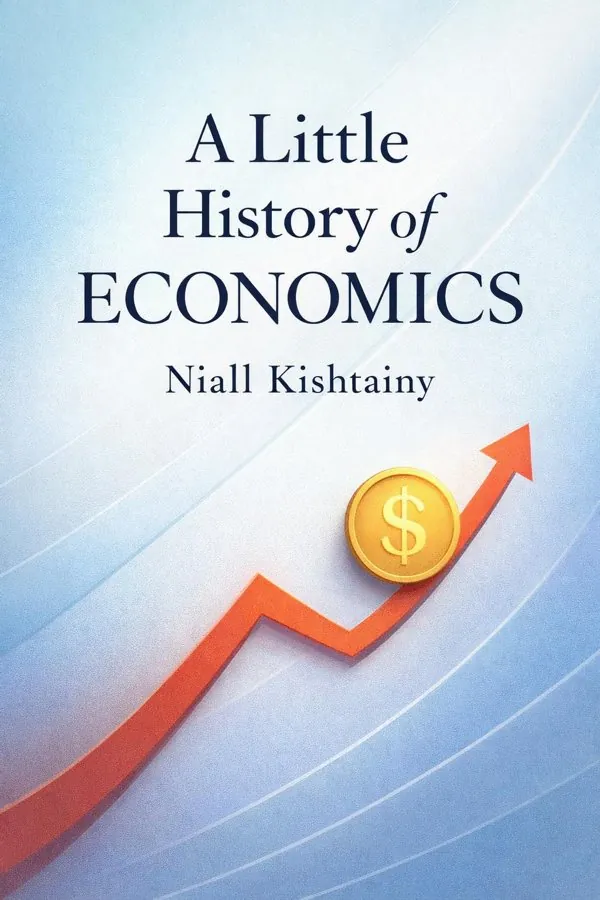
A Little History of Economics: Summary & Key Insights
 10 min9 chaptersAudio available
Key Takeaways from A Little History of Economics
A powerful way to understand economics is to see that it began long before modern graphs, equations, or central banks.
One of the most influential insights in economic history is that decentralized markets can create order without anyone centrally planning the whole system.
Economic growth may sound abstract, but the Industrial Revolution turned it into one of the defining forces of modern life.
Few economic questions are as persistent as the question of who gets what and why.
A central tension in economic history is that the same system capable of generating enormous prosperity can also produce crisis.
What Is A Little History of Economics About?
A Little History of Economics by Niall Kishtainy is a economics book. Economics shapes far more than stock markets and government budgets; it influences the food we buy, the jobs we pursue, the taxes we pay, and the opportunities available in society. In A Little History of Economics, Niall Kishtainy turns a subject that often seems technical or intimidating into a vivid story about ideas, power, wealth, poverty, and human behavior. Rather than presenting economics as a set of dry formulas, he traces its evolution through the thinkers, debates, crises, and social changes that gave rise to the modern world. The book matters because it helps readers understand not only what economists have said, but why those ideas emerged and how they continue to affect public policy and everyday life. Kishtainy shows how economic thought developed in response to real problems: trade, inequality, industrialization, unemployment, financial collapse, and globalization. His authority comes from both scholarly expertise and a gift for clear explanation. With a background in the history of economic thought and a talent for making complex ideas accessible, he offers readers an engaging guide to one of the most important conversations in human history.
This FizzRead summary covers all 9 key chapters of A Little History of Economics in approximately 10 minutes, distilling the most important ideas, arguments, and takeaways from Niall Kishtainy's work. Also available as an audio summary and Key Quotes Podcast.
A Little History of Economics
Economics shapes far more than stock markets and government budgets; it influences the food we buy, the jobs we pursue, the taxes we pay, and the opportunities available in society. In A Little History of Economics, Niall Kishtainy turns a subject that often seems technical or intimidating into a vivid story about ideas, power, wealth, poverty, and human behavior. Rather than presenting economics as a set of dry formulas, he traces its evolution through the thinkers, debates, crises, and social changes that gave rise to the modern world.
The book matters because it helps readers understand not only what economists have said, but why those ideas emerged and how they continue to affect public policy and everyday life. Kishtainy shows how economic thought developed in response to real problems: trade, inequality, industrialization, unemployment, financial collapse, and globalization. His authority comes from both scholarly expertise and a gift for clear explanation. With a background in the history of economic thought and a talent for making complex ideas accessible, he offers readers an engaging guide to one of the most important conversations in human history.
Who Should Read A Little History of Economics?
This book is perfect for anyone interested in economics and looking to gain actionable insights in a short read. Whether you're a student, professional, or lifelong learner, the key ideas from A Little History of Economics by Niall Kishtainy will help you think differently.
- ✓Readers who enjoy economics and want practical takeaways
- ✓Professionals looking to apply new ideas to their work and life
- ✓Anyone who wants the core insights of A Little History of Economics in just 10 minutes
Want the full summary?
Get instant access to this book summary and 100K+ more with Fizz Moment.
Get Free SummaryAvailable on App Store • Free to download
Key Chapters
A powerful way to understand economics is to see that it began long before modern graphs, equations, or central banks. At its core, economics starts with a simple human problem: resources are limited, but wants and needs are not. Kishtainy shows that early economic thinking emerged from questions about how societies produce food, organize labor, distribute goods, and survive scarcity. In that sense, economics is not merely about money; it is about choices under constraint.
The book helps readers see that every economy, whether ancient or modern, must answer a few enduring questions: What should be produced? Who should do the work? How should rewards be distributed? These are not just technical issues. They are moral, political, and social questions as well. When a family decides how to spend its monthly budget, when a city chooses whether to build roads or schools, or when a country debates healthcare spending, the same logic of scarce resources and competing priorities is at work.
Kishtainy���s historical approach is especially useful because it reveals that economic systems are human creations, not laws of nature. Markets, property rights, wages, and taxes all emerged from specific institutions and historical struggles. That means they can change. Understanding this frees readers from the false belief that current arrangements are inevitable.
A practical application of this idea is to ask more informed questions in daily life. Instead of simply asking whether something is expensive, ask what trade-offs are involved. What must be given up to fund one priority over another? What incentives are shaping behavior? Economics becomes clearer when we start noticing these choices around us.
Actionable takeaway: Train yourself to identify trade-offs in everyday decisions, because economic thinking begins the moment you ask, “What are we sacrificing to get this?”
One of the most influential insights in economic history is that decentralized markets can create order without anyone centrally planning the whole system. Kishtainy explains how thinkers like Adam Smith highlighted the remarkable ability of prices, competition, and self-interest to coordinate production and exchange. A baker does not need to love society in order to provide bread; the pursuit of livelihood can still meet social needs. This was a revolutionary idea because it suggested that prosperity could emerge from voluntary exchange rather than strict control.
Yet the book does not present markets as magical or flawless. Markets work well under certain conditions, but they can also misfire. Monopoly power can reduce competition. Information can be uneven. Pollution can impose costs on people who were never part of a transaction. Financial speculation can generate instability instead of prosperity. In other words, markets can be efficient, but they are not automatically fair or self-correcting in every case.
This balanced perspective is one of the book’s strengths. It encourages readers to move beyond simplistic positions such as “markets solve everything” or “markets are the problem.” Consider housing: a market can help allocate homes through prices, but if supply is constrained and speculation drives up costs, many people may be priced out. Or take healthcare, where patients often lack full information and urgent need weakens normal market discipline.
Understanding both the power and the limits of markets helps people become wiser citizens and consumers. It sharpens debates about regulation, competition law, public goods, and social safety nets.
Actionable takeaway: When evaluating any market, ask two questions at once: “What is this market coordinating well?” and “Where is it failing to protect the public interest?”
Economic growth may sound abstract, but the Industrial Revolution turned it into one of the defining forces of modern life. Kishtainy shows that before industrialization, most societies remained poor for long stretches of history, with only modest gains in living standards. Then came a dramatic transformation: machines, factories, fossil fuels, and new forms of organization allowed production to expand at unprecedented speed. This shift changed not only incomes, but family life, urbanization, class structure, education, and political power.
The book makes clear that growth is not a smooth or purely benevolent process. Industrialization raised productivity and created new wealth, but it also brought exploitation, dangerous working conditions, child labor, and severe inequality. Workers crowded into cities, often living in unhealthy environments while factory owners amassed fortunes. This dual reality is crucial. Growth can improve life on a broad scale, but it often generates winners and losers in the short and medium term.
The historical lens helps explain current debates about automation, globalization, and artificial intelligence. Just as the factory transformed agricultural societies, today’s digital technologies are reshaping labor markets and social expectations. New efficiencies may create prosperity, but they can also displace workers and widen gaps between high-skill and low-skill earners.
A practical lesson is that societies should care not only about whether economies grow, but how that growth is produced and shared. Strong institutions, labor protections, education, and public investment can influence whether growth becomes broadly beneficial or deeply divisive.
Actionable takeaway: Don’t judge an economy only by how fast it grows; also examine who benefits, who is harmed, and what institutions are shaping the transition.
Few economic questions are as persistent as the question of who gets what and why. Kishtainy traces how economists and political thinkers have wrestled with inequality across centuries, from land ownership and wages to capital, profit, and social class. The book shows that inequality is not just an accidental side effect of economic activity; it is deeply shaped by institutions, bargaining power, inheritance, technology, taxation, and political decisions.
One of the most important insights here is that unequal outcomes can arise even in growing economies. A nation may become richer overall while many citizens see little improvement in their own lives. This matters because inequality affects more than consumption. It influences health, education, social mobility, political voice, and trust in institutions. Extreme disparities can distort democracy and weaken social cohesion.
Kishtainy also helps readers see that debates over inequality are not simply about envy or punishment. They are often about fairness, opportunity, and long-term stability. For example, if children from poorer families lack access to quality education, then talent is wasted and society becomes less dynamic. If wealth is concentrated enough to shape laws in favor of the already powerful, markets may become less competitive rather than more.
In practical terms, this idea can be applied to policy debates on minimum wages, progressive taxation, access to education, healthcare, housing, and labor rights. It can also inform personal thinking about what counts as a healthy economy. A society should not be judged solely by the fortunes of its richest members.
Actionable takeaway: When assessing economic success, always pair the question “How much wealth is being created?” with “How widely are opportunity and security being shared?”
A central tension in economic history is that the same system capable of generating enormous prosperity can also produce crisis. Kishtainy examines how capitalism’s dynamism arises from investment, innovation, competition, and risk-taking. Businesses experiment, capital flows toward profitable opportunities, and consumers benefit from new products and lower costs. This process can be extraordinarily productive.
But the book also shows that capitalism is prone to boom-and-bust cycles. Optimism can turn into speculation, easy credit can inflate bubbles, and complex financial systems can amplify shocks. When confidence collapses, unemployment rises, businesses fail, and ordinary households suffer the consequences of decisions made far from their kitchen tables. The Great Depression and later financial crises made clear that markets do not always stabilize themselves quickly or painlessly.
This historical perspective is valuable because it explains why economists disagree about the proper role of the state. Some emphasize the discipline and innovation created by competition. Others stress the need for regulation, lender-of-last-resort institutions, social insurance, and countercyclical policy. Kishtainy presents these disagreements as part of a long-running conversation rather than a settled science.
The practical relevance is obvious in modern life. Rising asset prices, consumer debt, and banking fragility are not niche concerns; they affect jobs, retirement savings, public budgets, and social confidence. Understanding capitalism means recognizing both its creative energy and its fragility.
Actionable takeaway: Treat periods of rapid economic optimism with healthy skepticism, and pay attention to debt, speculation, and weak regulation as warning signs of instability.
A common myth is that the economy exists separately from government, as though markets thrive only when the state steps aside. Kishtainy’s historical survey challenges this view by showing that governments have always played major roles in defining property rights, enforcing contracts, building infrastructure, issuing currency, regulating trade, educating citizens, and responding to crises. Even so-called free markets depend on legal and institutional frameworks that states provide.
The book also explores how views on government intervention changed over time. Classical economists often emphasized restraint and the value of voluntary exchange, but industrialization, depression, war, and unemployment pushed later thinkers to consider a more active state. John Maynard Keynes, in particular, argued that governments could help stabilize economies when private demand collapsed. This marked a major turning point in economic thinking.
Importantly, Kishtainy does not reduce the issue to “more government” versus “less government.” The real question is what kind of intervention works, under what conditions, and for whose benefit. Poorly designed policies can create waste, corruption, or perverse incentives. But absent government action, societies may underinvest in public goods, tolerate dangerous concentrations of power, or fail to protect vulnerable citizens.
This idea has practical applications everywhere, from public transportation and environmental regulation to unemployment benefits and industrial policy. It encourages readers to evaluate institutions based on outcomes and design rather than ideology alone.
Actionable takeaway: In any policy debate, move past slogans and ask which public institutions are necessary to make markets fairer, more stable, and more productive.
One of the most revealing lessons in the book is that economics advances not only through theory, but through failure, shock, and historical disruption. Major economic ideas often gain influence because earlier assumptions stop matching reality. When inflation surges, unemployment persists, or financial systems collapse, societies revisit old doctrines and search for better explanations. Kishtainy presents economics as an evolving argument shaped by events as much as by abstract logic.
This perspective helps explain why economists from different eras focused on different problems. The classical economists were preoccupied with trade, production, and growth in emerging market societies. Marx responded to industrial capitalism and class conflict. Keynes addressed mass unemployment during the Great Depression. Later thinkers confronted inflation, globalization, development, and behavioral complexity. Economics changes because the world changes.
The practical implication is that no single framework is sufficient for all times and places. Policies that work in one context may fail in another. Austerity may be sensible in one situation and destructive in another. Deregulation may spur innovation in one sector while creating dangerous vulnerabilities in another. Historical awareness protects us from treating any economic doctrine as timeless truth.
This is especially useful for readers navigating contemporary debates. Instead of asking which theory is universally correct, we can ask which theory best fits the current problem and available evidence. That makes economics more humble, adaptable, and realistic.
Actionable takeaway: Whenever you encounter a strong economic claim, place it in context by asking what problem it was designed to solve and whether today’s conditions are truly comparable.
Trade can connect distant societies, expand choices, and raise living standards, but it also creates tension over jobs, dependency, and national power. Kishtainy explains how economists gradually came to understand the benefits of specialization and exchange. When countries focus on what they produce relatively efficiently and trade for the rest, total output can rise. This insight helped support arguments for freer trade and international integration.
Yet the book wisely avoids presenting trade as an uncomplicated blessing. While trade can lower prices and expand opportunity, its gains are not evenly distributed. Some industries shrink under foreign competition, some workers lose bargaining power, and some regions experience lasting decline. In addition, global trade raises questions about labor standards, environmental damage, supply-chain vulnerability, and political leverage.
This balanced account is highly relevant today. Consumers may enjoy affordable electronics, clothing, or food because of global production networks, but disruptions such as wars, pandemics, and sanctions reveal how interdependent economies have become. Likewise, debates over tariffs, reshoring, and industrial policy show that economic efficiency is only one value among many.
On a practical level, the history of trade teaches readers to distinguish between overall gains and local costs. A policy can improve aggregate welfare while still harming specific communities. Good policy therefore requires adjustment support, worker retraining, and strategic thinking rather than blind faith in either globalization or protectionism.
Actionable takeaway: When thinking about trade, look beyond cheaper prices and ask who gains, who loses, and what safeguards are needed to make openness more resilient and fair.
Perhaps the most refreshing idea running through Kishtainy’s book is that economics is fundamentally a human story. Behind every theory are people trying to explain hunger, wealth, work, crisis, ambition, and insecurity. The field often gets presented as a technical science filled with diagrams and mathematical models, but its real purpose is to understand how societies organize material life and what consequences follow.
By telling economics through thinkers, conflicts, and historical moments, the book restores drama and meaning to the subject. Readers encounter not just concepts, but arguments about justice, freedom, efficiency, power, and human welfare. This approach matters because economic ideas influence policy, and policy influences real lives. Taxation affects families. Inflation affects savings. Labor law affects dignity at work. Welfare programs affect survival and mobility.
This human-centered perspective also helps explain why economics cannot be value-free in any complete sense. Data and models are essential, but decisions about what to measure, what to prioritize, and what trade-offs are acceptable involve ethical judgment. Should we maximize growth even at environmental cost? How much inequality is tolerable? What obligations do societies owe those left behind? These are economic questions, but also moral ones.
In everyday life, this means readers should not be intimidated by economic language. You do not need to be a specialist to ask good economic questions. If a policy affects jobs, prices, debt, or opportunity, it deserves public understanding and debate.
Actionable takeaway: Approach economics as a tool for understanding human wellbeing, and judge every theory or policy by how it affects real people, not just abstract indicators.
All Chapters in A Little History of Economics
About the Author
Niall Kishtainy is an economist and writer known for making the history of economic thought accessible to broad audiences. He has taught economics and written extensively about how major economic ideas developed in response to real social and political problems. His work often bridges the gap between academic economics and public understanding, showing that the subject is deeply connected to daily life, public policy, and moral debate. Kishtainy has a talent for turning complex theories into clear, engaging narratives without losing their depth. In A Little History of Economics, he combines scholarly knowledge with an approachable style, guiding readers through centuries of debate about markets, wealth, inequality, government, and capitalism. He is especially valued for presenting economics as a human story rather than a purely technical discipline.
Get This Summary in Your Preferred Format
Read or listen to the A Little History of Economics summary by Niall Kishtainy anytime, anywhere. FizzRead offers multiple formats so you can learn on your terms — all free.
Available formats: App · Audio · PDF · EPUB — All included free with FizzRead
Download A Little History of Economics PDF and EPUB Summary
Key Quotes from A Little History of Economics
“A powerful way to understand economics is to see that it began long before modern graphs, equations, or central banks.”
“One of the most influential insights in economic history is that decentralized markets can create order without anyone centrally planning the whole system.”
“Economic growth may sound abstract, but the Industrial Revolution turned it into one of the defining forces of modern life.”
“Few economic questions are as persistent as the question of who gets what and why.”
“A central tension in economic history is that the same system capable of generating enormous prosperity can also produce crisis.”
Frequently Asked Questions about A Little History of Economics
A Little History of Economics by Niall Kishtainy is a economics book that explores key ideas across 9 chapters. Economics shapes far more than stock markets and government budgets; it influences the food we buy, the jobs we pursue, the taxes we pay, and the opportunities available in society. In A Little History of Economics, Niall Kishtainy turns a subject that often seems technical or intimidating into a vivid story about ideas, power, wealth, poverty, and human behavior. Rather than presenting economics as a set of dry formulas, he traces its evolution through the thinkers, debates, crises, and social changes that gave rise to the modern world. The book matters because it helps readers understand not only what economists have said, but why those ideas emerged and how they continue to affect public policy and everyday life. Kishtainy shows how economic thought developed in response to real problems: trade, inequality, industrialization, unemployment, financial collapse, and globalization. His authority comes from both scholarly expertise and a gift for clear explanation. With a background in the history of economic thought and a talent for making complex ideas accessible, he offers readers an engaging guide to one of the most important conversations in human history.
You Might Also Like
Business Adventures
John Brooks
10 min
Nudge
Richard H. Thaler, Cass R. Sunstein
10 min
The Hitchhiker"s Guide to the Galaxy
Douglas Adams
10 minThe Muqaddimah
Ibn Khaldun
10 minThe Outsiders
William N. Thorndike
10 min
Adapt: Why Success Always Starts With Failure
Tim Harford
10 minFeatured In
Browse by Category
Ready to read A Little History of Economics?
Get the full summary and 100K+ more books with Fizz Moment.