
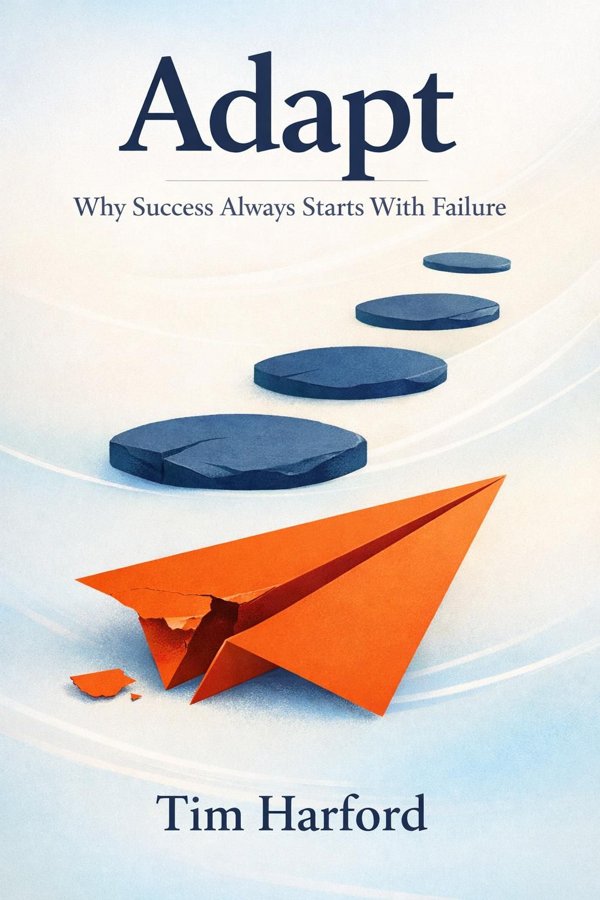
Adapt: Why Success Always Starts With Failure: Summary & Key Insights
by Tim Harford
 10 min9 chaptersAudio available
Key Takeaways from Adapt: Why Success Always Starts With Failure
The uncomfortable truth is that success rarely arrives fully formed; it is usually built out of mistakes, revisions, and failed attempts.
The more complicated the problem, the less likely it is to yield to a single elegant blueprint.
One of the book’s most powerful insights is that intelligence is often distributed, not concentrated.
A system cannot adapt if it cannot hear the truth.
Real progress depends on variation.
What Is Adapt: Why Success Always Starts With Failure About?
Adapt: Why Success Always Starts With Failure by Tim Harford is a economics book. What if the biggest obstacle to success is not failure, but the illusion that complex problems can be solved through perfect plans? In Adapt, economist and journalist Tim Harford argues that in a fast-changing, unpredictable world, the most reliable path to progress is not top-down certainty but trial, error, and continuous learning. Drawing on stories from war zones, business failures, urban policy, medicine, and social change, Harford shows that systems often become dangerous when leaders are too confident, too centralized, or too committed to a single grand design. Instead, resilient success comes from experimentation, feedback, and the willingness to revise ideas when reality disagrees. The book matters because many of today’s biggest challenges—economic crises, organizational dysfunction, public policy failures, and innovation bottlenecks—are too complex for tidy solutions. Harford is uniquely qualified to make this case: he is a respected economist, Financial Times columnist, and bestselling author known for translating difficult ideas into vivid, practical insights. Adapt is both a critique of rigid thinking and a hopeful guide to solving real-world problems more intelligently.
This FizzRead summary covers all 9 key chapters of Adapt: Why Success Always Starts With Failure in approximately 10 minutes, distilling the most important ideas, arguments, and takeaways from Tim Harford's work. Also available as an audio summary and Key Quotes Podcast.
Adapt: Why Success Always Starts With Failure
What if the biggest obstacle to success is not failure, but the illusion that complex problems can be solved through perfect plans? In Adapt, economist and journalist Tim Harford argues that in a fast-changing, unpredictable world, the most reliable path to progress is not top-down certainty but trial, error, and continuous learning. Drawing on stories from war zones, business failures, urban policy, medicine, and social change, Harford shows that systems often become dangerous when leaders are too confident, too centralized, or too committed to a single grand design. Instead, resilient success comes from experimentation, feedback, and the willingness to revise ideas when reality disagrees. The book matters because many of today’s biggest challenges—economic crises, organizational dysfunction, public policy failures, and innovation bottlenecks—are too complex for tidy solutions. Harford is uniquely qualified to make this case: he is a respected economist, Financial Times columnist, and bestselling author known for translating difficult ideas into vivid, practical insights. Adapt is both a critique of rigid thinking and a hopeful guide to solving real-world problems more intelligently.
Who Should Read Adapt: Why Success Always Starts With Failure?
This book is perfect for anyone interested in economics and looking to gain actionable insights in a short read. Whether you're a student, professional, or lifelong learner, the key ideas from Adapt: Why Success Always Starts With Failure by Tim Harford will help you think differently.
- ✓Readers who enjoy economics and want practical takeaways
- ✓Professionals looking to apply new ideas to their work and life
- ✓Anyone who wants the core insights of Adapt: Why Success Always Starts With Failure in just 10 minutes
Want the full summary?
Get instant access to this book summary and 100K+ more with Fizz Moment.
Get Free SummaryAvailable on App Store • Free to download
Key Chapters
The uncomfortable truth is that success rarely arrives fully formed; it is usually built out of mistakes, revisions, and failed attempts. Harford’s core argument is that in complex environments, failure is not the opposite of success but the raw material from which success emerges. When outcomes are uncertain and variables interact in unpredictable ways, no expert can reliably design a flawless solution from the start. What works instead is a process of trying something, observing the results, discarding what fails, and improving what shows promise.
This idea becomes especially important in business, public policy, and innovation. A startup launching a new product, for example, may believe it understands customer needs, only to discover that users behave very differently than expected. Companies that survive are often those that treat early missteps as information rather than embarrassment. The same is true in government. Policies designed in distant offices may look coherent on paper but fail when they meet local realities. Small-scale trials and iterative adjustments often outperform sweeping reforms.
Harford does not glorify failure for its own sake. Repeatedly making the same mistake is not adaptation. Productive failure happens when people learn quickly, gather honest feedback, and preserve enough flexibility to change direction. This requires cultures where bad news can travel upward, where leaders can admit uncertainty, and where experiments are small enough that failure does not become catastrophic.
A practical way to apply this principle is to break large ambitions into testable steps. Instead of betting everything on one perfect plan, run a pilot, measure the outcome, and refine your next move. The actionable takeaway: treat every setback as data, and design your work so that failure teaches before it destroys.
The more complicated the problem, the less likely it is to yield to a single elegant blueprint. Harford distinguishes between simple tasks, where expertise and planning can work well, and complex systems, where countless moving parts interact in ways that no one can fully predict. In those systems—financial markets, cities, military campaigns, healthcare systems, or education reform—grand plans often fail not because planners are unintelligent, but because reality is too messy to fit their assumptions.
Top-down control can be attractive because it offers clarity and confidence. Leaders want to appear decisive, and institutions prefer neat models to uncertainty. But complex systems do not stay still long enough to be mastered. Unexpected side effects, hidden constraints, and human behavior can unravel even the most sophisticated strategy. A policy that improves one metric can damage another. A company reorganization meant to increase efficiency may destroy communication and trust.
Harford’s point is not that planning is useless. Rather, planning must be humble. In complex settings, useful plans are provisional, adaptive, and open to revision. Urban development offers a strong example: cities that evolve through many small local decisions often become more resilient than those redesigned according to a single master vision. Similarly, organizations that empower teams to test different solutions can outperform those that insist on uniform compliance.
For readers, this has immediate relevance. If you are dealing with a challenging market, a struggling team, or a personal decision with many unknowns, resist the temptation to seek one definitive answer too early. Build optionality. Expect surprises. Create room to adjust.
The actionable takeaway: when facing complexity, replace the search for the perfect master plan with a series of smaller experiments that can reveal what reality actually supports.
One of the book’s most powerful insights is that intelligence is often distributed, not concentrated. Harford shows that complex problems are better solved when many people can contribute information, test ideas, and respond to changing conditions. Central authorities may have broad visibility, but local actors usually have better knowledge of what is happening on the ground. When decision-making is too centralized, organizations become slow, brittle, and blind to emerging problems.
Decentralization matters because information is unevenly spread. A frontline nurse notices workflow bottlenecks that hospital executives never see. A local entrepreneur understands customer preferences that head office data cannot capture. A teacher sees classroom dynamics that policymakers miss. If those insights are ignored because authority sits too far away, the system loses its ability to adapt.
This principle explains why some organizations recover from shocks better than others. Teams with autonomy can improvise. Branches can adjust to local demand. Communities can solve practical issues without waiting for permission. By contrast, rigid hierarchies often produce silence. People learn to follow procedures rather than report reality, especially when leaders punish dissent or reward appearances.
Yet decentralization does not mean chaos. It works best when there are clear goals, shared values, and mechanisms for learning across units. Think of it as structured freedom: people are empowered to try different methods, but results are visible and useful lessons spread. In business, that might mean allowing regional teams to experiment with marketing while sharing performance data company-wide. In personal life, it might mean giving team members ownership over projects instead of micromanaging every task.
The actionable takeaway: push decisions closer to the people with the most relevant information, and combine local autonomy with transparent feedback so the whole system can learn faster.
A system cannot adapt if it cannot hear the truth. Harford emphasizes that feedback is the lifeblood of improvement, but only when it is timely, accurate, and difficult to ignore. Many failures persist not because solutions are unavailable, but because institutions distort or suppress the signals that would force change. Leaders receive filtered reports, employees fear speaking up, and organizations become attached to narratives that protect status rather than reflect reality.
Fast feedback shortens the distance between action and learning. In software development, testing prototypes quickly allows teams to identify flaws before investing huge resources. In medicine, real-world monitoring can reveal whether a treatment works across different patient groups. In management, regular review cycles can show whether a strategy is delivering outcomes or merely sounding impressive in meetings.
Honesty matters just as much as speed. If people manipulate metrics or hide bad news, adaptation becomes impossible. Harford’s broader lesson is that many institutional disasters are really feedback failures. Banks ignore risk signals. governments cling to ineffective policies. Companies keep funding doomed initiatives because no one wants to be the first to admit they are failing. The result is delayed correction and much larger damage.
Creating better feedback loops requires more than dashboards. It demands psychological safety, clear metrics, and a willingness to confront uncomfortable evidence. Leaders should ask not only, “How are we doing?” but also, “What are we missing?” and “What would prove us wrong?” Small experiments are especially useful because they generate clearer, cheaper signals than giant irreversible commitments.
The actionable takeaway: build routines that expose reality quickly—track meaningful outcomes, invite dissent, and act on bad news early instead of waiting for certainty that may arrive too late.
Real progress depends on variation. If everyone follows the same method, a system may look efficient, but it loses the ability to discover better options. Harford argues that experimentation is essential because we often do not know in advance which idea will work. Diversity of approaches creates the possibility of finding unexpected solutions, especially in uncertain environments where old assumptions no longer hold.
This is true in science, entrepreneurship, education, and even personal development. A company may assume one product feature matters most, but user testing reveals another priority. A school may believe a reform will improve learning, only to find that student outcomes vary widely by context. An individual may think there is one right career path, yet small side projects expose talents and opportunities that formal planning never revealed.
Experimentation works best when it is disciplined rather than random. Harford is not advocating reckless improvisation. Good experiments are bounded, measurable, and reversible when possible. They compare alternatives, gather evidence, and avoid risking everything on one guess. This mindset allows organizations to innovate without self-destructing. It also reduces the ego cost of being wrong: the goal becomes learning, not defending one’s original idea.
A major barrier to experimentation is the fear of looking inconsistent. Leaders often prefer certainty because it signals competence. But in reality, refusing to test assumptions is frequently the more dangerous choice. The world changes whether institutions are ready or not. Those that keep experimenting stay alert; those that stop become fragile.
The actionable takeaway: create low-risk experiments in any area where outcomes are uncertain—test small before scaling big, compare alternatives, and let evidence decide which ideas deserve commitment.
Confidence can inspire action, but overconfidence can blind people to risk, complexity, and contradiction. Harford repeatedly shows that many costly failures begin with leaders who become too attached to their own models of how the world works. Once certainty hardens into dogma, warning signs are dismissed, dissenters are marginalized, and institutions continue down damaging paths long after reality has shifted.
This is especially dangerous in environments where leaders are rewarded for projecting control. Politicians, executives, generals, and experts often feel pressure to present solutions as decisive and comprehensive. Admitting uncertainty may seem weak. Yet pretending to know more than one does creates conditions for larger failure. If nobody is allowed to question the plan, errors multiply unnoticed. If leaders cannot revise their assumptions, adaptation stops.
Harford’s insight is deeply relevant in economics, where forecasts, models, and strategies are often treated with more precision than they deserve. Markets change, consumer behavior shifts, and crises emerge from interactions no model fully captures. The same dynamic appears in personal life. People cling to careers, habits, or investments because they have publicly committed to them, not because the evidence still supports them.
The antidote is intellectual humility. Humility does not mean indecision or passivity. It means holding beliefs firmly enough to act, but lightly enough to update. It means inviting criticism, stress-testing assumptions, and treating disagreement as useful rather than threatening. Organizations can encourage this by rewarding candor and by separating status from being right on the first attempt.
The actionable takeaway: whenever you feel most certain, ask what evidence would change your mind, who has a different perspective, and what small test could challenge your assumptions before reality does it more harshly.
Systems optimized for efficiency can become surprisingly fragile. Harford points out that when organizations eliminate slack, standardize everything, and rely on a narrow set of assumptions, they may perform well under stable conditions but collapse when circumstances change. Efficiency matters, of course, but in an unpredictable world, resilience often matters more. Resilience means having enough diversity, redundancy, and flexibility to absorb shocks and keep learning.
Consider supply chains, financial institutions, or project teams. A lean system may minimize cost in the short term, but if one supplier fails, one market turns, or one key person leaves, the whole operation can stall. By contrast, a resilient system keeps alternatives available. It may appear less optimized on paper, yet it performs better over time because it can survive surprises.
This idea also applies to careers and personal finance. Someone who depends on a single source of income, a single skill set, or a single plan may feel efficient, but they are vulnerable. Developing multiple capabilities, maintaining savings, and staying connected to different opportunities creates adaptability. In organizations, resilience can mean preserving discretionary resources, cross-training staff, and avoiding dependence on one untested strategy.
Harford challenges the assumption that all redundancy is waste. In reality, some slack is what makes adaptation possible. If every resource is already committed, there is no room to experiment, recover, or respond. A resilient system can take a hit without entering crisis mode immediately.
The actionable takeaway: do not optimize so aggressively that you remove your margin for error—build buffers, alternatives, and flexibility into your work so you can respond intelligently when conditions shift.
We often celebrate visionary individuals, but Harford suggests that durable success depends less on heroic leadership than on institutions that can learn. Charismatic leaders may energize people, yet if the surrounding culture punishes dissent, hides mistakes, or treats adaptation as disloyalty, even talented leaders will steer the system toward rigidity. The true competitive advantage is not a genius at the top but an environment where many people can detect problems and improve solutions.
A learning culture has several features. It allows bad news to travel quickly. It encourages questions rather than mere obedience. It values evidence over status. And it views changing one’s mind as a strength rather than a humiliation. These habits transform failure from a source of shame into a source of intelligence.
This can be seen in teams that conduct post-project reviews, startups that iterate with customers, and public institutions that openly compare interventions instead of assuming one policy must fit all contexts. By contrast, organizations built around hero narratives often become dependent on confidence and image. People stop challenging ideas because they do not want to threaten the leader’s authority. The result is slower learning and higher risk.
For managers, this insight is practical. You do not need all the answers yourself. You need processes that help the group generate better answers over time. Ask teams what they are noticing. Reward those who identify weak signals early. Treat mistakes as opportunities for diagnosis instead of occasions for blame. This creates trust and increases collective intelligence.
The actionable takeaway: focus less on appearing infallible and more on building a culture where people can surface mistakes, test alternatives, and improve together continuously.
Big ambitions often fail because they begin at full scale before anyone knows whether the idea works. Harford repeatedly returns to the value of starting small: pilot projects, local trials, prototype versions, and limited experiments generate evidence before major commitments are made. In uncertain conditions, this approach is not timid; it is strategic. It reduces the cost of failure while increasing the quality of learning.
Starting small is especially valuable in public policy and social change, where well-intentioned reforms can have unintended effects. A nationwide program may sound visionary, but if it is wrong, the damage spreads everywhere at once. A localized pilot allows policymakers to observe what happens, compare outcomes, and refine the design before broader expansion. The same is true in business. Rather than launch a full product line, a firm can test a minimum viable version with a smaller group of customers and learn what truly matters.
This principle also helps individuals. If you are considering a career move, business idea, or major lifestyle change, you do not always need to commit immediately. Freelance on the side, take a course, run a short project, or test demand. Small steps can reveal whether your assumptions are sound. They turn uncertainty into information.
Crucially, starting small is only half the lesson. The other half is scaling what works and abandoning what does not. Too many organizations pilot endlessly without making hard decisions. Harford’s adaptive model requires both openness and discipline: experiment broadly, evaluate honestly, and then commit resources where evidence is strongest.
The actionable takeaway: before making a large irreversible move, create a small real-world test, define what success looks like, and scale only after the results justify the investment.
All Chapters in Adapt: Why Success Always Starts With Failure
About the Author
Tim Harford is a British economist, journalist, and bestselling author known for explaining complex economic ideas in clear, engaging ways. He writes the long-running “Undercover Economist” column for the Financial Times and has built a wide audience through his books, articles, radio work, and public speaking. Harford studied economics at Oxford and has become widely respected for connecting academic thinking with real-world problems in business, policy, and everyday life. His notable books include The Undercover Economist, Fifty Things That Made the Modern Economy, Messy, and Adapt. Across his work, he explores how incentives, systems, uncertainty, and human behavior shape outcomes. His writing style blends sharp analysis, storytelling, and practical insight, making difficult subjects accessible without oversimplifying them.
Get This Summary in Your Preferred Format
Read or listen to the Adapt: Why Success Always Starts With Failure summary by Tim Harford anytime, anywhere. FizzRead offers multiple formats so you can learn on your terms — all free.
Available formats: App · Audio · PDF · EPUB — All included free with FizzRead
Download Adapt: Why Success Always Starts With Failure PDF and EPUB Summary
Key Quotes from Adapt: Why Success Always Starts With Failure
“The uncomfortable truth is that success rarely arrives fully formed; it is usually built out of mistakes, revisions, and failed attempts.”
“The more complicated the problem, the less likely it is to yield to a single elegant blueprint.”
“One of the book’s most powerful insights is that intelligence is often distributed, not concentrated.”
“A system cannot adapt if it cannot hear the truth.”
“If everyone follows the same method, a system may look efficient, but it loses the ability to discover better options.”
Frequently Asked Questions about Adapt: Why Success Always Starts With Failure
Adapt: Why Success Always Starts With Failure by Tim Harford is a economics book that explores key ideas across 9 chapters. What if the biggest obstacle to success is not failure, but the illusion that complex problems can be solved through perfect plans? In Adapt, economist and journalist Tim Harford argues that in a fast-changing, unpredictable world, the most reliable path to progress is not top-down certainty but trial, error, and continuous learning. Drawing on stories from war zones, business failures, urban policy, medicine, and social change, Harford shows that systems often become dangerous when leaders are too confident, too centralized, or too committed to a single grand design. Instead, resilient success comes from experimentation, feedback, and the willingness to revise ideas when reality disagrees. The book matters because many of today’s biggest challenges—economic crises, organizational dysfunction, public policy failures, and innovation bottlenecks—are too complex for tidy solutions. Harford is uniquely qualified to make this case: he is a respected economist, Financial Times columnist, and bestselling author known for translating difficult ideas into vivid, practical insights. Adapt is both a critique of rigid thinking and a hopeful guide to solving real-world problems more intelligently.
More by Tim Harford

The Data Detective: Ten Easy Rules to Make Sense of Statistics
Tim Harford
10 min
The Logic of Life: The Rational Economics of an Irrational World
Tim Harford
10 min
Messy: The Power of Disorder to Transform Our Lives
Tim Harford
10 min
The Undercover Economist: Exposing Why the Rich Are Rich, the Poor Are Poor—and Why You Can Never Buy a Decent Used Car!
Tim Harford
10 minYou Might Also Like

Business Adventures
John Brooks
10 min
Nudge
Richard H. Thaler, Cass R. Sunstein
10 min
The Hitchhiker"s Guide to the Galaxy
Douglas Adams
10 minThe Muqaddimah
Ibn Khaldun
10 minThe Outsiders
William N. Thorndike
10 min
A Little History of Economics
Niall Kishtainy
10 minFeatured In
Browse by Category
Ready to read Adapt: Why Success Always Starts With Failure?
Get the full summary and 100K+ more books with Fizz Moment.