
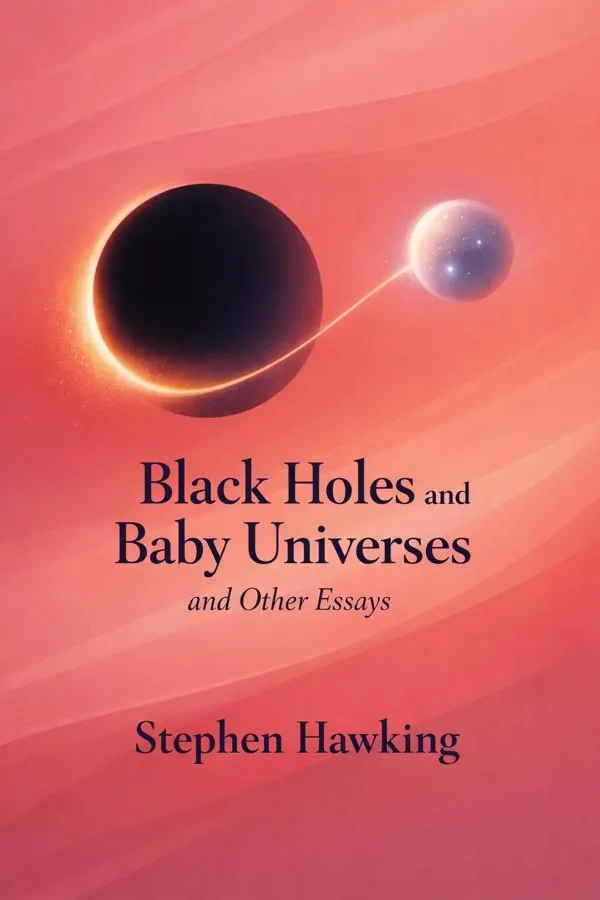
Black Holes and Baby Universes and Other Essays: Summary & Key Insights
 10 min9 chaptersAudio available
Key Takeaways from Black Holes and Baby Universes and Other Essays
A remarkable scientific life often starts not with genius on display, but with an environment that makes questioning feel natural.
Nothing clarifies life like the sudden realization that it may be shorter than expected.
Scientific progress often depends on choosing problems large enough to matter and precise enough to investigate.
The most exciting discoveries often begin by overturning a name.
To ask where the universe came from is to ask whether time itself has a beginning.
What Is Black Holes and Baby Universes and Other Essays About?
Black Holes and Baby Universes and Other Essays by Stephen Hawking is a popular_sci book spanning 11 pages. Black Holes and Baby Universes and Other Essays is Stephen Hawking at his most wide-ranging: scientist, public thinker, teacher, and human being. Rather than presenting one single argument from start to finish, the book gathers essays, lectures, and personal reflections that move between the deepest questions in cosmology and the realities of Hawking’s own life. He writes about black holes, the beginning of the universe, the direction of time, the search for a unified theory of physics, and the possibility of baby universes branching from our own. Alongside these ideas, he reflects on fame, disability, perseverance, and what it means to live meaningfully in a universe governed by elegant laws. What makes the book matter is its rare combination of intellectual ambition and accessibility. Hawking explains some of the most difficult ideas in modern science without losing their wonder, and he shows why abstract physics shapes how we think about origins, destiny, and human significance. As one of the most influential theoretical physicists of the twentieth century, Hawking writes with unmatched authority. Yet the lasting power of this collection comes from something more personal: it reveals a mind determined to keep asking large questions, even under extraordinary physical constraints.
This FizzRead summary covers all 9 key chapters of Black Holes and Baby Universes and Other Essays in approximately 10 minutes, distilling the most important ideas, arguments, and takeaways from Stephen Hawking's work. Also available as an audio summary and Key Quotes Podcast.
Black Holes and Baby Universes and Other Essays
Black Holes and Baby Universes and Other Essays is Stephen Hawking at his most wide-ranging: scientist, public thinker, teacher, and human being. Rather than presenting one single argument from start to finish, the book gathers essays, lectures, and personal reflections that move between the deepest questions in cosmology and the realities of Hawking’s own life. He writes about black holes, the beginning of the universe, the direction of time, the search for a unified theory of physics, and the possibility of baby universes branching from our own. Alongside these ideas, he reflects on fame, disability, perseverance, and what it means to live meaningfully in a universe governed by elegant laws.
What makes the book matter is its rare combination of intellectual ambition and accessibility. Hawking explains some of the most difficult ideas in modern science without losing their wonder, and he shows why abstract physics shapes how we think about origins, destiny, and human significance. As one of the most influential theoretical physicists of the twentieth century, Hawking writes with unmatched authority. Yet the lasting power of this collection comes from something more personal: it reveals a mind determined to keep asking large questions, even under extraordinary physical constraints.
Who Should Read Black Holes and Baby Universes and Other Essays?
This book is perfect for anyone interested in popular_sci and looking to gain actionable insights in a short read. Whether you're a student, professional, or lifelong learner, the key ideas from Black Holes and Baby Universes and Other Essays by Stephen Hawking will help you think differently.
- ✓Readers who enjoy popular_sci and want practical takeaways
- ✓Professionals looking to apply new ideas to their work and life
- ✓Anyone who wants the core insights of Black Holes and Baby Universes and Other Essays in just 10 minutes
Want the full summary?
Get instant access to this book summary and 100K+ more with Fizz Moment.
Get Free SummaryAvailable on App Store • Free to download
Key Chapters
A remarkable scientific life often starts not with genius on display, but with an environment that makes questioning feel natural. Hawking’s early life was not presented as a tale of instant brilliance. Instead, he describes a family atmosphere shaped by books, inquiry, and intellectual independence. His parents valued learning, conversation, and exploration, and that mattered more than polished achievement. The deeper point is that curiosity is usually cultivated long before expertise appears.
This idea reframes how we think about talent. Many people imagine scientists as obviously exceptional from childhood, but Hawking’s story suggests something more practical: an ordinary beginning can still produce extraordinary thinking when questions are welcomed. Informal influences matter. Dinner-table debates, reading widely, tinkering with ideas, and being allowed to think slowly all build habits of mind that later support serious work. In modern life, this applies beyond physics. A child encouraged to ask why the sky is blue, how machines work, or whether time has a beginning is already practicing the foundations of inquiry.
For adults, the lesson is equally relevant. You do not need a laboratory to live scientifically. Reading outside your field, discussing big ideas with friends, and staying open to uncertainty train the same muscles that formal education refines. Curiosity is less a gift than a discipline of attention.
Hawking’s childhood also reminds us that intellectual development is not always linear. Early signs can be mixed, and outward performance may lag behind inner interest. What matters is the long arc of engagement.
Actionable takeaway: create one small ritual that strengthens curiosity—read ten pages of serious nonfiction daily, ask one better question in every conversation, or keep a notebook of ideas worth exploring.
Nothing clarifies life like the sudden realization that it may be shorter than expected. Hawking’s diagnosis with ALS at age twenty-one forced him into direct confrontation with mortality. Doctors gave him a grim prognosis, and for a period he drifted into despair. Yet over time, the nearness of loss transformed into motivation. Instead of making effort seem pointless, the diagnosis made time feel precious. His life became defined not by the prediction itself, but by his response to it.
This is one of the book’s most powerful human insights. Adversity can narrow a person’s future, but it can also deepen commitment to what matters most. Hawking did not romanticize suffering; he was clear about its cruelty. But he showed that limits, once acknowledged, can strip away illusion. Academic work, relationships, humor, and purpose became more vivid because they were no longer assumed.
The practical application extends far beyond illness. Most people live as if time were abundant, postponing meaningful work, difficult conversations, or intellectual ambition. Hawking’s experience challenges that habit. We do not need a medical crisis to ask what deserves our finite attention. If anything, the book argues that urgency and gratitude should coexist.
His adaptation was also concrete, not merely philosophical. He accepted assistance, adjusted his methods, used technology, and kept working. Resilience here is not denial; it is disciplined adaptation.
Actionable takeaway: make a short list of three things that truly matter to you, then schedule one measurable step toward each this week. Treat finite time as a design constraint, not an excuse for delay.
Scientific progress often depends on choosing problems large enough to matter and precise enough to investigate. Hawking’s career centered on the biggest of all questions: how the universe began, how gravity behaves at extremes, what happens inside black holes, and whether physics can describe the whole cosmos in one framework. What stands out is not only his brilliance, but his willingness to focus on problems that sit at the edge of the knowable.
This focus reveals an important principle: ambitious thinking becomes productive when paired with mathematical discipline. Hawking was not chasing mysteries for their own sake. He pursued places where general relativity, quantum theory, and cosmology collided, because those collisions expose gaps in our understanding. Black holes were not just exotic objects; they were testing grounds for the laws of nature. The origin of the universe was not merely a philosophical puzzle; it was a scientific frontier.
In practical terms, this mindset applies in every field. Whether in business, medicine, education, or art, progress comes from identifying leverage points—questions that, if answered, change many other things. A researcher may ask which variable best predicts disease. A founder may ask what problem users repeatedly face. A teacher may ask what misunderstanding blocks all later learning. The scale differs, but the method is the same: go where the puzzle is foundational.
Hawking’s example also shows that specialization and imagination are not opposites. Serious inquiry requires both.
Actionable takeaway: identify the single most important unresolved question in your work or studies. Write it down, define why it matters, and spend your next focused hour working only on that high-leverage problem.
The most exciting discoveries often begin by overturning a name. Black holes sound like cosmic objects from which nothing can escape, yet Hawking’s most famous contribution showed that they are not completely black. By combining quantum theory with the physics of gravity near the event horizon, he argued that black holes can emit radiation and slowly lose mass. This idea, now known as Hawking radiation, changed black holes from perfect prisons into thermodynamic objects with temperature and entropy.
Why does this matter so much? Because it linked areas of physics that had long resisted integration. General relativity describes gravity and large-scale structure. Quantum mechanics governs the very small. Black holes sit at the border where both must be true, and Hawking’s work exposed deep tensions between them. If black holes can evaporate, then information, energy, and the nature of physical law must be reconsidered. A once purely theoretical object became central to the search for a deeper theory of reality.
For non-scientists, the practical value lies in learning how modern science works. Big breakthroughs often come from asking what happens when two trusted theories meet under extreme conditions. In everyday problem-solving, the equivalent is examining edge cases: unusual customers, rare failures, extreme weather, or moments of crisis often reveal the hidden assumptions in a system.
Hawking also preserves a sense of wonder. Black holes are not just destructive voids; they are clues.
Actionable takeaway: when facing a difficult problem, study the boundary conditions. Ask what your usual rules predict in extreme cases, because that is often where the most important insight appears.
To ask where the universe came from is to ask whether time itself has a beginning. Hawking explores the origin and fate of the cosmos not as myth or speculation, but as a subject physics can genuinely investigate. Modern cosmology suggests that the universe evolved from an extremely hot, dense early state and has been expanding ever since. But Hawking pushes further: if the universe has a history, then the beginning is not just a dramatic moment in the distant past—it is a clue to the laws governing everything that followed.
This changes how we think about cosmic questions. Instead of asking only what exists, Hawking asks how structure emerged: stars, galaxies, planets, and eventually observers capable of asking questions. He also examines possible futures, from endless expansion to recollapse, showing that cosmology is both retrospective and predictive. The universe is dynamic, not static.
The larger lesson is that origins matter because they shape constraints. In science, understanding initial conditions helps explain later outcomes. In ordinary life, the same logic applies. Institutions, habits, and relationships carry traces of how they began. A company culture, for example, often reflects early incentives. A personal routine reflects original motives, even after those motives are forgotten. Looking backward can clarify what now seems inevitable.
Hawking’s treatment also encourages intellectual humility. We are tiny, but not irrelevant. The fact that the universe is understandable at all is astonishing.
Actionable takeaway: choose one system you are trying to understand—your career, a project, a habit, or a relationship—and trace its origin. Ask what early assumptions still shape its present direction.
Some scientific ideas matter not because they are settled, but because they stretch the limits of what a theory might allow. Hawking’s discussions of baby universes belong to this category. These hypothetical universes could branch off from our own under extreme quantum-gravitational conditions, suggesting that spacetime itself may be more fertile and strange than common sense permits. The concept is speculative, yet it serves a serious purpose: it tests how far our models of reality can go before they break or evolve.
The value of such ideas lies in disciplined imagination. In science, speculation is useful when it is anchored to mathematical possibility and existing theory. Baby universes are not science fiction decorations in Hawking’s work; they are probes into the nature of spacetime, quantum uncertainty, and cosmic origin. They force us to ask whether our universe is unique, whether constants of nature could vary elsewhere, and whether creation is a one-time event or an ongoing feature of reality.
In practical settings, this mindset is enormously useful. Innovation often requires exploring ideas that sound implausible at first, provided they are examined rigorously. Engineers run thought experiments. Entrepreneurs test odd market hypotheses. Researchers imagine mechanisms before evidence fully arrives. The key is to distinguish fruitful speculation from fantasy by checking consequences, assumptions, and consistency.
Hawking models intellectual boldness without abandoning standards. He invites wonder, but also insists on reasoning.
Actionable takeaway: once a week, give one unconventional idea serious evaluation instead of dismissing it instantly. Ask: what would need to be true for this to work, and how could I test that cheaply?
One of the grand ambitions of modern physics is to find a framework that unites the fundamental forces and resolves the tension between quantum mechanics and general relativity. Hawking returns repeatedly to this quest because he sees it as more than technical tidying. A unified theory would reveal whether the universe is governed by one coherent set of principles at every scale, from subatomic particles to the structure of spacetime itself.
This search matters because fragmentation has limits. Physics currently works extraordinarily well in pieces: quantum theory explains the microscopic world, while relativity explains gravity and the large-scale universe. But the two frameworks become incompatible in extreme environments like black holes and the early universe. Hawking’s essays make clear that a satisfactory understanding of reality cannot stop at this mismatch. The unresolved gap is a signpost, not a footnote.
There is a broader intellectual lesson here. In many domains, local success can hide deeper inconsistency. A business may have departments that perform well individually but fail together. A person may hold beliefs that work in isolation but conflict under pressure. Real understanding often requires integration. Unifying principles reduce confusion, reveal trade-offs, and create stronger explanations.
Hawking also resists the idea that mystery means futility. The absence of a final theory is not failure; it is an invitation. Science advances by making ignorance more precise.
Actionable takeaway: look for one area where your knowledge is fragmented. Instead of collecting more disconnected facts, ask what larger principle could connect them and make your understanding more coherent.
The more science explains, the more urgently people ask what remains for meaning, ethics, and purpose. Hawking addresses this tension carefully. He does not turn physics into religion, nor does he dismiss spiritual questions as irrelevant. Instead, he argues that scientific explanation and human meaning occupy related but distinct spaces. Science tells us how the universe behaves; it does not automatically tell us what we ought to value. Yet scientific knowledge profoundly shapes the conditions under which those values must be chosen.
This point becomes especially powerful in Hawking’s personal reflections. Living with severe disability, public recognition, and constant dependence on technology gave him a grounded view of human dignity. He did not present life as fair, but he did insist that intelligence, humor, and purpose remain possible under difficult circumstances. That makes the book more than a cosmology collection. It becomes a meditation on how to live in a lawful universe without surrendering agency.
Hawking also reflects on humanity’s future. Our species is capable of extraordinary discovery, but also self-destruction. Scientific progress expands power, which increases responsibility. Questions about survival, technology, cooperation, and long-term thinking are therefore not optional. They are moral consequences of understanding.
For readers, the practical lesson is to pair knowledge with stewardship. Facts alone do not guarantee wisdom; they must be integrated into choices.
Actionable takeaway: when you learn something scientifically important—about climate, health, technology, or risk—ask one follow-up question: what responsibility does this knowledge place on me, however small, in how I live or decide?
All Chapters in Black Holes and Baby Universes and Other Essays
About the Author
Stephen Hawking (1942–2018) was a British theoretical physicist, cosmologist, and bestselling author whose work transformed the study of black holes and the early universe. Educated at Oxford and Cambridge, he became one of the world’s most influential scientific thinkers, serving as Lucasian Professor of Mathematics at the University of Cambridge, a chair once held by Isaac Newton. Hawking is best known for proposing that black holes emit radiation, a breakthrough that linked quantum theory, gravity, and thermodynamics. Beyond academia, he became a global symbol of scientific curiosity and perseverance while living for decades with ALS, using a computerized voice system to communicate. His books, including A Brief History of Time, introduced millions of readers to modern cosmology.
Get This Summary in Your Preferred Format
Read or listen to the Black Holes and Baby Universes and Other Essays summary by Stephen Hawking anytime, anywhere. FizzRead offers multiple formats so you can learn on your terms — all free.
Available formats: App · Audio · PDF · EPUB — All included free with FizzRead
Download Black Holes and Baby Universes and Other Essays PDF and EPUB Summary
Key Quotes from Black Holes and Baby Universes and Other Essays
“A remarkable scientific life often starts not with genius on display, but with an environment that makes questioning feel natural.”
“Nothing clarifies life like the sudden realization that it may be shorter than expected.”
“Scientific progress often depends on choosing problems large enough to matter and precise enough to investigate.”
“The most exciting discoveries often begin by overturning a name.”
“To ask where the universe came from is to ask whether time itself has a beginning.”
Frequently Asked Questions about Black Holes and Baby Universes and Other Essays
Black Holes and Baby Universes and Other Essays by Stephen Hawking is a popular_sci book that explores key ideas across 9 chapters. Black Holes and Baby Universes and Other Essays is Stephen Hawking at his most wide-ranging: scientist, public thinker, teacher, and human being. Rather than presenting one single argument from start to finish, the book gathers essays, lectures, and personal reflections that move between the deepest questions in cosmology and the realities of Hawking’s own life. He writes about black holes, the beginning of the universe, the direction of time, the search for a unified theory of physics, and the possibility of baby universes branching from our own. Alongside these ideas, he reflects on fame, disability, perseverance, and what it means to live meaningfully in a universe governed by elegant laws. What makes the book matter is its rare combination of intellectual ambition and accessibility. Hawking explains some of the most difficult ideas in modern science without losing their wonder, and he shows why abstract physics shapes how we think about origins, destiny, and human significance. As one of the most influential theoretical physicists of the twentieth century, Hawking writes with unmatched authority. Yet the lasting power of this collection comes from something more personal: it reveals a mind determined to keep asking large questions, even under extraordinary physical constraints.
More by Stephen Hawking
You Might Also Like

Structures: Or Why Things Don"t Fall Down
J.E. Gordon
10 min
The Road to Wigan Pier
George Orwell
10 min
Bonk: The Curious Coupling of Science and Sex
Mary Roach
10 min
First Bite: How We Learn to Eat
Bee Wilson
10 min
In Pursuit Of The Unknown: 17 Equations That Changed The World
Ian Stewart
10 min
Napoleon's Buttons: 17 Molecules That Changed History
Penny Le Couteur and Jay Burreson
10 minBrowse by Category
Ready to read Black Holes and Baby Universes and Other Essays?
Get the full summary and 100K+ more books with Fizz Moment.