
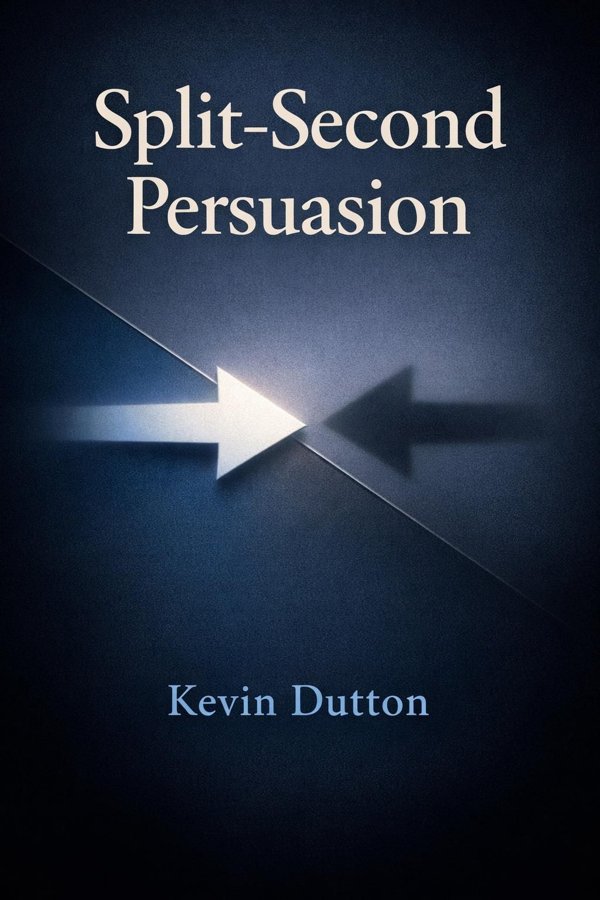
Split-Second Persuasion: The Ancient Art and New Science of Changing Minds: Summary & Key Insights
by Kevin Dutton
 10 min8 chaptersAudio available
What Is Split-Second Persuasion: The Ancient Art and New Science of Changing Minds About?
Split-Second Persuasion: The Ancient Art and New Science of Changing Minds by Kevin Dutton is a psychology book spanning 8 pages. In this book, psychologist Kevin Dutton explores the science of persuasion and influence, revealing how subtle cues and rapid judgments shape our decisions. Drawing on research from psychology, neuroscience, and behavioral science, Dutton explains how persuasion operates at both conscious and unconscious levels, and how understanding these mechanisms can help us become more effective communicators and decision-makers.
This FizzRead summary covers all 8 key chapters of Split-Second Persuasion: The Ancient Art and New Science of Changing Minds in approximately 10 minutes, distilling the most important ideas, arguments, and takeaways from Kevin Dutton's work. Also available as an audio summary and Key Quotes Podcast.
Split-Second Persuasion: The Ancient Art and New Science of Changing Minds
In this book, psychologist Kevin Dutton explores the science of persuasion and influence, revealing how subtle cues and rapid judgments shape our decisions. Drawing on research from psychology, neuroscience, and behavioral science, Dutton explains how persuasion operates at both conscious and unconscious levels, and how understanding these mechanisms can help us become more effective communicators and decision-makers.
Who Should Read Split-Second Persuasion: The Ancient Art and New Science of Changing Minds?
This book is perfect for anyone interested in psychology and looking to gain actionable insights in a short read. Whether you're a student, professional, or lifelong learner, the key ideas from Split-Second Persuasion: The Ancient Art and New Science of Changing Minds by Kevin Dutton will help you think differently.
- ✓Readers who enjoy psychology and want practical takeaways
- ✓Professionals looking to apply new ideas to their work and life
- ✓Anyone who wants the core insights of Split-Second Persuasion: The Ancient Art and New Science of Changing Minds in just 10 minutes
Want the full summary?
Get instant access to this book summary and 100K+ more with Fizz Moment.
Get Free SummaryAvailable on App Store • Free to download
Key Chapters
To understand persuasion, we must first understand our species. Long before cities and commerce, before speech and writing, humans relied on influence for survival. Our ancestors lived in tight-knit groups where cooperation meant the difference between life and death. To persuade was to survive—convincing others to share food, to defend territory, to trust and follow.
In my exploration of the evolutionary psychology behind persuasion, I found that influence arose from our need to form alliances and avoid conflict. Every nod of agreement, every subtle concession, was an adaptive tool honed over millennia. Even today, the roots of that behavior show up in our everyday interactions: the trust we place in authority figures, the warmth we feel toward those who mirror our emotions, the impulse to follow confidence rather than logic.
Empathy became our earliest persuasive device. Those who could read feelings, anticipate reactions, and align their intentions with others were more likely to lead and survive. Persuasion evolved as a social glue—an invisible current bonding individuals into groups. The same mechanisms underpin our instinct to imitate gestures or echo tone. These evolutionary echoes reveal why persuasion happens automatically, and why resistance often feels unnatural. You’re not yielding because you’re weak; you’re responding to centuries of wiring that made human cooperation possible.
Recognizing persuasion’s ancient origins doesn’t just illuminate the past—it empowers the present. When you see every conversation as a legacy of survival instincts, you begin to treat influence not merely as technique but as empathy in action. Persuasion becomes not about winning arguments but aligning instincts, not about dominance but resonance.
Persuasion begins where neuroscience meets emotion. In the laboratory, we can now watch as decisions emerge not from cool rationality but from the simmering depths of the limbic system. When someone persuades you, it isn’t your logical frontal cortex that first engages—it’s the emotional centers that light up in milliseconds, sending signals that shape your responses long before you believe you’ve made a choice.
My own research and that of colleagues in neuropsychology reveals that feelings guide thought. Persuasion hijacks this process by framing ideas in ways that fit those feelings. The amygdala responds to cues of trust or threat; the insula flags empathy or disgust. These primitive reactions provide the raw data your conscious mind interprets later. This means that subtle shifts in tone, eye contact, or even phrasing can alter your brain’s chemistry, leading to decisions that feel logical even when they are rooted in impulse.
Persuasion works on a split-second scale. Consider a salesperson who smiles just right or a speaker whose cadence creates comfort. These gestures trigger dopamine surges, giving the brain its hit of reward-based agreement. We don’t deliberate—we feel. Neuroscience shows that the most successful persuaders don’t force logic; they craft emotional landscapes where logic can peacefully follow.
Understanding this process lets you use persuasion ethically. It’s not about exploiting the unconscious; it’s about respecting it. When you learn to recognize emotional triggers and manage your presentation with authenticity, your brain and your audience’s brain align naturally. Influence emerges not through argument but through shared neural chemistry—a momentary synchronization we can learn to cultivate.
+ 6 more chapters — available in the FizzRead app
All Chapters in Split-Second Persuasion: The Ancient Art and New Science of Changing Minds
About the Author
Kevin Dutton is a British psychologist and writer known for his research on social influence, persuasion, and psychopathy. He holds a PhD in psychology from the University of Essex and is affiliated with the University of Oxford. His work bridges academic research and popular science, making complex psychological concepts accessible to general readers.
Get This Summary in Your Preferred Format
Read or listen to the Split-Second Persuasion: The Ancient Art and New Science of Changing Minds summary by Kevin Dutton anytime, anywhere. FizzRead offers multiple formats so you can learn on your terms — all free.
Available formats: App · Audio · PDF · EPUB — All included free with FizzRead
Download Split-Second Persuasion: The Ancient Art and New Science of Changing Minds PDF and EPUB Summary
Key Quotes from Split-Second Persuasion: The Ancient Art and New Science of Changing Minds
“To understand persuasion, we must first understand our species.”
“Persuasion begins where neuroscience meets emotion.”
Frequently Asked Questions about Split-Second Persuasion: The Ancient Art and New Science of Changing Minds
Split-Second Persuasion: The Ancient Art and New Science of Changing Minds by Kevin Dutton is a psychology book that explores key ideas across 8 chapters. In this book, psychologist Kevin Dutton explores the science of persuasion and influence, revealing how subtle cues and rapid judgments shape our decisions. Drawing on research from psychology, neuroscience, and behavioral science, Dutton explains how persuasion operates at both conscious and unconscious levels, and how understanding these mechanisms can help us become more effective communicators and decision-makers.
More by Kevin Dutton
The Good Psychopath’s Guide to Success: How to Use Your Inner Psychopath to Get the Most Out of Life
Andy McNab and Kevin Dutton
10 min
The Wisdom of Psychopaths: What Saints, Spies, and Serial Killers Can Teach Us About Success
Kevin Dutton
10 min
Flipnosis: The Art of Split-Second Persuasion
Kevin Dutton
10 min
Black-And-White Thinking: The Burden of a Binary Brain in a Complex World
Kevin Dutton
10 minYou Might Also Like
The Body Keeps the Score
Bessel van der Kolk
10 min
Surrounded by Idiots
Thomas Erikson
10 min
Emotional Intelligence
Daniel Goleman
10 min
Attached
Amir Levine
10 min
Why Does He Do That
Lundy Bancroft
10 min
Women Who Run with the Wolves
Clarissa Pinkola Estés
10 minBrowse by Category
Ready to read Split-Second Persuasion: The Ancient Art and New Science of Changing Minds?
Get the full summary and 100K+ more books with Fizz Moment.