
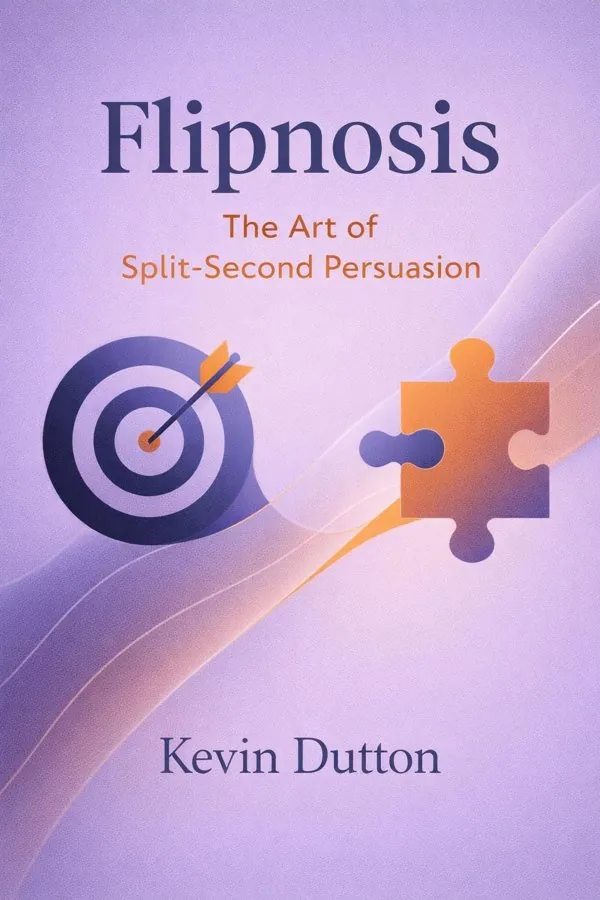
Flipnosis: The Art of Split-Second Persuasion: Summary & Key Insights
by Kevin Dutton
 10 min9 chaptersAudio available
What Is Flipnosis: The Art of Split-Second Persuasion About?
Flipnosis: The Art of Split-Second Persuasion by Kevin Dutton is a psychology book spanning 9 pages. Flipnosis explores the psychology and neuroscience behind rapid persuasion — the ability to influence others in an instant. Drawing on research from social psychology, behavioral science, and real-world examples, Dutton examines how certain individuals can trigger compliance and agreement through subtle cues, framing, and emotional leverage. The book blends scientific insight with storytelling to reveal how persuasion operates in everyday life, from sales and politics to personal relationships.
This FizzRead summary covers all 9 key chapters of Flipnosis: The Art of Split-Second Persuasion in approximately 10 minutes, distilling the most important ideas, arguments, and takeaways from Kevin Dutton's work. Also available as an audio summary and Key Quotes Podcast.
Flipnosis: The Art of Split-Second Persuasion
Flipnosis explores the psychology and neuroscience behind rapid persuasion — the ability to influence others in an instant. Drawing on research from social psychology, behavioral science, and real-world examples, Dutton examines how certain individuals can trigger compliance and agreement through subtle cues, framing, and emotional leverage. The book blends scientific insight with storytelling to reveal how persuasion operates in everyday life, from sales and politics to personal relationships.
Who Should Read Flipnosis: The Art of Split-Second Persuasion?
This book is perfect for anyone interested in psychology and looking to gain actionable insights in a short read. Whether you're a student, professional, or lifelong learner, the key ideas from Flipnosis: The Art of Split-Second Persuasion by Kevin Dutton will help you think differently.
- ✓Readers who enjoy psychology and want practical takeaways
- ✓Professionals looking to apply new ideas to their work and life
- ✓Anyone who wants the core insights of Flipnosis: The Art of Split-Second Persuasion in just 10 minutes
Want the full summary?
Get instant access to this book summary and 100K+ more with Fizz Moment.
Get Free SummaryAvailable on App Store • Free to download
Key Chapters
To grasp flipnosis, we must first understand what happens inside the brain when influence occurs in milliseconds. Persuasion isn’t just rhetorical; it’s biological. When faced with a decision, especially under uncertainty, the brain takes shortcuts. It leans on automatic processes — what psychologists call heuristics — to save energy and time. These processes are governed primarily by neural systems associated with emotion, such as the amygdala and orbitofrontal cortex. These regions bypass rational deliberation and react directly to cues of trust, authority, and familiarity.
In my research, I found that when a persuasive stimulus strikes — say, a confident tone or a strategic smile — the brain’s emotional centers predict reward or safety before conscious evaluation begins. That microsecond advantage is what smooth talkers, negotiators, and even interrogators exploit. They operate in this neural twilight where emotion precedes reason. It’s not magic; it’s neurobiology.
Cognitive scientists have documented that when we are under cognitive load or stress, our susceptibility to persuasion increases. Our prefrontal cortex, responsible for analytical reasoning, tires easily. When it does, our brain hands the decision-making reins to older, faster circuits that respond to emotional cues. This is why confidence alone — unbacked by evidence — often persuades more effectively than logic.
Flipnosis operates through the precise manipulation of timing, tone, and framing. Consider what happens during police negotiations or high-stakes sales encounters: the persuader uses empathy and mirroring at just the right moment, creating neurological resonance between themselves and the target. Brain-imaging studies show that this synchronization activates the mirror neuron system, causing the listener’s brain to mimic emotional states of trust and rapport. In essence, rapid persuasion isn’t about argument — it’s about *alignment*.
Our vulnerability to flipnosis isn’t a flaw; it’s evolutionary. The human brain evolved to favor cooperation and quick social judgments because, in ancient environments, hesitation could mean danger. Today, that same cognitive speed can sell us products, ideas, or even beliefs before our rational mind has caught up. Understanding these neural undercurrents gives us not just insight into persuasion — it gives us the power to recognize, resist, and ethically use it.
Throughout my exploration, I’ve met and studied compelling figures whose mastery of persuasion borders on art. Diplomats who calm crises with a single phrase, hostage negotiators who convert tension into cooperation, and con artists who win confidence only to betray it — all rely on flipnosis. What separates them from everyday communicators isn’t intellect or eloquence but timing and intuition.
Take the classic confidence trickster. They know that persuasion begins not with logic but with emotion. They establish a frame where trust feels inevitable — through body language, storytelling, or subtle verbal pacing — and the victim’s defensive systems deactivate. In experiments and field studies, I’ve observed that these persuaders intuitively sense when a person’s cognitive defenses are low — under stress, distraction, or social pressure — and strike precisely then. It’s a psychological ambush.
Contrast that with the trained negotiator. In a standoff, rational argument might inflame resistance. But when a negotiator mirrors the subject’s language, posture, and rhythm, something remarkable happens: tension converts to rapport almost instantly. That’s flipnosis at work — a neuropsychological handshake where emotions align before reason interferes. The negotiator doesn’t *convince* the person logically; they *synchronize* emotionally.
Even in business and politics, the same microtechnics apply. Persuasive leaders instinctively time their statements when group emotion peaks. They shape perception through framing — choosing words that trigger automatic associations. When authority is projected at just the right neural moment, followers comply without question. In studying such individuals, I found common traits: emotional intelligence, fearlessness, and a subtle disregard for conventions. In psychopaths, these qualities appear amplified — strategic charm without empathy. We’ll return to that link later.
The lesson is that rapid persuasion transcends context. Whether the motive is benevolent or deceitful, the mechanism remains the same: emotional cues, cognitive timing, and human instinct working faster than awareness. It reminds us that influence is never purely intellectual; it’s experiential, visceral, and deeply embedded in our social wiring.
+ 7 more chapters — available in the FizzRead app
All Chapters in Flipnosis: The Art of Split-Second Persuasion
About the Author
Kevin Dutton is a British psychologist and writer known for his research on social influence, persuasion, and psychopathy. He holds a PhD in psychology from the University of Essex and is affiliated with the University of Oxford. His works often explore the intersection of psychology and real-world behavior, combining academic rigor with accessible narrative.
Get This Summary in Your Preferred Format
Read or listen to the Flipnosis: The Art of Split-Second Persuasion summary by Kevin Dutton anytime, anywhere. FizzRead offers multiple formats so you can learn on your terms — all free.
Available formats: App · Audio · PDF · EPUB — All included free with FizzRead
Download Flipnosis: The Art of Split-Second Persuasion PDF and EPUB Summary
Key Quotes from Flipnosis: The Art of Split-Second Persuasion
“To grasp flipnosis, we must first understand what happens inside the brain when influence occurs in milliseconds.”
“Throughout my exploration, I’ve met and studied compelling figures whose mastery of persuasion borders on art.”
Frequently Asked Questions about Flipnosis: The Art of Split-Second Persuasion
Flipnosis: The Art of Split-Second Persuasion by Kevin Dutton is a psychology book that explores key ideas across 9 chapters. Flipnosis explores the psychology and neuroscience behind rapid persuasion — the ability to influence others in an instant. Drawing on research from social psychology, behavioral science, and real-world examples, Dutton examines how certain individuals can trigger compliance and agreement through subtle cues, framing, and emotional leverage. The book blends scientific insight with storytelling to reveal how persuasion operates in everyday life, from sales and politics to personal relationships.
More by Kevin Dutton
The Good Psychopath’s Guide to Success: How to Use Your Inner Psychopath to Get the Most Out of Life
Andy McNab and Kevin Dutton
10 min
The Wisdom of Psychopaths: What Saints, Spies, and Serial Killers Can Teach Us About Success
Kevin Dutton
10 min
Black-And-White Thinking: The Burden of a Binary Brain in a Complex World
Kevin Dutton
10 min
Split-Second Persuasion: The Ancient Art and New Science of Changing Minds
Kevin Dutton
10 minYou Might Also Like

The Body Keeps the Score
Bessel van der Kolk
10 min
Surrounded by Idiots
Thomas Erikson
10 min
Emotional Intelligence
Daniel Goleman
10 min
Attached
Amir Levine
10 min
Why Does He Do That
Lundy Bancroft
10 min
Women Who Run with the Wolves
Clarissa Pinkola Estés
10 minBrowse by Category
Ready to read Flipnosis: The Art of Split-Second Persuasion?
Get the full summary and 100K+ more books with Fizz Moment.