
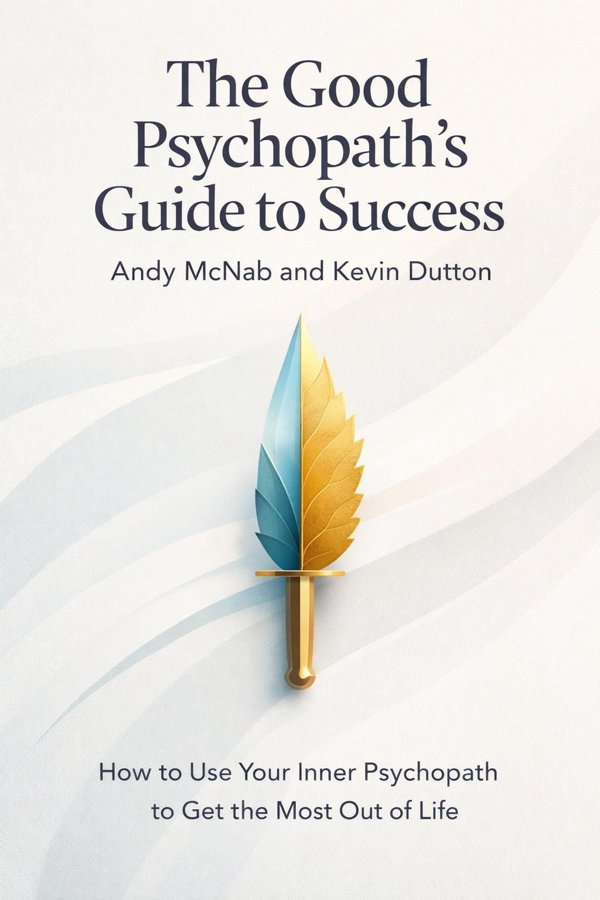
The Good Psychopath’s Guide to Success: How to Use Your Inner Psychopath to Get the Most Out of Life: Summary & Key Insights
 10 min6 chaptersAudio available
What Is The Good Psychopath’s Guide to Success: How to Use Your Inner Psychopath to Get the Most Out of Life About?
The Good Psychopath’s Guide to Success: How to Use Your Inner Psychopath to Get the Most Out of Life by Andy McNab and Kevin Dutton is a psychology book spanning 6 pages. This book explores how certain psychopathic traits—such as fearlessness, focus, and charm—can be harnessed positively to achieve success in work and life. Drawing on psychological research and real-world examples, the authors argue that a 'good psychopath' can balance empathy with ruthlessness to thrive in modern society.
This FizzRead summary covers all 6 key chapters of The Good Psychopath’s Guide to Success: How to Use Your Inner Psychopath to Get the Most Out of Life in approximately 10 minutes, distilling the most important ideas, arguments, and takeaways from Andy McNab and Kevin Dutton's work. Also available as an audio summary and Key Quotes Podcast.
The Good Psychopath’s Guide to Success: How to Use Your Inner Psychopath to Get the Most Out of Life
This book explores how certain psychopathic traits—such as fearlessness, focus, and charm—can be harnessed positively to achieve success in work and life. Drawing on psychological research and real-world examples, the authors argue that a 'good psychopath' can balance empathy with ruthlessness to thrive in modern society.
Who Should Read The Good Psychopath’s Guide to Success: How to Use Your Inner Psychopath to Get the Most Out of Life?
This book is perfect for anyone interested in psychology and looking to gain actionable insights in a short read. Whether you're a student, professional, or lifelong learner, the key ideas from The Good Psychopath’s Guide to Success: How to Use Your Inner Psychopath to Get the Most Out of Life by Andy McNab and Kevin Dutton will help you think differently.
- ✓Readers who enjoy psychology and want practical takeaways
- ✓Professionals looking to apply new ideas to their work and life
- ✓Anyone who wants the core insights of The Good Psychopath’s Guide to Success: How to Use Your Inner Psychopath to Get the Most Out of Life in just 10 minutes
Want the full summary?
Get instant access to this book summary and 100K+ more with Fizz Moment.
Get Free SummaryAvailable on App Store • Free to download
Key Chapters
To begin with, we must understand what psychopathy truly means. Kevin Dutton’s research at Oxford University shows that psychopathy isn’t a binary state—it’s a continuum of traits that range across human personality. Certain markers—fearlessness, focus, low anxiety, emotional detachment, and high charm—are common. Yet these features only become destructive when empathy and moral reasoning are absent.
As I’ve experienced on military missions, fear is both necessary and limiting. Too much of it paralyses you; too little can make you reckless. The ‘good psychopath’ manages this tension precisely. He channels fearlessness into performance, not chaos. He uses emotional detachment to maintain perspective, not cruelty. As Kevin explains, in neuroscience terms, the 'good psychopath' demonstrates lower amygdala reactivity—the brain region that triggers fear and impulsivity—but compensates with heightened prefrontal cortex regulation, the part responsible for judgment and decision control. In short, balance is everything.
What differentiates the good psychopath is intentionality. You’re not suppressing emotion to avoid feeling human; you’re regulating it to maintain effectiveness. When you face high-stakes situations at work or in relationships, imagine adjusting the volume knobs of your personality traits like a mental soundboard. Turn down fear when courage is needed; turn up empathy when connection matters. Success lies in mastering those adjustments.
Fearlessness is one of those psychopathic traits often misunderstood. It’s not recklessness—it’s composure. During my SAS training, fear was ever-present. Yet the mission demanded control, clarity, not panic. The same applies to civilian challenges: presenting an idea to a skeptical boardroom, negotiating a deal, or taking a career leap. The 'good psychopath' reframes fear as fuel. Emotionally, the sensation doesn’t vanish—it’s redirected.
Kevin’s research supports this through lab experiments: participants with higher psychopathic tendencies show reduced stress responses when under threat. This biological edge allows them to maintain calm where others crumble. But in a civilian setting, this isn’t about biological destiny—it’s about training. When you learn to manage anxiety through deliberate exposure to stress and focused breathing, you cultivate the same resilience.
Fearlessness must always be married to strategy. The psychopath’s boldness without foresight leads to ruin; the good psychopath tempers courage with foresight. This balance creates what psychologists call ‘productive risk tolerance.’ In business and personal life, that means daring to act, but only after weighing consequences. Real confidence is born not from ignoring danger—but from knowing you can handle it.
+ 4 more chapters — available in the FizzRead app
All Chapters in The Good Psychopath’s Guide to Success: How to Use Your Inner Psychopath to Get the Most Out of Life
About the Authors
Andy McNab is a former British SAS soldier and bestselling author of military thrillers. Kevin Dutton is a research psychologist at the University of Oxford, specializing in the study of psychopathy and social influence.
Get This Summary in Your Preferred Format
Read or listen to the The Good Psychopath’s Guide to Success: How to Use Your Inner Psychopath to Get the Most Out of Life summary by Andy McNab and Kevin Dutton anytime, anywhere. FizzRead offers multiple formats so you can learn on your terms — all free.
Available formats: App · Audio · PDF · EPUB — All included free with FizzRead
Download The Good Psychopath’s Guide to Success: How to Use Your Inner Psychopath to Get the Most Out of Life PDF and EPUB Summary
Key Quotes from The Good Psychopath’s Guide to Success: How to Use Your Inner Psychopath to Get the Most Out of Life
“To begin with, we must understand what psychopathy truly means.”
“Fearlessness is one of those psychopathic traits often misunderstood.”
Frequently Asked Questions about The Good Psychopath’s Guide to Success: How to Use Your Inner Psychopath to Get the Most Out of Life
The Good Psychopath’s Guide to Success: How to Use Your Inner Psychopath to Get the Most Out of Life by Andy McNab and Kevin Dutton is a psychology book that explores key ideas across 6 chapters. This book explores how certain psychopathic traits—such as fearlessness, focus, and charm—can be harnessed positively to achieve success in work and life. Drawing on psychological research and real-world examples, the authors argue that a 'good psychopath' can balance empathy with ruthlessness to thrive in modern society.
You Might Also Like

The Body Keeps the Score
Bessel van der Kolk
10 min
Surrounded by Idiots
Thomas Erikson
10 min
Emotional Intelligence
Daniel Goleman
10 min
Attached
Amir Levine
10 min
Why Does He Do That
Lundy Bancroft
10 min
Women Who Run with the Wolves
Clarissa Pinkola Estés
10 minBrowse by Category
Ready to read The Good Psychopath’s Guide to Success: How to Use Your Inner Psychopath to Get the Most Out of Life?
Get the full summary and 100K+ more books with Fizz Moment.