
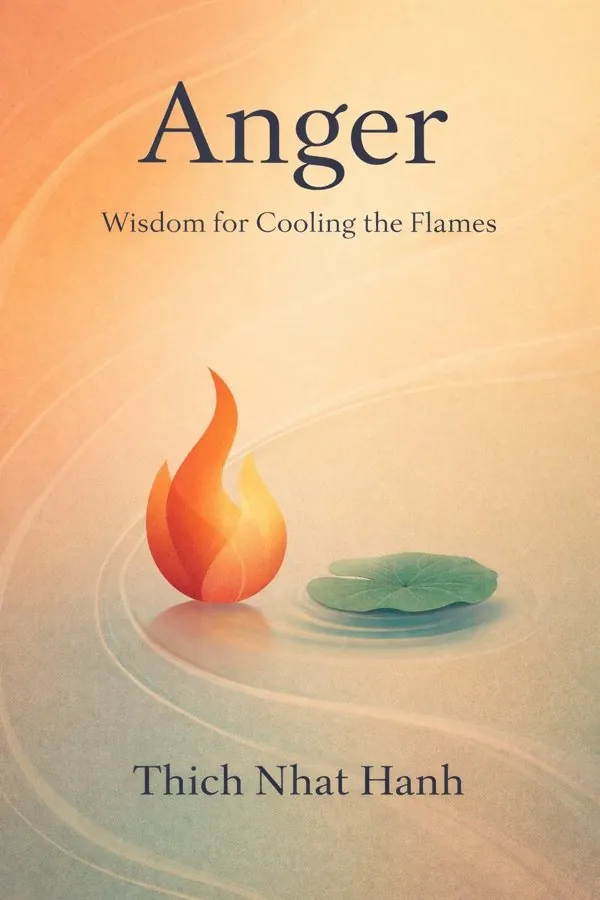
Anger: Wisdom for Cooling the Flames: Summary & Key Insights
 10 min9 chaptersAudio available
Key Takeaways from Anger: Wisdom for Cooling the Flames
Anger often looks like a reaction to other people, but its deepest roots are usually inside us.
What changes anger is not force, shame, or suppression, but awareness.
The more violently we struggle against anger, the more fragmented we often become.
Before understanding anger intellectually, we often need to calm it physically.
Anger narrows perception; compassion widens it.
What Is Anger: Wisdom for Cooling the Flames About?
Anger: Wisdom for Cooling the Flames by Thich Nhat Hanh is a eastern_wisdom book spanning 12 pages. Anger can feel immediate, justified, and impossible to control—but Thich Nhat Hanh argues that it is neither an enemy nor a permanent truth. In Anger: Wisdom for Cooling the Flames, the Vietnamese Zen master offers a gentle, practical path for understanding anger at its roots and transforming it through mindfulness, compassion, and insight. Rather than suppressing rage or acting it out, he teaches readers to recognize anger as suffering asking to be cared for. From mindful breathing and walking to deep listening and loving speech, the book presents concrete practices for cooling emotional intensity before it harms relationships, families, and communities. What makes this book so powerful is its combination of spiritual depth and everyday usefulness. Nhat Hanh does not treat anger as a moral failure; he treats it as human energy that can be understood and redirected. His teachings draw on Buddhist psychology, but they are accessible to readers of any background. As one of the world’s most respected mindfulness teachers and peace activists, he writes with unusual authority, tenderness, and clarity. This is a book for anyone who wants less reactivity, more peace, and wiser ways to respond when emotions run hot.
This FizzRead summary covers all 9 key chapters of Anger: Wisdom for Cooling the Flames in approximately 10 minutes, distilling the most important ideas, arguments, and takeaways from Thich Nhat Hanh's work. Also available as an audio summary and Key Quotes Podcast.
Anger: Wisdom for Cooling the Flames
Anger can feel immediate, justified, and impossible to control—but Thich Nhat Hanh argues that it is neither an enemy nor a permanent truth. In Anger: Wisdom for Cooling the Flames, the Vietnamese Zen master offers a gentle, practical path for understanding anger at its roots and transforming it through mindfulness, compassion, and insight. Rather than suppressing rage or acting it out, he teaches readers to recognize anger as suffering asking to be cared for. From mindful breathing and walking to deep listening and loving speech, the book presents concrete practices for cooling emotional intensity before it harms relationships, families, and communities.
What makes this book so powerful is its combination of spiritual depth and everyday usefulness. Nhat Hanh does not treat anger as a moral failure; he treats it as human energy that can be understood and redirected. His teachings draw on Buddhist psychology, but they are accessible to readers of any background. As one of the world’s most respected mindfulness teachers and peace activists, he writes with unusual authority, tenderness, and clarity. This is a book for anyone who wants less reactivity, more peace, and wiser ways to respond when emotions run hot.
Who Should Read Anger: Wisdom for Cooling the Flames?
This book is perfect for anyone interested in eastern_wisdom and looking to gain actionable insights in a short read. Whether you're a student, professional, or lifelong learner, the key ideas from Anger: Wisdom for Cooling the Flames by Thich Nhat Hanh will help you think differently.
- ✓Readers who enjoy eastern_wisdom and want practical takeaways
- ✓Professionals looking to apply new ideas to their work and life
- ✓Anyone who wants the core insights of Anger: Wisdom for Cooling the Flames in just 10 minutes
Want the full summary?
Get instant access to this book summary and 100K+ more with Fizz Moment.
Get Free SummaryAvailable on App Store • Free to download
Key Chapters
Anger often looks like a reaction to other people, but its deepest roots are usually inside us. Thich Nhat Hanh invites readers to see that when anger erupts, it is rarely caused by one harsh comment or frustrating event alone. Instead, those external triggers touch unresolved pain, fear, insecurity, or disappointment already present in consciousness. This shift matters because it moves us from blame to understanding. If we believe others “made” us angry, we remain trapped in accusation. If we recognize anger as our own suffering being activated, we regain the power to care for it.
In Buddhist terms, anger is a seed stored in consciousness. Certain situations water that seed, and when conditions are right, it manifests strongly. Some people have practiced irritation for years, so small inconveniences quickly produce disproportionate rage. Others have nurtured patience and can meet the same situation with calm. This does not mean harmful behavior from others is acceptable. It means that our reaction contains valuable information about our inner life.
A practical example is conflict at home. A partner forgets something important, and the resulting anger feels enormous. Looking deeply may reveal not just annoyance but a deeper wound: feeling unappreciated, unseen, or chronically overburdened. Once the deeper pain is seen, the response can become more honest and less destructive.
The key lesson is that anger is not proof of another person’s evil; it is a signal that suffering within us needs attention. Actionable takeaway: the next time anger arises, pause and ask, “What pain in me is being touched right now?”
What changes anger is not force, shame, or suppression, but awareness. Nhat Hanh presents mindfulness as the central tool for transforming difficult emotions because it allows us to recognize anger without becoming it. Mindfulness is the capacity to know what is happening in the present moment: “I am angry. My body is tense. My mind is racing.” That simple recognition creates space. Instead of being swept away by emotion, we begin relating to it consciously.
This is a radical idea in a culture that often rewards instant reaction. Many people either explode or repress. Mindfulness offers a third path: presence. When awareness shines on anger, the emotion loses some of its power to dominate behavior. We can observe physical sensations, stories in the mind, and impulses to attack, all without obeying them. In this way, mindfulness acts like a steady lamp in a dark room. It does not deny what is there; it helps us see clearly.
Nhat Hanh often compares mindful awareness to a mother holding a crying baby. The mother does not punish the child for crying. She picks the baby up and offers calm presence. In the same way, we are invited to hold anger tenderly, not aggressively. For example, if you receive a provoking email at work, mindfulness means noticing the heat in your chest and choosing not to reply immediately. You breathe, perhaps step away, and return only when clarity has replaced impulsiveness.
Mindfulness does not make anger disappear instantly. It changes our relationship to it, making transformation possible. Actionable takeaway: practice naming your state in simple language—“anger is here”—before speaking or acting.
The more violently we struggle against anger, the more fragmented we often become. Nhat Hanh teaches that anger should not be treated as an enemy to crush, because it is part of us. If we divide ourselves into a “good self” and a “bad angry self,” we create inner conflict on top of the original suffering. Healing begins when we stop making war inside.
To embrace anger means to recognize it, accept its presence, and care for it skillfully. Acceptance here does not mean approval of harmful actions. It means refusing to add self-hatred to emotional pain. This is especially important because many people feel ashamed after becoming angry, and that shame can trigger more reactivity. By meeting anger with tenderness, we create the conditions for insight.
One practical method is to place attention on the body. Instead of feeding angry thoughts, you can notice clenched jaws, shallow breathing, or a pounding heart. You are saying, in effect, “Dear anger, I know you are here, and I will take care of you.” This softens the internal resistance that often keeps anger alive. Another application is parenting: when a child is upset, wise parents do not usually scream, “Stop feeling!” They try to soothe and understand. Nhat Hanh asks us to offer ourselves the same humane treatment.
Embracing anger also prevents projection. When we stop denying our pain, we are less likely to dump it on others through sarcasm, blame, or revenge. Actionable takeaway: when anger appears, resist the urge to judge yourself and instead spend three full breaths simply acknowledging, “This feeling belongs to me, and I can care for it.”
Before understanding anger intellectually, we often need to calm it physically. Nhat Hanh emphasizes mindful breathing and walking as immediate, practical ways to cool the inner fire. Anger is not just a mental event; it changes the body. Breathing becomes short, muscles tighten, and the nervous system shifts into threat mode. Trying to reason clearly while in that state is difficult. The body must be helped first.
Mindful breathing restores steadiness by anchoring attention in something simple and always available. A practice like breathing in, “I know anger is in me,” and breathing out, “I calm my body,” gives the mind a nonviolent rhythm. This interrupts escalation. Mindful walking works similarly. Slow, attentive steps reconnect us to the earth and to the present moment instead of the mental storyline fueling rage.
These practices are especially useful in everyday conflict. If a conversation with a family member becomes heated, stepping outside for ten minutes of walking meditation may prevent words that cause lasting harm. In a workplace setting, going to the restroom or taking a lap around the building while breathing consciously can turn a reactive confrontation into a thoughtful response. The point is not avoidance; it is emotional regulation through awareness.
Nhat Hanh’s approach is refreshingly concrete: peace is practiced with the lungs, the feet, and the body, not just with ideas. We do not need to wait until life is calm to begin. Actionable takeaway: create a personal emergency ritual for anger—ten mindful breaths or fifty slow steps before replying to anything charged.
Anger narrows perception; compassion widens it. One of Nhat Hanh’s most transformative teachings is that understanding another person’s suffering can soften even intense anger. This does not excuse cruelty or erase accountability. It simply reveals that people who hurt others are often acting from their own pain, confusion, fear, or unmet needs. When we see that, the desire to punish can begin to give way to the wish to understand.
This is what Nhat Hanh means by “looking deeply.” Instead of freezing someone in the role of enemy, we ask what conditions may have shaped their words or behavior. Perhaps a parent’s harshness comes from exhaustion and inherited trauma. Perhaps a colleague’s coldness reflects insecurity and pressure rather than contempt. Such insight changes the emotional climate. We may still set boundaries, but we do so with less hatred.
Compassion also includes self-compassion. Many angry people carry old wounds and become furious because they feel chronically threatened. Seeing this clearly helps them stop identifying as “a bad person” and begin the work of healing. In relationships, this can be powerful. Imagine replacing “You always disrespect me” with “When this happened, I felt hurt and scared.” The conversation shifts from attack to truth.
Compassion is not sentimental weakness; it is a form of clarity. It lets us respond to suffering without becoming another source of it. Actionable takeaway: when anger toward someone arises, ask, “What might this person be suffering that I cannot yet see?” and let that question open space before judgment.
Many conflicts continue not because people disagree, but because they do not feel heard. Nhat Hanh teaches that anger can be transformed in relationship through two profound practices: deep listening and loving speech. Deep listening means listening with one purpose—to help the other person suffer less. Instead of preparing counterarguments or defending ourselves, we make room for the other person’s pain, confusion, and perspective. This alone can dramatically reduce hostility.
Loving speech complements listening. It means speaking truthfully, but in ways that do not humiliate, blame, or inflame. Nhat Hanh does not advocate passivity. He encourages honest communication, but honesty delivered with care. Timing matters too. We should not start difficult conversations when anger is at its peak. First calm the body and mind, then speak from the wish to restore understanding.
A practical example is saying, “I would like to tell you something important, and I want to do it in a way that helps us understand each other,” rather than launching into accusation. In family life, this can interrupt long cycles of defensiveness. In friendships, it can preserve trust. In teams and organizations, it can create a culture where difficult issues are addressed without emotional violence.
Listening deeply may reveal that what sounded like attack was actually fear. Loving speech may help the other person hear concerns they would reject if delivered harshly. These practices are demanding, but they are among the most effective tools for reconciliation. Actionable takeaway: in your next difficult conversation, aim first to understand the other person’s suffering, then express your own needs without blame or contempt.
Anger is personal, but it is never only personal. Nhat Hanh expands the discussion from the individual to families, communities, and the wider social environment. We inherit emotional habits from our ancestors, our culture, and the people around us. If a family normalizes shouting, criticism, or silent resentment, anger is continually watered. If a household practices mindful pauses, respectful communication, and shared care, healthier emotional responses become possible.
This insight matters because many people try to solve anger only at the level of individual willpower. Nhat Hanh reminds us that conditions shape consciousness. To transform anger, we should also transform the environment. Families can create rituals such as mindful meals, no-argument pauses, weekly check-ins, or agreements not to discuss charged issues when anyone is flooded. Communities can foster nonviolent communication and spaces where pain is acknowledged rather than denied.
The same principle applies to media and daily consumption. Violent entertainment, outrage-driven news, and constant digital stimulation can reinforce agitation and reactivity. Mindfulness includes protecting consciousness from these inputs. In this sense, peace is ecological: what we consume, how we speak, and what atmosphere we create all influence the seeds that grow within us.
This teaching is liberating because it shows that anger is not just a private flaw. It is shaped by conditions we can help redesign. Actionable takeaway: identify one recurring condition in your home or work life that feeds anger, and replace it with a concrete mindfulness-supporting habit, such as a pause before debates or a device-free meal.
Resentment stays alive when we see ourselves and others as fixed. Nhat Hanh draws on core Buddhist insights—impermanence and non-self—to loosen the grip of anger. Impermanence means that everything changes: emotions, identities, relationships, and circumstances. Non-self means that no person exists as a separate, unchanging entity independent of conditions. Together, these teachings soften rigid narratives like “He is always selfish” or “I will never forgive this.”
Why does this matter practically? Because anger feeds on simplification. We reduce a person to a hurtful moment and freeze them there. We reduce ourselves to the role of victim and freeze ourselves there too. Insight reveals a more fluid reality. The person who harmed us was shaped by many causes and conditions; we too are changing from moment to moment. This does not erase pain or invalidate justice. It prevents the mind from building a permanent prison out of a temporary event.
Seeing impermanence also helps us value reconciliation. Life is brief. People die, circumstances shift, and opportunities to heal do not last forever. Many people discover too late that years were lost to pride and resentment. Nhat Hanh urges readers not to wait for perfect conditions before making peace where possible.
On a personal level, this teaching can help during long-standing family conflict. Instead of clinging to a decades-old identity for another person, we can ask who they are now, and who we are now. Actionable takeaway: when resentment returns, remind yourself, “This person is not fixed, I am not fixed, and this moment is not the whole story.”
The goal of this book is not merely to survive angry moments, but to cultivate a life in which anger arises less often and passes more easily. Nhat Hanh stresses that peace is built through daily practice. If mindfulness appears only in crisis, it will be weak. If it is woven into ordinary activities—breathing, eating, walking, speaking, resting—it becomes a reliable source of stability when emotions intensify.
This means happiness and anger transformation are connected. A person who nourishes joy, rest, gratitude, and meaningful connection is less vulnerable to emotional combustion. Conversely, a life driven by hurry, exhaustion, isolation, and constant stimulation creates ideal conditions for anger to flourish. So Nhat Hanh encourages positive cultivation, not just damage control. Water the seeds of peace, and the seeds of anger will have less room to dominate.
Examples are simple but powerful: beginning the day with a few minutes of breathing, pausing before meals, walking without rushing, smiling gently to oneself, or ending the evening by reflecting on moments of gratitude. Over time, these practices increase emotional resilience. They also make forgiveness more possible, because the mind is less crowded with stress and hostility.
The broader message is hopeful: transformation does not depend on dramatic breakthroughs. It depends on repeated, compassionate attention. Little practices done consistently can reshape consciousness and relationships. Actionable takeaway: choose one daily mindfulness ritual—morning breathing, mindful tea, or an evening gratitude pause—and commit to it for the next seven days as training for calmer, wiser living.
All Chapters in Anger: Wisdom for Cooling the Flames
About the Author
Thich Nhat Hanh (1926–2022) was a Vietnamese Thien Buddhist monk, author, poet, and peace activist whose teachings helped bring mindfulness into mainstream global culture. Ordained as a young monk in Vietnam, he became a leading voice for “engaged Buddhism,” applying spiritual practice to issues of war, reconciliation, and social healing. During the Vietnam War, his calls for peace led to exile, after which he continued teaching internationally. He later founded Plum Village in France, which became one of the world’s best-known mindfulness communities. Through dozens of books, retreats, and talks, he offered simple yet profound guidance on meditation, compassion, communication, and daily awareness. Revered for his clarity and gentleness, he remains one of the most influential Buddhist teachers of the modern era.
Get This Summary in Your Preferred Format
Read or listen to the Anger: Wisdom for Cooling the Flames summary by Thich Nhat Hanh anytime, anywhere. FizzRead offers multiple formats so you can learn on your terms — all free.
Available formats: App · Audio · PDF · EPUB — All included free with FizzRead
Download Anger: Wisdom for Cooling the Flames PDF and EPUB Summary
Key Quotes from Anger: Wisdom for Cooling the Flames
“Anger often looks like a reaction to other people, but its deepest roots are usually inside us.”
“What changes anger is not force, shame, or suppression, but awareness.”
“The more violently we struggle against anger, the more fragmented we often become.”
“Before understanding anger intellectually, we often need to calm it physically.”
“Anger narrows perception; compassion widens it.”
Frequently Asked Questions about Anger: Wisdom for Cooling the Flames
Anger: Wisdom for Cooling the Flames by Thich Nhat Hanh is a eastern_wisdom book that explores key ideas across 9 chapters. Anger can feel immediate, justified, and impossible to control—but Thich Nhat Hanh argues that it is neither an enemy nor a permanent truth. In Anger: Wisdom for Cooling the Flames, the Vietnamese Zen master offers a gentle, practical path for understanding anger at its roots and transforming it through mindfulness, compassion, and insight. Rather than suppressing rage or acting it out, he teaches readers to recognize anger as suffering asking to be cared for. From mindful breathing and walking to deep listening and loving speech, the book presents concrete practices for cooling emotional intensity before it harms relationships, families, and communities. What makes this book so powerful is its combination of spiritual depth and everyday usefulness. Nhat Hanh does not treat anger as a moral failure; he treats it as human energy that can be understood and redirected. His teachings draw on Buddhist psychology, but they are accessible to readers of any background. As one of the world’s most respected mindfulness teachers and peace activists, he writes with unusual authority, tenderness, and clarity. This is a book for anyone who wants less reactivity, more peace, and wiser ways to respond when emotions run hot.
More by Thich Nhat Hanh
The Miracle of Mindfulness: An Introduction to the Practice of Meditation
Thich Nhat Hanh
10 min
The Heart of Understanding: Commentaries on the Prajñāpāramitā Heart Sutra
Thich Nhat Hanh
10 min
Savor: Mindful Eating, Mindful Life
Thich Nhat Hanh, Lilian Cheung
10 min
Living Buddha, Living Christ
Thich Nhat Hanh
10 minYou Might Also Like

A New Earth
Eckhart Tolle
10 min
The Daily Stoic
Ryan Holiday, Stephen Hanselman
10 min
Buddhism: Plain and Simple
Steve Hagen
10 min
Enchiridion
Epictetus
10 min
The Book of Tea
Kakuzō Okakura
10 min
The Light We Give: How Sikh Wisdom Can Transform Your Life
Simran Jeet Singh
10 minFeatured In
Browse by Category
Ready to read Anger: Wisdom for Cooling the Flames?
Get the full summary and 100K+ more books with Fizz Moment.