
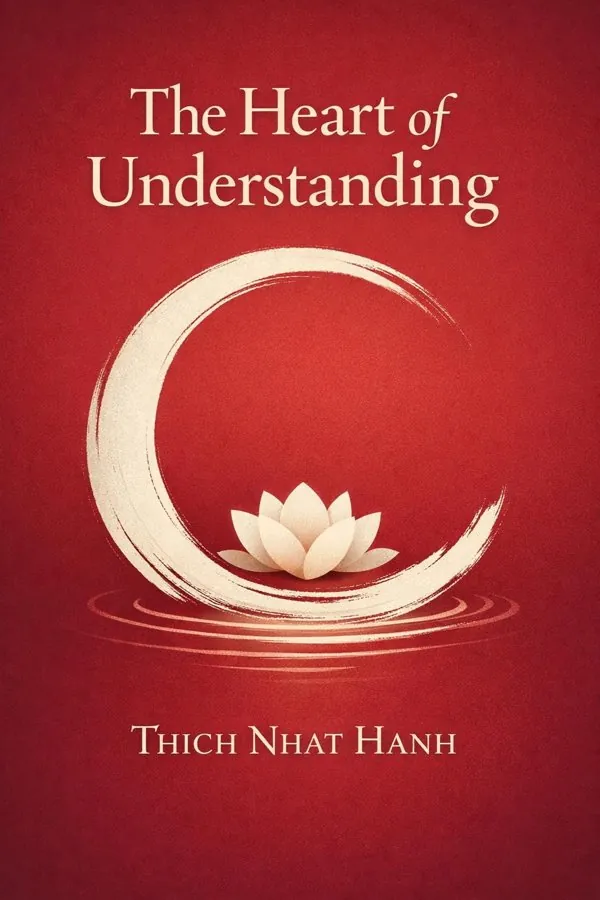
The Heart of Understanding: Commentaries on the Prajñāpāramitā Heart Sutra: Summary & Key Insights
 10 min10 chaptersAudio available
Key Takeaways from The Heart of Understanding: Commentaries on the Prajñāpāramitā Heart Sutra
Sometimes the shortest teachings contain the widest universe.
Freedom begins not when life changes, but when perception deepens.
One misunderstood word can hide an entire path of liberation.
The most famous line in the Heart Sutra is also one of the most radical: “Form is emptiness, emptiness is form.
The illusion of separateness is one of the deepest roots of suffering.
What Is The Heart of Understanding: Commentaries on the Prajñāpāramitā Heart Sutra About?
The Heart of Understanding: Commentaries on the Prajñāpāramitā Heart Sutra by Thich Nhat Hanh is a eastern_wisdom book spanning 10 pages. Some books explain an idea; this one changes the way you see reality. In The Heart of Understanding, Thich Nhat Hanh offers a luminous commentary on the Prajñāpāramitā Heart Sutra, one of the shortest yet most influential scriptures in Mahayana Buddhism. Rather than treating the sutra as an abstract philosophical puzzle, he brings it to life through clear language, vivid examples, and practical insight. His central aim is to help readers understand emptiness not as nothingness, but as interdependence—the truth that nothing exists separately or by itself. That shift matters because it transforms how we relate to suffering, identity, fear, and even everyday objects. A sheet of paper contains clouds, sunshine, loggers, and time; a human being contains family, society, ancestors, and the whole cosmos. By learning to see in this way, we loosen our attachment to rigid concepts and become more compassionate, less afraid, and more present. Thich Nhat Hanh is an ideal guide for this journey. A revered Zen master, peace activist, and teacher of engaged Buddhism, he combines deep scriptural understanding with extraordinary accessibility. This book is both a spiritual commentary and a practical manual for seeing deeply into life.
This FizzRead summary covers all 10 key chapters of The Heart of Understanding: Commentaries on the Prajñāpāramitā Heart Sutra in approximately 10 minutes, distilling the most important ideas, arguments, and takeaways from Thich Nhat Hanh's work. Also available as an audio summary and Key Quotes Podcast.
The Heart of Understanding: Commentaries on the Prajñāpāramitā Heart Sutra
Some books explain an idea; this one changes the way you see reality. In The Heart of Understanding, Thich Nhat Hanh offers a luminous commentary on the Prajñāpāramitā Heart Sutra, one of the shortest yet most influential scriptures in Mahayana Buddhism. Rather than treating the sutra as an abstract philosophical puzzle, he brings it to life through clear language, vivid examples, and practical insight. His central aim is to help readers understand emptiness not as nothingness, but as interdependence—the truth that nothing exists separately or by itself.
That shift matters because it transforms how we relate to suffering, identity, fear, and even everyday objects. A sheet of paper contains clouds, sunshine, loggers, and time; a human being contains family, society, ancestors, and the whole cosmos. By learning to see in this way, we loosen our attachment to rigid concepts and become more compassionate, less afraid, and more present.
Thich Nhat Hanh is an ideal guide for this journey. A revered Zen master, peace activist, and teacher of engaged Buddhism, he combines deep scriptural understanding with extraordinary accessibility. This book is both a spiritual commentary and a practical manual for seeing deeply into life.
Who Should Read The Heart of Understanding: Commentaries on the Prajñāpāramitā Heart Sutra?
This book is perfect for anyone interested in eastern_wisdom and looking to gain actionable insights in a short read. Whether you're a student, professional, or lifelong learner, the key ideas from The Heart of Understanding: Commentaries on the Prajñāpāramitā Heart Sutra by Thich Nhat Hanh will help you think differently.
- ✓Readers who enjoy eastern_wisdom and want practical takeaways
- ✓Professionals looking to apply new ideas to their work and life
- ✓Anyone who wants the core insights of The Heart of Understanding: Commentaries on the Prajñāpāramitā Heart Sutra in just 10 minutes
Want the full summary?
Get instant access to this book summary and 100K+ more with Fizz Moment.
Get Free SummaryAvailable on App Store • Free to download
Key Chapters
Sometimes the shortest teachings contain the widest universe. Thich Nhat Hanh presents the Heart Sutra as the concentrated essence of the Prajñāpāramitā, or “Perfection of Wisdom,” tradition—a vast body of Buddhist teaching concerned with seeing beyond illusion and waking up to reality as it is. Though the sutra is brief, it addresses some of the deepest human confusions: who we are, why we suffer, and how wisdom frees us.
Nhat Hanh emphasizes that this text is not meant to be admired only as sacred poetry or recited mechanically. It is a tool for practice. The Heart Sutra cuts through our habitual tendency to divide life into fixed categories: self and other, being and non-being, gain and loss, birth and death. Its compact language can feel paradoxical at first, but that is precisely the point. It disrupts ordinary conceptual thinking so a deeper insight can emerge.
He also shows why the sutra has remained central in Mahayana Buddhism for centuries: it unites wisdom and compassion. Understanding reality correctly is not a cold intellectual achievement; it naturally opens the heart. When we see that all things inter-are, we stop defending the illusion of a separate self so fiercely.
In practical life, this means reading sacred or philosophical texts differently. Instead of asking, “Do I agree with this?” ask, “How do I observe this in my own experience?” You can apply this when facing stress, conflict, or loss. Rather than reacting from habit, pause and investigate the deeper conditions shaping the moment.
Actionable takeaway: Approach profound teachings not as theories to memorize, but as mirrors for direct observation in daily life.
Freedom begins not when life changes, but when perception deepens. In the Heart Sutra, Avalokiteśvara—the bodhisattva of compassion—looks deeply into the five skandhas, the elements that make up what we call a person: form, feelings, perceptions, mental formations, and consciousness. He sees that each is empty, and through this insight transcends suffering. For Thich Nhat Hanh, this is the model of meditation itself.
To “look deeply” does not mean to withdraw from life or suppress thought. It means observing experience with calm, sustained attention until its true nature reveals itself. When you feel anger, for example, looking deeply means asking: What conditions gave rise to this? Is it permanent? Is it identical with me? Does it exist independently? Such inquiry weakens the belief that mental states are solid and absolute.
Nhat Hanh makes the skandhas understandable by showing that what we call a self is actually a flowing collection of changing processes. Your body changes constantly. Feelings come and go. Perceptions are often inaccurate. Habits are conditioned. Consciousness depends on contact and conditions. The “person” you cling to is not a fixed entity, but a dynamic event.
This insight is liberating rather than frightening. If anger is not a permanent self, it can be transformed. If sadness is conditioned, it can be understood. If identity is fluid, we need not imprison ourselves in old stories.
In everyday practice, this can be applied during emotional upheaval. Instead of saying, “I am anxious,” try, “Anxiety is present.” Then look into its causes: lack of rest, fear of judgment, unresolved memory, uncertainty. You are already moving from identification to wisdom.
Actionable takeaway: When a strong emotion arises, pause and investigate it as a changing process rather than a fixed identity.
One misunderstood word can hide an entire path of liberation. The word “emptiness” often sounds bleak to modern readers, as if Buddhism were claiming that nothing matters or nothing exists. Thich Nhat Hanh carefully corrects this misunderstanding. Emptiness does not mean nonexistence; it means being empty of a separate, independent self.
A flower is empty of a separate self because it is made entirely of non-flower elements: sunshine, rain, soil, minerals, time, and the gardener’s care. Remove those conditions, and no flower appears. The flower is real, but not independently real. In the same way, a human being is made of ancestors, food, culture, language, education, relationships, and countless conditions. We exist, but we do not exist alone.
This understanding changes how we approach suffering. If the self is not an isolated, permanent entity, then fear, pride, shame, and possessiveness begin to loosen. Emptiness is not nihilism; it is openness. It makes compassion possible because the boundary between “my suffering” and “your suffering” becomes less rigid.
In practical terms, this insight can transform everyday frustrations. Suppose a coworker behaves rudely. Instead of seeing a fixed “difficult person,” you might recognize stress, upbringing, institutional pressure, fear, and misunderstanding all expressing themselves through that person. This does not excuse harmful behavior, but it creates space for wise rather than reactive action.
Nhat Hanh insists that emptiness itself is also empty—meaning we should not turn it into a rigid doctrine. It is a tool to free us from clinging, not another concept to defend.
Actionable takeaway: When you feel isolated or offended, reflect on the many conditions that shape both you and others, and respond from connection rather than separation.
The most famous line in the Heart Sutra is also one of the most radical: “Form is emptiness, emptiness is form.” Thich Nhat Hanh explains this not as mystical wordplay, but as a precise statement about reality. Form refers to all tangible phenomena—bodies, trees, buildings, sounds, sensations. Emptiness refers to their lack of separate existence. The two are not opposites. They are two ways of describing the same reality.
If something were not empty, it could never change, grow, decay, or relate. A cloud can become rain because it is empty of a fixed self. A child can become an adult because the child is not locked into permanent identity. Your own life can heal because your pain is not a sealed essence. Emptiness makes transformation possible.
Nhat Hanh’s examples make this teaching graspable. A sheet of paper contains a cloud because without rain, trees cannot grow; without trees, there is no paper. It also contains sunlight, the logger, the truck, the mill, and your own consciousness reading it. The paper is “empty” of separate existence, and precisely because of that, it is full of everything else.
This insight helps dissolve both attachment and despair. We stop clinging to appearances as absolute, but we also stop dismissing the world as unreal. The world is wonderfully present, yet relational and fluid.
You can practice this in ordinary observation. Look at a meal and trace its conditions: farmers, soil, water, transport, labor, weather, community. Or look at your stress and ask what conditions sustain it and what conditions might transform it. The line between philosophy and mindfulness disappears.
Actionable takeaway: Choose one ordinary object each day and contemplate the countless conditions that allow it to exist.
The illusion of separateness is one of the deepest roots of suffering. To help readers understand emptiness positively, Thich Nhat Hanh introduces one of his most memorable terms: interbeing. Everything inter-is with everything else. Nothing exists by itself alone. This is not sentimental spirituality but an experiential description of reality.
Interbeing means that your life is woven from countless visible and invisible relationships. You breathe air exhaled by trees. You speak with words inherited from generations before you. Your happiness depends on food, shelter, community, and conditions beyond your control. Even your most private experience is shaped by society, family, biology, and history.
This teaching has ethical force. If we truly understand interbeing, indifference becomes irrational. Harm done to others eventually harms the whole system we belong to. Likewise, caring for others is not merely altruism; it is realism. Environmental destruction, social violence, and personal alienation all grow from forgetting our interconnected nature.
Nhat Hanh’s genius is making this immediate. When he asks us to see a cloud in a sheet of paper, he is training perception. Once you really see interbeing in one thing, you can begin to see it everywhere: in a cup of tea, in your child, in your own breath.
This insight can be used in relationships. In conflict, instead of defending your separate position, ask what shared conditions created this tension. In environmental choices, recognize that consumption links you to ecosystems and workers. In loneliness, remember that your life is upheld in every moment by countless forms of support.
Actionable takeaway: In moments of conflict or isolation, ask, “What am I connected to here that I am forgetting to see?”
Much of human confusion comes from treating mental categories as reality itself. Thich Nhat Hanh shows that the Heart Sutra challenges dualistic thinking: birth versus death, pure versus impure, self versus other, existence versus nonexistence. These opposites are useful in language, but they can imprison us when taken as absolute truth.
Consider birth and death. We usually imagine a person begins at one point and ends at another. But from the perspective of interbeing, nothing comes from nothing and nothing disappears into nothing. A cloud does not “die” when it becomes rain. It changes form. Likewise, what we call life is a continuation of causes and conditions.
This perspective softens existential fear. We still experience grief and loss, but not with the same metaphysical panic. We begin to see continuity within change. Nhat Hanh does not ask us to deny conventional reality; he invites us to see beyond its surface boundaries.
Dualistic thinking also fuels moral rigidity and self-judgment. We divide ourselves into success and failure, spiritual and unspiritual, worthy and unworthy. But human experience is more fluid. When we cling to fixed categories, we suffer and make others suffer.
Practically, this insight matters in conversations, politics, and personal identity. If you see every disagreement as a battle between right and wrong selves, compassion vanishes. If you see perspectives as conditioned and partial, dialogue becomes possible. If you view your own shortcomings as permanent labels, growth is blocked. But if you see them as temporary formations, change becomes available.
The Heart Sutra’s negations are meant to free us from attachment to categories, not to erase the lived world. They create room for direct, flexible, compassionate wisdom.
Actionable takeaway: When caught in rigid either-or thinking, ask what larger reality both sides belong to.
Insight does not arrive by force; it ripens through presence. For Thich Nhat Hanh, mindfulness is the practical ground of the Heart Sutra. Without mindful attention, teachings like emptiness or interbeing remain intellectual ideas. With mindfulness, they become lived experience.
Mindfulness means being fully present with body, feelings, mind, and the world. It is not passive drifting or detached observation. It is clear, gentle awareness that reveals conditions and patterns. When you breathe consciously, walk attentively, or listen deeply, you begin to notice how experience forms and dissolves. This is the basis for seeing emptiness directly.
Nhat Hanh consistently links profound wisdom to ordinary practice. Washing dishes can become meditation when done with full attention. Drinking tea can reveal interbeing when you see the rain, earth, labor, and sunlight within the cup. Even suffering becomes workable when observed with tenderness rather than resistance.
Mindfulness also protects against turning spiritual teachings into abstraction. It is easy to say “there is no self” while remaining deeply reactive, proud, or fearful. But mindful awareness shows us where attachment still operates. It reveals impatience in the body, defensiveness in speech, craving in the mind. In this way, mindfulness is both diagnostic and transformative.
A practical example is difficult communication. Before responding to criticism, take three conscious breaths. Feel your body. Notice emotion arising. Listen for the suffering behind the words. This short pause can prevent an old pattern from taking control.
Nhat Hanh’s great contribution is showing that wisdom is not hidden in remote metaphysics. It is available in each mindful moment. The doorway is simple, but the practice is profound.
Actionable takeaway: Build one daily mindfulness ritual—such as three conscious breaths before meals or meetings—to anchor insight in real life.
One of the most liberating insights in the Heart Sutra is also one of the most difficult to accept: there is no attainment. Thich Nhat Hanh explains that this does not mean practice is pointless. It means awakening is obstructed by the very ego that wants to acquire it like a possession. As long as we seek enlightenment as something that will enhance “me,” we remain trapped in the illusion of separateness.
The sutra states that because there is nothing to attain, the bodhisattva, grounded in prajñāpāramitā, has no obstacles in the mind. With no obstacles, there is no fear. This sequence is crucial. Obstruction comes from clinging: to views, identity, success, purity, certainty, and even spiritual progress. When clinging relaxes, the mind becomes spacious.
In modern life, attainment mentality is everywhere. We pursue productivity, status, self-improvement, and even wellness in a spirit of accumulation. We may treat meditation as another performance metric. Nhat Hanh gently interrupts this habit. The point of practice is not to become a superior self, but to see through the illusion of a separate self.
This does not make life passive. Effort still matters, but it becomes non-grasping effort. You meditate, study, serve, and reflect not to manufacture worth, but to uncover what is already available when confusion settles.
In everyday terms, this teaching helps with perfectionism. If you are constantly striving to prove yourself, pause and ask what identity you are trying to secure. If your worth is not dependent on attainment, action can become more relaxed, clear, and compassionate.
Actionable takeaway: Notice one area where you are turning growth into self-worth, and practice doing it with care but without identity-based grasping.
Sometimes a mantra is not meant to explain truth but to carry us into it. The Heart Sutra culminates in the famous mantra: “Gate gate paragate parasamgate bodhi svaha,” often understood as “Gone, gone, gone beyond, gone altogether beyond, awakening, hail!” Thich Nhat Hanh treats this not as magical sound alone, but as a concise expression of the path of liberation.
To go “beyond” is to move beyond fear, fixed concepts, and dualistic perception. It is a crossing from surface appearances to deeper insight, from clinging to openness, from separation to interbeing. The mantra is joyful because wisdom is not merely analytical—it is freeing. It carries an energy of release.
Nhat Hanh’s reading encourages a living relationship with the mantra. Recitation is not about superstition or escape. It can be a way of collecting the mind, remembering the direction of practice, and embodying trust in the possibility of awakening. Spoken with understanding, the mantra becomes a form of meditation.
In practical use, a mantra like this can help interrupt spirals of anxiety or fixation. During a stressful commute, before a difficult conversation, or in moments of grief, repeating the phrase slowly can remind you that you do not have to stay trapped inside your ordinary mental prison. You can cross over, even slightly, into a wider perspective.
The deeper meaning is existential: every moment offers the possibility of moving beyond ignorance. The crossing is not only after years of practice; it happens now, whenever insight loosens the grip of illusion.
Actionable takeaway: Use a short phrase, mantra, or breath-based reminder during stressful moments to return to spacious awareness and wiser perspective.
A spiritual teaching proves itself in the way we live. Thich Nhat Hanh never leaves the Heart Sutra in the realm of abstract doctrine. Its value lies in how it transforms daily life—our relationships, fears, work, speech, and response to suffering. Understanding emptiness and interbeing should make us kinder, steadier, and less attached to narrow self-interest.
If there is no separate self, then compassion is not a moral decoration; it is the natural response to reality. When someone suffers, part of the same web suffers. When you speak harshly, you damage not only another person but the relational field you both inhabit. When you care for your own body and mind, you also care for everyone your presence touches.
Nhat Hanh’s style of engaged Buddhism is visible here. Insight must enter society. It should shape how we consume, how we listen, how we raise children, how we work, and how we respond to injustice. Deep understanding is not withdrawal from the world but wiser participation in it.
A practical example is conscious speech. Before speaking in anger, reflect that your words are not separate from the relationship. They will continue in the other person and in yourself. Or consider mindful consumption: recognizing interbeing may lead you to buy less wastefully, eat with more gratitude, or support more ethical systems.
The book ultimately invites a profound simplicity: see deeply, cling less, love more. Wisdom and compassion are not two paths. They are one movement.
Actionable takeaway: Choose one daily behavior—speech, eating, listening, or consuming—and practice it as an expression of interbeing and compassion.
All Chapters in The Heart of Understanding: Commentaries on the Prajñāpāramitā Heart Sutra
About the Author
Thich Nhat Hanh (1926–2022) was a Vietnamese Zen master, monk, poet, scholar, and peace activist whose teachings shaped modern mindfulness practice around the world. Ordained as a monk in Vietnam, he became a leading voice for engaged Buddhism, insisting that meditation and spiritual insight must be expressed through compassion, reconciliation, and ethical action. During the Vietnam War, he advocated nonviolence and humanitarian relief, and was later exiled from his homeland for many years. He founded Plum Village in France, which became one of the world’s best-known mindfulness communities. Through dozens of books, retreats, and public talks, he brought Buddhist wisdom to global audiences with rare simplicity and warmth. His work bridges traditional Zen insight and practical daily living, making him one of the most trusted guides to Buddhist thought in the modern era.
Get This Summary in Your Preferred Format
Read or listen to the The Heart of Understanding: Commentaries on the Prajñāpāramitā Heart Sutra summary by Thich Nhat Hanh anytime, anywhere. FizzRead offers multiple formats so you can learn on your terms — all free.
Available formats: App · Audio · PDF · EPUB — All included free with FizzRead
Download The Heart of Understanding: Commentaries on the Prajñāpāramitā Heart Sutra PDF and EPUB Summary
Key Quotes from The Heart of Understanding: Commentaries on the Prajñāpāramitā Heart Sutra
“Sometimes the shortest teachings contain the widest universe.”
“Freedom begins not when life changes, but when perception deepens.”
“One misunderstood word can hide an entire path of liberation.”
“The most famous line in the Heart Sutra is also one of the most radical: “Form is emptiness, emptiness is form.”
“The illusion of separateness is one of the deepest roots of suffering.”
Frequently Asked Questions about The Heart of Understanding: Commentaries on the Prajñāpāramitā Heart Sutra
The Heart of Understanding: Commentaries on the Prajñāpāramitā Heart Sutra by Thich Nhat Hanh is a eastern_wisdom book that explores key ideas across 10 chapters. Some books explain an idea; this one changes the way you see reality. In The Heart of Understanding, Thich Nhat Hanh offers a luminous commentary on the Prajñāpāramitā Heart Sutra, one of the shortest yet most influential scriptures in Mahayana Buddhism. Rather than treating the sutra as an abstract philosophical puzzle, he brings it to life through clear language, vivid examples, and practical insight. His central aim is to help readers understand emptiness not as nothingness, but as interdependence—the truth that nothing exists separately or by itself. That shift matters because it transforms how we relate to suffering, identity, fear, and even everyday objects. A sheet of paper contains clouds, sunshine, loggers, and time; a human being contains family, society, ancestors, and the whole cosmos. By learning to see in this way, we loosen our attachment to rigid concepts and become more compassionate, less afraid, and more present. Thich Nhat Hanh is an ideal guide for this journey. A revered Zen master, peace activist, and teacher of engaged Buddhism, he combines deep scriptural understanding with extraordinary accessibility. This book is both a spiritual commentary and a practical manual for seeing deeply into life.
More by Thich Nhat Hanh
The Miracle of Mindfulness: An Introduction to the Practice of Meditation
Thich Nhat Hanh
10 min
Anger: Wisdom for Cooling the Flames
Thich Nhat Hanh
10 min
Savor: Mindful Eating, Mindful Life
Thich Nhat Hanh, Lilian Cheung
10 min
Living Buddha, Living Christ
Thich Nhat Hanh
10 minYou Might Also Like
A New Earth
Eckhart Tolle
10 min
The Daily Stoic
Ryan Holiday, Stephen Hanselman
10 min
Buddhism: Plain and Simple
Steve Hagen
10 min
Enchiridion
Epictetus
10 min
The Book of Tea
Kakuzō Okakura
10 min
The Light We Give: How Sikh Wisdom Can Transform Your Life
Simran Jeet Singh
10 minBrowse by Category
Ready to read The Heart of Understanding: Commentaries on the Prajñāpāramitā Heart Sutra?
Get the full summary and 100K+ more books with Fizz Moment.