
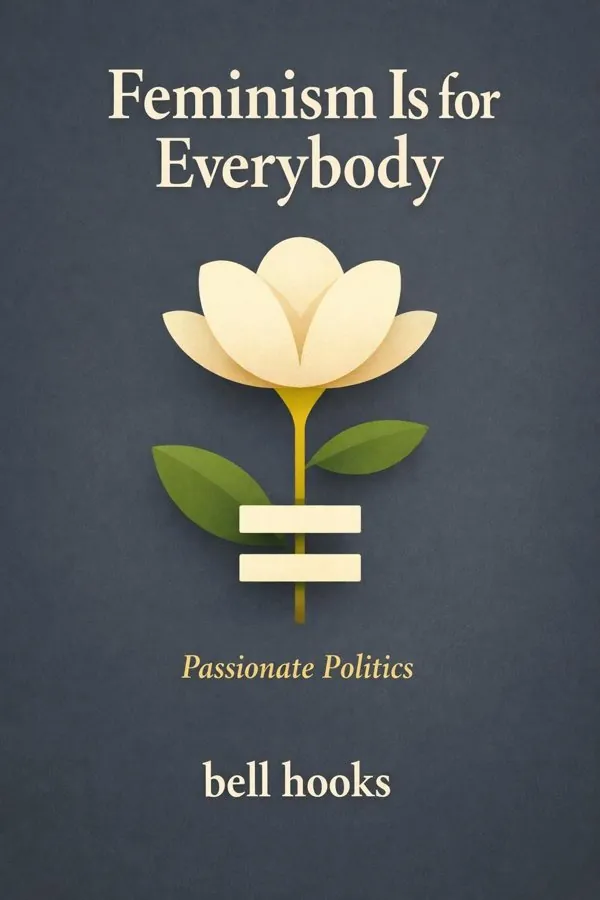
Feminism Is for Everybody: Passionate Politics: Summary & Key Insights
by bell hooks
 10 min11 chaptersAudio available
What Is Feminism Is for Everybody: Passionate Politics About?
Feminism Is for Everybody: Passionate Politics by bell hooks is a sociology book spanning 11 pages. In this concise and accessible work, bell hooks presents feminism as a movement for everyone, not just for women. She argues that feminism’s goal is to end sexism, sexist exploitation, and oppression, and she outlines how feminist theory can transform both personal lives and social structures. The book serves as an introduction to feminist thought, emphasizing inclusivity, love, and social justice.
This FizzRead summary covers all 11 key chapters of Feminism Is for Everybody: Passionate Politics in approximately 10 minutes, distilling the most important ideas, arguments, and takeaways from bell hooks's work. Also available as an audio summary and Key Quotes Podcast.
Feminism Is for Everybody: Passionate Politics
In this concise and accessible work, bell hooks presents feminism as a movement for everyone, not just for women. She argues that feminism’s goal is to end sexism, sexist exploitation, and oppression, and she outlines how feminist theory can transform both personal lives and social structures. The book serves as an introduction to feminist thought, emphasizing inclusivity, love, and social justice.
Who Should Read Feminism Is for Everybody: Passionate Politics?
This book is perfect for anyone interested in sociology and looking to gain actionable insights in a short read. Whether you're a student, professional, or lifelong learner, the key ideas from Feminism Is for Everybody: Passionate Politics by bell hooks will help you think differently.
- ✓Readers who enjoy sociology and want practical takeaways
- ✓Professionals looking to apply new ideas to their work and life
- ✓Anyone who wants the core insights of Feminism Is for Everybody: Passionate Politics in just 10 minutes
Want the full summary?
Get instant access to this book summary and 100K+ more with Fizz Moment.
Get Free SummaryAvailable on App Store • Free to download
Key Chapters
When people think about feminism, many imagine angry women who hate men, who seek superiority instead of equality. This caricature has done more harm than most of us realize. In the early days of the movement, mass media helped spread the lie that feminists were anti-family, anti-male, perhaps even anti-love. As a result, the revolutionary potential of feminism was reduced to a cultural joke. But feminism has never been about reversing hierarchies—it has always been about dismantling them. When I say 'patriarchy,' I don’t mean that men are evil; I mean they, too, are shaped by a system that tells them domination is their birthright, that love must mean control.
I have met countless men afraid of feminism because they have been taught it would make them the enemy. I have also met women who reject feminism because they believe it demands they turn against their fathers, their lovers, or their faith. The truth is the opposite. Feminism asks us to love more deeply, to love in freedom, not possession; to cherish each other not because of what we control but because of who we are. Once we let go of the myth that feminism is about man-hating, we can see its gentler, more expansive heart—the heart that seeks healing for everyone wounded by patriarchy.
Another misunderstanding is that feminism belongs only to white middle-class women. That image erases decades of work by women of color, working-class women, queer people, and men who recognized that gender justice cannot exist without racial and economic justice. Feminism is not a private club—it’s a movement of many voices, each expanding our vision of freedom.
My feminist politics are grounded in transformation. When I write about ending sexism, I am speaking about systems that infiltrate our daily lives: the family, the workplace, religion, education, and government. A feminist politics doesn’t seek inclusion into a corrupt system; it demands the creation of a new order based on equality and peace. True transformation happens when we refuse to accept domination in any form—whether it is the domination of men over women, the rich over the poor, or one race over another.
At the center of feminist politics is the belief that personal change and social change are interconnected. You cannot have one without the other. We learn sexism from childhood; we absorb it as we are taught to obey, to compete, to devalue our nurturing selves. To unlearn this conditioning requires consciousness-raising, a process through which we see how our personal pain connects to structural injustice. When a woman realizes that her silent domestic labor mirrors the unpaid work of millions of women worldwide, she gains a political awakening; when a man realizes that the pressure to be invulnerable is part of his social training under patriarchy, he too begins to change.
Feminist politics are therefore both radical and tender. They insist that we can rebuild the world on different principles—that love and justice are not naive ideals but strategic necessities. A feminist vision dares us to dream beyond equality-as-access, imagining genuine community where every life has value and every voice is heard.
+ 9 more chapters — available in the FizzRead app
All Chapters in Feminism Is for Everybody: Passionate Politics
About the Author
bell hooks (1952–2021) was an American author, feminist theorist, and cultural critic. Her work explored the intersections of race, gender, and class, and she was known for her accessible writing style and commitment to social justice. She wrote numerous influential books on feminism, love, and education, including 'Ain’t I a Woman?' and 'All About Love.'
Get This Summary in Your Preferred Format
Read or listen to the Feminism Is for Everybody: Passionate Politics summary by bell hooks anytime, anywhere. FizzRead offers multiple formats so you can learn on your terms — all free.
Available formats: App · Audio · PDF · EPUB — All included free with FizzRead
Download Feminism Is for Everybody: Passionate Politics PDF and EPUB Summary
Key Quotes from Feminism Is for Everybody: Passionate Politics
“When people think about feminism, many imagine angry women who hate men, who seek superiority instead of equality.”
“My feminist politics are grounded in transformation.”
Frequently Asked Questions about Feminism Is for Everybody: Passionate Politics
Feminism Is for Everybody: Passionate Politics by bell hooks is a sociology book that explores key ideas across 11 chapters. In this concise and accessible work, bell hooks presents feminism as a movement for everyone, not just for women. She argues that feminism’s goal is to end sexism, sexist exploitation, and oppression, and she outlines how feminist theory can transform both personal lives and social structures. The book serves as an introduction to feminist thought, emphasizing inclusivity, love, and social justice.
More by bell hooks

You Might Also Like

Between the World and Me
Ta-Nehisi Coates
10 min
Half the Sky
Nicholas D. Kristof, Sheryl WuDunn
10 min
Men Explain Things To Me
Rebecca Solnit
10 min
Rational Ritual
Michael Suk-Young Chwe
10 min
The New Jim Crow
Michelle Alexander
10 min
Beyond Culture
Edward T. Hall
10 minBrowse by Category
Ready to read Feminism Is for Everybody: Passionate Politics?
Get the full summary and 100K+ more books with Fizz Moment.