
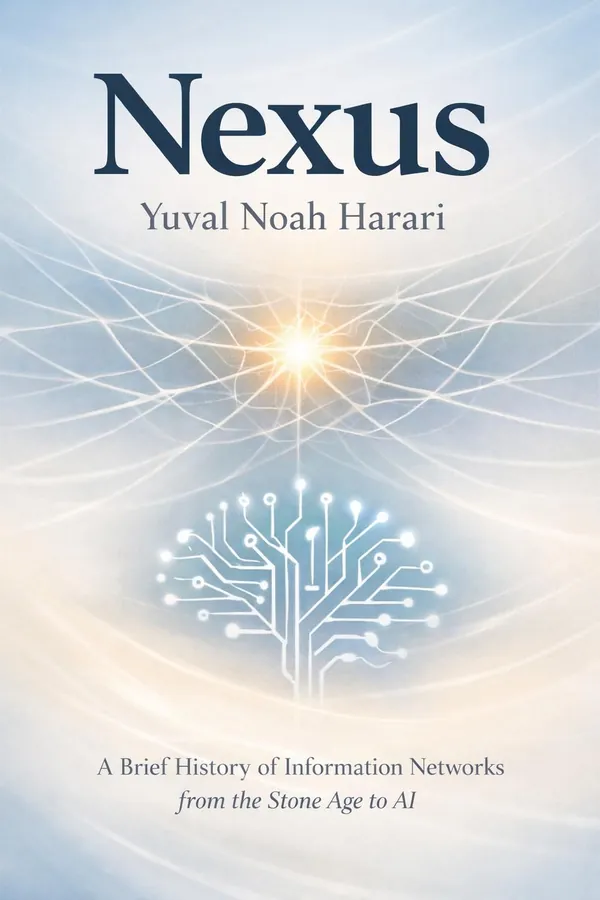
Nexus: A Brief History of Information Networks from the Stone Age to AI: Summary & Key Insights
 10 min12 chaptersAudio available
What Is Nexus: A Brief History of Information Networks from the Stone Age to AI About?
Nexus: A Brief History of Information Networks from the Stone Age to AI by Yuval Noah Harari is a world_history book spanning 12 pages. The story of how information networks have made, and unmade, our world. For the last 100,000 years, we Sapiens have accumulated enormous power. But despite all our discoveries, inventions, and conquests, we now find ourselves in an existential crisis. The world is on the verge of ecological collapse. Misinformation abounds. And we are rushing headlong into the age of AI—a new information network that threatens to annihilate us. If we are so wise, why are we so self-destructive? Nexus looks through the long lens of human history to consider how the flow of information has shaped us, and our world. Taking us from the Stone Age, through the canonization of the Bible, early modern witch-hunts, Stalinism, Nazism, and the resurgence of populism today, Yuval Noah Harari asks us to consider the complex relationship between information and truth, bureaucracy and wisdom, wisdom and power. He explores how different societies and political systems have wielded information to achieve their goals, for good and ill. And he addresses the urgent choices we face as non-human intelligence threatens our very existence. Information is not the raw material of truth; it is the raw material of power. All the way from the clay tablets of Sumer to the algorithms of today, Nexus offers the thrilling tale of the networks we have built, and which might soon destroy us.
This FizzRead summary covers all 12 key chapters of Nexus: A Brief History of Information Networks from the Stone Age to AI in approximately 10 minutes, distilling the most important ideas, arguments, and takeaways from Yuval Noah Harari's work. Also available as an audio summary and Key Quotes Podcast.
Nexus: A Brief History of Information Networks from the Stone Age to AI
The story of how information networks have made, and unmade, our world.
For the last 100,000 years, we Sapiens have accumulated enormous power. But despite all our discoveries, inventions, and conquests, we now find ourselves in an existential crisis. The world is on the verge of ecological collapse. Misinformation abounds. And we are rushing headlong into the age of AI—a new information network that threatens to annihilate us. If we are so wise, why are we so self-destructive?
Nexus looks through the long lens of human history to consider how the flow of information has shaped us, and our world. Taking us from the Stone Age, through the canonization of the Bible, early modern witch-hunts, Stalinism, Nazism, and the resurgence of populism today, Yuval Noah Harari asks us to consider the complex relationship between information and truth, bureaucracy and wisdom, wisdom and power. He explores how different societies and political systems have wielded information to achieve their goals, for good and ill. And he addresses the urgent choices we face as non-human intelligence threatens our very existence.
Information is not the raw material of truth; it is the raw material of power. All the way from the clay tablets of Sumer to the algorithms of today, Nexus offers the thrilling tale of the networks we have built, and which might soon destroy us.
Who Should Read Nexus: A Brief History of Information Networks from the Stone Age to AI?
This book is perfect for anyone interested in world_history and looking to gain actionable insights in a short read. Whether you're a student, professional, or lifelong learner, the key ideas from Nexus: A Brief History of Information Networks from the Stone Age to AI by Yuval Noah Harari will help you think differently.
- ✓Readers who enjoy world_history and want practical takeaways
- ✓Professionals looking to apply new ideas to their work and life
- ✓Anyone who wants the core insights of Nexus: A Brief History of Information Networks from the Stone Age to AI in just 10 minutes
Want the full summary?
Get instant access to this book summary and 100K+ more with Fizz Moment.
Get Free SummaryAvailable on App Store • Free to download
Key Chapters
Throughout history, many traditions have believed that a fatal flaw in our nature tempts us to pursue powers we do not know how to handle. The Greek myth of Phaethon and Goethe's poem "The Sorcerer's Apprentice" both tell cautionary tales of individuals who summon powers they cannot control, leading to disaster. In these stories, the problem is framed as individual hubris or incompetence. However, this analysis misses the crucial point that human power is never the outcome of individual initiative alone. Power stems from cooperation between large numbers of humans.
Our tendency to summon powers we cannot control stems from the unique way our species cooperates. We build massive networks held together by information. But information is not necessarily truth. Sapiens have built large networks by spreading fictions and fantasies—about gods, nations, and money. These fictions allow us to cooperate, but they also predispose us to use our power unwisely. The Nazi and Stalinist regimes were exceptionally powerful networks held together by exceptionally deluded ideas. Their strength proves that delusional networks are not doomed to immediate failure; ignorance can indeed be strength in the short term.
The naive view of information argues that big networks achieve wisdom by processing vast amounts of data, leading to truth. It assumes that more information leads to greater accuracy and that in a free market of ideas, truth will prevail. This view has been the ideology of the computer age, championed by figures like Ronald Reagan and Barack Obama, and corporations like Google. While more information has helped in areas like reducing child mortality, it has not solved our biggest existential threats. In fact, despite our hoard of data, we are destroying our ecological foundations and stockpiling doomsday weapons.
Now, we face the rise of AI, a technology that some believe will solve all our problems. Yet, AI poses the risk of creating a "Silicon Curtain" that could divide humanity or separate us from our new AI overlords. AI is the first technology that can make decisions and create ideas independently. It is not a tool; it is an agent. Trusting algorithms to make wise decisions is a gamble far greater than trusting an enchanted broom. We must move beyond the naive view and understand that information networks are built to maintain order, often at the expense of truth.
To understand our predicament, we must ask: What is information? It is difficult to define. In everyday usage, we associate it with symbols like words or numbers. Consider the story of Cher Ami, the carrier pigeon who saved the Lost Battalion in World War I by carrying a message. The pigeon conveyed information that saved lives. But information can also be a rainbow, a star, or a window shutter used by spies. Any object can be information in the right context.
The naive view defines information as an attempt to represent reality. If it succeeds, it is truth; if it fails, it is misinformation. This view assumes the main role of information is to represent a preexisting reality. However, most information does not attempt to represent reality at all. Music, for example, connects people and synchronizes emotions without representing anything external. DNA does not represent a lion or a zebra; it initiates chemical processes that create a functioning organism. Similarly, information in human history is primarily about connection, not representation. Information connects different points into a network. It puts things "in formation."
This definition explains the power of things like astrology or the Bible. The Bible makes many errors about biology and history, yet it has been incredibly effective in connecting billions of people into religious networks. If the main job of information were to represent reality accurately, the Bible would be a failure. But as a tool for connection, it is a resounding success. Information creates new realities—intersubjective realities like laws, gods, and nations—by tying disparate things together. Therefore, when we look at the history of information networks, we see a rise in connectivity, but not necessarily a rise in truthfulness or wisdom. We Sapiens rule the world because we are talented at using information to connect large numbers of individuals, often by relying on fictions and fantasies.
+ 10 more chapters — available in the FizzRead app
All Chapters in Nexus: A Brief History of Information Networks from the Stone Age to AI
About the Author
Prof. Yuval Noah Harari is a historian, philosopher, and the bestselling author of Sapiens: A Brief History of Humankind, Homo Deus: A Brief History of Tomorrow, 21 Lessons for the 21st Century, and the series Sapiens: A Graphic History and Unstoppable Us. He is a lecturer at the Hebrew University of Jerusalem and a Distinguished Research Fellow at the University of Cambridge's Centre for the Study of Existential Risk. In 2019, he co-founded Sapienship, a social impact company, with his husband, Itzik Yahav.
Get This Summary in Your Preferred Format
Read or listen to the Nexus: A Brief History of Information Networks from the Stone Age to AI summary by Yuval Noah Harari anytime, anywhere. FizzRead offers multiple formats so you can learn on your terms — all free.
Available formats: App · Audio · PDF · EPUB — All included free with FizzRead
Download Nexus: A Brief History of Information Networks from the Stone Age to AI PDF and EPUB Summary
Key Quotes from Nexus: A Brief History of Information Networks from the Stone Age to AI
“Throughout history, many traditions have believed that a fatal flaw in our nature tempts us to pursue powers we do not know how to handle.”
“To understand our predicament, we must ask: What is information?”
Frequently Asked Questions about Nexus: A Brief History of Information Networks from the Stone Age to AI
Nexus: A Brief History of Information Networks from the Stone Age to AI by Yuval Noah Harari is a world_history book that explores key ideas across 12 chapters. The story of how information networks have made, and unmade, our world. For the last 100,000 years, we Sapiens have accumulated enormous power. But despite all our discoveries, inventions, and conquests, we now find ourselves in an existential crisis. The world is on the verge of ecological collapse. Misinformation abounds. And we are rushing headlong into the age of AI—a new information network that threatens to annihilate us. If we are so wise, why are we so self-destructive? Nexus looks through the long lens of human history to consider how the flow of information has shaped us, and our world. Taking us from the Stone Age, through the canonization of the Bible, early modern witch-hunts, Stalinism, Nazism, and the resurgence of populism today, Yuval Noah Harari asks us to consider the complex relationship between information and truth, bureaucracy and wisdom, wisdom and power. He explores how different societies and political systems have wielded information to achieve their goals, for good and ill. And he addresses the urgent choices we face as non-human intelligence threatens our very existence. Information is not the raw material of truth; it is the raw material of power. All the way from the clay tablets of Sumer to the algorithms of today, Nexus offers the thrilling tale of the networks we have built, and which might soon destroy us.
More by Yuval Noah Harari
You Might Also Like
The Age of Capital
Eric Hobsbawm
10 min
The Gulag Archipelago
Aleksandr Solzhenitsyn
10 min
Jerusalem: The Biography
Simon Sebag Montefiore
10 min
The Anglo-Saxons
James Campbell
10 min
The Boer War
Thomas Pakenham
10 min
The Industrial Revolutionaries: The Making of the Modern World 1776–1914
Gavin Weightman
10 minBrowse by Category
Ready to read Nexus: A Brief History of Information Networks from the Stone Age to AI?
Get the full summary and 100K+ more books with Fizz Moment.