
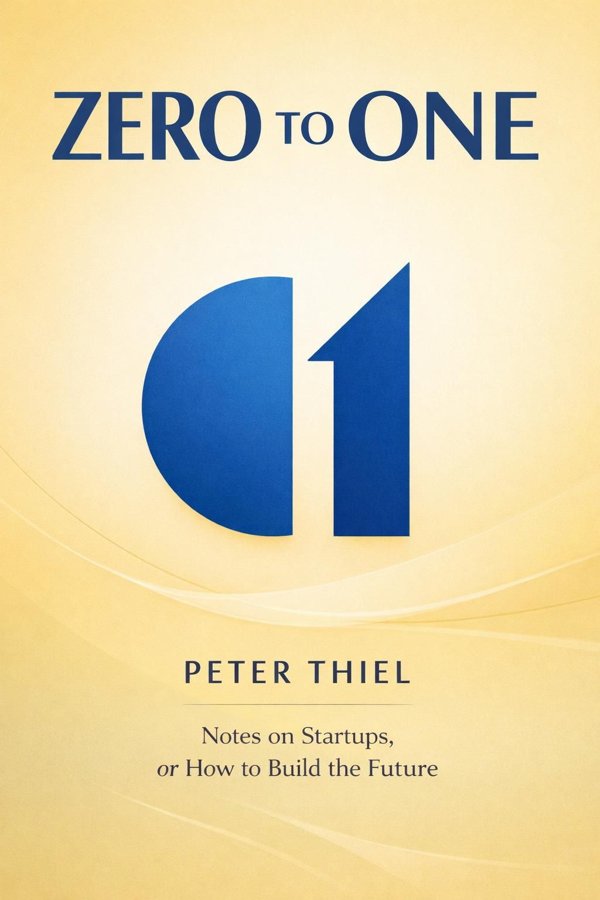
Zero to One: Summary & Key Insights
by Peter Thiel
 10 min9 chaptersAudio available
Key Takeaways from Zero to One
Most people talk about the future as if it will simply arrive on schedule.
A failed boom can teach more than a smooth success.
Thiel’s famous claim that competition is for losers sounds extreme, but it highlights an important truth: the best businesses are not trapped in endless price wars.
A great business is not just one that grows quickly.
One of the book’s most underrated ideas is that successful builders are not passive optimists.
What Is Zero to One About?
Zero to One by Peter Thiel is a business book published in 2014 spanning 13 pages. Zero to One by Peter Thiel, based on notes by Blake Masters, is one of the most provocative books ever written about startups, innovation, and building companies that matter. Rather than offering generic business advice, Thiel asks a deeper question: how do you create something truly new? His answer is the idea of going from “zero to one” — producing a breakthrough that did not exist before — instead of going from “one to many,” which simply means copying or scaling what is already known. That distinction sits at the heart of the book. Drawing on his experience as a co-founder of PayPal, an early investor in Facebook, and a leading Silicon Valley thinker, Thiel challenges many popular assumptions about competition, risk, technology, and success. He argues that the best businesses are not those that fight hardest in crowded markets, but those that build unique products so valuable they effectively become monopolies. Along the way, he explores founding teams, sales, culture, long-term planning, and the role of secrets in entrepreneurship. For founders, investors, students, and ambitious professionals, Zero to One is a sharp, contrarian guide to creating the future instead of merely reacting to it.
This FizzRead summary covers all 9 key chapters of Zero to One in approximately 10 minutes, distilling the most important ideas, arguments, and takeaways from Peter Thiel's work. Also available as an audio summary and Key Quotes Podcast.
Zero to One
Zero to One by Peter Thiel, based on notes by Blake Masters, is one of the most provocative books ever written about startups, innovation, and building companies that matter. Rather than offering generic business advice, Thiel asks a deeper question: how do you create something truly new? His answer is the idea of going from “zero to one” — producing a breakthrough that did not exist before — instead of going from “one to many,” which simply means copying or scaling what is already known. That distinction sits at the heart of the book.
Drawing on his experience as a co-founder of PayPal, an early investor in Facebook, and a leading Silicon Valley thinker, Thiel challenges many popular assumptions about competition, risk, technology, and success. He argues that the best businesses are not those that fight hardest in crowded markets, but those that build unique products so valuable they effectively become monopolies. Along the way, he explores founding teams, sales, culture, long-term planning, and the role of secrets in entrepreneurship. For founders, investors, students, and ambitious professionals, Zero to One is a sharp, contrarian guide to creating the future instead of merely reacting to it.
Who Should Read Zero to One?
This book is perfect for anyone interested in business and looking to gain actionable insights in a short read. Whether you're a student, professional, or lifelong learner, the key ideas from Zero to One by Peter Thiel will help you think differently.
- ✓Readers who enjoy business and want practical takeaways
- ✓Professionals looking to apply new ideas to their work and life
- ✓Anyone who wants the core insights of Zero to One in just 10 minutes
Want the full summary?
Get instant access to this book summary and 100K+ more with Fizz Moment.
Get Free SummaryAvailable on App Store • Free to download
Key Chapters
Most people talk about the future as if it will simply arrive on schedule. Thiel’s central insight is that the future is built, not inherited. It depends on whether people create new things rather than merely expanding what already exists. He separates progress into two forms: horizontal progress, which means copying something that works and spreading it wider, and vertical progress, which means inventing something genuinely new. Horizontal progress takes the world from 1 to n; vertical progress takes it from 0 to 1.
This distinction matters because globalization alone cannot solve every problem. If one country successfully manufactures products and another country copies the process, that is useful, but it does not fundamentally change what humanity can do. Technology does. A smartphone, a life-saving drug, a search engine, or a breakthrough energy source creates new capabilities that did not exist before. That is real progress.
In business, this means the biggest opportunities are often hidden inside unsolved problems, not crowded markets. A founder who launches the tenth meal-delivery app may be joining a trend, but a founder who discovers a new way to reduce battery costs or detect disease early may create an entirely new category. Individuals can apply the same idea in their careers by focusing less on imitating successful paths and more on building rare, valuable skills.
Actionable takeaway: Ask yourself one practical question: what important problem do I see that others are ignoring, and what would a genuine solution look like?
A failed boom can teach more than a smooth success. Thiel uses the dot-com bubble of the late 1990s to show how mass enthusiasm can produce both real innovation and disastrous judgment. The internet did transform the world, but many investors and founders made reckless assumptions about timing, business models, and growth. When the bubble burst, people overcorrected and became too cautious, drawing lessons that were often just as harmful as the earlier excess.
Thiel identifies several flawed post-bubble rules: make incremental advances only, stay lean at all costs, improve on the competition instead of trying to dominate a market, and focus only on product while assuming sales will take care of themselves. These ideas sound prudent, but taken too far, they discourage bold thinking. Great companies often do require ambitious visions, concentrated bets, and strong distribution.
The lesson is not that bubbles prove ambition is dangerous. It is that founders must combine optimism with discipline. For example, Amazon survived the dot-com era not because it avoided ambition, but because it paired a large vision with operational execution and a credible path to long-term dominance. Many failed startups had big ideas but weak economics.
This idea also applies beyond startups. In investing, careers, and strategy, people often swing from one extreme to another after painful losses. The wiser approach is to separate temporary hype from enduring truth.
Actionable takeaway: When a trend collapses, do not reject the entire category. Instead, ask which core insight was right and what assumptions were wrong.
Thiel’s famous claim that competition is for losers sounds extreme, but it highlights an important truth: the best businesses are not trapped in endless price wars. In his view, every truly successful company is unique because it has found a way to solve a specific problem better than anyone else. That uniqueness gives it pricing power, strategic freedom, and room to think long term.
He contrasts monopoly with perfect competition. In economic theory, competition seems healthy, but in practice, hypercompetitive markets often produce weak profits and short-term behavior. Restaurants, airlines, and commodity businesses may be full of hardworking people, yet many struggle because customers can switch easily and products are difficult to differentiate. By contrast, a company with proprietary technology, strong network effects, a trusted brand, or high switching costs can build a durable edge.
Thiel is not praising abusive monopoly behavior. He is describing the kind of business every founder should aim for: one that creates so much value in a narrowly defined market that it becomes the clear leader. Google in search, for example, did not win by being slightly better in a crowded field forever. It built a product so superior that it became the default.
For entrepreneurs, this means starting with a small market you can dominate rather than entering a giant market filled with rivals. For professionals, it means becoming known for something specific and difficult to replace.
Actionable takeaway: Define the smallest market where you can become the obvious number one, then expand from that strong position.
A great business is not just one that grows quickly. It is one that can still generate value many years from now. Thiel argues that the most important measure of a company is not short-term revenue but its ability to produce durable future cash flows. That is why he emphasizes monopoly characteristics and what he calls the last mover advantage: the winner is often the company that makes the final, enduring improvement in a category.
Many founders obsess over being first. Thiel says it is often better to be the one that lasts. Friendster came before Facebook, and early search engines existed before Google, but being early did not guarantee dominance. What matters is building the product, systems, and market position that are strongest over time. Proprietary technology, scale economies, network effects, and brand all make it harder for competitors to catch up.
This changes how you should evaluate opportunities. A startup that goes viral for six months but has no defensibility may be far weaker than a slower-growing company with a distinctive product and loyal users. Similarly, a founder should think beyond launch-day attention and ask: what will make this business better and harder to copy in five years?
In practical terms, this could mean designing products that improve as more people use them, locking in customer relationships through workflow integration, or owning hard-to-replicate data. Long-term thinking also requires patience in hiring, capital allocation, and market expansion.
Actionable takeaway: Before pursuing growth, identify what will make your company more defensible with time rather than merely bigger.
One of the book’s most underrated ideas is that successful builders are not passive optimists. Thiel distinguishes between indefinite optimism and definite optimism. Indefinite optimists believe the future will somehow improve, but they do not know how. Definite optimists believe the future can be better and make concrete plans to build it. In Thiel’s view, modern society often favors vague hope over clear design.
This framework explains why many people treat life like a lottery ticket. They diversify every option, avoid strong commitments, and wait for luck to reveal the next step. That mindset feels safe, but it often prevents exceptional outcomes. Founders, by contrast, usually have to be definite: they choose a market, commit to a product, recruit a team, and pursue a specific vision despite uncertainty.
The same principle applies to careers. A person who keeps every path open forever may avoid obvious mistakes, but may also miss the compounding benefits of mastery and reputation. A software engineer who commits to a difficult but valuable field such as AI infrastructure or cybersecurity may create far more long-term opportunity than someone drifting through low-conviction roles.
Definite planning does not mean rigid certainty. It means having a point of view. The future cannot be controlled completely, but it can be shaped by people who are willing to choose and act.
Actionable takeaway: Replace one vague goal with a concrete plan. Define what you want to build, why it matters, and what the next three committed steps are.
In most areas of life, people assume results are normally distributed. Thiel argues that startups and venture investing do not work that way. They follow a power law, where a tiny number of companies create the vast majority of returns. One extraordinary success can outweigh dozens of mediocre outcomes. This insight is crucial for founders, investors, and anyone evaluating ambitious projects.
For venture capitalists, this means a portfolio does not succeed because every company performs well. It succeeds because one or two companies perform unbelievably well. For founders, it means the goal is not to build a merely decent company. A good-but-not-great startup may still fail to justify the time, risk, and capital involved. Because outcomes are so skewed, aiming for outlier value matters.
This idea also explains why conventional decision-making can fail in entrepreneurial settings. If returns were evenly distributed, diversification and average-case thinking might be enough. But in a power-law world, the quality of your best bets matters disproportionately. That is why choosing what to work on, whom to work with, and what market to enter are among the highest-leverage decisions you can make.
Individuals can learn from this too. A rare skill, an unusually strong network, or a breakthrough project can change a career much more than many small improvements. The goal is not reckless gambling but informed concentration on high-upside opportunities.
Actionable takeaway: Identify the one project, market, or capability in your work that could produce outsized results, and invest more attention there than in low-impact tasks.
Important truths are usually hidden in plain sight. Thiel calls these truths secrets: ideas about the world that are real, valuable, and not yet widely recognized. A startup succeeds when it is built around a secret others do not see or do not believe. This could be a hidden technical insight, a market need that incumbents ignore, or a social truth about how people actually behave.
Many people assume there are no secrets left because information is everywhere. Thiel disagrees. If there were no secrets, there would be no reason to create anything new. The challenge is that finding them requires independent thinking. You have to ask uncomfortable questions like: what valuable company is nobody building? What belief do I hold that few people agree with? Why is an obvious problem still unsolved?
Secrets can come from nature or from people. A scientific breakthrough may reveal a new possibility in biology or materials. A social secret may reveal that customers want a product in a way they cannot easily articulate. Airbnb, for example, depended on an insight that strangers would trust each other enough to exchange lodging if the platform was designed correctly.
To uncover secrets, entrepreneurs need curiosity, direct observation, and the courage to look where consensus is weak. This often means spending time close to users, studying inefficient systems, or developing expertise in neglected areas.
Actionable takeaway: Write down three things you believe about your industry that most people either overlook or assume are impossible, then investigate whether one could become a business opportunity.
A company’s early decisions are far more permanent than most founders realize. Thiel argues that startups are like countries: their constitutions are written at the beginning. Choices about co-founders, ownership, mission, governance, and culture can shape everything that follows. If those foundations are weak, later success becomes much harder.
He places special emphasis on choosing co-founders carefully. A startup may begin with an idea, but execution depends on trust between the people building it. Co-founder conflict destroys many companies because the team was assembled casually rather than deliberately. Thiel also stresses the importance of clear roles and aligned incentives. Equity, salaries, and responsibilities should encourage commitment and fairness, not hidden resentment.
Culture matters too. Thiel describes startups as tribes with a shared mission. The strongest teams are not just collections of talent; they are groups united by a sense of purpose. This is why hiring should focus on both capability and fit. A startup should not hire just to fill seats. It should recruit people who are genuinely excited by the company’s mission and ready to contribute in focused ways.
Operationally, good foundations include a board that supports the business, a structure that enables decision-making, and a mission that guides trade-offs. These are not bureaucratic details. They are strategic choices that either reinforce momentum or create friction.
Actionable takeaway: Audit your team’s foundation by asking whether roles, incentives, and mission are clear enough that everyone knows why they are here and what success looks like.
The most brilliant product in the world can still fail if nobody adopts it. Thiel pushes back against the common startup belief that product alone wins. Distribution matters. Sales matters. Marketing matters. Founders often underestimate these functions because they prefer to believe that superior technology will naturally speak for itself. In reality, every business needs a way to reach customers and persuade them.
The right distribution model depends on the product. A complex enterprise software tool may require a direct sales force and long relationships with a small number of clients. A consumer app may rely on viral loops, branding, and low-friction onboarding. The mistake is not choosing the wrong tactic initially; it is pretending distribution is secondary.
Thiel also explores the relationship between humans and technology. He rejects the idea that computers simply replace people. The strongest businesses often combine man and machine, using software to augment human capability. PayPal used technology to move money more efficiently, but it still depended on people making trust, risk, and business decisions. Modern examples include radiologists using AI to improve diagnosis or financial analysts using software to process data faster while still applying judgment.
The broader lesson is that technology should not be viewed only as automation. It can be amplification. Companies that design systems where machines handle scale and humans handle nuance can create powerful advantages.
Actionable takeaway: Map your product’s path to customers and identify the single biggest distribution bottleneck, then solve it as seriously as you solve product development.
All Chapters in Zero to One
About the Author
Peter Thiel is an American entrepreneur, investor, and writer known for his major influence on Silicon Valley. He co-founded PayPal, helping pioneer online payments, and later became the first outside investor in Facebook. He also co-founded Palantir Technologies, a data analytics company focused on government and enterprise use, and Founders Fund, a venture capital firm that has backed many high-profile startups. Thiel studied philosophy at Stanford and later earned a law degree there, but he became best known for his contrarian ideas about technology, competition, and innovation. Zero to One grew out of a Stanford course he taught on startups, with Blake Masters compiling and shaping the notes into book form. His work has made him one of the most discussed and influential thinkers in modern entrepreneurship.
Get This Summary in Your Preferred Format
Read or listen to the Zero to One summary by Peter Thiel anytime, anywhere. FizzRead offers multiple formats so you can learn on your terms — all free.
Available formats: App · Audio · PDF · EPUB — All included free with FizzRead
Download Zero to One PDF and EPUB Summary
Key Quotes from Zero to One
“Most people talk about the future as if it will simply arrive on schedule.”
“A failed boom can teach more than a smooth success.”
“Thiel’s famous claim that competition is for losers sounds extreme, but it highlights an important truth: the best businesses are not trapped in endless price wars.”
“A great business is not just one that grows quickly.”
“One of the book’s most underrated ideas is that successful builders are not passive optimists.”
Frequently Asked Questions about Zero to One
Zero to One by Peter Thiel is a business book that explores key ideas across 9 chapters. Zero to One by Peter Thiel, based on notes by Blake Masters, is one of the most provocative books ever written about startups, innovation, and building companies that matter. Rather than offering generic business advice, Thiel asks a deeper question: how do you create something truly new? His answer is the idea of going from “zero to one” — producing a breakthrough that did not exist before — instead of going from “one to many,” which simply means copying or scaling what is already known. That distinction sits at the heart of the book. Drawing on his experience as a co-founder of PayPal, an early investor in Facebook, and a leading Silicon Valley thinker, Thiel challenges many popular assumptions about competition, risk, technology, and success. He argues that the best businesses are not those that fight hardest in crowded markets, but those that build unique products so valuable they effectively become monopolies. Along the way, he explores founding teams, sales, culture, long-term planning, and the role of secrets in entrepreneurship. For founders, investors, students, and ambitious professionals, Zero to One is a sharp, contrarian guide to creating the future instead of merely reacting to it.
Compare Zero to One
You Might Also Like



Featured In
Elon Musk's Book Picks
Elon Musk's Bookshelf: What the Tech Titan Reads
Naval Ravikant's Book Picks
Naval Ravikant on Wealth and Wisdom: Essential Reads
Sam Altman's Book Picks
Sam Altman's Reading List: Books Behind the AI Revolution
Curated's Book Picks
Best Business Books Every Professional Should Read
Curated's Book Picks
Best Audiobooks of All Time — Listen to the Greatest Books
Browse by Category
Ready to read Zero to One?
Get the full summary and 100K+ more books with Fizz Moment.