
Elon Musk's Bookshelf: What the Tech Titan Reads
From AI risks to space colonization, Elon Musk's reading list reveals the ideas driving Tesla, SpaceX, and his vision for humanity. These books span philosophy, strategy, and technology — handpicked from his tweets and interviews.
 10 min read
Zero to One
by Peter Thiel
Zero to One by Peter Thiel, based on notes by Blake Masters, is one of the most provocative books ever written about startups, innovation, and building companies that matter. Rather than offering generic business advice, Thiel asks a deeper question: how do you create something truly new? His answer is the idea of going from “zero to one” — producing a breakthrough that did not exist before — instead of going from “one to many,” which simply means copying or scaling what is already known. That distinction sits at the heart of the book. Drawing on his experience as a co-founder of PayPal, an early investor in Facebook, and a leading Silicon Valley thinker, Thiel challenges many popular assumptions about competition, risk, technology, and success. He argues that the best businesses are not those that fight hardest in crowded markets, but those that build unique products so valuable they effectively become monopolies. Along the way, he explores founding teams, sales, culture, long-term planning, and the role of secrets in entrepreneurship. For founders, investors, students, and ambitious professionals, Zero to One is a sharp, contrarian guide to creating the future instead of merely reacting to it.
Key Takeaways
- 1The Future Depends on New Creation — Most people talk about the future as if it will simply arrive on schedule. Thiel’s central insight is that the future is…
- 2Learn from Bubbles Without Becoming Cynical — A failed boom can teach more than a smooth success. Thiel uses the dot-com bubble of the late 1990s to show how mass ent…
- 3Happy Companies Escape Destructive Competition — Thiel’s famous claim that competition is for losers sounds extreme, but it highlights an important truth: the best busin…
 10 min read
Superintelligence
by Nick Bostrom
What happens if humanity creates minds that outperform the best human brains in nearly every domain? In Superintelligence, philosopher Nick Bostrom tackles that question with unusual seriousness, arguing that the rise of machine intelligence could become the most important turning point in human history. This is not a book of science-fiction speculation or simple techno-optimism. It is a rigorous exploration of how advanced AI might emerge, why it could become extraordinarily powerful, and why even a system with seemingly harmless goals could pose catastrophic risks if its capabilities vastly exceed our own. Bostrom examines multiple paths to superintelligence, from machine learning and brain emulation to biological enhancement and collective systems, while also confronting the central challenge of AI control: how do we ensure that a more intelligent-than-human system remains aligned with human values? The book matters because its core argument has only grown more relevant as AI capabilities accelerate. Bostrom writes with the authority of a leading philosopher of existential risk and long-term futures, offering one of the foundational frameworks for thinking clearly about advanced AI before it arrives.
Key Takeaways
- 1Intelligence Is Power Toward Goals — A crucial misunderstanding sits at the center of most public debates about AI: people often imagine intelligence as wisd…
- 2Many Roads Lead To Superintelligence — The future may not arrive through the path we expect. One of Bostrom’s most important contributions is showing that supe…
- 3Small Advantages Can Compound Rapidly — The most unsettling possibility in the book is not simply that machine intelligence might exceed ours, but that once it …
 10 min read
Benjamin Franklin: An American Life
by Walter Isaacson
Benjamin Franklin’s autobiography is a classic work of American literature and one of the most influential autobiographies ever written. Composed intermittently between 1771 and 1790, it recounts Franklin’s early life, his rise from modest beginnings in Boston to success as a printer, inventor, scientist, and statesman. The work reflects his values of industry, frugality, and self-improvement, offering insight into the formation of American identity and Enlightenment ideals.
Key Takeaways
- 1Early Life and Apprenticeship in Boston — I came into the world in Boston, in 1706, the fifteenth of seventeen children. My father, Josiah Franklin, was a humble …
- 2Journey to Philadelphia and the Lessons of Perseverance — I left Boston first for New York, where I sought work as a printer, but none was to be found. Fortune led me to Philadel…
- 3The Pursuit of Moral Improvement and the Thirteen Virtues
 10 min read
Structures: Or Why Things Don"t Fall Down
by J.E. Gordon
Why does a bridge remain standing under thousands of passing cars, while a small flaw can bring down a whole machine? In Structures: Or Why Things Don"t Fall Down, J.E. Gordon answers these questions with unusual clarity, wit, and humanity. Rather than treating engineering as a dry technical subject, he reveals it as a way of seeing the world: a practical science of forces, materials, shape, and failure. From cathedrals and ships to bones, trees, and aircraft, Gordon shows that all structures live under stress and survive only by managing it well. What makes this book enduring is its ability to turn intimidating ideas—stress, strain, compression, bending, fracture, safety factors, scaling—into vivid, memorable insights. Gordon was not only a distinguished materials scientist and engineer, but also one of the rare experts who could explain difficult principles to general readers without oversimplifying them. His examples are concrete, his humor is dry and charming, and his lessons remain relevant in an age of megastructures, lightweight materials, and ambitious design. This is a classic popular science book because it teaches more than engineering: it teaches how the physical world really works.
Key Takeaways
- 1Forces, Stresses, and Strains Everywhere — A structure does not fail because it exists; it fails because forces are asking more of it than it can give. That simple…
- 2Tension and Compression Shape Destiny — Materials do not suffer all forces equally, and the difference between being pulled and being squeezed can determine whe…
- 3Shear, Bending, and Torsion Matter Too — Structures rarely enjoy the simplicity of pure pulling or pure crushing; most real failures happen in the messy middle. …
 10 min read
Life 3.0
by Max Tegmark
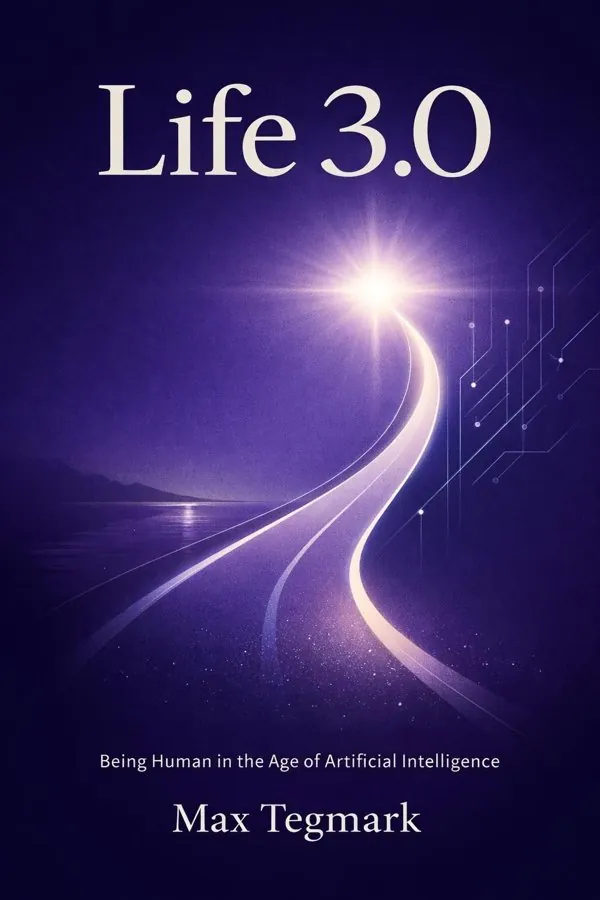
What happens when intelligence is no longer tied to biology? In Life 3.0, Max Tegmark asks readers to think beyond today’s chatbots and algorithms and confront a much larger question: what kind of future do we want to build if machines become smarter than humans? The book explores artificial intelligence not as a narrow technical topic, but as a civilization-shaping force that could transform work, politics, warfare, ethics, identity, and even humanity’s role in the universe. Tegmark begins with vivid scenarios that make abstract risks and opportunities feel immediate, then expands into a wide-ranging inquiry into intelligence, consciousness, and long-term destiny. What makes the book especially valuable is Tegmark’s perspective. As an MIT physicist, cosmologist, and co-founder of the Future of Life Institute, he combines scientific rigor with a talent for big-picture thinking. He neither glorifies AI nor reduces it to doom. Instead, he argues that the future of advanced intelligence is still open—and that deliberate choices made now will matter enormously. Life 3.0 is both a warning and an invitation: if we take AI seriously, we may still steer it toward outcomes that benefit humanity.
Key Takeaways
- 1The Omega Team Makes AI Concrete — The future becomes easier to understand when it is turned into a story. Tegmark opens with the fictional Omega Team, a s…
- 2Intelligence Does Not Guarantee Wisdom — A system can be brilliant and still dangerously misguided. Tegmark defines intelligence broadly as the ability to accomp…
- 3AI Will Reshape Work Before Everything — The first major AI shock may not be a robot uprising, but a reorganization of everyday economic life. Tegmark argues tha…
 10 min read
Meditations
by Marcus Aurelius
What does it mean to stay calm, just, and fully human in a world full of pressure, conflict, ego, and loss? That is the enduring question at the heart of Meditations, the private journal of Roman emperor Marcus Aurelius. Written in Greek and never intended for publication, these reflections are not polished philosophy lectures. They are personal reminders from one of the most powerful men in the world trying to govern not only an empire, but also his own mind. That tension is exactly why this book still matters. Meditations remains one of the clearest guides to Stoic philosophy because it speaks directly to everyday struggles: dealing with difficult people, accepting change, resisting vanity, and acting with integrity when no one is watching. Marcus Aurelius is remembered as both a Roman emperor and a Stoic philosopher, a rare figure often described as a philosopher-king. His reflections on virtue, discipline, mortality, and inner peace have influenced readers for centuries. If you want practical wisdom rather than abstract theory, Meditations offers a deeply human blueprint for living with clarity, resilience, and moral purpose.
Key Takeaways
- 1Book I: Lessons from Those Who Shaped Me — The opening book of Meditations is an extraordinary act of gratitude. Instead of launching into abstract arguments, Marc…
- 2Book II: Accepting Fate and Living Rationally — Book II opens with one of the most quoted passages in Stoic philosophy: a morning reminder that we will meet interfering…
- 3Book III: Integrity Beyond Fame — In Book III, Marcus Aurelius turns his attention to time, mortality, and the danger of living for approval. He reminds h…
 10 min read
What We Owe the Future
by William MacAskill
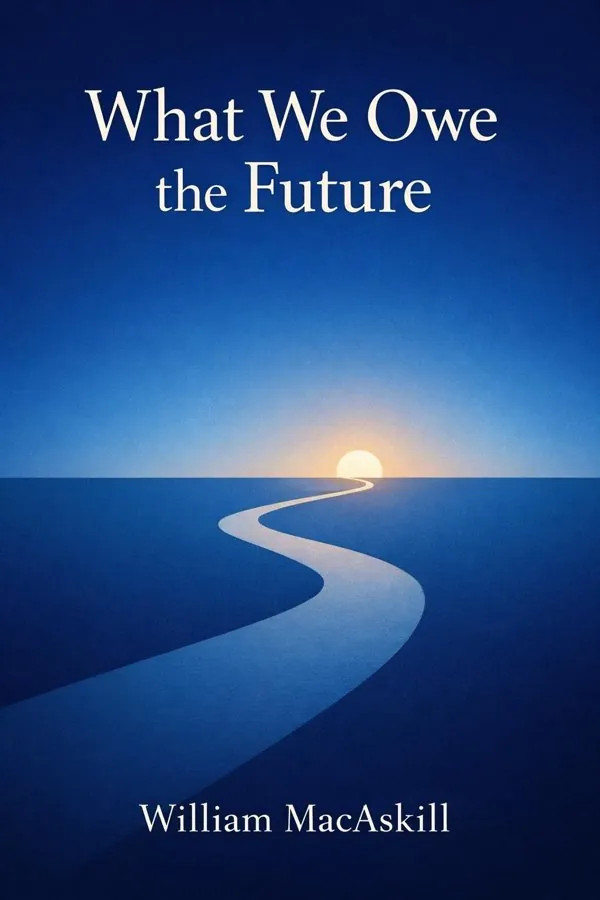
What if the most important moral choices of our time are not only about the people alive today, but about the billions or even trillions who may live after us? In What We Owe the Future, philosopher William MacAskill makes the case that our responsibilities extend far beyond the present generation. He argues that because future people can matter just as much as those alive now, decisions made in this century could shape the entire trajectory of human civilization. That claim turns questions about technology, politics, war, institutions, and moral progress into matters of extraordinary ethical importance. MacAskill combines philosophy, history, economics, and risk analysis to develop the case for longtermism: the view that positively influencing the long-run future should be a central moral priority. Rather than offering abstract speculation alone, he grounds his argument in examples of historical turning points, existential risks, and the possibility that today’s values may become locked in for centuries. As a leading moral philosopher, Oxford professor, and co-founder of major effective altruist organizations, MacAskill brings both intellectual rigor and practical urgency to one of the biggest ethical questions of our age: what do we owe the people who come after us?
Key Takeaways
- 1Future people count morally too — A simple idea can rearrange an entire moral worldview: people who do not exist yet can still matter. MacAskill begins fr…
- 2The future could be unimaginably vast — The moral stakes of the future become enormous once we recognize how much life may still lie ahead. Humanity is a very y…
- 3Long-term effects often outweigh immediate ones — Some actions matter not because of what they do today, but because of what they set in motion. MacAskill argues that whe…
Want the full summary?
Get instant access to this book summary and 100K+ more with Fizz Moment.
Get Free SummaryAvailable on App Store • Free to download
About This List
From AI risks to space colonization, Elon Musk's reading list reveals the ideas driving Tesla, SpaceX, and his vision for humanity. These books span philosophy, strategy, and technology — handpicked from his tweets and interviews.
This list features 7 carefully selected books. With FizzRead, you can read AI-powered summaries of each book in just 15 minutes. Get the key takeaways and start applying the insights immediately.
Ready to start reading?
Get instant access to all 7 book summaries and 100K+ more with FizzRead.