
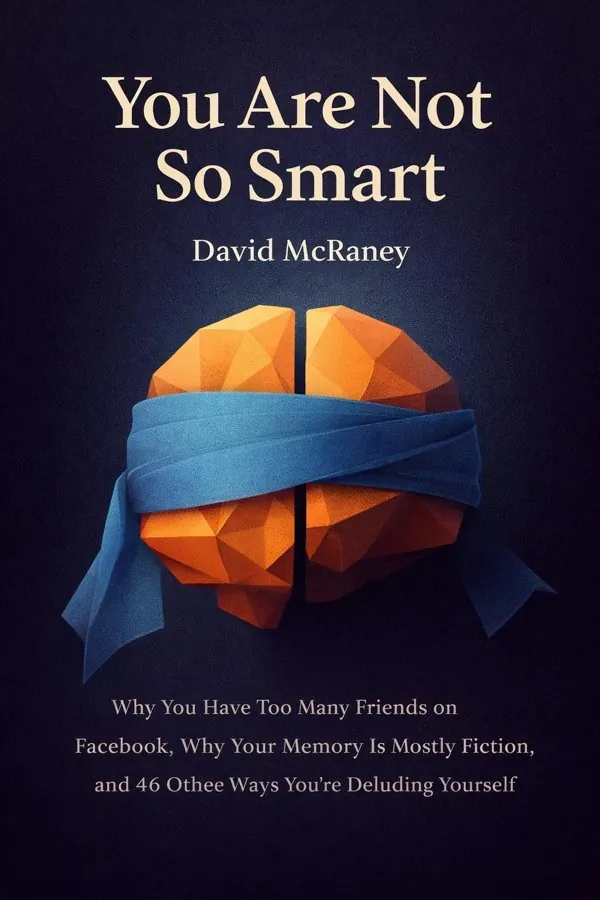
You Are Not So Smart: Why You Have Too Many Friends on Facebook, Why Your Memory Is Mostly Fiction, and 46 Other Ways You're Deluding Yourself: Summary & Key Insights
 10 min9 chaptersAudio available
Key Takeaways from You Are Not So Smart: Why You Have Too Many Friends on Facebook, Why Your Memory Is Mostly Fiction, and 46 Other Ways You're Deluding Yourself
One of the most disturbing facts about the mind is that your memories feel true long before they are accurate.
The mind is skilled at producing the feeling of understanding without the substance of understanding.
People do not usually form beliefs by carefully weighing evidence and then following the facts wherever they lead.
A surprising amount of suffering comes from refusing to quit what no longer works.
Much of everyday judgment rests on a flawed instinct: we assume behavior reveals stable character when it may actually reveal circumstance.
What Is You Are Not So Smart: Why You Have Too Many Friends on Facebook, Why Your Memory Is Mostly Fiction, and 46 Other Ways You're Deluding Yourself About?
You Are Not So Smart: Why You Have Too Many Friends on Facebook, Why Your Memory Is Mostly Fiction, and 46 Other Ways You're Deluding Yourself by David McRaney is a cognition book spanning 7 pages. You Are Not So Smart is a sharp, funny, and unsettling tour through the hidden flaws in human thinking. In this book, David McRaney explores the strange truth that most of us are far less rational, objective, and self-aware than we imagine. We like to believe our memories are reliable, our judgments are sound, and our beliefs are based on evidence. McRaney shows that the opposite is often true: our minds are full of shortcuts, blind spots, emotional distortions, and comforting illusions. Drawing on psychology, behavioral science, neuroscience, and real-world examples, he explains dozens of cognitive biases and mental errors in clear, accessible language. The result is not a dry academic catalog, but an engaging guide to why people cling to false ideas, misremember the past, overestimate their abilities, and act as if luck or coincidence proves personal genius. McRaney’s authority comes from his talent for translating research into memorable stories and practical insight. This book matters because it helps readers become more skeptical of their own certainty. In a world shaped by persuasion, polarization, and misinformation, that is not just interesting knowledge; it is a survival skill.
This FizzRead summary covers all 9 key chapters of You Are Not So Smart: Why You Have Too Many Friends on Facebook, Why Your Memory Is Mostly Fiction, and 46 Other Ways You're Deluding Yourself in approximately 10 minutes, distilling the most important ideas, arguments, and takeaways from David McRaney's work. Also available as an audio summary and Key Quotes Podcast.
You Are Not So Smart: Why You Have Too Many Friends on Facebook, Why Your Memory Is Mostly Fiction, and 46 Other Ways You're Deluding Yourself
You Are Not So Smart is a sharp, funny, and unsettling tour through the hidden flaws in human thinking. In this book, David McRaney explores the strange truth that most of us are far less rational, objective, and self-aware than we imagine. We like to believe our memories are reliable, our judgments are sound, and our beliefs are based on evidence. McRaney shows that the opposite is often true: our minds are full of shortcuts, blind spots, emotional distortions, and comforting illusions.
Drawing on psychology, behavioral science, neuroscience, and real-world examples, he explains dozens of cognitive biases and mental errors in clear, accessible language. The result is not a dry academic catalog, but an engaging guide to why people cling to false ideas, misremember the past, overestimate their abilities, and act as if luck or coincidence proves personal genius.
McRaney’s authority comes from his talent for translating research into memorable stories and practical insight. This book matters because it helps readers become more skeptical of their own certainty. In a world shaped by persuasion, polarization, and misinformation, that is not just interesting knowledge; it is a survival skill.
Who Should Read You Are Not So Smart: Why You Have Too Many Friends on Facebook, Why Your Memory Is Mostly Fiction, and 46 Other Ways You're Deluding Yourself?
This book is perfect for anyone interested in cognition and looking to gain actionable insights in a short read. Whether you're a student, professional, or lifelong learner, the key ideas from You Are Not So Smart: Why You Have Too Many Friends on Facebook, Why Your Memory Is Mostly Fiction, and 46 Other Ways You're Deluding Yourself by David McRaney will help you think differently.
- ✓Readers who enjoy cognition and want practical takeaways
- ✓Professionals looking to apply new ideas to their work and life
- ✓Anyone who wants the core insights of You Are Not So Smart: Why You Have Too Many Friends on Facebook, Why Your Memory Is Mostly Fiction, and 46 Other Ways You're Deluding Yourself in just 10 minutes
Want the full summary?
Get instant access to this book summary and 100K+ more with Fizz Moment.
Get Free SummaryAvailable on App Store • Free to download
Key Chapters
One of the most disturbing facts about the mind is that your memories feel true long before they are accurate. Most people imagine memory as a recording device, a mental archive that stores events and retrieves them intact. McRaney explains that memory works nothing like that. Instead, it is reconstructive. Each time you remember something, you rebuild it from fragments, emotions, expectations, and later information. In other words, remembering is less like opening a file and more like rewriting a story.
This is why eyewitness testimony is often unreliable, even when the witness is completely sincere. A person can confidently recall details that were never there, especially after leading questions, repeated retellings, or exposure to other people’s accounts. Your brain prefers a coherent narrative over a perfectly accurate one. It fills gaps, smooths contradictions, and turns guesswork into certainty.
This matters in everyday life more than most people realize. Arguments with partners, siblings, coworkers, or friends often become battles between competing fictions. Each side is convinced they remember what happened. Both may be wrong. The same process shapes your personal identity. The story of who you are is built partly from memories that have been revised so many times they no longer resemble the original experience.
A practical response is to treat strong confidence as a weak signal of truth. Write important details down soon after events occur. Be cautious when using phrases like “I remember exactly.” Ask others what they recall before telling them your version. The actionable takeaway: trust memory less, document more, and approach personal recollections with humility.
The mind is skilled at producing the feeling of understanding without the substance of understanding. McRaney highlights what psychologists call the illusion of explanatory depth: people believe they understand how things work until they are asked to explain them in detail. Suddenly, confidence collapses. You may think you understand how a zipper, a toilet, a bicycle, or the internet works, but once you try to explain the mechanism step by step, the gaps become obvious.
This illusion helps explain why overconfidence is so common. The famous Dunning-Kruger effect shows that people who know the least about a topic are often the most likely to overestimate their competence. Without enough expertise to recognize complexity, they mistake familiarity for mastery. Experts, by contrast, are often more cautious because they see how much there is to know.
In practice, this affects decision-making everywhere. Someone may feel qualified to judge economics after reading headlines, medicine after a podcast episode, or parenting after observing one family. Social media intensifies the problem by rewarding certainty, not accuracy. People perform knowledge even when they lack it, and audiences often cannot tell the difference.
The antidote is intellectual friction. Force yourself to explain beliefs in plain language. Ask, “How does this actually work?” and “What evidence would prove me wrong?” If you cannot teach a concept simply, you probably do not understand it well enough. This mindset improves learning, reduces arrogance, and makes better conversations possible. The actionable takeaway: regularly test your own understanding by explaining it from first principles, and let confusion be the beginning of real learning rather than a threat to your ego.
People do not usually form beliefs by carefully weighing evidence and then following the facts wherever they lead. More often, they adopt a belief for emotional, social, or intuitive reasons and then recruit logic to defend it. McRaney explores confirmation bias, the tendency to notice, remember, and value information that supports what we already believe while ignoring or minimizing what challenges us. Once a belief becomes tied to identity, contradiction can feel like an attack.
He also points to the backfire effect, the phenomenon in which correcting false beliefs can sometimes make people hold them more tightly. This happens because beliefs often function as badges of belonging. To abandon one can feel like betrayal, humiliation, or loss. Facts alone are rarely enough to overcome that emotional resistance.
You can see this in politics, health debates, investing, relationships, and even workplace culture. A manager convinced an employee is lazy notices every missed deadline and overlooks every quiet success. A person who believes a diet is miraculous interprets every fluctuation as proof it works. A voter reads only sources that validate their worldview and assumes the other side is irrational.
This does not mean evidence is useless. It means evidence has to get past motivated reasoning. A better approach is curiosity before correction. Instead of arguing head-on, ask questions that encourage reflection: “What led you to that conclusion?” or “What evidence would change your mind?” Use the same questions on yourself. The actionable takeaway: whenever you feel defensive, pause and assume your brain may be protecting identity rather than searching for truth; actively seek the strongest argument against your position.
A surprising amount of suffering comes from refusing to quit what no longer works. McRaney discusses the sunk cost fallacy, the tendency to continue investing in something because of the time, money, effort, or emotion already spent on it. Rationally, past costs are gone and should not determine present decisions. Psychologically, however, walking away feels like admitting waste, failure, or foolishness.
This is why people stay too long in bad relationships, hold losing stocks, finish terrible books, continue failing projects, or wait in painfully long lines after already spending an hour there. The more you have invested, the harder it becomes to leave. Commitment becomes a trap. Pride joins the process and whispers, “If you stop now, everything before this was for nothing.”
Organizations fall for the same pattern. Companies keep funding doomed initiatives because executives do not want to acknowledge poor judgment. Governments persist with failing policies because reversal looks weak. Teams throw good resources after bad simply to justify earlier decisions.
McRaney’s point is not that persistence is bad. Persistence is admirable when the path is still promising. The problem is confusing consistency with wisdom. The relevant question is never “How much have I already put in?” but “Knowing what I know now, would I begin this again today?” If the answer is no, staying may be irrational.
A useful habit is to decide in advance what conditions would trigger quitting or reevaluation. Create exit criteria before emotion takes over. Seek advice from someone with no personal stake. The actionable takeaway: evaluate choices based on future value, not past investment, and give yourself permission to abandon a path that no longer deserves your resources.
Much of everyday judgment rests on a flawed instinct: we assume behavior reveals stable character when it may actually reveal circumstance. McRaney examines attribution errors, especially the tendency to explain other people’s actions as reflections of their personality while explaining our own actions as products of context. If another driver cuts us off, they are reckless. If we do it, we were in a rush. This asymmetry preserves our self-image while making others easier to condemn.
He pairs this with the halo effect, where one positive impression spills over into unrelated judgments. Attractive people are often assumed to be smarter, kinder, or more competent. Charismatic leaders are credited with wisdom they have not demonstrated. First impressions become lenses that distort all later information.
Then there is the illusion of control. Humans are deeply uncomfortable with randomness, so we overestimate our influence over events. We develop rituals, trust lucky streaks, or interpret success as evidence of special skill when chance played a major role. This helps explain superstition, overconfidence in investing, and the belief that outcomes always reflect personal merit.
Together, these tendencies create distorted social worlds. We reward appearance over evidence, blame individuals for structural problems, and take too much credit when things go right. To counter them, examine situations before judging people. Ask what invisible pressures, incentives, or constraints might be operating. Separate likability from competence. In uncertain situations, acknowledge the role of luck.
The actionable takeaway: before deciding why something happened, force yourself to list situational explanations, possible biases in your impression, and the role chance may have played.
The mind does not treat all information equally. It prioritizes what is vivid, recent, emotionally charged, or easy to recall. McRaney explores several distortions built on this tendency, including the spotlight effect, the availability heuristic, and anchoring. Together they show that what feels important often merely feels noticeable.
The spotlight effect makes people believe others are paying far more attention to them than they really are. You assume everyone noticed your awkward comment, stained shirt, or small mistake, when in reality most people are preoccupied with themselves. This bias increases social anxiety and self-consciousness.
The availability heuristic leads you to judge frequency or risk based on how easily examples come to mind. After seeing dramatic news reports about plane crashes, flying feels dangerous even though driving is statistically riskier. A recent story about layoffs can make the economy seem universally collapsing, even when the broader picture is more mixed.
Anchoring shows how arbitrary starting points shape later judgments. An initial price makes a discount look generous. A first offer in negotiation frames what seems reasonable. Even random numbers can influence estimates if they appear before a decision.
These effects matter in shopping, relationships, media consumption, and personal confidence. They can make you fear unlikely risks, overvalue early information, and imagine you are under constant observation. The solution is to slow down and ask what data is missing. Look for base rates, not headlines. Reassess first impressions after gathering more evidence.
The actionable takeaway: when something feels urgent, embarrassing, or obviously true, ask whether it is genuinely important or simply the easiest thing for your brain to notice right now.
People desperately want the world to make moral sense. McRaney discusses the just-world hypothesis, the comforting belief that good people are rewarded and bad people are punished. This belief reduces anxiety because it suggests life is orderly and controllable. But it also has a dark side: when bad things happen, people often assume the victim must have done something to deserve it.
This is why observers may blame someone for being scammed, getting sick, losing a job, or suffering abuse. If misfortune can strike randomly, then anyone is vulnerable. Blaming the victim restores the illusion of safety: “That would not happen to me, because I am different.” The result is reduced empathy and distorted judgment.
McRaney also explores groupthink, where the desire for harmony or belonging suppresses dissent. In groups, people often self-censor, echo dominant opinions, and mistake consensus for correctness. The pressure to fit in can overpower individual reasoning, especially when status, identity, or loyalty are involved. Teams then make poor decisions not because everyone agrees independently, but because disagreement feels too costly.
These patterns appear in offices, families, political movements, juries, and online communities. When fairness myths combine with social pressure, people become eager to rationalize injustice and hesitant to challenge the crowd. The result can be cruelty dressed up as common sense.
A healthier stance is to separate outcome from deservingness and consensus from truth. Ask who is missing from the conversation, who feels unsafe disagreeing, and what evidence is being ignored. The actionable takeaway: resist the impulse to explain suffering as earned, and make deliberate space for dissent whenever a group seems too confident too quickly.
One of McRaney’s deepest themes is that the stable, rational self you experience is partly an after-the-fact storyteller. You feel like a unified decision-maker who weighs options and chooses deliberately. In reality, many judgments arise automatically, emotionally, and unconsciously before conscious thought arrives to explain them. The conscious mind often acts less like a commander and more like a press secretary, generating reasons for decisions already made elsewhere.
This explains why introspection can be so misleading. When asked why they chose something, people often provide sincere explanations that sound plausible but are partly invented. The brain dislikes uncertainty and quickly builds narratives that preserve coherence. That narrative becomes identity: “I am this kind of person.” Yet identity is more flexible, situational, and socially shaped than it feels.
This is not an argument for despair. It is an invitation to curiosity. If the self is partly constructed, then many personal certainties deserve reexamination. Why do you like what you like? Why do you vote the way you do? Why do you interpret your past through certain themes? Often the answer is not a clear principle but a web of habits, influences, and stories that gradually hardened into conviction.
In practical terms, this insight makes personal change more possible. If your current self is not a fixed essence, then better routines, new environments, and revised narratives can create different outcomes. You are not trapped by every conclusion your mind produces.
The actionable takeaway: treat your inner explanations as hypotheses, not revelations, and use journaling, feedback, and experimentation to discover who you are beyond the stories you automatically tell.
All Chapters in You Are Not So Smart: Why You Have Too Many Friends on Facebook, Why Your Memory Is Mostly Fiction, and 46 Other Ways You're Deluding Yourself
About the Author
David McRaney is an American journalist, author, and podcaster known for making psychology and behavioral science accessible to broad audiences. He gained wide recognition through his You Are Not So Smart project, which began as a blog and expanded into bestselling books and a popular podcast. His work focuses on cognitive biases, reasoning errors, persuasion, belief formation, and the many ways people misunderstand themselves. McRaney has a talent for translating academic research into vivid stories, practical insights, and memorable examples drawn from everyday life. In addition to writing about self-delusion and irrationality, he has explored topics such as cult thinking, identity, and the psychology of changing minds. His work is widely appreciated for being smart, funny, and deeply relevant to modern life.
Get This Summary in Your Preferred Format
Read or listen to the You Are Not So Smart: Why You Have Too Many Friends on Facebook, Why Your Memory Is Mostly Fiction, and 46 Other Ways You're Deluding Yourself summary by David McRaney anytime, anywhere. FizzRead offers multiple formats so you can learn on your terms — all free.
Available formats: App · Audio · PDF · EPUB — All included free with FizzRead
Download You Are Not So Smart: Why You Have Too Many Friends on Facebook, Why Your Memory Is Mostly Fiction, and 46 Other Ways You're Deluding Yourself PDF and EPUB Summary
Key Quotes from You Are Not So Smart: Why You Have Too Many Friends on Facebook, Why Your Memory Is Mostly Fiction, and 46 Other Ways You're Deluding Yourself
“One of the most disturbing facts about the mind is that your memories feel true long before they are accurate.”
“The mind is skilled at producing the feeling of understanding without the substance of understanding.”
“People do not usually form beliefs by carefully weighing evidence and then following the facts wherever they lead.”
“A surprising amount of suffering comes from refusing to quit what no longer works.”
“Much of everyday judgment rests on a flawed instinct: we assume behavior reveals stable character when it may actually reveal circumstance.”
Frequently Asked Questions about You Are Not So Smart: Why You Have Too Many Friends on Facebook, Why Your Memory Is Mostly Fiction, and 46 Other Ways You're Deluding Yourself
You Are Not So Smart: Why You Have Too Many Friends on Facebook, Why Your Memory Is Mostly Fiction, and 46 Other Ways You're Deluding Yourself by David McRaney is a cognition book that explores key ideas across 9 chapters. You Are Not So Smart is a sharp, funny, and unsettling tour through the hidden flaws in human thinking. In this book, David McRaney explores the strange truth that most of us are far less rational, objective, and self-aware than we imagine. We like to believe our memories are reliable, our judgments are sound, and our beliefs are based on evidence. McRaney shows that the opposite is often true: our minds are full of shortcuts, blind spots, emotional distortions, and comforting illusions. Drawing on psychology, behavioral science, neuroscience, and real-world examples, he explains dozens of cognitive biases and mental errors in clear, accessible language. The result is not a dry academic catalog, but an engaging guide to why people cling to false ideas, misremember the past, overestimate their abilities, and act as if luck or coincidence proves personal genius. McRaney’s authority comes from his talent for translating research into memorable stories and practical insight. This book matters because it helps readers become more skeptical of their own certainty. In a world shaped by persuasion, polarization, and misinformation, that is not just interesting knowledge; it is a survival skill.
More by David McRaney

You Might Also Like
A Field Guide to Lies: Critical Thinking in the Information Age
Daniel J. Levitin
10 min
A Theory of Cognitive Dissonance
Leon Festinger
10 min
Black-And-White Thinking: The Burden of a Binary Brain in a Complex World
Kevin Dutton
10 min
Born Liars: Why We Can’t Live Without Deceit
Ian Leslie
10 min
Collective Illusions: Conformity, Complicity, and the Science of Why We Make Bad Decisions
Todd Rose
10 min
Concrete Mathematics: A Foundation for Computer Science
Ronald L. Graham, Donald E. Knuth, Oren Patashnik
10 minBrowse by Category
Ready to read You Are Not So Smart: Why You Have Too Many Friends on Facebook, Why Your Memory Is Mostly Fiction, and 46 Other Ways You're Deluding Yourself?
Get the full summary and 100K+ more books with Fizz Moment.