
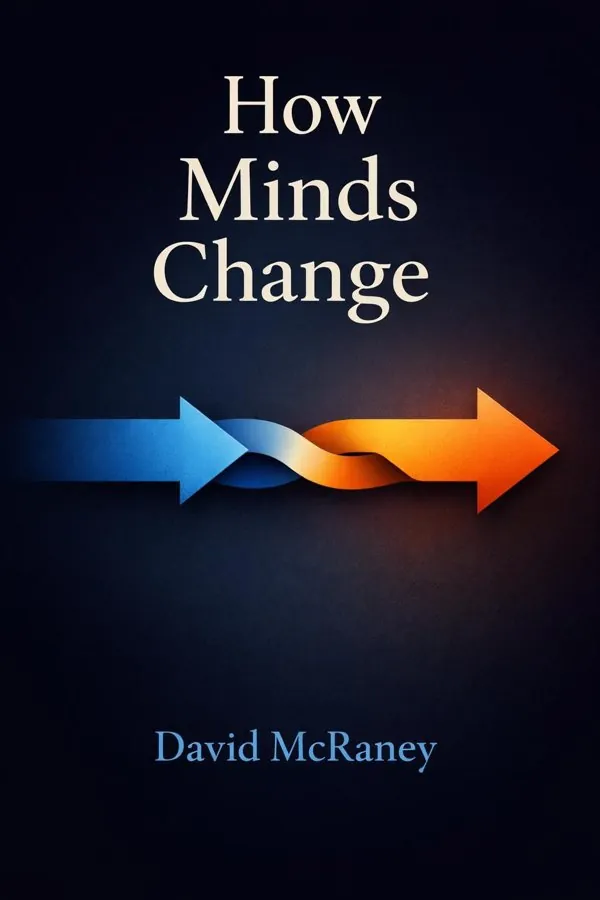
How Minds Change: The Surprising Science of Belief, Opinion, and Persuasion: Summary & Key Insights
 10 min8 chaptersAudio available
What Is How Minds Change: The Surprising Science of Belief, Opinion, and Persuasion About?
How Minds Change: The Surprising Science of Belief, Opinion, and Persuasion by David McRaney is a cognition book spanning 8 pages. In 'How Minds Change', David McRaney explores the psychological and social mechanisms behind why people change their minds—or refuse to. Drawing on cognitive science, social psychology, and real-world examples, McRaney investigates how persuasion works, how beliefs are formed, and what it takes to bridge divides in an era of polarization. The book combines scientific research with compelling storytelling to reveal how empathy and understanding can transform conversations and beliefs.
This FizzRead summary covers all 8 key chapters of How Minds Change: The Surprising Science of Belief, Opinion, and Persuasion in approximately 10 minutes, distilling the most important ideas, arguments, and takeaways from David McRaney's work. Also available as an audio summary and Key Quotes Podcast.
How Minds Change: The Surprising Science of Belief, Opinion, and Persuasion
In 'How Minds Change', David McRaney explores the psychological and social mechanisms behind why people change their minds—or refuse to. Drawing on cognitive science, social psychology, and real-world examples, McRaney investigates how persuasion works, how beliefs are formed, and what it takes to bridge divides in an era of polarization. The book combines scientific research with compelling storytelling to reveal how empathy and understanding can transform conversations and beliefs.
Who Should Read How Minds Change: The Surprising Science of Belief, Opinion, and Persuasion?
This book is perfect for anyone interested in cognition and looking to gain actionable insights in a short read. Whether you're a student, professional, or lifelong learner, the key ideas from How Minds Change: The Surprising Science of Belief, Opinion, and Persuasion by David McRaney will help you think differently.
- ✓Readers who enjoy cognition and want practical takeaways
- ✓Professionals looking to apply new ideas to their work and life
- ✓Anyone who wants the core insights of How Minds Change: The Surprising Science of Belief, Opinion, and Persuasion in just 10 minutes
Want the full summary?
Get instant access to this book summary and 100K+ more with Fizz Moment.
Get Free SummaryAvailable on App Store • Free to download
Key Chapters
Every belief you hold feels like a picture of reality, yet none are pure reflections. They’re constructions—stories your brain tells based on predictions, emotions, and social input. Our beliefs are not logical conclusions we reach; they are emotional commitments our brains defend. We form them through a lifelong process of learning who we are within a social context. Neuroscience shows that belief formation begins with pattern recognition—the brain’s relentless effort to predict what will happen next. Every observation triggers a cascade of neural activity seeking to minimize surprises, what scientists call 'prediction error.' When the world aligns with our expectations, belief feels solid. When it doesn’t, we have two choices: update the model, or ignore the discrepancy.
For most of us, ignoring feels safer. Especially because beliefs are never purely cognitive—they’re bound to emotion and identity. We believe what makes us feel safe within our groups, what keeps us bonded to people we trust. As I discovered, belief is fundamentally social. Even empirical facts pass through filters of belonging. That realization reframes persuasion: to change a person’s mind, you’re not just challenging a position—you’re reaching into a web of relationships and emotional meanings that define who they are.
Learning this changed my own approach. I stopped thinking of beliefs as data to be replaced, and started seeing them as living constructs to be understood. Science shows that only when people feel their identity isn’t threatened can their brain entertain new interpretations. That’s the groundwork for all meaningful persuasion: safety before insight.
The discomfort we feel when holding conflicting ideas—cognitive dissonance—is one of the most powerful forces shaping belief. When new evidence clashes with what we already think, our brains rush to resolve the tension, often by dismissing the evidence instead of updating the belief. I saw this vividly in interviews with people who had escaped cults or extremist organizations. Their eventual change didn’t come from being shown proof; it came when their emotional commitment to the group began to fray.
Psychologists have long documented this phenomenon. Motivated reasoning ensures that once an idea becomes linked to our identity, we defend it not as truth, but as territory. Facts become soldiers in an emotional battle for belonging. When we label others 'irrational,' we misunderstand the purpose their beliefs serve. Resistance isn’t a flaw; it’s a defense mechanism guarding the integrity of the self.
This insight suggests a deeper challenge for communication: persuasion isn’t about overpowering dissonance but guiding someone through it with empathy. Change becomes possible only when the emotional cost of staying wrong becomes higher than the social cost of admitting it.
+ 6 more chapters — available in the FizzRead app
All Chapters in How Minds Change: The Surprising Science of Belief, Opinion, and Persuasion
About the Author
David McRaney is an American science journalist, author, and podcaster known for his work on human psychology and behavior. He is the creator of the popular blog and podcast 'You Are Not So Smart' and has written several books exploring cognitive biases, belief formation, and critical thinking.
Get This Summary in Your Preferred Format
Read or listen to the How Minds Change: The Surprising Science of Belief, Opinion, and Persuasion summary by David McRaney anytime, anywhere. FizzRead offers multiple formats so you can learn on your terms — all free.
Available formats: App · Audio · PDF · EPUB — All included free with FizzRead
Download How Minds Change: The Surprising Science of Belief, Opinion, and Persuasion PDF and EPUB Summary
Key Quotes from How Minds Change: The Surprising Science of Belief, Opinion, and Persuasion
“Every belief you hold feels like a picture of reality, yet none are pure reflections.”
“The discomfort we feel when holding conflicting ideas—cognitive dissonance—is one of the most powerful forces shaping belief.”
Frequently Asked Questions about How Minds Change: The Surprising Science of Belief, Opinion, and Persuasion
How Minds Change: The Surprising Science of Belief, Opinion, and Persuasion by David McRaney is a cognition book that explores key ideas across 8 chapters. In 'How Minds Change', David McRaney explores the psychological and social mechanisms behind why people change their minds—or refuse to. Drawing on cognitive science, social psychology, and real-world examples, McRaney investigates how persuasion works, how beliefs are formed, and what it takes to bridge divides in an era of polarization. The book combines scientific research with compelling storytelling to reveal how empathy and understanding can transform conversations and beliefs.
More by David McRaney

You Are Now Less Dumb: How to Conquer Mob Mentality, How to Buy Happiness, and All the Other Ways to Outsmart Yourself
David McRaney
10 min
You Are Not So Smart: Why You Have Too Many Friends on Facebook, Why Your Memory Is Mostly Fiction, and 46 Other Ways You're Deluding Yourself
David McRaney
10 minYou Might Also Like
A Field Guide to Lies: Critical Thinking in the Information Age
Daniel J. Levitin
10 min
A Theory of Cognitive Dissonance
Leon Festinger
10 min
Black-And-White Thinking: The Burden of a Binary Brain in a Complex World
Kevin Dutton
10 min
Born Liars: Why We Can’t Live Without Deceit
Ian Leslie
10 min
Collective Illusions: Conformity, Complicity, and the Science of Why We Make Bad Decisions
Todd Rose
10 min
Concrete Mathematics: A Foundation for Computer Science
Ronald L. Graham, Donald E. Knuth, Oren Patashnik
10 minBrowse by Category
Ready to read How Minds Change: The Surprising Science of Belief, Opinion, and Persuasion?
Get the full summary and 100K+ more books with Fizz Moment.